Risk-Reversal Guarantees That Close CPG Clients: Experiential Marketing Edition

Business professional presenting a proposal to clients in a modern office with Toronto skyline and CN Tower in the background.

Every CPG brand manager has the same fear. They have a budget. They have a product. But they are not sure the activation will actually work. That hesitation kills deals. It delays campaigns. It costs agencies revenue and brands momentum. Risk-reversal guarantees exist to solve exactly this problem. In experiential marketing, a well-structured guarantee removes the client’s fear of loss and replaces it with confidence. At Brand Guruz, we use risk-reversal frameworks to close CPG clients faster — and deliver the results that make those guarantees easy to keep.

What Is a Risk-Reversal Guarantee in Experiential Marketing?

A risk-reversal guarantee shifts the perceived burden of risk from the client to the agency. Instead of asking a brand to trust that an activation will perform, the agency commits to a specific, measurable outcome. If the outcome is not delivered, the client receives compensation — a partial refund, additional activation days, or a free campaign extension.

The core principle: The agency believes in its own work enough to put something on the line. That confidence closes deals that hesitation never would.

This model is well-established in performance marketing and SaaS sales. However, it remains underused in experiential marketing. That gap is a significant opportunity for agencies willing to lead with accountability.


According to Edelman’s Trust Barometer, 81 percent of consumers say brand trust is a deciding factor in their purchase decisions. The same psychology applies to B2B relationships. CPG clients choose agencies they trust. A guarantee accelerates that trust dramatically.

Why CPG Clients Hesitate Without One

CPG brand managers face real pressure. They are accountable to sales targets, retail partners, and quarterly budgets. When they consider an experiential activation, they are weighing a significant spend against an uncertain return.

Here are the four objections that risk-reversal guarantees directly dismantle:

  1. “We’ve tried sampling before and it didn’t move retail numbers.” A performance guarantee tied to retail sales lift data gives the client a concrete safety net. It reframes the conversation from “will this work?” to “here’s what happens if it doesn’t.”
  2.  
  3. “Our budget is tight and we can’t afford to waste it.” A conditional refund or make-good clause removes the financial risk of a poor-performing activation. The client’s downside is capped.
  4.  
  5. “We need board approval and they’re skeptical of experiential ROI.” A documented guarantee gives the brand manager ammunition for internal sign-off. It is far easier to get approval for a guaranteed outcome than a hopeful estimate.
  6.  
  7. “We don’t know your agency well enough yet.” A guarantee signals confidence. It says the agency has done this before and is willing to prove it. That is more persuasive than any case study.
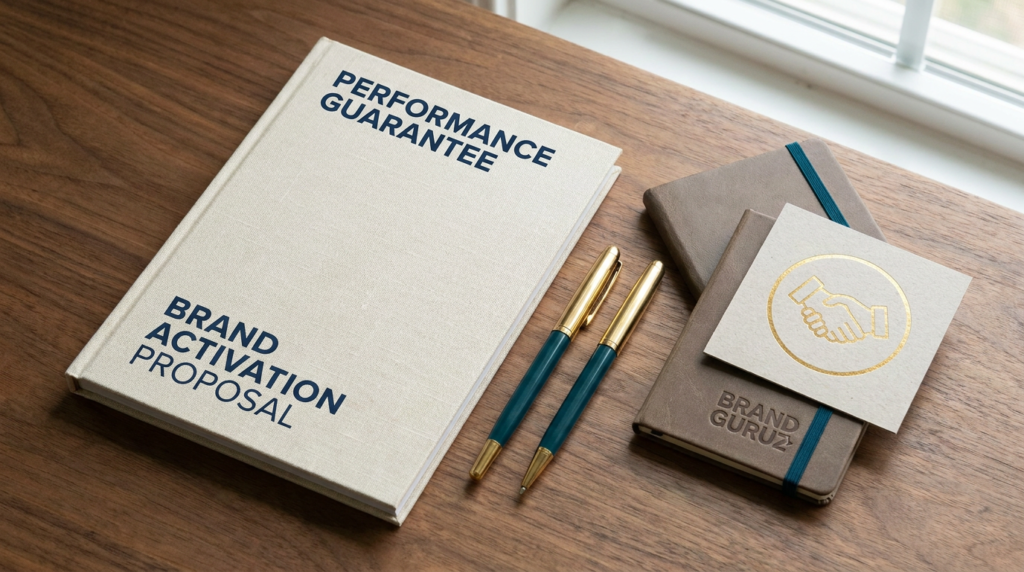
Brand activation proposal booklet with “Performance Guarantee” on a wooden desk, alongside branded notebook, business card, and pens.

The 3 Types of Risk-Reversal Guarantees That Work for CPG Activations

Not all guarantees are equal. The right structure depends on the campaign type, the client’s primary concern, and what your agency can reliably deliver. Here are the three most effective models for CPG experiential marketing.

1. The Sampling Volume Guarantee

What it promises: A minimum number of product samples distributed within a defined timeframe.

Why it works: Volume is easy to measure and directly tied to trial — the primary goal of most CPG activations. If the threshold is not reached, the agency provides additional activation hours at no charge.

Best for: New product launches, grocery retail activations, and festival sampling programs.

2. The Retail Sales Lift Guarantee

What it promises: A measurable percentage increase in retail sales within a defined post-activation window — typically 30 days.

Why it works: This guarantee ties directly to the metric CPG clients care about most. It requires robust post-activation tracking. However, for agencies with strong measurement infrastructure, it is the most powerful closing tool available.

Best for: Established brands seeking to defend or grow shelf space at key Ontario retailers.

3. The Data Capture Guarantee

What it promises: A minimum number of verified consumer contacts collected during the activation.

Why it works: Data has quantifiable downstream value. A guaranteed contact list gives the client a tangible asset — one that fuels retargeting campaigns, loyalty program sign-ups, and CRM growth long after the event ends.

Best for: Brands building first-party data strategies or launching subscription and loyalty programs.

How to Structure a Guarantee Without Overexposing Your Agency

A guarantee is only as good as your ability to keep it. Poorly structured guarantees create financial risk for agencies and erode client trust when they fall short. Here is how to build a guarantee that protects both sides.

ElementWhat to Define
MetricExactly what will be measured (samples, sales lift %, contacts)
ThresholdThe specific number that triggers the guarantee
TimeframeThe measurement window (event day, 30-day post-activation)
RemedyWhat the client receives if the threshold is not met
ExclusionsConditions outside the agency’s control (weather, venue cancellation)

Keep the language simple. Clients do not want to read dense legal clauses. They want clarity. A one-page guarantee summary with plain language closes faster than a five-page appendix.

Furthermore, set your guarantee thresholds conservatively at first. Deliver above them consistently. Then raise the bar with each new proposal. This builds a track record that makes your guarantees increasingly credible — and your close rate increasingly high.

Handshake over a desk with quarterly growth reports and a tablet map of Ontario marked with location pins, symbolizing a business agreement and regional expansion.

Why Brand Guruz Builds Guarantees Into Every CPG Proposal

At Brand Guruz, we believe accountability is a competitive advantage. We do not treat guarantees as a last resort to close reluctant clients. We lead with them.

Our guarantee framework is built on years of activation data across Ontario’s most diverse markets. We know our sampling conversion rates. Our retail sales lift benchmarks. We know how multicultural, bilingual activations perform relative to generic campaigns. That knowledge gives us the confidence to make commitments — and the infrastructure to keep them.

For CPG brands exploring on-ground activations for the first time, a guarantee removes the single biggest barrier to starting. For established brands looking to scale, it provides the accountability framework that justifies increased investment. Either way, the conversation changes completely. It moves from “can we trust this agency?” to “which guarantee structure fits our campaign best?”

To see how our guarantee model works inside a full activation strategy, explore our post on how to achieve 4X ROI with on-ground experiential activations for CPG brands in Ontario. You can also review our experiential marketing services page for a complete overview of what we deliver — and stand behind.

Frequently Asked Questions

A risk-reversal guarantee is a formal commitment from an experiential marketing agency to deliver a specific, measurable result. In CPG experiential marketing, this typically means guaranteeing a minimum number of product samples distributed, a defined retail sales lift percentage, or a set number of verified consumer data contacts collected.


If the agency falls short of the agreed threshold, the client receives a clear remedy. That remedy could be a partial refund, additional activation days, or a complimentary campaign extension. Essentially, the agency puts something on the line to prove it believes in its own work. As a result, the client enters the campaign with a defined safety net rather than an open-ended risk.

Not yet — and that is precisely the opportunity. Most experiential agencies still rely on projections, case studies, and creative pitches to close CPG clients. However, very few agencies back their promises with a formal, documented guarantee tied to measurable outcomes.


In contrast, performance marketing and SaaS companies have long used guarantee structures to accelerate client decisions. Experiential marketing has been slow to adopt this model. Therefore, agencies that lead with guarantees stand out immediately in a competitive pitch process. For CPG brands, a guaranteed activation is simply a more compelling offer than a hopeful estimate.

CPG brand managers face real internal pressure. They must justify experiential marketing spend to finance teams, retail partners, and company leadership. Consequently, a guarantee gives them exactly what they need to gain internal approval: a documented, accountable commitment with a clear downside scenario.


Instead of asking a brand manager to sell an uncertain ROI projection to their board, a guarantee lets them present a protected investment. Moreover, the guarantee signals that the agency is confident enough in its process to accept accountability. That confidence accelerates trust — and trust is what closes deals. According to Edelman's Trust Barometer, 81 percent of consumers cite trust as a key purchase driver. The same principle applies when CPG brands choose their agency partners.

A strong guarantee has five core elements. First, it defines the exact metric being guaranteed — whether that is sampling volume, retail sales lift, or data contacts. Second, it sets a specific threshold number. Third, it establishes a clear measurement timeframe, such as event day or a 30-day post-activation window. Fourth, it outlines the remedy the client receives if the threshold is not reached. Fifth, it documents any exclusions — conditions outside the agency's control, such as severe weather or venue cancellation.


Above all, the language should be simple and direct. A one-page guarantee summary in plain language is far more reassuring than a dense contractual appendix. If an agency cannot explain its guarantee clearly and concisely, that is a warning sign. The goal is clarity, not complexity.

Yes — and in many cases, multicultural activations are the most suitable candidates for performance guarantees. That is because culturally specific campaigns, when executed with genuine community intelligence, consistently outperform generic sampling approaches in both conversion rate and post-event retail sales lift.


At Brand Guruz, for example, our multicultural activation model in Vaughan delivered a 61 percent sampling-to-conversion rate — well above the industry average. Furthermore, our bilingual ambassador programs generate consumer interactions that are two to three times longer than standard English-only engagements. Those results give us the confidence to attach guarantees to multicultural campaigns with certainty. To learn more about how we structure multicultural activations, read our post on multicultural CPG activations in Vaughan or explore our guide to multicultural festivals for CPG sampling in Toronto.

The Bottom Line

Risk-reversal guarantees in CPG experiential marketing are not a sign of desperation. They are a sign of expertise. Agencies that offer them are saying: we know this market, we trust our process, and we are willing to prove it.

CPG clients do not need to be convinced that experiential marketing works. They need to be convinced that your activation will work for their brand. A well-structured guarantee answers that question before it is even asked.

That is how deals get closed. Contact Brand Guruz today and let us show you what a guaranteed activation looks like for your brand.

Author