Why Trade Shows Are Experiential Marketing's Most Underrated Brand Activation Channel

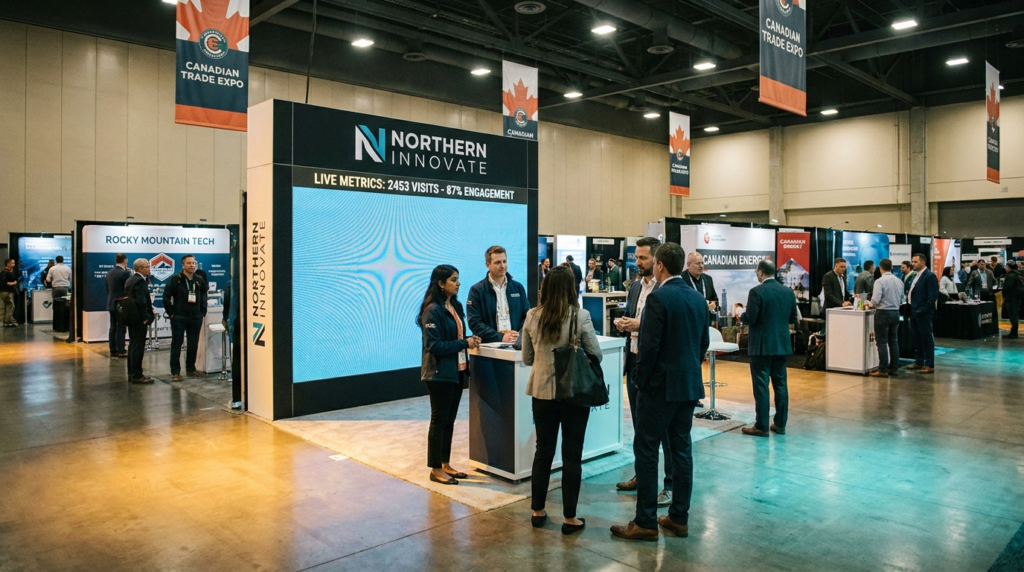
Trade show booth for “Northern Innovate” at a Canadian Trade Expo, featuring a large digital display with live engagement metrics while attendees network and discuss services.

Most brands treat trade shows as a necessary expense. They book the minimum floor space, ship a pop-up banner, and station a junior sales rep behind a folding table. Then they wonder why their leads are cold and their ROI is unclear.

Here is the reality: a trade show is not an obligation. It is one of the highest-density brand activation environments in the marketing calendar. Every attendee in that convention centre is a qualified, interested professional who showed up voluntarily. No algorithm brought them there. No paid impression nudged them past your booth. They came because the industry matters to them — and that intent makes them extraordinarily valuable.

The question is not whether to attend trade shows. It is whether your marketing agency knows how to turn floor space into a genuine experiential marketing engine. At Brand Guruz, we do. Here is the framework we use.

The Problem With How Most Brands Show Up at Trade Shows

Before getting into solutions, it is worth being honest about the common failure modes. Most trade show brand activations fail for one of three reasons.

They prioritise aesthetics over interaction. A beautiful booth generates compliments. A well-designed activation generates conversations, data, and leads. The difference is intentional engagement mechanics — and most brands skip them entirely.

They rely on passive display instead of active experience. Brochures on a table do not create memories. Demonstrations, trials, and interactive moments do. Experiential marketing works because it puts the product in the prospect’s hands, not just in their line of sight.

They have no post-show follow-up plan. The activation ends when the show floor closes. The revenue opportunity does not. Without an automated, data-driven follow-up sequence, even strong on-floor engagement evaporates within 48 hours.

A capable marketing agency addresses all three failure modes before the show begins — not after.

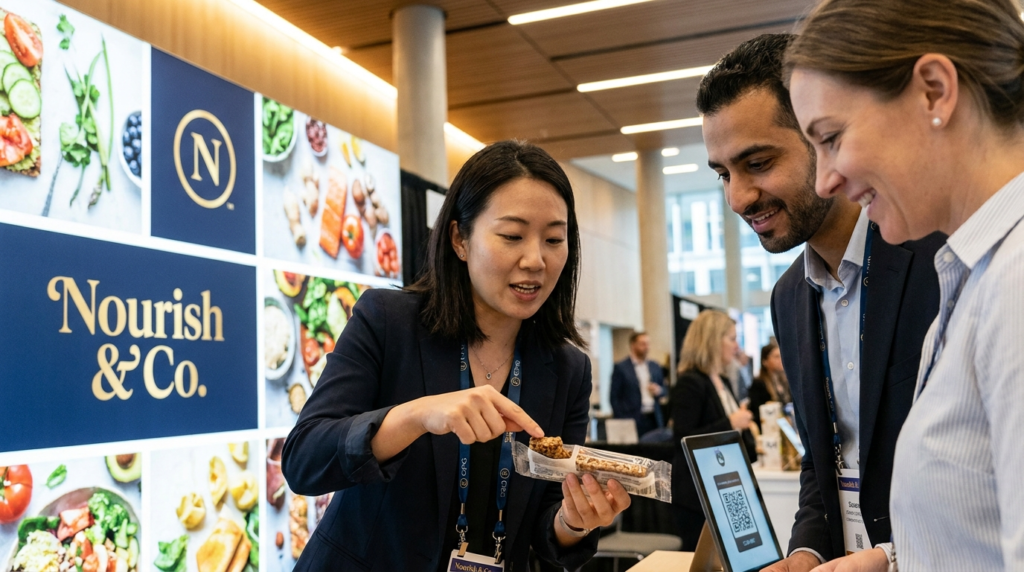
Brand representative at a “Nourish & Co.” trade show booth demonstrating a snack product to attendees, with food imagery display and QR code sign for engagement.

The Brand Guruz Trade Show Activation Framework

A trade show brand activation built for results operates across three phases. Each phase compounds the value of the one before it.

Phase 1: Pre-Show — Build Audience Before You Build the Booth

The brands that win at trade shows start their experiential marketing campaign weeks before the show opens. Pre-show outreach to registered attendees — through personalised email sequences, social media teasers, and event app notifications — creates anticipation and drives deliberate traffic to your booth rather than relying solely on casual floor walk-throughs.

Furthermore, pre-show outreach allows your marketing agency to segment the audience in advance. Identifying which attendees match your ideal buyer profile means your brand ambassadors can prioritise high-value conversations on the show floor instead of spending equal time with every passerby. In short, pre-show strategy turns a reactive presence into a proactive one.

Phase 2: On-Floor — Design for Dwell Time, Not Just Foot Traffic

Foot traffic is a vanity metric. Dwell time is a conversion metric. The goal of a trade show brand activation is not to get as many people to notice your booth — it is to get the right people to stay long enough to experience your product, engage with your team, and take a meaningful next step.

Three elements drive dwell time effectively:

  1. A live demonstration or interactive product experience. Give visitors something to watch or participate in. Movement attracts attention. Participation creates memory. A product trial at a trade show carries the same psychological weight as a test drive — it creates a sense of ownership before the purchase decision is made. For more on this principle, read our Vaughan multicultural CPG activation case study.
  2.  
  3. A reason to stay beyond the initial interaction. A timed product demonstration, a short personalised consultation, or an on-site competition all give visitors a structured reason to remain at your booth. Consequently, the conversation has time to develop — and so does the relationship.
  4.  
  5. A clear, low-friction call to action. Every booth interaction should end with a next step. A QR code that delivers a personalised follow-up sequence, a digital sample request form, or a booked post-show meeting slot all convert a conversation into a trackable lead. According to the Center for Exhibition Industry Research, 81 percent of trade show attendees have buying authority. Therefore, every interaction that ends without a clear next step is a missed revenue opportunity.

Phase 3: Post-Show — Automate the Follow-Up Before the Floor Opens

The 48 hours after a trade show closes are the most valuable — and the most wasted — in the entire exhibition calendar. Most brands send a generic follow-up email three days later. By that point, the memory of the interaction has faded and the competitor who followed up immediately has already booked the meeting.

A marketing agency running a proper trade show experiential marketing campaign builds the follow-up automation before the show begins. Every lead captured on the floor triggers an immediate personalised sequence: a same-day confirmation, a 24-hour value-add message, and a 72-hour meeting request. As a result, the brand stays front of mind during the window when purchase decisions are most actively forming.

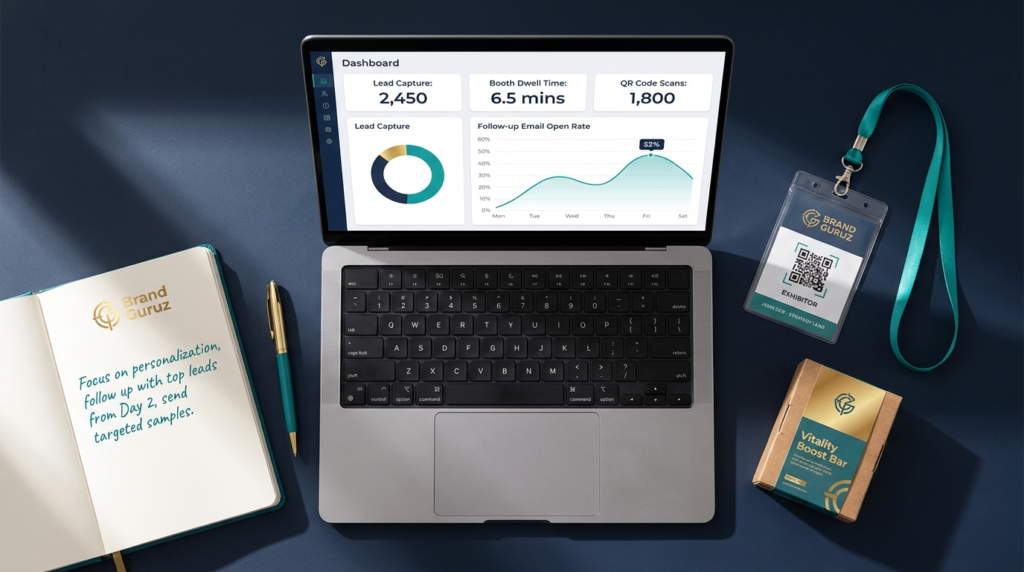
Furthermore, pairing post-show automation with QR code tracking means your team knows exactly which booth interactions generated the highest post-show engagement — intelligence that sharpens the next trade show activation considerably. Our post on QR code ROI tracking for experiential campaigns breaks down exactly how this closed-loop measurement works in practice.

Laptop displaying a marketing analytics dashboard with lead capture, dwell time, and QR scan metrics, alongside a Brand Guruz notebook, pen, exhibitor badge, and sample product box on a desk.

What Trade Show ROI Actually Looks Like When Done Right

The industry benchmark, according to Exhibitor Magazine, is this: it costs 38 percent less to close a lead generated at a trade show than one generated through outbound sales efforts alone.

That statistic reframes the trade show entirely. It is not a marketing expense. It is a sales acceleration tool — one that a well-executed brand activation makes dramatically more efficient.

At Brand Guruz, our trade show clients consistently report three measurable outcomes. First, booth dwell time increases significantly when an active experiential mechanic replaces a passive display. Second, lead quality improves when pre-show audience segmentation focuses ambassador conversations on high-value attendees. Third, post-show conversion rates rise when an automated follow-up sequence launches within hours of the show floor closing.

Together, these outcomes deliver the kind of trade show ROI that justifies increased investment — not budget cuts. That is the difference between showing up at a trade show and activating at one.

If your brand is ready to treat its next trade show as the high-performance brand activation it has the potential to be, contact the Brand Guruz team today. We will build an experiential marketing strategy that converts the floor into measurable revenue.

Author