The Intimacy Advantage: Why Smaller Brand Activations Outperform Larger Ones

Your brand just got the sponsorship opportunity of a lifetime: a booth at the city’s largest consumer festival. Fifty thousand people will pass through. Your competitor is there. Television crews will be filming. Your CMO is thrilled.

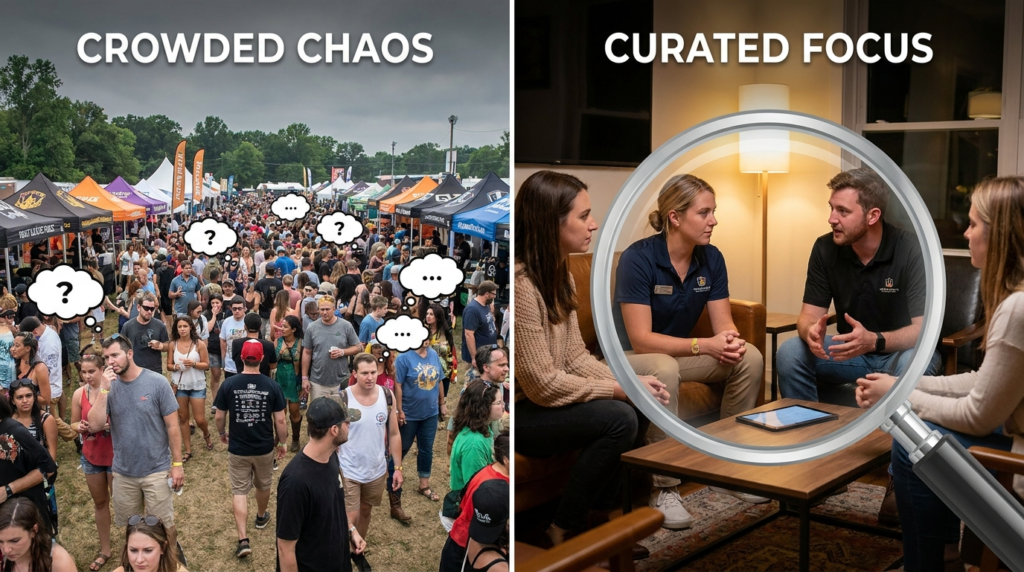
Three weeks later, you’ve got attendance numbers that look impressive until you dig deeper. Foot traffic was massive, but dwell time was minimal. Most visitors grabbed your free item and kept walking. Social media mentions exist, but so do mentions of seventeen other brands. Your cost per engaged attendee was astronomical.

Meanwhile, a boutique activation a few blocks away with just 150 invited guests generated stronger recall, more qualified leads, and a conversion rate triple yours.

Welcome to the intimacy advantage.

The Myth of Scale

The conventional wisdom says bigger is better. More people, more impressions, more potential customers. This logic works for billboard advertising or TV commercials. For experiential marketing, it’s fundamentally wrong.

Research shows that 74% of U.S. consumers are more likely to purchase from brands they interact with personally, emphasizing the value of direct engagement over passive advertising. When you’re competing for attention in a crowd of thousands, meaningful interaction becomes mathematically impossible. Your brand ambassadors can’t have real conversations. Attendees can’t experience your product meaningfully. Connection doesn’t happen at scale.

Boutique activations drive higher engagement and stronger recall than many large-scale events. It’s not about more. It’s about meaning. BizBash research consistently shows that when attendees have space to breathe and time to engage, their memory encoding is fundamentally different. Passive exposure fades quickly. Experiences tied to direct participation, emotion, and novelty are recalled far more readily.

Comparison of crowded vs intimate brand activation attention

Where Your Competitor Can't Go

Large festivals come with an invisible cost beyond sponsorship fees: corporate non-compete agreements.

Your competitor secures a slot at the major music festival. That same contract typically locks you out. You can’t sponsor the same event. You can’t set up within a certain radius. You’re relegated to secondary activations or blocked entirely. The sponsorship cost ($700,000 to $4 million, plus staffing and production) leaves minimal budget for anything else that year.

Smaller local events have no such restrictions. Over 10 million small events take place nationwide annually—neighborhood festivals, community craft fairs, regional food markets, charity events, local music nights. These gatherings provide the inverse economics of large festivals: sponsorship costs typically range from $500 to $10,000.

Your budget that would fund one major festival sponsorship can now execute ten to twenty targeted activations in communities where your ideal customer actually lives. You’re meeting people in their element, not competing for their attention in a chaotic multiplex of brands.

The Math of Conversion

Here’s where smaller activations win decisively.

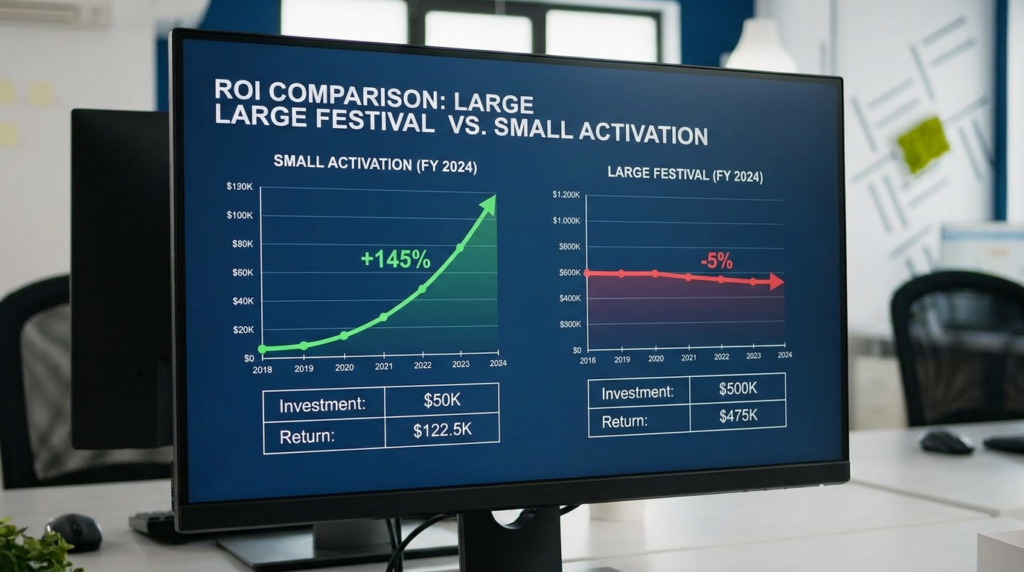
Calculate the cost per engaged attendee. At a large festival with 50,000 visitors and a $200,000 sponsorship, you spend $4 per attendee—but only a fraction actually engaged meaningfully. If 500 genuine interactions happened, your cost per real engagement is $400.

At a 150-person curated activation with a $3,000 budget, your spend is $20 per attendee. But if 120 people genuinely engaged (80% conversion), your cost per meaningful interaction is just $25.

The difference compounds when you track purchase intent. 61% of consumers are more inclined to purchase after attending a brand event according to EventTrack 2026. At large festivals, that 61% applies to your 500 engaged attendees = 305 purchase-intent signals for $200,000 = $655 per interested buyer.

At the boutique activation, 61% of 120 engaged attendees = 73 purchase-intent signals for $3,000 = $41 per interested buyer.

The math isn’t close.

ROI comparison: smaller activations vs large festivals

The Psychology of Exclusivity

Humans want to feel special. Exclusivity creates desire.

A 10,000-person music festival feels democratic—everyone’s invited. A 150-person curated activation feels exclusive—you were specifically chosen. Psychologically, the latter creates stronger emotional resonance. Attendees feel recognized, valued, and part of an insider circle.

When paired with strong staffing support, these environments become spaces for genuine engagement and conversation. Your brand ambassadors aren’t frantically managing crowds. They’re listening. They’re having real conversations about what matters to attendees. They’re adjusting their pitch based on actual feedback rather than delivering a canned presentation to everyone equally.

This creates word-of-mouth momentum your paid amplification can’t buy. Attendees tell their networks: “You have to experience this brand activation. I felt like they actually understood me.” That recommendation carries more weight than any advertisement.

Building Community vs. Building Awareness

Large activations prioritize awareness. Small activations prioritize community.

Awareness is easy to measure and easy to dilute. Fifty thousand people saw your booth. Twenty thousand noticed your brand. Five thousand remembered it. The metric sounds impressive until you realize 45,000 people forgot about you within hours.

Community is harder to measure but far more valuable. One hundred fifty people experienced your brand at the deepest level. They participated in a meaningful way. They felt heard. Seventy percent of them become repeat engagers. They attend your next activation. They recommend your product to friends. They create user-generated content. They become brand advocates.

One builds awareness. The other builds loyalty.

The Boutique Activation Playbook

Successful small activations follow a simple framework.

Start with hyper-specific targeting. Instead of “millennials in our city,” narrow to “venture capitalists interested in climate tech who attend local networking events” or “wellness enthusiasts in specific neighborhoods.” Precision beats volume.

Design for conversation. Eliminate presentation barriers. Your setup shouldn’t feel like a broadcast booth. Create spaces where two to four people can comfortably interact with your brand. Include comfortable seating. Use open-ended questions instead of sales scripts. Let the experience breathe.

Capture data intentionally. Use QR codes, digital forms, and attendee conversations to understand your audience. Post-event, nurture these relationships with personalized follow-ups. You’re building a list of genuinely interested people, not collecting vanity metrics.

Track meaningful metrics. Measure dwell time per person (target: 10+ minutes), conversation quality (feedback quality scores), intent signals (people who asked clarifying questions), and post-event actions (website visits, demo requests, purchases). These matter. Attendance numbers don’t.


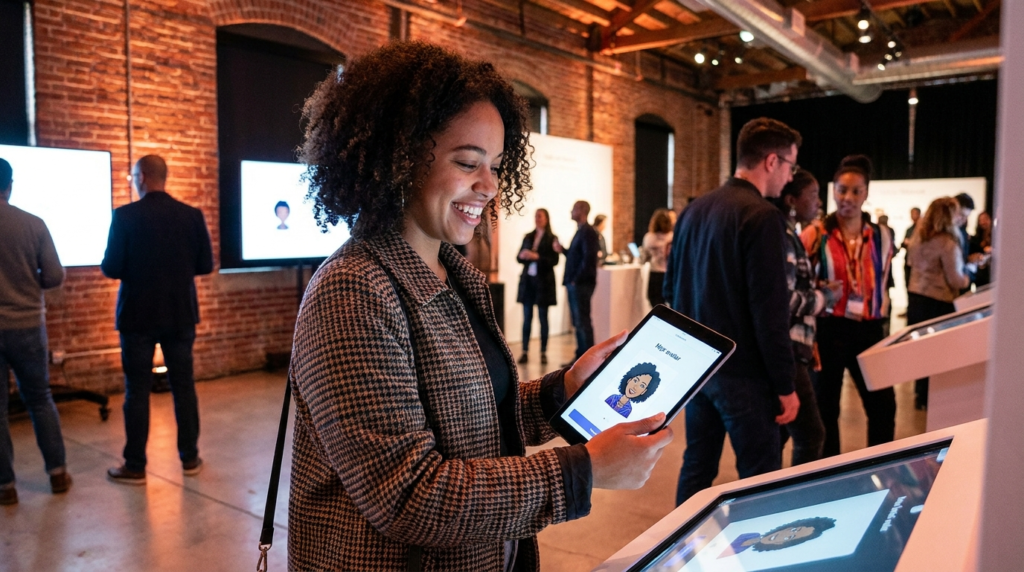
Attendee delighted by personalized experiential marketing experience

The Ontario Advantage for Agencies

Toronto, Vancouver, and Calgary have vibrant communities hungry for authentic brand experiences. Smaller neighborhoods have weekly markets, seasonal festivals, and community events that collectively draw millions of intentional participants.

Small local events are goldmines for brands seeking to stretch their budgets and maximize engagement. For Ontario experiential agencies, this represents a significant competitive opportunity. Agencies that position themselves as boutique activation experts rather than “big event specialists” can command premium pricing because the ROI is demonstrably higher.

Brands increasingly recognize that one thoughtfully executed fifty-person activation in a neighborhood where their target customer lives generates more value than one booth at a regional mega-event. Agencies that understand this psychology win more strategic work and justify higher fees.

When Small Doesn't Work (And When It Does)

Small activations aren’t universally superior. They work brilliantly for:

  • B2B brands where you’re targeting specific decision-makers
  • Premium consumer brands where exclusivity aligns with positioning
  • Brands with products requiring hands-on experience and explanation
  • Companies building community and loyalty over time
  • Categories where conversion happens post-event (longer sales cycles)

Large activations make sense when:

  • Your only goal is raw brand awareness
  • Your product is already well-understood (you’re fighting for top-of-mind)
  • You have a massive budget and efficiency doesn’t matter
  • Distribution requires reaching geographically dispersed audiences
  • You’re launching a genuinely innovative product that needs explanation at scale

The best agencies offer both. They recommend small activations when the strategy demands intimacy. They recommend larger ones when scale serves the objective. Most agencies today lean toward scale by default because that’s what they’re equipped to execute.

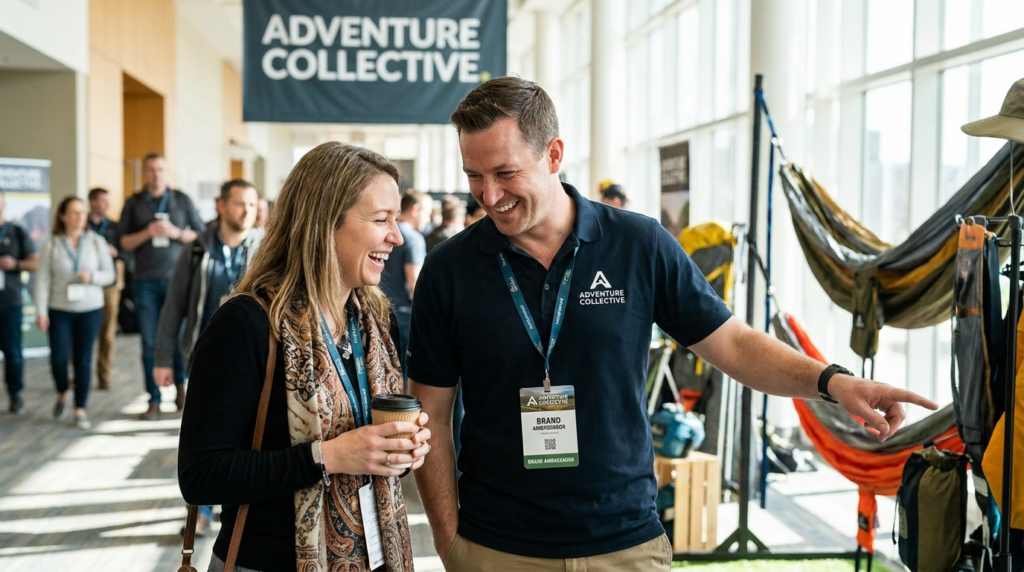
Genuine connection between attendee and brand representative at intimate activation

Your Next Activation Strategy

Before committing to that large sponsorship, ask yourself these questions:

Who is your actual target customer? Not “people interested in [category]” but the specific person who becomes a loyal customer. Can you describe them in detail? If yes, you’ve identified your boutique audience.

How much time do you need to create genuine value? If your product requires 15+ minutes to appreciate meaningfully, boutique activations are necessary. If it’s a 30-second pitch, any event works.

What’s your post-event goal? Immediate sales? Long-term loyalty? Raw awareness? Intimacy matters most when you’re building relationships. It matters less if you’re fighting for attention.

What’s your budget? If you have $30,000, one large festival sponsorship gets you a small booth in a crowded environment. Ten boutique activations at $3,000 each give you complete control and exclusivity across multiple communities.

Answer these honestly, and your optimal activation strategy becomes clear.

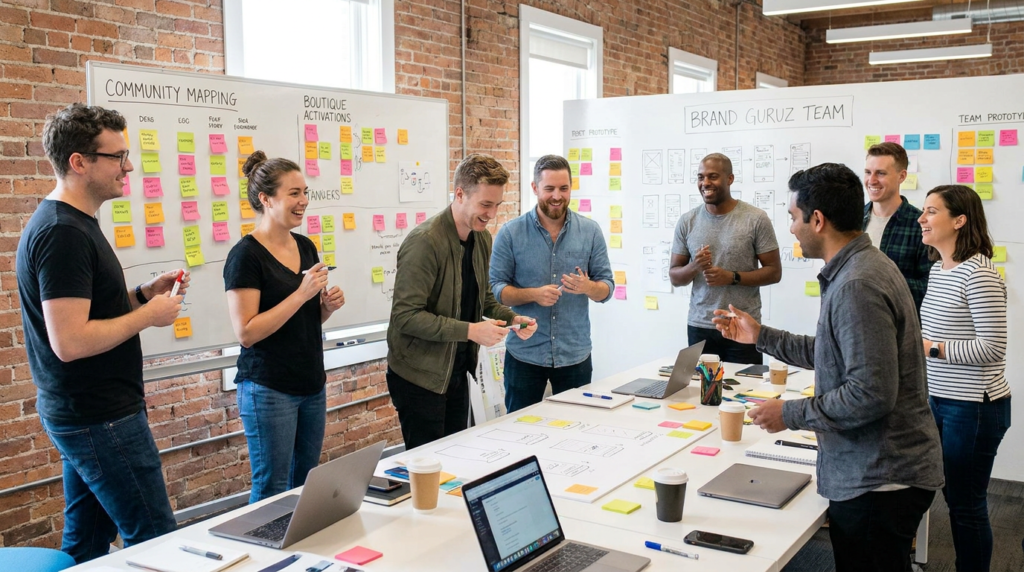
Brand Guruz team designing boutique activation strategy

Ready to stop competing for attention and start building loyalty? Contact Brand Guruz to design intimate activations that convert attendees into advocates.

Author