How to Build a Brand Ambassador Program in Canada

A brand ambassador program is more than a roster of enthusiastic people. It is a structured, ongoing system for putting the right faces in front of the right audiences — consistently, measurably, and at scale.

Brand Guruz builds and manages brand ambassador programs across Canada for consumer brands, food and beverage companies, and multicultural marketers. Ultimately, this guide covers how to design one: the profile, the recruitment, the training, the compliance, and the metrics.

92%

of consumers trust recommendations from individuals over brands (Nielsen)

82%

of consumers seek referrals from peers before making a purchase decision

76%

of people are more likely to trust content from a real individual than from a brand

What makes a brand ambassador program different from ad-hoc staffing?

Most brands hire field marketing talent reactively — a campaign comes up, they staff for it, and the team disbands when the activation ends. A brand ambassador program works differently. Instead, it builds a vetted, trained, consistent talent bench the brand can deploy repeatedly, quickly, and reliably.

The difference shows up most clearly in activation quality. A trained ambassador who has represented the brand five times outperforms a first-day hire every time — in brand knowledge, audience reading, and conversion rate. Generally, programs with a consistent bench outperform event-by-event staffing on brand consistency, message accuracy, and consumer conversion.

According to Social Ladder’s ambassador marketing research, 92 percent of consumers trust recommendations from individuals over brands. Additionally, 82 percent seek referrals from peers before making a purchase decision. Those numbers only hold when the individual delivering the recommendation is trained, credible, and genuinely aligned with the brand. A revolving door of temporary hires cannot produce that. A program can.

Archivemarketresearch’s 2025 brand ambassador market analysis projects the brand ambassador solutions market at $384.8 million in 2025, growing at 8.8 percent annually. The investment is following the results.

Who should your brand ambassadors be?

The ambassador profile is the foundation of the entire program. Get it wrong and every subsequent investment — in training, deployment, and management — compounds on the wrong people.

The right profile has three dimensions.

Brand alignment. The ambassador needs to genuinely represent the brand’s values, aesthetic, and target audience. Consumers detect inauthenticity quickly — particularly in live environments where there is no editing or retakes. Ambassadors who are authentic fans of the brand or category outperform those who are simply competent.

Communication skills and energy. Live brand ambassador work demands non-verbal communication, adaptability, and the ability to hold conversations with strangers in a noisy environment. In fact, these traits are hard to train from scratch. Instead, look for them in pre-screening and select accordingly.

Cultural fluency. In Canada’s multicultural markets — Toronto, Vancouver, Brampton, Calgary, and Montreal — brand ambassadors need to read and connect with diverse audiences. Still, most brand ambassador programs source generically and miss this entirely. A program operating in multicultural neighbourhoods without multilingual or culturally fluent ambassadors leaves conversion on the table. For the research behind this, see our multicultural market research guide.

How do you recruit and select brand ambassadors in Canada?

Sourcing the right ambassadors is a talent acquisition problem, not a staffing problem. The distinction matters — staffing means filling slots; talent acquisition means finding people who fit the profile.

The most effective sourcing channels for brand ambassador programs in Canada are generally:

  • Agency rosters. Established experiential marketing agencies maintain vetted pools of brand ambassadors pre-screened for communication skills, reliability, and prior activation experience. Generally, this is the fastest route to a qualified bench for brands building a program quickly.
  • Community recruiting. In multicultural markets, the best ambassadors are often recruited from the community itself — through cultural organisations, community events, and university networks. In contrast, generic job board sourcing rarely surfaces candidates with genuine cultural fluency.
  • Internal advocates. Some brands recruit from their own customer base — genuine fans who apply to represent a brand they already use. This produces authentic ambassadors, though it requires a more intensive training investment since most have no prior activation experience.

Screening should always include a short in-person or recorded pitch exercise. Additionally, any candidate who cannot hold a conversation in a structured context will not hold one in a live activation environment either.

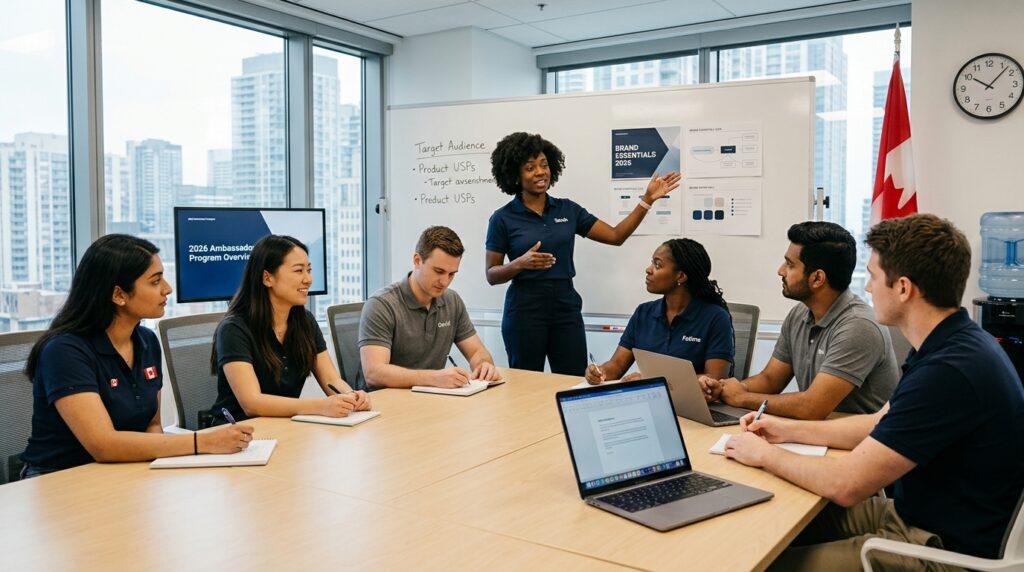
Brand ambassador team participating in a training session before a Canadian activation in 2026.
Training is not an onboarding cost — it is the single highest-yield investment in the activation.

What does brand ambassador training actually cover?

Training is where most brand ambassador programs underinvest. The assumption is that enthusiastic, personable hires will figure the rest out. In fact, they rarely do.

A complete training program generally covers five areas.

Brand knowledge. The ambassador needs to know the product, the brand values, the competitive landscape, and the key messages — including what not to say. However, this is not simply a product manual review. It requires a verbal check to confirm the ambassador can explain the brand clearly and accurately to a stranger.

Sales and engagement technique. This covers how to open a conversation with a stranger, handle objections, transition to a sample or trial, and close toward a conversion. These are learnable skills that separate good brand ambassador programs from great ones.

Compliance and safety. This includes venue rules, health and safety protocols relevant to the activation environment, and confidentiality requirements. For programs with mascot elements, see our brand mascots guide.

Data capture. Specifically how to log leads, opt-ins, and sales data on the tools the brand uses — without breaking the flow of the interaction. In short, missed data is missed ROI.

Brand voice. How the ambassador speaks about the brand — tone, vocabulary, phrases to use, and phrases to avoid. This is especially important for regulated categories like finance, healthcare, and food and beverage.

Overall, training is not a cost. It is the activation’s highest-yield investment. For the hands-on hiring and training framework, see our in-store pop-up sales hiring and training guide.


How do you deploy, manage, and compensate brand ambassadors in Canada?

Deployment is where programs succeed or fail in practice. Still, even well-recruited and well-trained ambassador benches underperform without the right field management structure.

Scheduling and roster management. Programs of any scale need a clear system for matching ambassadors to activations — by availability, location, language, and experience. A spreadsheet works for small programs; field management software handles anything larger.

On-the-ground support. Also, every activation should have a designated team lead — someone who runs the daily brief, solves real-time problems, and collects the end-of-shift debrief. Ambassadors operating without field support become inconsistent over time.

Employment classification in Canada. How brand ambassadors are classified legally is not a minor detail. According to People20’s analysis of Canadian gig worker law, labelling someone a contractor in an agreement is insufficient if the working relationship resembles employment. The CRA applies a common law test covering control, tool ownership, financial risk, and business integration. The HYPE Agency’s guide to brand ambassador classification notes that misclassification creates real liability exposure for both the brand and the agency. Additionally, a program that misclassifies ambassadors faces retroactive payroll remittances, Employment Standards penalties, and potential wrongful dismissal exposure. Work with qualified legal counsel or a compliant agency to structure the classification correctly from day one.

Pay rates. Generally, brand ambassador pay in Canada ranges from $18 to $27 per hour for live activation work. Team leads and bilingual performers command higher rates, and overnight or travel assignments add further premiums.

How do you measure brand ambassador program ROI?

Measurement is where most brand ambassador programs are weakest. Yet impressions and shift counts are not ROI — they are activity metrics. Instead, ROI means connecting ambassador deployment to business outcomes: lead generation, trial rates, sales conversion, and brand recall lift.

Zigpoll’s analysis of brand ambassador program effectiveness recommends anchoring KPIs in incremental outcomes — new customers attributed to ambassador interactions, social engagement converted into store visits, and purchase intent shift measured before and after engagement.

The core measurement framework for a Canadian brand ambassador program should include three tiers:

  • Shift-level KPIs. Conversations initiated, samples distributed, opt-ins collected, and sales attributed. These are captured by the ambassador at the end of every shift in a brief debrief form.
  • Program-level KPIs. Week-over-week conversion rate by ambassador, by activation type, and by market. This is where top performers are identified and underperformers are coached or rotated.
  • Brand KPIs. Recall lift among consumers who engaged the ambassador versus those who did not — measured via post-activation survey. Ultimately, this is the number that justifies the program to senior leadership.
 

For the full measurement framework, see our experiential marketing ROI guide. However, the principle is always the same: define what winning looks like before the first ambassador is deployed.

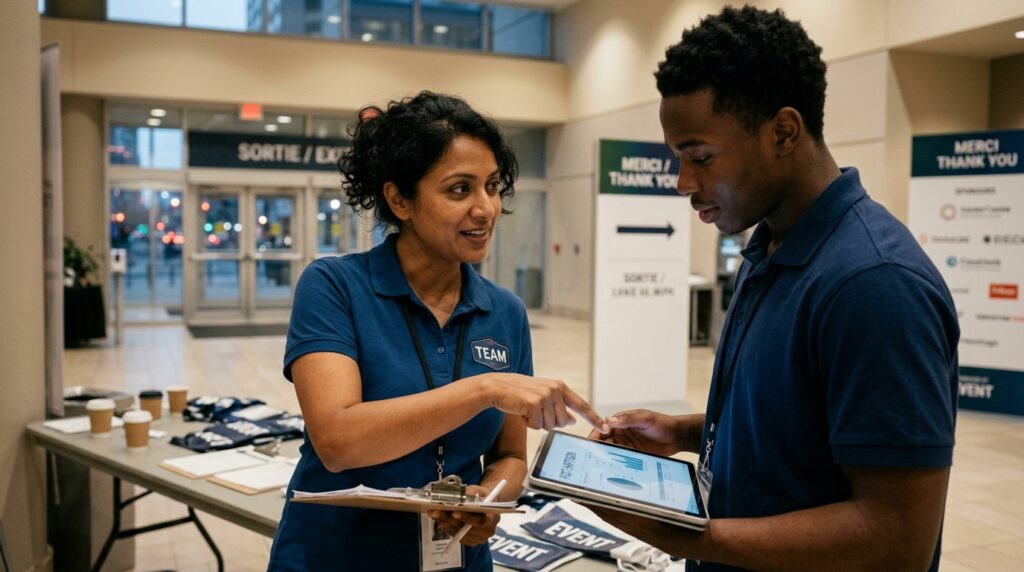
Brand ambassador team lead reviewing post-shift debrief data with an ambassador in Canada in 2026.
The shift debrief is where the activation data lives — and where the next deployment gets better.

Why Brand Guruz builds brand ambassador programs that scale

Brand Guruz builds and manages brand ambassador programs across Canada — structured, ongoing programs with vetted rosters, trained talent, and compliance frameworks built in from day one.

Our multilingual ambassador roster spans South Asian, Caribbean, East Asian, Latin, and mainstream Canadian communities across Ontario. In fact, that depth of cultural range gives brands access to multicultural markets that generic staffing agencies cannot reach.

We also handle the labour classification and compliance side that most brands and most agencies miss. Every program we run is structured with the right employment agreements from the start — because misclassification is a liability that compounds fast. For the street team framework that often runs alongside an ambassador program, see our street team marketing guide.

Frequently asked questions about brand ambassador programs

What is a brand ambassador program? A brand ambassador program is a structured, ongoing system for recruiting, training, and deploying brand representatives to engage consumers at live events, in retail environments, and in community settings. It builds a consistent bench of trained talent the brand deploys repeatedly and reliably.

How much does a brand ambassador program cost in Canada? Generally, ambassador pay rates run $18 to $27 per hour for activation work, with team leads and bilingual performers at higher rates. A pilot program for a single market typically runs $15,000 to $50,000+, covering ambassador pay, training, program management, and compliance setup. Larger ongoing programs for national deployment require a separate scoping conversation.

How should brand ambassadors be classified in Canada — employee or contractor? Canada’s CRA applies a common law test: control, tool ownership, financial risk, and business integration. Labelling someone a contractor in an agreement is insufficient if the working relationship resembles employment. Misclassification creates real legal and financial exposure. Work with qualified legal counsel or a compliant agency to structure the program correctly.

What is the difference between a brand ambassador and a street team? A street team is a short-term field crew deployed for a specific campaign — sampling, flyering, or event coverage. A brand ambassador program is longer-term and more structured: the same trained roster representing the brand across multiple activations, with consistent messaging, tracked KPIs, and ongoing relationship management. See our street team marketing guide for how the two compare.

How many brand ambassadors do you need to start? A useful pilot starts with 10 to 20 ambassadors across one or two markets. This gives enough coverage for regular activations, volume to identify top performers, and data to refine the profile before scaling. Generally, the program should be reviewed after 90 days and adjusted before expanding.

Ready to build your brand ambassador program?

The roster, the training, and the compliance framework all need to be in place before the first activation. Talk to Brand Guruz about building your brand ambassador program for 2026. Or browse case studies to see how our ambassador programs have delivered across Canadian markets.

Author