Corporate Event Planning Toronto: Cost, Vendors, and the Buyer's Checklist for 2026
Corporate event planning in Toronto looks deceptively simple on paper. Pick a venue, book a caterer, send invites, light it up. In practice, the gap between a forgettable corporate event and one that moves business metrics comes down to vendor choices, cost discipline, and a buyer’s checklist most brand managers never get handed.
Heading into 2026, that gap is widening. Toronto venue prices are up, production lead times have stretched, and the bar for what attendees expect has reset entirely. As a result, the brands that win this year will treat corporate events like a strategic spend — not a line item.
This guide breaks down what corporate event planning in Toronto actually costs in 2026, the vendor stack you need to assemble, and the buyer’s checklist Brand Guruz hands every new client before a single dollar leaves the budget.
The 2026 Toronto Corporate Event Market at a Glance
Toronto is North America’s third-largest corporate event market behind New York and Chicago. According to Destination Toronto, millions of business visitors pass through the city each year. That density of buyers, sellers, and venues makes Toronto a default choice — but it also means demand pressure is real.
What Toronto companies are budgeting in 2026
In our experience working with Ontario brands, internal corporate event budgets have grown roughly 12 to 18 percent year over year since 2023. The drivers are not mysterious. Venue minimums in core downtown wards are up. Audiovisual rental costs climbed sharply post-pandemic. Furthermore, the talent layer — emcees, performers, brand ambassadors — has priced into a tighter labour market.
That said, most brand managers we talk to are not over-spending. They are under-scoping. A typical corporate event budget covers venue, catering, and production. However, it rarely covers the experience design and brand integration that separate a forgettable evening from a memorable activation. That gap is where 2026 budgets need to grow.
Why corporate event spend is rising heading into 2026
Three forces are pushing budgets higher this year. First, hybrid fatigue is real. After three years of virtual-everything, employees and clients want rooms, food, and face time. As a result, in-person event ROI has rebounded sharply. Next, Toronto’s hospitality supply has not fully recovered, so the venues that exist command a premium. Finally, attendee expectations have reset — guests now compare your annual sales kickoff to the last activation they attended at TIFF or the Toronto Caribbean Carnival.
In short, the floor has risen. A corporate event that would have impressed in 2022 reads as flat in 2026.
What Corporate Event Planning in Toronto Actually Costs
Cost ranges depend on guest count, format, and how much of the experience is custom-built versus pulled from a vendor’s standard kit. Here are the bands we see most often.
Small internal events: $15,000 – $50,000
This band covers team off-sites, internal town halls, and small client appreciation evenings of 30 to 100 attendees. The spend usually breaks down like this: venue 30%, catering 35%, production 20%, talent and extras 15%.
For instance, an 80-person leadership offsite at a mid-tier downtown venue with three speakers, simple AV, and a plated dinner typically lands near $42,000 all-in. The trap at this size is over-spending on venue and under-spending on the moments that make the room feel intentional.
Mid-market client events and conferences: $50,000 – $250,000
This is where most B2B corporate events in Toronto sit. Think 150 to 500 attendees, a half- or full-day conference format, multiple speakers, branded staging, and an evening reception. Production becomes the biggest line item here — often 30 to 40% of the budget — because the room itself has to perform.
Specifically, a 300-person client conference at a venue like Arcadian or The Carlu, with full-stage production, two hosted bars, and bespoke registration design, typically lands between $180,000 and $230,000. For a deeper view of how production and brand experience costs interact, see our breakdown of brand activation costs in Ontario.
Flagship brand experiences: $250,000+
At the top end, corporate events stop being events and start being brand experiences. These are launches, anniversaries, and partner summits with bespoke creative, custom-built environments, and integrated talent. Spend at this tier routinely passes $500,000. Equally important, this is the natural home of experiential marketing thinking — which is a different discipline than logistics.
Where hidden costs hide
The line items that quietly inflate corporate event budgets are almost always the same.
Venue overtime fees after 11 p.m.
AV labour calls on top of equipment rental
Permits, SOCAN/Re:Sound fees, and insurance riders
Branded signage and wayfinding produced under deadline
Talent green-room riders and per diems
Last-minute headcount adjustments to catering
In short, the quote you sign is rarely the cheque you write. Build a 10 to 15 percent contingency line into every corporate event budget in Toronto, and ringfence it.
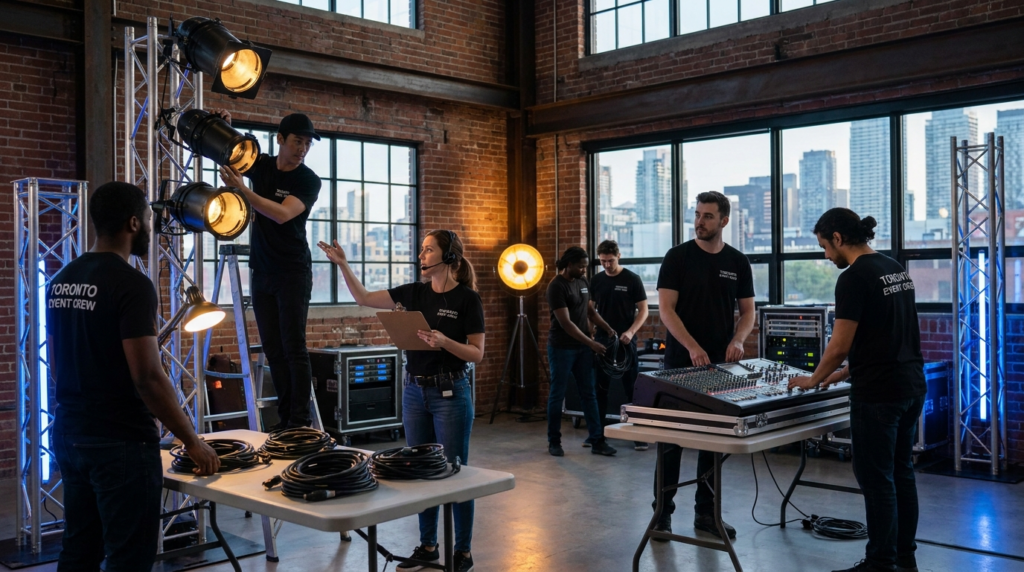
Production labour and AV are the line items where most Toronto corporate event budgets quietly bleed.
The Vendor Stack: Who You Actually Need
A corporate event in Toronto typically pulls from six vendor categories. Treating them as one bundled “event planner” purchase is the most common mistake we see.
Venue
Toronto’s corporate venue market spans hotel ballrooms, industrial conversions, and modern event-only spaces. Expect minimum food and beverage spends from $15,000 at boutique venues to $80,000+ at flagship downtown ballrooms. Always ask for the venue’s preferred vendor list — and then ask whether you are allowed to bring in your own.
Production (AV, staging, lighting, scenic)
Production is the single most leveraged spend on a corporate event. Good production makes a $100,000 event feel like $250,000. Bad production does the inverse. To be clear, you want itemized quotes — never accept a lump-sum production line.
Catering and beverage
In Toronto, catering is usually venue-tied or pulled from the venue’s preferred list. Per-head costs in 2026 typically run $85 to $175 for plated dinners and $55 to $110 for stations or canapés, before bar. Importantly, bar costs scale by drink count, not just headcount.
Talent and entertainment
Emcees, DJs, live musicians, and brand ambassadors all live in this layer. Toronto has a deep talent bench. For instance, pulling from the city’s multicultural performance community is what makes an event feel rooted in the room it is in, rather than airlifted from a stock playbook.
Brand experience and activation
This is the layer most corporate event briefs forget. It covers the strategic frame, the moments designed for social capture, the branded touchpoints, and the integration between the event and the broader marketing campaign. Notably, this is where Brand Guruz typically enters a corporate event scope — not as the venue booker, but as the team turning a logistics plan into a brand moment.
Project management and onsite delivery
Someone has to run the room on the day. That role can sit with the venue, the production company, or your agency. It cannot sit with no one.
The 2026 Corporate Event Buyer's Checklist
Use this checklist before signing any vendor agreement.
Seven questions to answer internally before you brief
What is the single business outcome this event has to produce — pipeline, retention, recruitment, or brand equity?
Who is the audience, in concrete demographic terms, not job titles?
What is the all-in budget, including a 12 percent contingency?
What does success look like in measurable terms?
Which executives are non-negotiable on-stage commitments?
What date constraints are fixed, and which are flexible?
How does this event integrate with the rest of the marketing calendar?
What every vendor quote must include
A corporate event quote in Toronto that does not break out the following is not a quote — it is a hope. Insist on itemized lines for venue, food and beverage per head and bar, production with labour calls separated from equipment, talent fees plus riders, design and print, project management hours, taxes and gratuities, and contingency. If a vendor pushes back on this level of detail, that is your answer.
Contract red flags to negotiate out
Auto-renewing exclusivity clauses on future events
Overtime triggers under four hours
Force majeure clauses that exclude public health events
“Subject to availability” language on confirmed talent
Cancellation penalties that escalate inside 30 days
For a deeper view of how cost discipline plays out across formats, our case studies walk through the budgets and outcomes of recent Toronto corporate work.
Why Most Corporate Event Briefs Underperform
Most corporate event briefs in Toronto fail at one specific seam: the gap between production and experience. The production company can hang lights and run cues beautifully. The experience layer — what attendees feel, do, share, and remember — does not live on a production rider.
The production-vs-experience gap
Production answers “is the room ready?” Experience answers “is the room memorable?” Both are required. However, brands that hire only for production end up with technically perfect events nobody talks about on Monday morning.
How Brand Guruz approaches corporate events
Brand Guruz sits at the intersection of corporate event production and experiential marketing. In practice, that means we plan the room, the run-of-show, and the budget — and we design the brand-led moments inside it. According to research summarized by Event Marketer, experiential moments inside corporate events drive significantly higher brand recall than presentation-only formats. That is the gap we close. To talk through your 2026 plan, reach out directly.
Corporate Event Planning Toronto: FAQ
How far in advance should I book a corporate event in Toronto for 2026?
Book venues 6 to 9 months out for events of 150+ attendees. Major downtown ballrooms in Q4 2026 are already filling. For smaller boutique formats, 3 to 4 months is workable.
What is the average cost of a corporate event in Toronto in 2026?
Mid-market corporate events in Toronto typically range from $50,000 to $250,000 all-in. Costs scale with guest count, production complexity, and venue tier.
Should I hire a corporate event planner or an experiential agency?
It depends on the outcome you need. A planner runs logistics. An experiential agency like Brand Guruz designs the brand moment inside the logistics. For events tied to a marketing goal, an experiential partner is usually the better fit.
What permits do I need for a corporate event in Toronto?
Most indoor events at licensed venues need no attendee permits. However, SOCAN and Re:Sound fees apply for music, special occasion permits apply if you bring your own alcohol, and outdoor activations require City of Toronto event permits.
How do I measure ROI on a corporate event?
Tie the event to a defined business outcome before you brief it. Then track pipeline created, retention rates, employer-brand engagement, or earned-media impressions — depending on which outcome the event was built for.
Plan your 2026 corporate event with a team that thinks beyond logistics. Brand Guruz is Toronto’s experiential marketing partner for brands who want corporate events that move metrics, not just calendars. Book a strategy call or explore our case studies to see how we work.