Retail Merchandising Services Explained: Planograms, Stock-Outs, Audits, Mystery Shops

Retail merchandising services exist because what happens at corporate headquarters is not what happens on the shelf. To be specific, the average retail store follows the approved planogram about 60% of the time. Furthermore, the gap costs brands real money. As a result, out-of-stocks alone cost the global retail industry over $1.7 trillion a year. Consequently, the brands and retailers that maintain shelf discipline win the categories the rest are leaking.

At Brand Guruz, we run retail merchandising services across Canadian grocery, drug, mass, and ethnic banners. In our experience, the brands that get this right treat merchandising as a measurement layer, not a maintenance one. Specifically, the four core services close the gap: planograms, stock-outs, audits, and mystery shops.

This is the explainer for what each one does, how they work together, and how to use them in 2026.

$1.73 trillion

Global cost of retail inventory distortion in 2025 (IHL Group)

~60%

Average planogram compliance rate in retail

~10% per week

Recommended lead time to plan a cross-Canada roadshow

What retail merchandising services actually do

Retail merchandising services are the field operations that connect shelf strategy to what shoppers actually see in store. Specifically, the work includes setting planograms, catching stock-outs, auditing compliance, and running mystery shops. Furthermore, the modern version of all four is mobile-first, photo-based, and data-driven.

The category exists because retail execution is messy. In our experience, a single grocery store can deviate from corporate planning in dozens of small ways every week. Consequently, brands and retailers need a field layer that catches the gap before it becomes lost sales.

Planograms: the shelf blueprint

A planogram is the visual blueprint that dictates exactly where every product belongs on the shelf. Specifically, it specifies the position, facings, and adjacencies for each SKU in a category. Furthermore, planograms are the foundation of every other retail merchandising service — without one, there is nothing to audit against.

How planogram compliance affects retail performance

Planogram compliance is the share of stores executing the planogram as designed. Specifically, research compiled by SafetyCulture from the National Association of Retail Marketing Services shows that maintaining compliance can lift retail profits by 8.1%. Furthermore, the same research puts the average compliance rate near 60%.

The drift is constant. Specifically, even a freshly executed planogram loses about 10% compliance every week. In our experience, that drift is what merchandising services exist to catch. As a result, compliance is not a one-time setup — it is an ongoing discipline.

How merchandisers enforce planogram compliance

Merchandisers enforce planogram compliance through scheduled in-store visits. Specifically, a field rep checks the shelf against the current planogram, corrects what is wrong, and reports what cannot be fixed on the spot. Furthermore, the modern version of this work happens through a mobile app with photo capture.

In our experience, the brands that visit high-velocity categories weekly hold compliance highest. By comparison, brands that audit quarterly are essentially flying blind.

Stock-outs: the silent killer of retail sales

A stock-out is what happens when a product is missing from the shelf while the store is open for business. Specifically, the shopper came ready to buy and left with a competitor instead. Furthermore, the cost is enormous. As Chain Store Age coverage of the latest IHL inventory study notes, global retail loses $1.73 trillion a year to inventory distortion — equivalent to 6.5% of all global retail sales.

How field merchandisers catch stock-outs

Field merchandisers catch stock-outs by walking the aisle and checking the shelf against the planogram. Specifically, they confirm whether a missing facing means an actual out-of-stock or just an unfilled slot. Furthermore, many merchandisers can fix backroom-stock issues on the spot.

In our experience, an active merchandising program reduces store-level stock-outs significantly. As a result, sales recover from the same shelf the next week.

Why stock-outs are a multicultural retail problem

Stock-outs hit multicultural retail particularly hard. Specifically, ethnic SKUs in mainstream banners are often stocked thinner and replenished slower. Furthermore, the buyer who could not find what they came for rarely substitutes — they go to a competing banner or a community grocer.

In our experience, neighborhood-store audits frequently expose stock-out patterns that headquarters cannot see from sales data alone. For more on the underlying audience research, see our multicultural market research guide. As a result, multicultural retail merchandising services often pay back fastest.

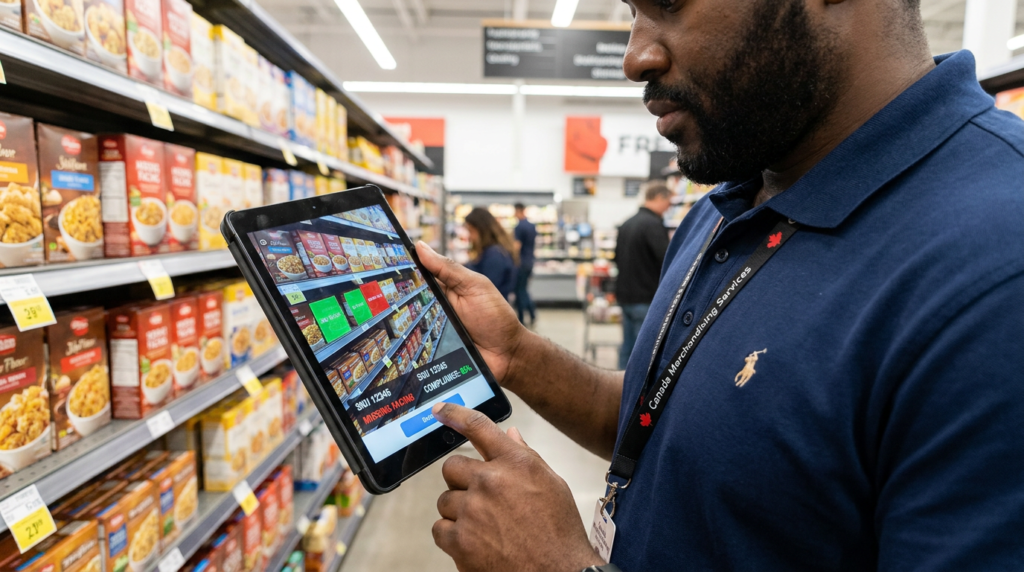
Retail merchandising services associate using a tablet with image recognition to audit a planogram in a Canadian retail store in 2026.
Modern retail audits run through a tablet and a camera, not a clipboard.

Retail audits: the data layer of merchandising services

A retail audit is a structured store-by-store check on execution. Specifically, audits measure planogram compliance, pricing accuracy, signage, display compliance, and competitive presence. Furthermore, the audit is what turns merchandising into a measurable function.

As Retail TouchPoints coverage of inventory distortion research shows, the execution gaps audits exist to catch cost retailers over a trillion dollars annually. In our experience, the brands that audit consistently catch problems weeks before sales data shows them.

What a modern retail audit covers

A modern retail audit covers far more than shelf compliance. Specifically, it scores share of shelf, pricing versus competitors, promotional execution, and signage placement. Furthermore, the best audits also capture qualitative observations — what the category looks and feels like from a shopper’s view.

In our experience, the most valuable audit data is the share-of-shelf reading. As a result, brands can quantify exactly how much physical retail space competitors are winning each quarter.

How mobile and AI changed retail audits

Mobile and AI changed retail audits from a quarterly paper exercise into a real-time stream. Specifically, field reps photograph shelves on a smartphone, and image-recognition software returns SKU-level compliance data within seconds. Furthermore, the brand sees deviation alerts before the rep leaves the store.

In our experience, image-recognition audits cut reporting lag from weeks to minutes. Consequently, decisions that used to wait for next quarter happen the same afternoon.

Mystery shopper interacting with a retail associate in a Canadian store in 2026.
Mystery shops measure the human side of retail execution that audits cannot see.

Mystery shops: the experience layer of retail execution

A mystery shop is an anonymous, structured evaluation of the in-store experience by a trained shopper posing as a customer. Specifically, the mystery shopper rates staff service, product knowledge, brand presentation, and sales execution. Furthermore, the mystery shop captures what audits cannot — the actual customer journey.

As Greenbook research on mystery shopping for customer experience notes, the method has evolved from compliance checking into a full customer-experience research tool. In our experience, the best mystery shop programs sit alongside audits, not instead of them.

What mystery shops measure that audits don't

Mystery shops measure the parts of retail execution audits cannot see. Specifically, they capture staff behaviour, conversation quality, brand recommendation rates, and customer-experience friction. Furthermore, they catch the moments where great shelf compliance still loses the sale.

For example, a perfectly stocked aisle with an unknowledgeable associate is a different failure than a stock-out. In our experience, both failures cost the brand — but only one shows up in an audit.

How to design a mystery shop program for retail

A useful mystery shop program starts with clear questions. Specifically, the brand defines what it actually wants to learn about service, recommendation rates, competitive comparison, or a specific in-store campaign. Furthermore, the shopper script and evaluation form should match the question being asked.

As Quirk’s reference on the Mystery Shopping Providers Association notes, certified mystery shopping is regulated by trade bodies for a reason — sloppy mystery shopping produces useless data. Consequently, program design matters as much as shopper recruitment.

How the four retail merchandising services work together

The four services are complementary, not substitutes. Specifically, each one catches a different layer of retail execution. Furthermore, the brands that use all four get a complete picture of what is happening on the shelf and on the floor.

ServiceWhat it measuresTypical frequencyBest at catching
PlanogramsShelf layout vs. planReset cycle (quarterly)Strategic placement gaps
Stock-outsOn-shelf availabilityWeeklyLost sales in real time
AuditsCompliance and competitionMonthly to quarterlySystemic execution drift
Mystery shopsCustomer experienceQuarterly to annualService and sales gaps

In our experience, the brands that integrate all four metrics in one dashboard make faster category decisions. As a result, retail execution becomes a strategic asset, not a back-office cost.

Common retail merchandising mistakes

Most underperforming retail merchandising programs share the same mistakes. To be specific, here are the four most common.

  • Auditing without planogram discipline. Specifically, an audit against a non-existent or outdated planogram catches nothing. Furthermore, this is the most common gap in mid-size CPG brands.
  • Treating mystery shops as a compliance check only. For instance, sending shoppers to confirm staff said the right script wastes the channel. Consequently, the brand misses real customer-experience insight.
  • Ignoring multicultural and ethnic retail. Importantly, mainstream-banner audits miss the South Asian, East Asian, halal, and Caribbean grocery channels where many products actually sell. By comparison, the brands that audit ethnic banners often find their best growth markets.
  • Treating merchandising as a cost line. As a result, the function is underfunded and reactive. Consequently, the data never reaches the strategy table where it could move the business.

Why Brand Guruz delivers stronger retail merchandising services

Brand Guruz is the agency Canadian brands hire when retail merchandising services need to actually move the category. To begin with, our field network covers mainstream banners and ethnic retail in every major Canadian market. Furthermore, our multilingual auditors and mystery shoppers read communities the average national vendor cannot.

Equally important, we run all four services on integrated dashboards. Specifically, planogram compliance, stock-out data, audit scores, and mystery shop reports all roll up to one view. As a result, the brand sees the full picture of retail execution, not four disconnected slivers.

If you are scoping retail merchandising services in Canada for 2026, talk to Brand Guruz about your category and banner mix. For broader retail strategy, see our retail activations guide. For the wider category context, see our experiential marketing overview. Or browse case studies to see how the services land at the shelf.

Frequently asked questions about retail merchandising services

What are retail merchandising services? Retail merchandising services are the field operations that ensure a brand’s products are properly displayed, in stock, and represented in retail stores. Specifically, the four core services are planograms, stock-out monitoring, retail audits, and mystery shopping. As a result, brands maintain shelf discipline across hundreds or thousands of stores.

What is the difference between a retail audit and a mystery shop? A retail audit measures physical execution — planograms, stock, pricing, signage, and display compliance. A mystery shop measures the human experience — staff service, product knowledge, and sales behavior. Furthermore, the two are complementary, not substitutes.

Why do brands hire third-party retail merchandising services? Brands hire third-party retail merchandising services for objective measurement and field coverage. Specifically, an independent vendor catches problems retailers will not self-report. Furthermore, third-party teams scale across markets faster than internal hiring.

How often should a brand audit its retail execution? Most brands audit monthly to quarterly, with weekly checks on high-velocity categories. Specifically, the right frequency depends on category volatility, promotional calendar, and competitive intensity. Furthermore, planogram resets always trigger a fresh audit.


Ready to tighten your retail merchandising?

The retail merchandising calendar fills fast around quarterly resets and promotional seasons. Talk to Brand Guruz about your 2026 planogram, audit, and mystery shop programs. Or browse our case studies to see how the field work lands in the data.

Author