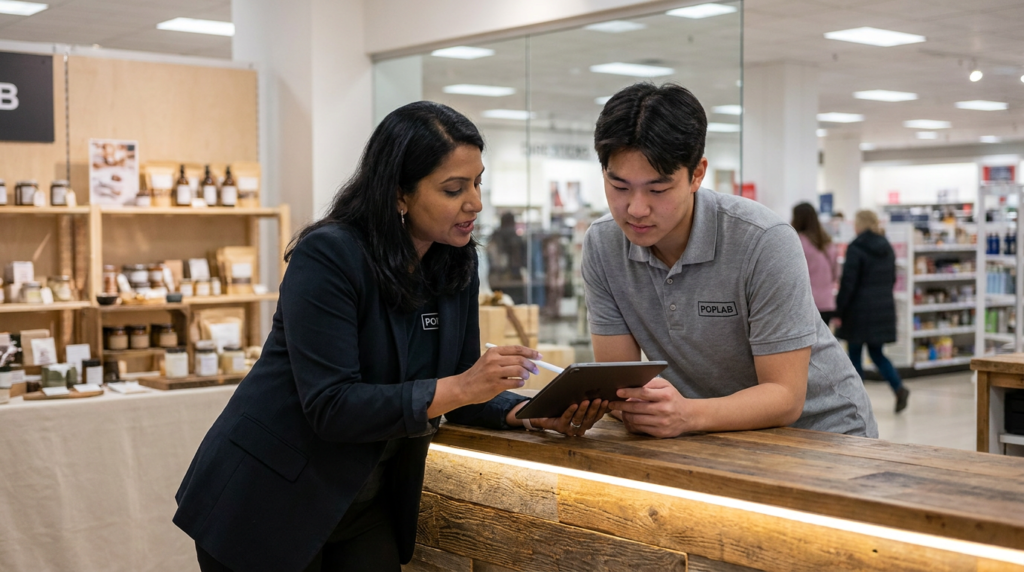
In-store pop-up sales are different from any other retail activation. To be specific, a brand counter sits inside a host retailer and must perform on both fronts. The team sells the brand’s voice while following the host retailer’s rules. Furthermore, the people standing behind that counter are the entire activation. Consequently, hiring and training that team is the single biggest lever in the program.
At Brand Guruz, we hire, train, and deploy in-store pop-up sales teams across Canadian retail. In our experience, brands that treat staffing as a strategic question outperform those who treat associates as filler. Specifically, the conversion difference at the same counter usually comes down to who is behind it. It can mean 4% versus 14% on the same product line.
This is the five-step playbook for hiring and training in-store pop-up sales teams in 2026.
Projected pop-up retail revenue in 2025 (Capital One Shopping)
Retailers who consider their pop-up shop a success (Capital One Shopping)
Higher income per employee at companies with formal training programs (ASTD/ATD)
In-store pop-up sales describes a brand-staffed temporary sales counter, kiosk, or shop-in-shop set up inside another retailer. Specifically, the brand brings its own team, training, and tactics into a host environment. Furthermore, the format covers beauty counter pop-ups, seasonal gifting kiosks, CPG demo stations, and limited-time shop-in-shop activations.
The format is booming. According to Capital One Shopping research on pop-up retail, pop-up shops are projected to generate over $95 billion in revenue in 2025. Furthermore, 80% of retailers that opened a pop-up consider it a success, and 58% plan to open another. As a result, the staffing decision behind every one of these activations is suddenly a strategic question.
Defining the role is where most pop-up programs go quietly wrong. Specifically, brands hire “pop-up staff” as if there is one job description. Furthermore, the real role varies enormously by category, host retailer, and sales goal.
Before hiring, the brand should define three things:
In our experience, brands that skip this step end up hiring generalists who fit no specific job. Consequently, the activation underperforms because no one was asked to do anything specific.
Sourcing the right candidates is half the hiring battle. Specifically, the best pop-up sales associates rarely come from the same pool as permanent retail hires. Furthermore, sourcing channels should match the activation type.
The strongest sourcing channels include:
As Storefront’s coverage of 2025 retail trends shows, pop-up retail increasingly leans on collaboration and community-relevant talent. Consequently, multicultural Canadian retail activations require multicultural recruiting. For more on the underlying audience research, see our multicultural market research guide.
Interviewing for pop-up sales is fundamentally different from interviewing for an office role. Specifically, the goal is to identify sales aptitude, brand fit, and energy in a 15-minute window. Furthermore, traditional resume-driven interviewing misses what actually matters.
The strongest interview formats include:
In our experience, the right traits become visible within ten minutes of a structured role-play. Consequently, brands that build role-plays into the interview process hire dramatically better.
Training is where most brands underinvest and then overpay. Specifically, an untrained pop-up team converts at a fraction of a trained team — often less than half. Furthermore, training is the single highest-ROI activity in the entire program.
Rallyware’s research on retail sales training notes that companies with comprehensive training programs deliver 218% higher income per employee. Importantly, that lift comes from product knowledge, brand voice, objection handling, and sales technique combined.
A useful training day covers four blocks:
In our experience, a half-day of structured training pays for itself in the first shift. Consequently, training is not an expense — it is the activation.
Coaching on the floor is where the training day either pays off or evaporates. Specifically, sales associates need real-time feedback, not just a pre-launch briefing. Furthermore, the brands that coach every shift outperform those that train once and disappear.
Axonify’s research on retail employee training shows that on-the-job reinforcement beats one-and-done sessions. In our experience, the highest-converting pop-ups run a daily 15-minute team huddle and an end-of-shift debrief. As a result, the team learns from real shifts rather than imagined scenarios.
The coaching playbook should include:
As TruRating notes on real-time retail coaching, modern retail coaching is now data-driven and continuous. Consequently, the brands that adopt this rhythm hold sales performance week over week.
Most underperforming in-store pop-up sales programs share the same mistakes. To be specific, here are the four most common.
Brand Guruz is the agency Canadian brands hire when in-store pop-up sales need to actually convert. To begin with, our talent network spans mainstream and ethnic retail in every major Canadian market. Furthermore, our multilingual sales rosters give brands the cultural fluency that generic agencies cannot match.
Equally important, we treat hiring and training as one integrated playbook. Specifically, every team we deploy goes through structured role-plays, branded training, and daily coaching. As a result, the brand sees consistent conversion rather than shift-to-shift variability.
If you are scoping in-store pop-up sales for 2026, talk to Brand Guruz about your category and goals. For the broader retail context, see our retail activations guide and retail merchandising services explainer. Or browse case studies to see how the playbook plays at the counter.
What are in-store pop-up sales? In-store pop-up sales are temporary brand-staffed sales activations inside a host retailer. Specifically, the format includes beauty counter pop-ups, seasonal gifting kiosks, CPG demo stations, and shop-in-shop activations. As a result, brands gain a physical retail presence without committing to a permanent location.
How do you hire pop-up sales staff? Hire pop-up sales staff through a combination of agency rosters, community recruiting, and adjacent-industry talent. Specifically, the best sourcing channels match the activation type and audience. Furthermore, every candidate should pass a short role-play and brand-fit interview before hiring.
How much training does a pop-up sales team need? At minimum, a structured half-day before deployment, plus daily coaching on the floor. Specifically, training should cover product, brand voice, sales technique, host retailer protocols, and data capture. Furthermore, research shows formal training drives dramatically higher income per employee.
What does an in-store pop-up sales activation cost? An in-store pop-up sales activation ranges from about $10,000 to over $100,000. Specifically, a single-store weekend sits at the low end and a multi-week multi-store program at the high end. Furthermore, cost depends on team size, training, host retailer fees, and program length. Importantly, multilingual rosters and structured coaching add to the budget.

The pop-up calendar fills fast around seasonal retail peaks. Talk to Brand Guruz about your 2026 in-store pop-up sales plans. Or browse our case studies to see how the playbook plays at the counter.