Music festival sponsorship is one of the most effective brand investments in live events — and one of the most mismanaged. The brand that treats it as a logo placement loses the moment. The brand that treats it as an experiential platform wins the summer.
Brand Guruz has structured and executed music festival sponsorships across Canada for brands in food and beverage, telecom, finance, and consumer goods. Ultimately, this playbook covers three things: how to choose the right festival, what each sponsorship tier delivers, and how to turn the rights agreement into measurable brand impact.
Canada’s projected music festival market in 2025, with 3.2M+ attendees
of marketers report positive ROI from sponsorships (Deloitte)
of consumers feel more loyal to brands that sponsor events they enjoy (Nielsen)
Canadian music festivals are not a niche category. According to Global Growth Insights, Canada’s music festival market is projected at $210 million in 2025, with 3.2 million attendees — up 9.4 percent from 2023. Major festivals like Osheaga, the Montreal International Jazz Festival, and FVDED in the Park anchor the national calendar, while hundreds of smaller and culturally specific events fill the summer from coast to coast.
The sponsorship opportunity is growing alongside it. Keevee’s 2025 sponsorship statistics, drawing on Deloitte research, found that 89 percent of marketers report positive ROI from event sponsorships. Additionally, 63 percent of consumers feel more loyal to brands that sponsor events they enjoy. For brand managers evaluating where to place live marketing budget, those numbers are hard to ignore.
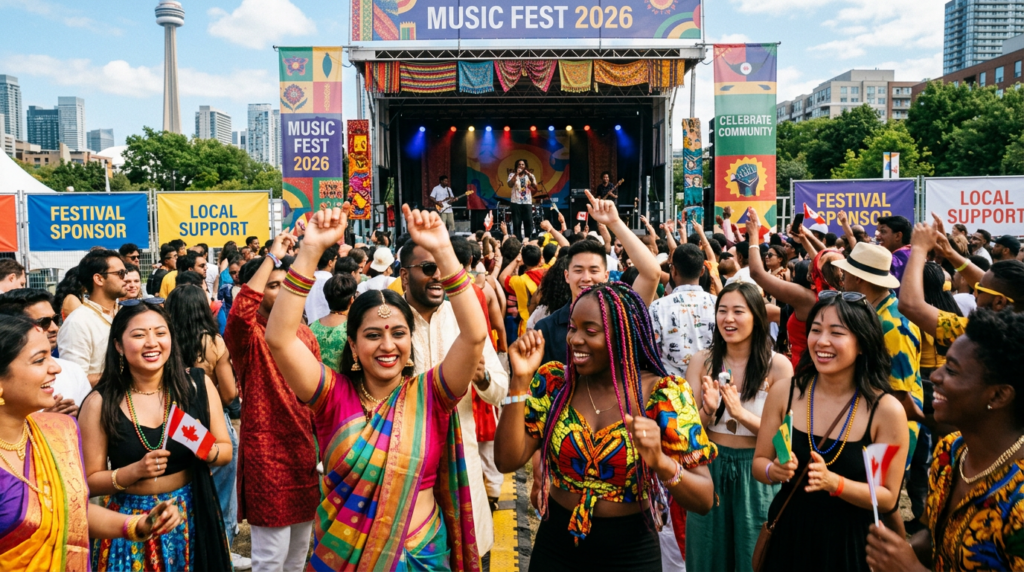
Canada’s multicultural festival calendar also adds a dimension most markets cannot match. In Ontario alone, Caribbean, South Asian, West African, Latin American, and East Asian music festivals draw hundreds of thousands of community-invested attendees each summer. Yet that depth remains the sponsorship opportunity most Canadian brands have not fully explored.
Every music festival sponsorship decision should pass three filters before commitment. Skipping any one of them is where most brand investments underperform.
Audience fit is the first filter. The festival’s demographic profile — age, income, cultural background, and values — has to align with the brand’s target audience. A premium financial services brand at an all-ages EDM festival is a mismatch regardless of the attendance number. Otherwise, high footfall means nothing for brand performance.
Cultural fit is the second. Festival Pro’s 2025 analysis of music festival sponsorship dynamics notes that festival-goers take a notably dim view of brands that feel out of place or inauthentic. In fact, an ill-fitting sponsor can damage the festival’s own identity as much as the brand’s. Although a brand doesn’t need to be in the same product category as the music, the cultural alignment has to be genuine.
Activation fit is the third. The festival’s physical layout, foot traffic patterns, and programming schedule have to support the type of activation the brand needs. Some festivals have tight restrictions on branded footprint. Others actively welcome immersive sponsor experiences. Knowing this before committing saves significant rework — and budget — after signing.
Music festival sponsorship typically operates on four tiers, and each delivers a different kind of return.
Title or presenting sponsorship is the highest tier. The brand’s name is embedded in the festival’s identity — “Presented by [Brand]” — and the package carries naming rights, top-tier activation space, and prominent placement across all festival marketing. Costs range from $100,000 to several million dollars depending on festival scale. This tier makes sense when the brand is building top-of-mind awareness in a specific demographic and has the activation resources to fully exploit the rights.
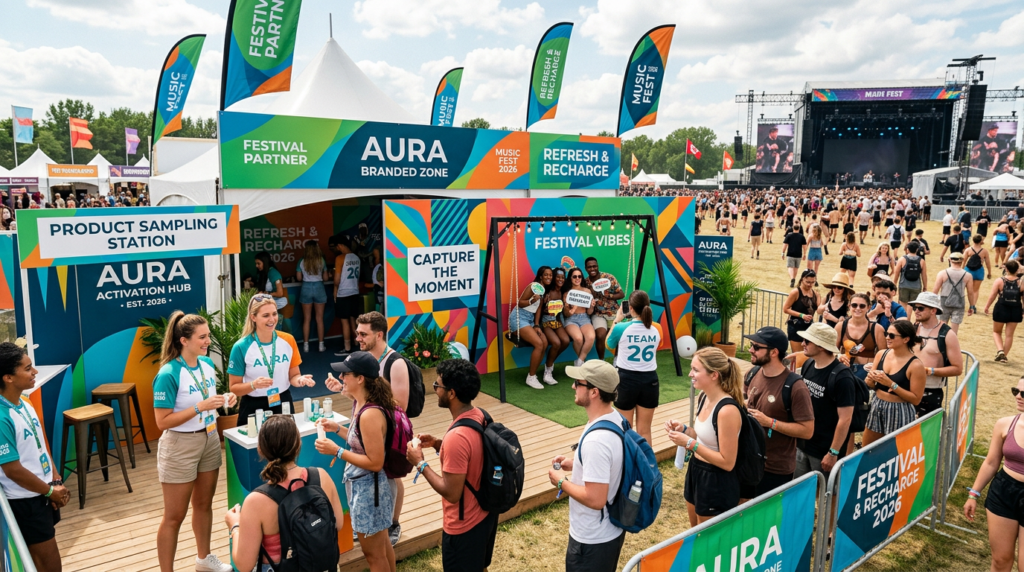
Stage or zone sponsorship is the most popular middle tier. The brand sponsors a specific stage, a VIP area, or a dedicated zone — with exclusivity in that footprint and strong visibility during performances. Costs typically run $25,000 to $200,000. This tier is particularly effective for brands that want a defined, controllable activation space without the cost of title sponsorship.
Product integration and sampling sponsorship gives brands active festival presence at a lower investment, usually $5,000 to $50,000. The brand is the official beverage, snack, or service partner — with sampling points, branded concession partnerships, or product distribution rights. Additionally, ROI here is directly measurable through units distributed, leads captured, and sign-ups converted.
Community or cultural sponsorship is the fastest-growing tier. Brands sponsor a culturally specific stage, pavilion, or programming block that aligns with a distinct fan community. For multicultural brands activating in Canada, this is often the highest-yield tier because the audience alignment is exact and the activation depth is far greater than a general festival slot.

A music festival sponsorship without a strong activation plan is a logo on a banner. The rights agreement opens the door. The activation, however, is what audiences actually experience.
According to Ticket Fairy’s 2026 guide to live music brand partnerships, the brands winning at festival sponsorship are not just advertising — they are becoming part of the festival experience itself. That means interactive installations, immersive spaces, sampling moments, and content capture that extends the brand’s presence well beyond the festival gates.
Five elements define a strong music festival sponsorship activation:
Canada’s multicultural communities are also some of its most festival-oriented. Caribbean carnival festivals, South Asian mela celebrations, Afrobeats showcases, and Latin music events draw hundreds of thousands of Canadians annually. Yet they receive a fraction of the corporate sponsorship that mainstream pop and country festivals attract.
That gap is the opportunity. A brand committing to a multicultural music festival sponsorship reaches a culturally aligned, community-invested audience that is far harder to reach through broadcast or digital alone. The audience is not just attending — they are celebrating. In fact, the receptivity to brands that show up authentically is measurably higher.
For the audience research behind this, see our multicultural market research guide. Carassauga — one of Canada’s largest multicultural cultural festivals, drawing 300,000+ attendees — is a strong specific example; see our Carassauga brand activation guide.
Brand Guruz also specializes specifically in this lane. We have the community relationships, the cultural knowledge, and the multilingual teams to execute music festival sponsorships that land authentically — not as corporate intrusion, but as genuine community investment.
Music festival sponsorship ROI is measurable — though it requires defining the right metrics before the event, not after. The mistake most brands make is treating impressions and social reach as primary KPIs. Those numbers are easy to produce but don’t show whether the sponsorship built consideration, drove purchase intent, or created lasting brand recall.
Amra & Elma’s festival marketing statistics show that 73 percent of event marketers raised their event budgets in recent years. Budget increases without measurement discipline compound waste, however — not returns.
The metrics that actually matter in music festival sponsorship are recall lift among attendees, lead capture and opt-in rate, product trial numbers, social content generated, and audience sentiment shift. Each is trackable. Each requires a measurement framework built in before deployment, not assembled after the recap is due.
For the full framework, see our experiential marketing ROI guide. The same methodology applies here as in broader experiential marketing — the festival context adds scale and cultural intensity, but the measurement logic stays the same.
Brand Guruz structures and executes music festival sponsorships that convert — from the initial rights negotiation to the post-event recap. We have also placed brands into mainstream Canadian music festivals, multicultural cultural festivals, and community-specific programming. Each of those contexts requires a different activation approach, and we build for all three.
The top Canadian experiential marketing agencies know how to show up at a mainstream festival. What ultimately separates the best is multicultural range — authentic activation at a Caribbean carnival, a South Asian mela, or an Afrobeats showcase. That is where cultural knowledge matters more than logistics experience alone.
Music festival sponsorship is a brand agreement granting activation rights, naming placement, and promotional integration at a music festival. Tiers range from title or presenting sponsorship down to product sampling and community programming partnerships. In exchange, the brand gains access to the festival’s audience, on-site visibility, and experiential marketing opportunities during the event.
Generally, it varies by festival scale and tier. Title or presenting sponsorship at a major Canadian festival can range from $100,000 to several million dollars. Stage or zone sponsorships typically run $25,000 to $200,000. Product sampling and community-level sponsorships can start at $5,000 to $50,000. Smaller multicultural and community festivals often offer highly targeted sponsorship at significantly lower costs.
Instead, run it through three filters: audience fit, cultural fit, and activation fit. The festival’s demographic profile should match your target audience. The festival’s identity and values should align with your brand character. And the festival’s physical setup and restrictions should allow the type of activation your brand needs to justify the investment.
Sponsorship is a formal rights agreement granting official presence, naming placement, and exclusive access. Brand activation, however, is what the brand does physically within that space. You can activate at a festival without a formal sponsorship — for example, in surrounding areas or adjacent events — but a sponsorship provides broader access, exclusivity, and integration that activation-only arrangements cannot match.
Major festivals include Osheaga in Montreal, the Montreal International Jazz Festival, FVDED in the Park in Vancouver, and WayHome near Barrie. Additionally, Canada’s multicultural festival calendar — including Caribbean carnival festivals, South Asian mela events, and Afrobeats showcases across Ontario — offers highly targeted community sponsorships that mainstream festivals cannot replicate.
Music festival sponsorship slots fill well before the season opens. Talk to Brand Guruz about which festivals fit your brand, which tier makes sense, and what the activation should look like. Or browse case studies to see how festival sponsorships have delivered measurable brand impact.