The Complete Guide to Brand Mascots in 2026: Costume, Casting, Compliance

Brand mascots are everywhere again. From Duolingo’s green owl to sports franchises to retail activations at Canadian festivals and events, mascot marketing is in the middle of a genuine renaissance. Most brands, however, think of mascots as a single problem — design a character, put someone in a costume, send them out. The reality is three separate disciplines: costume, casting, and compliance.

Brand Guruz designs, staffs, and deploys brand mascot programs across Canada. Ultimately, this guide covers what each discipline actually requires — and where most programs quietly fall apart.

41%

boost in emotional connection with customers from mascot-led marketing (MPC research)

37%

more likely to increase market share — campaigns with a mascot vs. without (System1/IPA)

30 minutes

maximum recommended in-costume performance time before a mandatory break (National Mascot Association)

Why brand mascots work in 2026

Brand mascots are not nostalgia. They are one of the most evidence-backed tools in experiential marketing. According to Frontify’s 2025 analysis of mascot marketing, mascot-led campaigns are 37 percent more likely to drive brand linkage and 30 percent more likely to command audience attention than campaigns without a character. A 2024 Kantar report cited in the same analysis found that characters consistently outperformed celebrities in long-term brand equity.

Campaignasia’s coverage of MPC’s brand character research found that mascots boost emotional connection with customers by up to 41 percent. In a media environment where digital ads are skipped and banner blindness is near-universal, a well-executed live mascot generates attention and emotional engagement that no bought impression can replicate.

Graphicdesignergeeks’ mascot branding roundup also notes that brands using mascots are 37 percent more competitive in their sector. Overall, the pattern holds across categories — food and beverage, sports, retail, financial services, and increasingly B2B.

Costume — building the physical brand

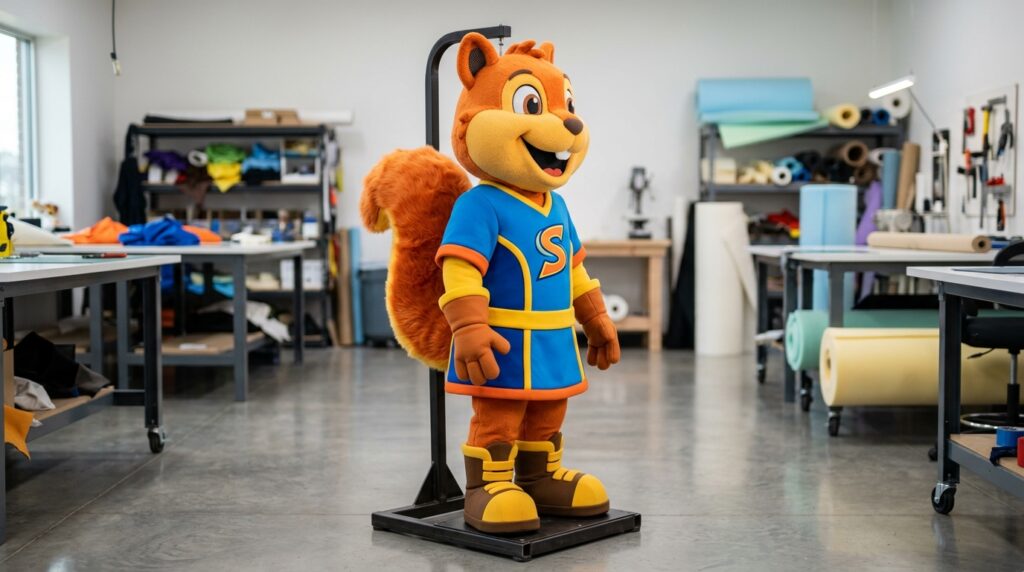
The costume is the brand. Every visible element — colour accuracy, proportion, finish, and structural integrity — communicates brand standards to the public. A poorly built mascot costume undercuts the brand faster than no mascot at all.

Quality tiers. Mascot costumes fall into three broad production tiers. Generally, entry-level costumes run $500 to $1,500 and are pre-made with limited customisation. Mid-tier custom builds, however, run $2,500 to $6,000 and allow brand-accurate colours, shapes, and proportions. Premium production-grade costumes — built for high-frequency use, professional ventilation, and broadcast-quality detail — run $8,000 to $20,000 and above. Ultimately, the right tier depends on deployment frequency and event environment.

Design for performance. A costume that looks great on a design brief can fail the performer entirely. Hogtownmascots’ guide to custom mascot safety recommends avoiding long tails, excessive material, and features that create trip hazards or restrict arm and leg movement. The head should also be removable in under ten seconds. Ventilation — mesh panels, internal fans, or both — is not optional in the Canadian summer.

Canadian climate considerations. Outdoor events in July and August create real heat risk. Costumes deployed in Ontario heat require internal cooling systems and strict rotation schedules. Similarly, winter deployments need layering considerations that affect performer mobility. Neither variable is optional to plan for.

Maintenance. A professional mascot costume is an asset, not a prop. Additionally, after every deployment the interior requires sanitising, the exterior requires inspection for damage, and all moving components require checking. Neglected costumes degrade fast — and a visible tear or discolouration at a public event is a brand liability.

Professional brand mascot costume showing quality construction and ventilation detail in 2026.
Costume quality is brand quality — a poorly built mascot communicates exactly as much as a well-built one.

Casting — finding and preparing the right performer

The costume is the hardware. The performer is the software. A beautifully built mascot operated by the wrong person becomes an uncomfortable, unresponsive brand moment.

Physical requirements. Mascot performance is physically demanding. Performers need to match the costume’s internal dimensions, maintain character energy for 30-minute intervals, and manage limited vision, hearing, and mobility throughout. Heat tolerance is a genuine pre-screening factor — not every performer can handle sustained costume time in warm environments, however fit they are.

Performance traits. The qualities that make a great mascot performer are different from those that make a great brand ambassador. In fact, non-verbal communication — body language, gesture, timing, and crowd reading — carries the entire performance. Instead, candidates should be screened with a short in-character trial, not a resume and interview alone.

Training. Before any deployment, mascot performers need three types of training: character training, safety training, and event-specific briefing. Character training covers the mascot’s personality and signature interactions. Safety training covers emergency head removal, crowd management, and distress recognition. Skipping any one of these creates avoidable problems on the day.

Multicultural fluency. In Canada’s multicultural markets, a mascot performer needs to read diverse audiences and adapt energy and interaction style accordingly. A mascot activation at a South Asian festival, a Caribbean carnival, or a hockey arena calls for different crowd energy and different non-verbal registers. For context on why this matters across Canadian markets, see our multicultural market research guide.

Confidentiality. The performer’s identity is generally protected for brand integrity and performer safety. All performers should sign a confidentiality agreement before deployment. This is standard practice — not optional.

Compliance — what most brand mascot programs get wrong

Compliance is the most under-resourced area in most brand mascot programs. It is also the area most likely to create liability when ignored.

Performer safety. The National Mascot Association’s best practices set the industry standard: performers should never work more than 30 minutes in costume without a break with the head removed, shorter in hot or humid conditions. Additionally, every deployment requires a dedicated chaperone — someone whose only job is to monitor the performer, manage crowd interaction, and remove the mascot if distress signals appear. A mascot operating alone is a safety failure.

Heat and environment. Heat stroke, dehydration, and heat exhaustion are real and documented risks for mascot performers. In particular, pre-event protocols should include hydration requirements, environmental temperature checks, and clear pull-from-costume thresholds. These need to be written, not assumed.

Child safety protocols. The National Mascot Association explicitly advises against mascot performers picking up or holding children. Instead, photos with children should always involve the caregiver holding the child. This protocol protects both the performer and the brand.

Employment classification. In Ontario and across Canada, how a mascot performer is classified — employee versus independent contractor — has legal and tax implications. Still, misclassification is a real exposure for brands that bring in performers for activations without proper agreements in place.

Insurance and permits. Public mascot appearances often require event liability coverage that names the mascot performer as an insured party. Some municipalities and venues also require permits for character appearances that attract crowd gatherings. However, these requirements vary by city and venue type. For the broader activation compliance picture, see our festival brand activation guide and street team marketing playbook.

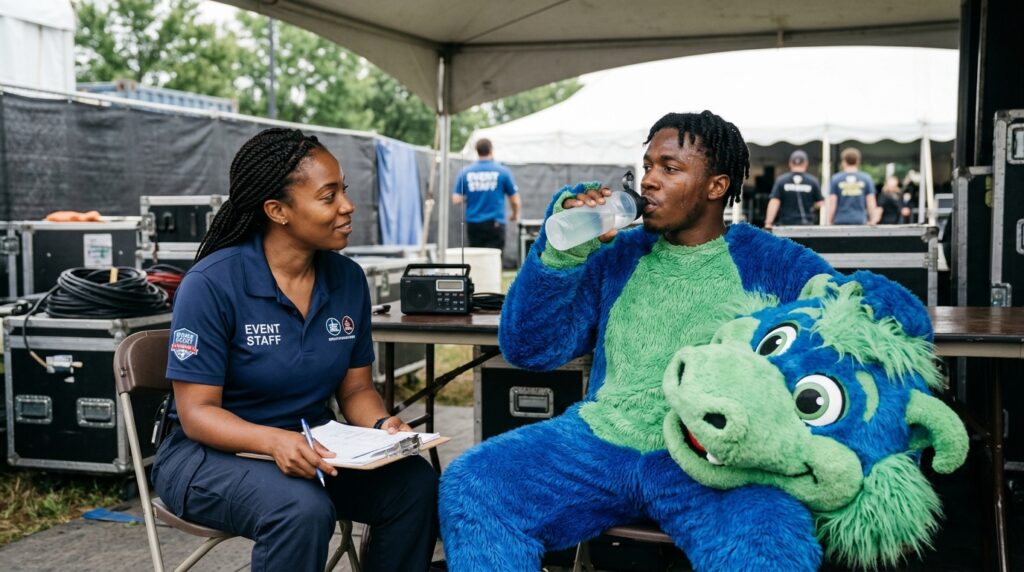
Brand mascot performer taking a supervised break with a chaperone at a Canadian event in 2026.
A chaperone is not optional — it is the first line of compliance for any brand mascot deployment.

Why Brand Guruz manages brand mascots that convert

Brand Guruz manages brand mascot programs from concept to deployment — costume production, performer casting, training, and compliance protocols. We build mascot programs that hold up across multiple activations, not just the launch event.

The top experiential marketing agencies in Canada understand costume production. What also matters is the casting depth and the compliance infrastructure behind it — the performer roster, the chaperone protocols, the venue and permit navigation, and the rotation schedules that keep performers safe through a full event day.

We also carry multilingual casting capability for Canadian markets where multicultural fluency is the difference between a mascot that lands and one that misses. For the ROI framework behind mascot activations, see our experiential marketing ROI guide. Or browse our retail activations guide to see how mascots perform at in-store activations specifically.

Frequently asked questions about brand mascots

How much does a brand mascot costume cost? Generally, entry-level pre-made mascot costumes start around $500 to $1,500. Mid-tier custom builds, however, typically run $2,500 to $6,000 with brand-accurate colours and proportions. Premium production-grade costumes built for high-frequency professional deployment range from $8,000 to $20,000 and above. The right tier depends on how often the mascot performs and in what conditions.

What training does a mascot performer need? Generally, mascot performers need three types of training before any deployment: character training, safety training, and event-specific briefing. Character training covers the mascot’s personality and signature interactions. Safety training covers emergency head removal, crowd management, and distress recognition. Event briefing covers the brand, the day’s format, and the rotation schedule.

What compliance requirements apply to brand mascots in Canada? In fact, key requirements include performer safety protocols, employment classification, event liability insurance that covers the performer, and municipal permits where required for crowd-attracting appearances. Requirements vary by city and venue.

How long can a mascot performer stay in costume? The National Mascot Association recommends a maximum of 30 minutes in costume before a break with the head removed. In hot or humid conditions, that window should be shorter. Still, ignoring this guideline creates real heat stroke risk and is increasingly treated as an occupational health standard.

Do we need a chaperone for our brand mascot? Yes. A mascot without a dedicated chaperone is a safety failure. Additionally, the chaperone manages crowd interaction, clears a path in dense crowds, and calls the pull-from-costume if distress signals appear. No professional mascot deployment should proceed without one.

Ready to build your brand mascot program?

Brand mascot programs that work start with all three disciplines aligned. Talk to Brand Guruz about costume, casting, and compliance for your 2026 activation calendar. Or browse case studies to see how mascot programs have performed across Canadian markets.

Author