Corporate Event Planning Checklist: A Step-by-Step Guide for Canadian Brands (2026)

Corporate event planning is the process of setting goals, building a budget, booking a venue and vendors, managing guests and running a business event from first brief to post-event report. For most Canadian brands, a 100- to 300-guest corporate event takes four to six months to plan properly using a clear checklist and timeline.

Updated November 2026

Key takeaways

  • Start planning four to six months out for most corporate events, and nine to twelve months out for conferences or December holiday parties in the GTA.
  • Lock the objective and the budget before anything else; every later decision depends on them.
  • Venue and food and beverage typically absorb 35 to 45 percent of the total budget, so book the venue early and negotiate the minimum spend.
  • Plan the follow-up and the KPIs before the event, not after it, so you can prove results to leadership.

88% of people trust recommendations from people they know (Nielsen) · ~6.2 million people live in the Toronto CMA, Canada's largest corporate event market (Statistics Canada, 2021 Census) · 656,480 people live in Brampton and 338,503 in Markham (Statistics Canada, 2021 Census)

What is corporate event planning?

Corporate event planning is the structured work of designing and delivering an event that serves a business goal, such as closing deals, launching a product, training staff or thanking clients. It covers strategy, budget, venue, vendors, content, guest experience, logistics and measurement.

What types of events count as corporate events?

Corporate events include conferences, sales kick-offs, product launches, client appreciation nights, holiday parties, town halls, award galas, leadership retreats and trade show activations. The checklist stays the same; the weight of each step changes.

Who owns corporate event planning inside a company?

Ownership usually sits with marketing, HR or an executive office, depending on the audience. Whoever owns it needs one named project lead with authority to approve spend and make calls on deadlines.

Corporate event planning timeline: 6 months to event day

A corporate event timeline works backwards from the event date. The table below shows a practical six-month plan for a 100- to 300-guest event in the GTA. Larger conferences should add three to six months at the front.

WhenKey tasksOwner
6 months outDefine objective and KPIs, set budget range, confirm stakeholders, pick target datesProject lead and sponsor
5 months outShortlist venues, run site visits, issue vendor requests for proposalProject lead
4 months outSign venue contract, book AV, catering and key speakers, approve creative directionProject lead and procurement
3 months outLaunch save-the-dates, build registration page, draft agenda, book hotel room blocksMarketing
2 months outSend formal invitations, confirm decor, signage and swag, plan accessibility and dietary needsMarketing and operations
1 month outFinalize run of show, floor plan, staffing plan and shipping; confirm speaker contentProject lead
2 weeks outGive final guest count to caterer, print badges, brief staff, test registration techOperations
1 week outReconfirm every vendor, rehearse key segments, prepare emergency kit and contact sheetProject lead
Event dayLoad-in, AV check, staff briefing, run the show, manage issues, strikeOn-site lead
1 to 2 weeks afterSend thank-yous and survey, pass leads to sales, reconcile budget, report resultsMarketing and finance

Is six months enough time to plan a corporate event?

Six months is enough for most mid-size corporate events in Canada. It gets tight for 500-plus guest conferences and December dates, when downtown ballrooms book a year ahead.

The step-by-step corporate event planning checklist

Use this corporate event planning checklist in order; do not book vendors before the objective and budget are signed off.

Step 1: Define the business objective and KPIs

Write one sentence that says what the event must achieve, such as generating 40 qualified sales meetings or lifting employee engagement scores. Then choose two to four measurable KPIs.

Step 2: Set the budget and approval path

Agree on a total budget range and a ten percent contingency before you contact vendors. Confirm who signs contracts, what procurement needs and how long purchase orders take.

Step 3: Build the guest profile and invite list

Decide who must attend for the objective to succeed: clients, prospects, employees, partners or media. Estimate the guest count, expected acceptance rate and any VIPs who need special handling.

Step 4: Choose the date and format

Pick two or three candidate dates that avoid major holidays, industry conferences and fiscal year-end. Decide the format: in-person, hybrid or a reception after a daytime program. In Canada, weigh winter weather risk for January to March events.

Step 5: Shortlist and book the venue

Shortlist three venues that fit your capacity, budget, transit access and brand. Visit each one, compare the food and beverage minimum, load-in rules and AV restrictions, then sign the contract with clear cancellation and attrition terms.

Step 6: Book core vendors

Lock the vendors that sell out first: audiovisual and staging, catering if not in-house, photography and video, entertainment and transportation. Ask for itemized quotes so you can compare value, not just totals.

Step 7: Design the agenda and content

Build the agenda around the objective, with speaker slots, breaks, networking time and a clear closing moment. Brief speakers early and set slide deadlines.

Step 8: Plan the guest experience and branding

Map the guest journey from invitation to exit. Apply your brand to signage, stage design, digital screens and takeaways.

Step 9: Launch registration and communications

Set up a registration page that captures the data you need for follow-up, dietary needs and accessibility requests. Schedule save-the-dates, invitations, reminders and a know-before-you-go email with parking, transit and timing details.

Step 10: Handle accessibility, safety, permits and insurance

Confirm step-free access, accessible washrooms, captioning where useful and quiet space if needed; Ontario organizations should keep AODA requirements in mind. Check liquor licensing, special event permits for outdoor or unusual spaces, event liability insurance and a basic emergency plan.

Step 11: Build the run of show and staffing plan

Write a minute-by-minute run of show covering load-in, doors, every segment and strike. Assign each task to a named person, and plan staffing for registration, greeters, wayfinding and VIP hosting.

Step 12: Plan the follow-up before the event

Draft the thank-you email, the survey and the sales hand-off process before the doors open. Decide who receives leads and how quickly they get contacted.


How much does corporate event planning cost in Canada?

Corporate event planning in Canada typically costs between about $100 and $900 or more per guest, depending on format, venue, food and production. In our experience, a 150-guest evening reception in Toronto often lands between $20,000 and $45,000, while a full-day conference for the same group can run $40,000 to $90,000.

What does a typical corporate event budget include?

A typical budget splits across the categories below. These are estimated ranges from our experience, not industry statistics, and every event will shift them.

Budget categoryTypical share of totalWhat it covers
Venue and food and beverage35 to 45 percentRoom rental, catering, bar, service charges and taxes
AV and production15 to 25 percentSound, lighting, screens, staging, technicians, livestream
Decor, branding and signage10 to 15 percentStage design, printed signage, florals, branded builds
Staffing and management5 to 10 percentEvent staff, registration, security, planning fees
Speakers and entertainment5 to 10 percentKeynotes, emcee, performers, travel
Marketing and registration tech3 to 5 percentInvitations, registration platform, badges, photography
ContingencyAbout 10 percentOverages, last-minute changes, rush fees

What are typical per-guest costs in the GTA?

Typical per-guest ranges in the GTA are roughly $100 to $250 for a networking reception, $250 to $600 for a full-day conference with meals and $350 to $900 or more for a plated gala with production.

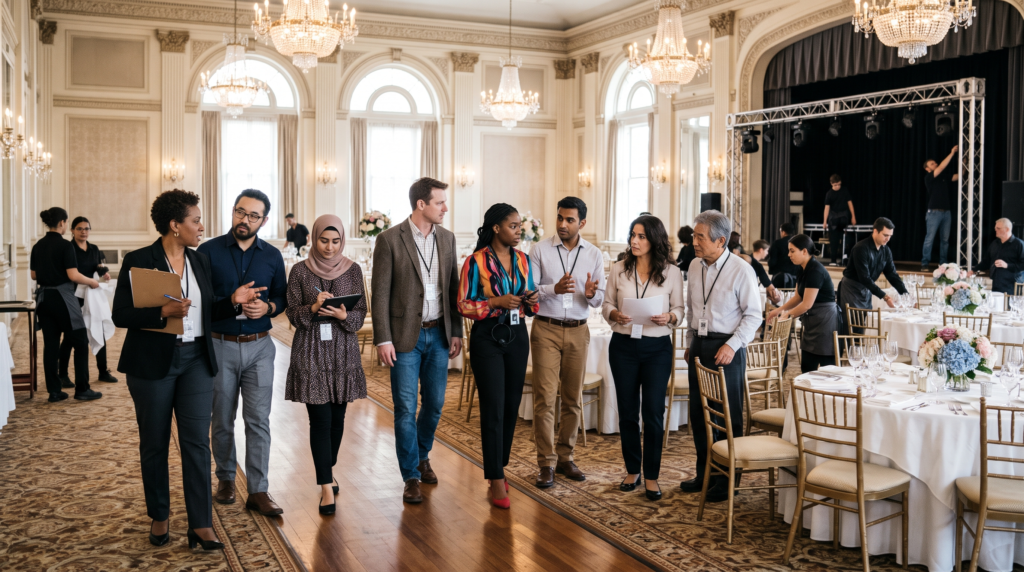
Corporate event planning venue walkthrough in a hotel ballroom in the GTA
A venue walkthrough is one of the most important steps in corporate event planning.

Choosing venues, vendors and staff in the GTA

Choosing venues, vendors and staff in the GTA comes down to fit: the right capacity, location and capability for your objective, at a cost the budget can carry. With roughly 6.2 million people in the Toronto CMA, according to Statistics Canada, the region offers more venue and vendor choice than anywhere else in the country.

Which GTA venue types suit which corporate events?

Downtown Toronto hotel ballrooms suit galas and large conferences with out-of-town guests. Converted lofts in King West and Liberty Village suit launches and client nights. Conference centres near Pearson in Mississauga work well for national teams flying in, and hotels in Markham and Vaughan offer value and easy parking for suburban audiences.

What should a venue walkthrough cover?

A venue walkthrough should cover capacity by layout, load-in access and timing, power and rigging points, Wi-Fi capacity, accessibility, washrooms, coat check, green room space and where registration will sit.

How do you vet event vendors?

Vet vendors by asking for recent comparable work, two references, an itemized quote, proof of insurance and the name of the person who will be on site.

Should you use in-house staff or event staffing?

Use in-house staff for hosting clients and representing the company, and professional event staff for registration, wayfinding and floor management. Many brands bring in an event management company to run production, or work with experiential marketing companies in Toronto when the event includes a branded activation.

Corporate event planning in action: staffed conference registration desk on event day
A well-staffed registration desk sets the tone on event day.

Event-day run of show and on-site checklist

An event-day run of show is the minute-by-minute script that tells every person and vendor what happens, when and who is responsible.

What goes into a run of show?

A run of show lists every time-stamped action from load-in to strike: vendor arrivals, AV checks, staff briefing, doors open, each agenda segment, speaker cues, music and lighting changes, food service and closing.

What is on the on-site checklist?

  • Printed and digital copies of the run of show, floor plan and vendor contact sheet
  • Registration tested, badges sorted and a walk-in process ready
  • AV, microphones, slides and livestream checked twice before doors
  • Signage, wayfinding and accessibility routes in place
  • Emergency kit, first aid location and evacuation routes known by all staff

How to measure corporate event success

Corporate event success is measured against the objective you set in step one, using a mix of attendance, engagement and business outcome metrics.

Which KPIs matter for corporate events?

Useful KPIs include registration-to-attendance rate, session attendance, survey satisfaction or net promoter score, meetings booked, qualified leads, pipeline influenced and social content generated. For internal events, track engagement survey results instead.

How do you report event ROI to leadership?

Report ROI by comparing total cost with the outcomes tied to the objective, such as pipeline created or deals closed within 90 days of the event. For industry benchmarks and trends, Event Marketer publishes regular coverage of corporate and experiential events.

Why Brand Guruz

Brand Guruz, a Toronto-based experiential marketing agency, plans and produces corporate events and brand experiences for Canadian companies. We handle strategy, venue sourcing, vendor management, staffing, production and the post-event follow-up, so in-house teams keep control without carrying every task.

Our team works across Toronto and the GTA, from downtown ballrooms to suburban conference centres. As Nielsen research on recommendations shows, people trust people, so we design events that start real conversations. Learn more about our corporate events in Canada and our wider experiential marketing services.

Corporate event planning FAQ

How far in advance should you start corporate event planning?

Start four to six months ahead for most corporate events of 100 to 300 guests. Large conferences, multi-day programs and December holiday parties in Toronto should start nine to twelve months out, because prime venues, AV crews and hotel room blocks book early.

What is the first step in planning a corporate event?

The first step is defining the business objective and the KPIs that will prove success. Once you know whether the event must generate leads, train staff or thank clients, you can set the budget, choose the format and build the guest list.

How much does a corporate event cost per person in Canada?

In our experience, corporate events in Canada typically cost about $100 to $250 per guest for a reception, $250 to $600 for a full-day conference with meals and $350 to $900 or more for a produced gala.

What should a corporate event planning checklist include?

A complete checklist covers objective and KPIs, budget and approvals, guest list, date and format, venue, vendors, agenda, guest experience, registration, accessibility and permits, run of show and staffing, and follow-up.

Do you need a planner for a corporate event?

You do not always need an outside planner, but most teams benefit from one for events over about 150 guests or with complex production. An experienced partner brings vendor relationships, staffing and on-site leadership.

How do you measure if a corporate event was successful?

Measure success against the original objective using attendance rate, survey scores, meetings booked, qualified leads and pipeline or engagement results. Send a short survey within 48 hours and compare total cost with outcomes.

Plan your next corporate event with Brand Guruz

Ready to turn this corporate event planning checklist into a real event? Brand Guruz can run the whole plan or support your team where it matters most.

Tell us your goal, guest count and date, and we will come back with a clear plan and a realistic budget. To start, book a call with Brand Guruz.

Let's Grow Your Brand

Author