B2B Experiential Marketing in Canada: How Account-Based Brand Activations Win Enterprise Deals in 2026

B2B experiential marketing is how Canadian enterprise brands actually move pipelines in 2026. To be specific, the buying committee at most enterprise accounts now includes six to ten stakeholders. Furthermore, no paid campaign in the world can build trust with that many people at once. Consequently, brand activations designed around target accounts and executive audiences are the highest-ROI move B2B marketers can make.

At Brand Guruz, we have designed B2B experiential programs for SaaS, financial services, and professional services brands across Canada. In our experience, the most effective B2B activations blend three things. They are precise account targeting, executive-grade design, and multicultural fluency. Specifically, the brands that integrate all three see deal velocity accelerate inside named accounts within a single quarter.

Below, you will find the four B2B experiential tactics that consistently win enterprise deals. You will also find the multicultural design framework, the measurement model, and the common mistakes B2B marketers repeat most often.

Fast Facts:

  • 6-10 — Stakeholders in a typical B2B buying committee
  • 78% — Enterprise buyers who say live brand experiences influence vendor selection
  • 9 months — Average B2B sales cycle that strategic experiential compresses

Why B2B experiential marketing wins enterprise deals in 2026

B2B experiential marketing wins enterprise deals in 2026 because the enterprise sales cycle has fundamentally changed. To be specific, buying committees have grown larger and more cautious. Furthermore, digital-only outreach has hit saturation. Consequently, the brands that meet target accounts in person — and design those moments deliberately — close.

The buying committee problem B2B experiential solves

The buying committee is the central problem in modern enterprise sales. To be specific, account-based marketing frameworks assume six to ten stakeholders per deal. Furthermore, each stakeholder has different priorities, different objections, and different timelines.

In our experience, no email cadence or LinkedIn campaign reaches all of them with equal weight. By comparison, a single executive dinner or private demo can put six decision-makers in the same room. As a result, the experiential moment compresses what digital takes months to accomplish.

Why Canadian B2B audiences are increasingly multicultural

Canadian enterprise procurement is more multicultural than at any point in the country’s history. Specifically, the executive suite at Canadian banks, telecoms, and Fortune 500 regional offices reflects the country’s demographic shift. Furthermore, the buying committees driving the largest enterprise deals are no longer monolithic.

For example, a financial services activation in Toronto needs to consider South Asian, Chinese, Filipino, and Latin executive perspectives. Multicultural buyer representation is reshaping enterprise procurement faster than most vendors have adjusted. The broader trend is well-covered in Forbes B2B reporting. Consequently, B2B experiential design has to follow.

Four B2B experiential marketing tactics that close enterprise deals

Not every B2B experiential tactic moves enterprise pipelines. To be specific, the four tactics below consistently produce measurable deal velocity for Canadian B2B brands in 2026.

Executive roundtables: the highest-ROI B2B experiential format

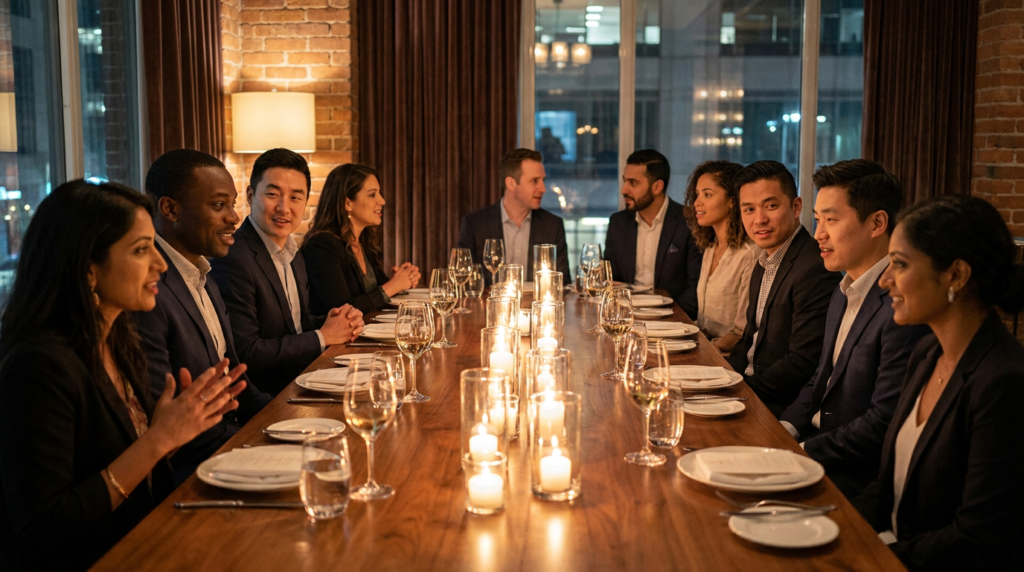
Executive roundtables and private dinners are the highest-conversion B2B experiential tactic. Specifically, 8 to 12 senior decision-makers from named target accounts share a curated dinner with thought-leadership content. Furthermore, the format puts competitors out of the room while the vendor builds trust with the entire buying committee.

In our experience, a well-designed executive dinner produces follow-on meetings with 60-80% of attendees within two weeks. As a result, the dinner is not a marketing tactic — it is a sales accelerator.

B2B conference activations and hospitality suites

B2B conference activations capture target accounts at peak relevance. To illustrate, conferences like Collision, Web Summit Toronto, and SaaS North concentrate enterprise decision-makers across categories. Furthermore, hospitality suites at major conferences let brands have intimate conversations beside the public booth.

For example, a private hospitality suite at a major conference can host 30-50 named-account conversations over three days. Consequently, the conference becomes a focused ABM execution channel rather than a generic awareness play.

Account-based B2B brand activations for target accounts

Account-based brand activations are designed for one company, one buying committee, one decision. Specifically, the activation might be a private innovation day at the target’s office or a custom briefing centre experience. Other formats include a co-branded executive event with the target’s leadership. Furthermore, the deeper personalization signals genuine commitment to the account.

Account-based approaches generate strong pipeline lift compared to broad marketing tactics. The pattern is well-documented in Harvard Business Review enterprise sales coverage. As a result, the per-activation cost is justified by the per-deal value.

Executive briefing centres in B2B experiential strategy

Executive briefing centres put the target buying committee inside the vendor’s environment. To be specific, the brand designs a curated half- or full-day experience. Custom content, leadership access, and product depth are the core elements. Furthermore, the format gives the vendor full control of pacing, narrative, and follow-up.

In our experience, executive briefing centres convert qualified opportunities into closed deals at significantly higher rates than digital alternatives. Consequently, this is the format most often used at the late stage of a Fortune 500 enterprise sale.

Multicultural senior executives engaging in conversation at a private B2B executive dinner activation in Toronto 2026.
A single executive dinner can compress months of digital outreach into one evening.

How to design B2B experiential marketing for multicultural enterprise Canada

Multicultural design is where B2B experiential becomes a strategic moat. To be specific, the buying committees inside Canada’s largest enterprise accounts are demographically diverse. Furthermore, generic B2B activation templates ignore the cultural codes that drive trust at the executive level.

Multicultural B2B audiences are not a niche

Multicultural enterprise audiences are the majority in most Canadian buying committees. To illustrate, senior leadership at major Canadian banks, telecoms, and tech employers reflects the country’s broader demographic mix. Furthermore, multicultural executives often hold disproportionate influence in procurement decisions tied to growth markets.

In our experience, B2B activations designed only around an English-speaking white executive archetype underperform across most named-account programs. By comparison, multicultural-aware activations build trust with the full committee.

Language and protocol in B2B experiential activations

Language and cultural protocol matter at the executive level. Specifically, small details signal whether the host understands the audience. These include greeting protocols, dietary planning, and seating arrangements. Furthermore, these signals operate below the rational layer of decision-making.

For example, an enterprise dinner that respects halal, kosher, and vegetarian needs without making them a feature reads as professional. Consequently, the activation feels prepared rather than performative.

Community trust in multicultural B2B activation

Community trust in multicultural Canada translates directly into enterprise trust. To be specific, a vendor with credibility in a multicultural community signals broader cultural competence to the executive. Furthermore, executive networks inside multicultural Canada are denser than outsiders assume.

In our experience, vendors that show up in community contexts see enterprise warmth follow. Specifically, multicultural festivals, professional associations, and mentorship programs all open executive doors. As a result, the community and enterprise channels reinforce each other.

Senior multicultural executives engaging in an executive briefing centre B2B experiential marketing activation in Toronto 2026.
Multicultural enterprise audiences are the majority in most Canadian buying committees.

Measuring B2B experiential marketing ROI

B2B experiential ROI is measured differently than B2C activation ROI. To be clear, footfall and impressions are not the metric. Furthermore, the buying committee structure means individual attendee data matters less than account-level progression.

The metrics that actually matter:

  • Named-account engagement: Track how many target accounts had at least one stakeholder attend.
  • Buying committee coverage: Measure how many decision-makers from each target account engaged.
  • Sales cycle acceleration: Compare deal velocity inside attending accounts versus non-attending accounts.
  • Pipeline influenced: Tag deals where the activation appeared in the buyer journey.
  • Win-rate lift: Compare close rates between attended and non-attended target accounts.

For more on broader experiential ROI methodology, see our experiential marketing ROI framework guide. Importantly, B2B experiential ROI shows up in pipeline data — not impression counts. As a result, sales and marketing alignment matters more than ever. Tools like HubSpot make sales-marketing alignment easier to operationalize.

Common mistakes in B2B experiential marketing

Most B2B experiential programs underperform for the same handful of reasons. To be specific, here are the four mistakes Canadian B2B marketers repeat most often.

  • Treating B2B experiential like B2C. Specifically, B2B activations need account-level targeting, not foot-traffic optimization. Furthermore, polished intimate formats outperform high-volume booths every time.
  • Inviting individuals instead of buying committees. For instance, hosting one champion without their CFO, CIO, and procurement counterparts leaves the deal stuck. Consequently, multi-stakeholder invitation strategy is essential.
  • Skipping multicultural design at the executive level. Importantly, multicultural executives notice every cultural detail. By comparison, generic execution signals lack of preparation.
  • Failing to align sales and marketing on follow-up. As a result, leads cool off in the 48 hours after the activation. Furthermore, the entire investment leaks out through poor handoff.

Why Brand Guruz is built for B2B experiential marketing in Canada

Brand Guruz is the experiential agency Canadian B2B brands hire when enterprise deals are on the line. To begin with, our team has executed executive dinners, conference activations, executive briefing centres, and account-based programs. We serve SaaS, financial services, and professional services clients. Furthermore, our multicultural fluency is the differentiator that wins inside Canada’s demographically diverse buying committees.

Equally important, we measure B2B experiential outcomes the way enterprise sales leaders demand. Specifically, named-account engagement, buying committee coverage, sales cycle acceleration, and pipeline influenced. As a result, our clients walk into the next QBR with deal-level proof, not vanity metrics.

If you are planning B2B experiential marketing in Canada for 2026, scope it now. Executive audiences on LinkedIn get harder to reach every quarter. Consequently, brands that build experiential into their ABM mix early own the relationships. Talk to Brand Guruz and we will map target accounts, formats, and measurement against your sales pipeline. For more on our category approach, see our experiential marketing overview. Or browse case studies to see how B2B experiential lands in real campaigns.

Frequently asked questions

What is B2B experiential marketing? B2B experiential marketing is the practice of designing live brand experiences for enterprise buying committees and named target accounts. Specifically, it includes executive dinners, conference activations, executive briefing centres, and account-based events. As a result, B2B brands build trust with multiple decision-makers in a single moment.

How is B2B experiential different from B2C? B2B experiential targets named accounts and buying committees rather than broad consumer audiences. Specifically, the focus is intimate, account-level, and sales-aligned. Furthermore, B2B activations measure pipeline impact and deal velocity, not foot traffic or impressions.

How much does B2B experiential marketing cost in Canada? Entry-tier B2B activations (one executive dinner or conference suite) start around $30,000 to $80,000. Mid-tier programs combining multiple formats run $80,000 to $250,000. Premium multi-account programs begin at $250,000 and scale up. For more on related pricing, see our multicultural marketing consultant costs guide.

Which B2B experiential tactic delivers the strongest ROI? Executive roundtables and private dinners typically deliver the strongest B2B experiential ROI. Specifically, 8 to 12 senior decision-makers in one room produces follow-on meetings with 60-80% of attendees. Furthermore, the format compresses months of digital outreach.

Why does multicultural design matter for B2B experiential in Canada? Multicultural design matters because Canadian enterprise buying committees are demographically diverse. Specifically, language, dietary planning, protocol, and community awareness all signal cultural competence. As a result, vendors who design with multicultural fluency outperform those who default to generic execution.


Ready to plan B2B experiential marketing for 2026?

The best conferences, hospitality slots, and target-account windows close fast in Q1. Talk to Brand Guruz about your 2026 B2B activation calendar. Or browse our case studies to see how the playbook lands.

Author