Trade show booth design is the difference between a busy booth and an empty one. To be specific, attendees walk past hundreds of booths and stop at only a handful. Furthermore, the booth that wins attention does so through deliberate layout, technology, and human engagement — not luck. Consequently, booth design is the highest-leverage investment any Canadian exhibitor makes.
At Brand Guruz, we design and build trade show booths for technology, CPG, financial services, and manufacturing brands in Canada. In our experience, the booths that outperform combine three things — smart layout, purposeful technology, and multicultural audience activation. Specifically, the exhibitors that integrate all three capture more qualified leads per square foot than competitors twice their size.
Below, you will find the booth layouts every Canadian exhibitor should know. You will also find the technology that drives engagement in 2026. Finally, we cover the multicultural activation framework that converts diverse audiences.
Window to capture a passing attendee’s attention
Core trade show booth layout types to choose from
Trade show attendees with buying authority (CIER)
Trade show booth design wins or loses the floor in the first few seconds. To be specific, attendees decide whether to approach before they read a single word. Furthermore, the booths that convert are engineered for attention, flow, and engagement. Consequently, design is strategy — not decoration.
Trade show booth design operates on a three-second rule. Specifically, a passing attendee gives any booth about three seconds before deciding to engage or walk on. Furthermore, that window is won through height, lighting, clear messaging, and open sightlines.
As Exhibitor Magazine consistently documents, the winning booths share common traits. These include bold overhead identification, uncluttered sightlines, and a clear focal point. In our experience, exhibitors lose the three-second window most often by overcrowding the booth. As a result, less is genuinely more in booth design.
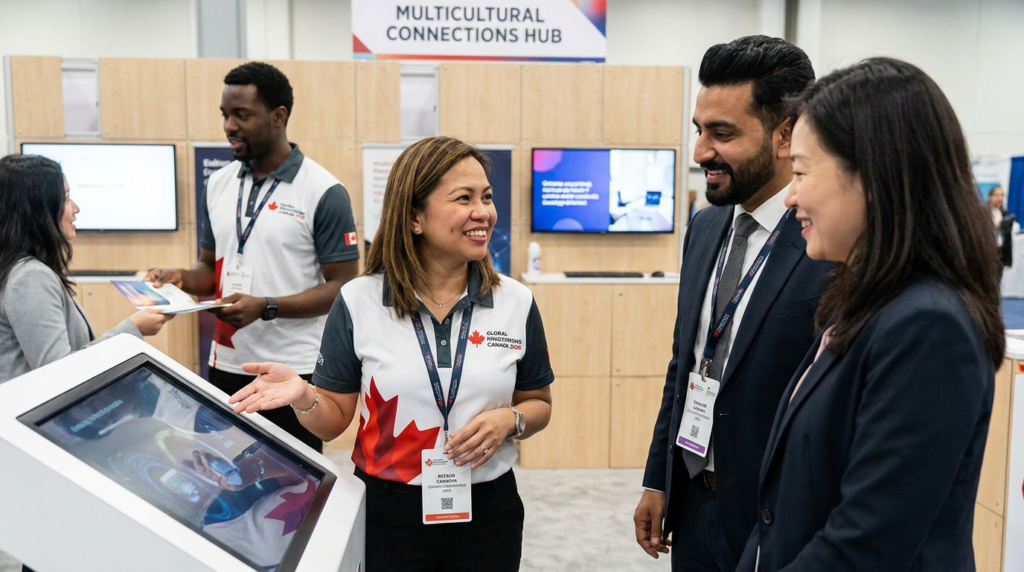
Multicultural booth design matters at Canadian trade shows because the audience is diverse. Specifically, trade show attendees in Toronto, Vancouver, and Calgary span dozens of cultural and language backgrounds. Furthermore, attendees engage more readily with booths that signal cultural fluency.
For example, a booth with multilingual staff and signage converts a wider slice of the floor. In our experience, multicultural-aware booths capture leads generic competitors walk right past. Consequently, multicultural design is a conversion lever, not a courtesy.
Trade show booth layout determines traffic flow, sightlines, and engagement capacity. To be specific, the four core layouts each suit different goals and budgets. Furthermore, CEIR exhibition research shows that layout choice directly affects lead volume per square foot.
Inline, corner, and peninsula booths form the foundation of trade show exhibiting. Specifically, inline booths (open on one side, typically 10×10 or 10×20) are the entry point for most exhibitors. Furthermore, corner booths open on two sides, doubling sightlines and traffic.
Peninsula booths open on three sides and anchor an aisle end. As a result, peninsula booths capture significantly more foot traffic than inline equivalents. Consequently, the upgrade from inline to corner to peninsula is often worth the cost difference.
Island booths are the premium trade show layout. Specifically, they open on all four sides and stand free of neighbours. Furthermore, island booths allow 360-degree branding, multiple engagement zones, and dramatic overhead structures.
In our experience, island booths produce the strongest brand impression and the highest lead volume. As a result, they suit category leaders and brands making a major market statement. Importantly, the island layout demands the most design discipline to avoid clutter.
Choosing the right trade show booth layout depends on goals and budget. To be specific, match the layout to lead targets, brand stature, and show importance. Furthermore, a strategic corner booth often outperforms a poorly-designed island.
For instance, a first-time exhibitor testing a market fits a corner or peninsula booth. By comparison, a category leader defending share belongs in an island. Consequently, layout should follow strategy, not ego.
Trade show booth technology turns passive foot traffic into measurable engagement. To be specific, the right technology captures attention, demonstrates value, and generates qualified leads. Furthermore, the wrong technology becomes expensive decoration.
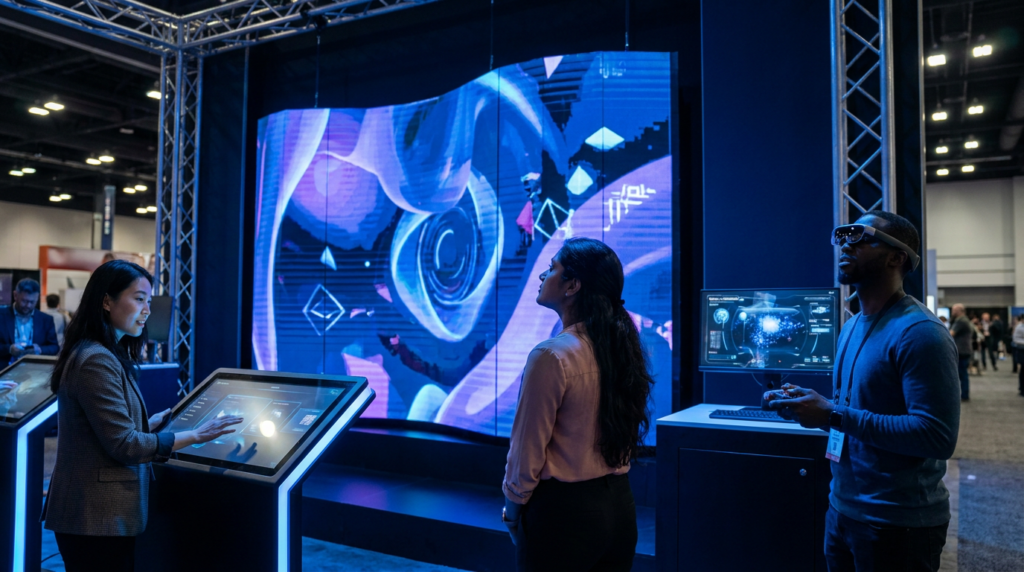
LED video walls and interactive touchscreens are the core booth technology in 2026. Specifically, large LED walls stop foot traffic with dynamic motion visible across the hall. Furthermore, touchscreens let attendees self-serve product information at their own pace.
As Trade Show News Network coverage consistently shows, motion and interactivity outperform static displays on every engagement metric. In our experience, the booths that pair an LED wall with hands-on touchscreens hold attendees longest. As a result, dwell time and lead quality both climb.
AI-powered lead capture is the most important booth technology shift in 2026. Specifically, AI tools capture visitor data, qualify leads in real time, and route follow-up automatically. Furthermore, AI removes the manual lead-entry bottleneck that loses leads after the show.
For example, an AI-driven badge scan can instantly score and segment a visitor for sales follow-up. As a result, the booth produces a clean, qualified lead pipeline by the show’s end. Consequently, post-show conversion improves dramatically.
Multicultural audience activation is where Canadian booth design becomes a competitive advantage. To be specific, Canadian trade show floors are among the most diverse in the world. Furthermore, the exhibitors that activate for that diversity convert a wider audience.
Multilingual booth staffing and signage unlock conversions generic booths miss. Specifically, staff who speak the languages of the floor build instant rapport. Furthermore, bilingual or multilingual signage signals that the brand sees the whole audience.
In our experience, a multilingual booth team converts noticeably more visitors than a monolingual one. As a result, staffing strategy matters as much as booth structure. Importantly, IAEE exhibition standards emphasize staff readiness as a top driver of booth performance.
Cultural cues in booth design deepen engagement with multicultural audiences. To be specific, food, music, hospitality, and visual references all shape how welcome attendees feel. Furthermore, these cues operate below the conscious level.
For example, a booth offering culturally familiar refreshments reads as genuinely welcoming. For more on sampling strategy, see our food and beverage experiential marketing guide. As a result, attendees linger longer and engage more openly. Consequently, cultural fluency turns a booth visit into a relationship.
Trade show booth design costs in Canada in 2026 vary widely by size and technology. To be specific, booth cost depends on layout, custom fabrication, technology, and reusability.
Furthermore, modular reusable systems reduce per-show cost across multiple events. As the Canadian Association of Exposition Management notes, reusable booth investment pays back across a show season. For more on broader activation pricing, see our brand activation cost guide for Ontario.
Most underperforming trade show booths share the same design mistakes. To be specific, here are the four mistakes Canadian exhibitors repeat most often.
Brand Guruz is the agency Canadian brands hire when trade show booth design has to convert, not just look good. To begin with, our team designs and builds booths with layout, technology, and multicultural activation integrated from the start. Furthermore, our multilingual staffing and community fluency capture audiences generic exhibitors miss.
Equally important, we design booths for reuse and measurement. Specifically, modular systems, AI lead capture, and post-show reporting all come standard. As a result, the booth investment works across a full show season, not a single event.
If you are planning trade show booth design in Canada for 2026, scope it now. Talk to Brand Guruz and we will map layout, technology, and activation against your show calendar. For more on our category approach, see our experiential marketing overview. Or browse case studies to see how trade show booths come to life.
What makes a good trade show booth design? A good trade show booth design wins attention in three seconds, guides traffic flow, and converts visitors into leads. Specifically, it combines bold overhead identification, open sightlines, purposeful technology, and engaged staffing. As a result, the booth captures more qualified leads per square foot.
What are the main trade show booth layout types? The four main trade show booth layouts are inline, corner, peninsula, and island. Specifically, inline booths open on one side, corner on two, peninsula on three, and island on all four. Furthermore, more open sides generally mean more traffic and higher cost.
How much does trade show booth design cost in Canada? Trade show booth design in Canada ranges widely. A basic inline booth starts at $5,000, while a custom island booth can exceed $250,000. Specifically, cost depends on layout, custom fabrication, and integrated technology. Furthermore, modular reusable systems reduce per-show cost.
What booth technology works best at trade shows in 2026? The most effective booth technology in 2026 includes LED video walls, interactive touchscreens, AR demos, and AI-powered lead capture. Specifically, motion and interactivity outperform static displays. Furthermore, AI lead capture improves post-show conversion significantly.
Why does multicultural design matter for trade show booths in Canada? Multicultural design matters because Canadian trade show floors are highly diverse. Specifically, multilingual staffing, signage, and cultural cues convert audiences generic booths miss. As a result, multicultural-aware booths capture more leads from the same foot traffic.

The best fabrication and tech-integration windows fill fast before show season. Talk to Brand Guruz about your 2026 trade show calendar. Or browse our case studies to see how the playbook lands.