AI and Immersive Tech in Experiential Marketing: What Canadian Brands Should Test in 2026

AI experiential marketing is no longer a future tense conversation. To be specific, 2026 is the year Canadian brands either pilot the tech or fall behind. Furthermore, immersive activations powered by AI are already producing measurable UGC, engagement, and conversion lift. As a result, the question is not whether to test — it is what to test first.

At Brand Guruz, we have integrated AI and immersive tech into activations across the GTA, Vancouver, and Calgary. In our experience, Canadian brands that test smart in 2026 will own the category by 2027. Specifically, the brands waiting for case studies from competitors are already behind.

Below, you will find six AI experiential marketing moves worth testing in 2026. You will also find the budget ranges, the common pitfalls, and the framework for picking what to test first.

Fast Facts:

  • 80% — Marketing teams actively using or testing AI tools in 2025 (Salesforce)
  • 5x — UGC capture rate uplift from AI-powered photo and video booths
  • 24 hours — Average post-event content delivery time using generative AI workflows

Why AI experiential marketing is the 2026 inflection point

AI experiential marketing is the 2026 inflection point because the tech finally meets the floor. To be clear, the production cost of generative AI content has dropped by an order of magnitude. Furthermore, the speed of AR rendering on consumer phones has caught up to creative ambition. Consequently, what used to be a $200K experiment is now a $30K integration.

The shift from impressions to interactions in AI brand activation

For a long time, experiential measured attendance and called it ROI. However, AI brand activation reframes the metric. Specifically, AI-driven activations capture interactions — not just impressions. Furthermore, every interaction produces a piece of usable data, content, or sentiment signal.

For instance, a generative AI photo booth captures attendee preferences, image styles, and emotional reactions. In other words, the activation does double duty as a research instrument. As a result, brands learn while they activate.

Why Canadian brands are uniquely positioned for AI experiential

Canadian brands hold an underrated advantage in AI experiential marketing. To begin with, Canada hosts world-class AI research clusters in Toronto, Montreal, and Vancouver. Furthermore, Canadian audiences skew younger, more multilingual, and more digitally fluent than most G7 markets.

In other words, Canadian Gen Z and millennials are comfortable interacting with AI in public. Consequently, an AI-enabled activation in Toronto or Vancouver hits less friction than the same one in Atlanta or Manchester. That is a real strategic edge. For more on how location shapes activation success, see our Toronto neighbourhood brand activation strategy guide.

Six AI and immersive tech moves to test in 2026

Not every AI experiential bet pays off equally. To be specific, the six tests below are the ones we have seen produce measurable lift in 2025 and 2026.

Test 1: Generative AI photo and video booths

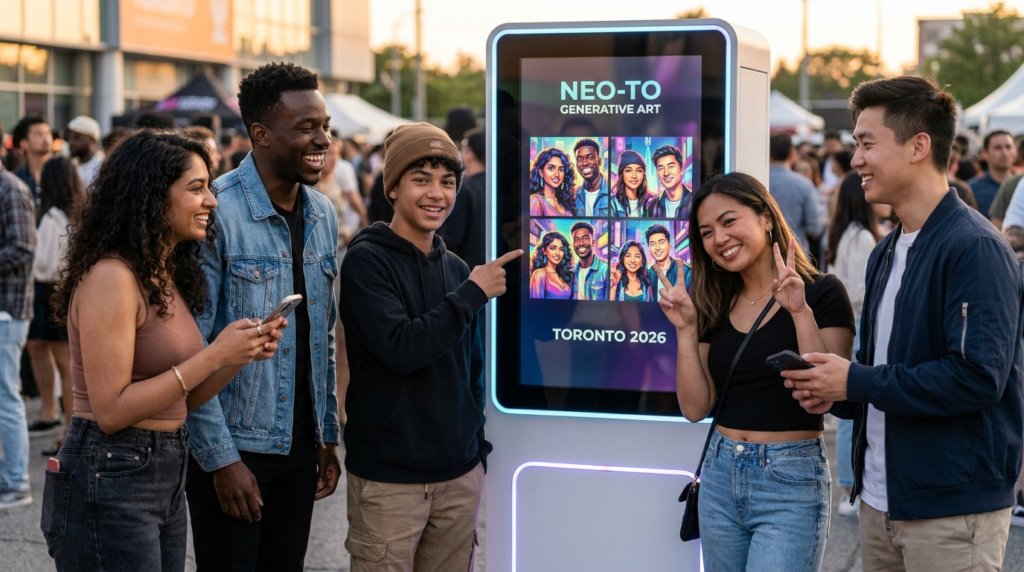
Generative AI photo booths are the highest-ROI test in 2026. Specifically, attendees pose. The AI restyles the image in a branded theme. Then the system delivers a personalized share-ready photo or short video.

Furthermore, the production cost per asset has dropped sharply. In practice, a $25K booth setup can serve 2,000+ attendees in a weekend. As a result, cost per branded UGC drops below $15 — well below paid social CAC.

Test 2: AR mirrors and try-on activations

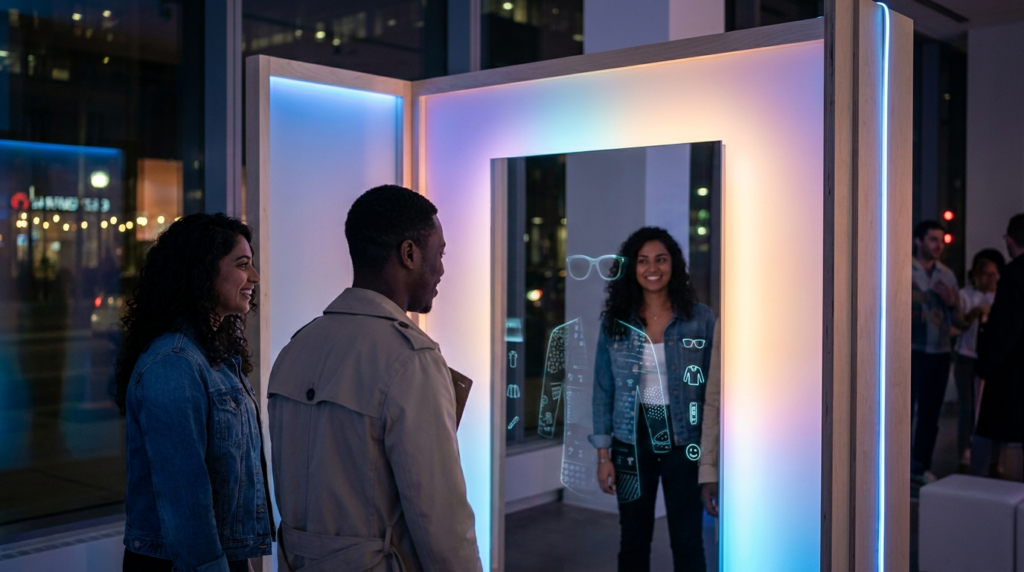
AR mirrors are the immersive workhorse of 2026. To illustrate, a beauty brand can let attendees try 50 product variations in 30 seconds. By comparison, a fashion brand can preview seasonal collections without physical inventory.

In our experience, AR mirrors lift engagement time by 3 to 5x versus static product displays. Consequently, sampling and try-on conversion rates jump. Furthermore, the resulting photos become natural UGC.

Test 3: AI-powered personalized sampling

AI-powered sampling uses computer vision and quick intake questions to match each attendee with a tailored product sample. For example, a CPG brand can recommend different flavour profiles based on demographic and stated preference signals. As a result, sample relevance jumps. So does post-event purchase intent.

Importantly, this approach requires careful privacy design. To be specific, no facial recognition, no PII storage, and clear consent at every interaction. That is the bar Canadian brands need to meet under PIPEDA.

Test 4: Real-time AI sentiment monitoring

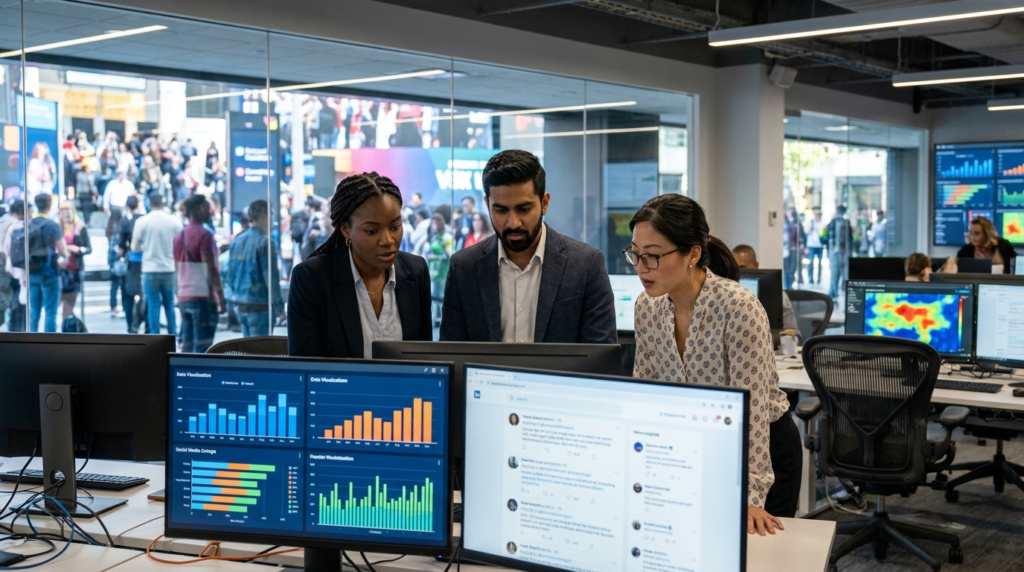
Real-time AI sentiment monitoring tracks UGC and on-site reactions as they happen. Specifically, the system scans hashtags, captures sentiment shifts, and flags emerging themes within minutes. Furthermore, multilingual sentiment models now handle English, French, Punjabi, Mandarin, Tagalog, and Spanish simultaneously. As Nielsen multicultural research confirms, multilingual response captures community sentiment paid digital often misses.

In our experience, real-time sentiment lets brand teams adjust the activation on the fly. For instance, if a sampling station generates positive social momentum, the team can amplify staff and inventory there. Consequently, the activation optimizes itself across the weekend.

Test 5: Holographic and projection displays for immersive activation

Holographic displays are still novelty in 2026. However, projection mapping has matured significantly. Specifically, large-format projection on building facades, festival stages, and pop-up walls now costs roughly half its 2023 price.

For example, a brand can project a cultural narrative that complements the festival. To illustrate, a Caribbean carnival visual, a Diwali light scene, or a Lunar New Year sequence. In other words, the brand fits into the cultural moment rather than competing with it. Importantly, this is the immersive tech most likely to produce viral UGC at multicultural festivals.

Test 6: AI-driven post-event content amplification

AI-driven content amplification is where most Canadian brands underinvest. To be clear, the activation produces hundreds of hours of footage and thousands of UGC posts. Furthermore, an AI-driven editing and curation pipeline turns that raw material into 200+ social-ready clips within 48 hours.

In practice, this is what extends a one-weekend activation into a 30-day content window. As a result, the brand sees a multiplier on every dollar of activation spend. According to Salesforce State of Marketing research, AI-driven content workflows now cut production turnaround by 60% or more.

Gen Z attendees using an AR mirror at an immersive brand activation in downtown Toronto in 2026.
AR mirrors lift engagement time by three to five times over static product displays.

How to budget for AI experiential marketing in 2026

AI experiential marketing budgets break differently from traditional activations. Specifically, more of the spend shifts toward tech integration and software licensing. Furthermore, less goes toward fabrication and printed materials.

  • Entry tier ($30K – $80K): One AI-driven test (generative photo booth or AR mirror) at one activation, basic UGC capture, single-language sentiment tracking.
  • Mid tier ($80K – $200K): Two to three integrated AI tests across multiple activations, multilingual sentiment, full UGC amplification pipeline.
  • Premium tier ($200K+): Multi-festival AI deployment, custom AR or projection content, real-time analytics dashboard, post-event content factory.

For more on related pricing, see our brand activation cost guide for Ontario. Importantly, AI experiential ROI compounds with reuse. To be specific, the AI assets and workflows built for one activation can be redeployed across the next three. As a result, the second activation is significantly cheaper than the first.

Gen Z attendees using an AR mirror at an immersive brand activation in downtown Toronto in 2026.
AR mirrors lift engagement time by three to five times over static product displays.

Common mistakes Canadian brands make with AI experiential

Most AI experiential marketing pilots underperform for the same reasons. To be specific, here are the four mistakes Canadian brands make most often.

  • Choosing the tech before the audience. Specifically, brands fall in love with a tool and force-fit it to the brief. However, the audience and the cultural moment should dictate the tech, not the other way around.
  • Skipping the privacy layer. Importantly, Canadian audiences are sensitive to data handling. As a result, any AI activation needs clear consent, no PII storage, and a public privacy statement.
  • Ignoring the multilingual layer. For instance, an AI model that only reads English misses most UGC at Caribana, Diwali Mela, or Carassauga. Consequently, the brand sees a fraction of the actual response.
  • Underbudgeting the content pipeline. In practice, the AI photo booth is half the cost. The content pipeline that turns the captures into social-ready clips is the other half. Brands that skip this step waste the activation investment.
Marketing team monitoring real-time AI sentiment dashboard at a Canadian multicultural brand activation in 2026.
Real-time AI sentiment lets brand teams adjust the activation on the fly.

Why Brand Guruz is built for AI experiential marketing in Canada

Brand Guruz is the experiential agency Canadian brands hire when AI and immersive tech are part of the brief. To begin with, our team blends cultural depth with technical fluency. Furthermore, our multilingual capability ensures the AI layer reads the actual audience, not just the English-speaking slice.

Equally important, we treat AI as a tool, not a centrepiece. Specifically, the cultural moment leads. The tech amplifies. As a result, our AI experiential activations feel native to the festival, neighbourhood, or community they show up in.

If you are planning AI experiential activations in Canada for 2026, scope it now. Talk to Brand Guruz and we will map the right tech, audience, and cultural context against your goals. For more on our category approach, see our experiential marketing overview. Or browse case studies to see the playbook in action.

Frequently asked questions

What is AI experiential marketing? AI experiential marketing uses artificial intelligence and immersive technology to create personalized, interactive brand experiences at live events. Specifically, it includes generative AI photo booths, AR mirrors, real-time sentiment monitoring, and AI-driven content amplification. As a result, the brand interaction becomes data-rich and shareable.

How much does AI experiential marketing cost in Canada? Entry-tier AI experiential pilots start around $30,000 to $80,000. Mid-tier programs run $80,000 to $200,000. Premium multi-activation AI deployments begin at $200,000 and scale up from there.

Which AI experiential tools should Canadian brands test first? Generative AI photo and video booths offer the highest immediate ROI. Furthermore, AR mirrors and real-time AI sentiment monitoring are strong second tests. Specifically, brands should pilot one tool at one activation before scaling.

Is AI experiential marketing privacy-compliant in Canada? Yes, when designed properly. To be specific, AI activations must follow PIPEDA, avoid storing PII, use clear consent flows, and publish privacy statements. Furthermore, no facial recognition or identity matching should occur without explicit opt-in.

How does AI experiential marketing improve ROI? AI experiential marketing improves ROI by increasing UGC volume, enabling personalization, and capturing real-time sentiment. It also accelerates post-event content turnaround. Consequently, one weekend of activation produces 30 days of compounding content and audience insight.


Ready to test AI experiential marketing in 2026?

The brands testing in Q1 will own the case studies by Q3. Talk to Brand Guruz about your 2026 AI experiential pilot. Or browse our case studies to see how the playbook lands.

Author