AI in Event Planning: What Canadian Brands Should Test in 2026

Most Canadian brands doing event marketing are now touching AI in event planning in some form. A planning tool here, a content draft there, an analytics dashboard on the back end. The adoption numbers look impressive. The results, however, are far less so.

Brand Guruz works with Canadian brands on experiential and corporate event programs. In 2026, we see a clear split: brands experimenting with AI, and brands actually benefiting from it. Ultimately, this guide is for brands who want to move into the second group.

91%

of event professionals are using AI in some capacity (Highbar.ai Events + AI Index, 2026)

16%

say AI has significantly improved their event planning and execution (Cvent/Northstar PULSE Survey)

45%

of event organisers are actively using AI to enhance operations and personalise attendee experiences (EIN/EventMobi AI Report)

Why the gap between AI adoption and AI impact matters

The Highbar.ai Events + AI Index draws on Forrester, PCMA/Gevme, and Cvent data from 1,800+ respondents. It found 91 percent of event professionals use AI in some capacity. Yet only 15 percent qualify as strategic leaders. The Cvent/Northstar PULSE Survey of 1,000+ planners confirmed the pattern. Sixty-five percent report using generative AI, while only 16 percent say it has significantly improved their work.

The tools are accessible. The workflows are not. Most event teams pick up an AI tool, use it once or twice, and never build it into a system. The result is AI adoption without AI advantage.

Glue Up’s 2026 research on AI in event planning finds that tools succeeding long-term reduce friction rather than add steps. They support judgment instead of replacing it. For Canadian brands in 2026, the practical question is not whether to use AI. It is which applications are worth building into a repeatable system.

Test first: AI for pre-event content and communications

Content creation is the most adopted AI use case in event planning — and still the most underutilised. Forrester’s 2025-26 B2B events research shows 39 percent of event professionals creating content with AI in 2025. That climbs to 43 percent for content repurposing in 2026.

The reason content leads is structural. In fact, it is asynchronous, low-stakes, and human-reviewed before anything reaches an attendee. That makes it the ideal entry point for any event team.

For pre-event programs, the worthwhile AI applications are personalised email sequences, social content variations, event website copy, and speaker bios. Vendor outreach drafts and run-of-show scripting are also worth adding to the workflow. In each case, AI generates a working draft and the team refines it.

Generally, teams that build AI content workflows into their pre-event phase report meaningful time savings on repeatable writing tasks. The key is building a prompt library and brand voice guardrails — not using AI ad hoc. For the event content brief structure that supports this, see our corporate event planner buyers guide.

Test second: AI for post-event analysis and ROI reporting

Post-event analysis is the AI application with the clearest and most immediate return for Canadian event teams. Yet it remains one of the least adopted.

The use case is direct: large language models are genuinely excellent at synthesising qualitative data — open-ended survey responses, attendee feedback, staff debrief notes — into structured summaries. A task that previously took a senior planner three to four hours now takes thirty minutes with a well-structured AI prompt and a clean data export.

Lensmor’s 2026 guide to AI tools for event planning notes that 40 percent of event teams still struggle to prove event ROI in 2026, down from 70 percent in 2025. AI-assisted analysis tools are a significant reason that number is falling. Additionally, teams that automate the synthesis layer get to the strategic interpretation faster and produce cleaner reports for stakeholders.

The specific applications worth testing: attendee sentiment analysis from survey exports, executive recap reports drafted from debrief notes, year-over-year comparison narratives, and AI-assisted ROI calculations built from cost and conversion data. For the measurement framework behind this, see our experiential marketing ROI guide.

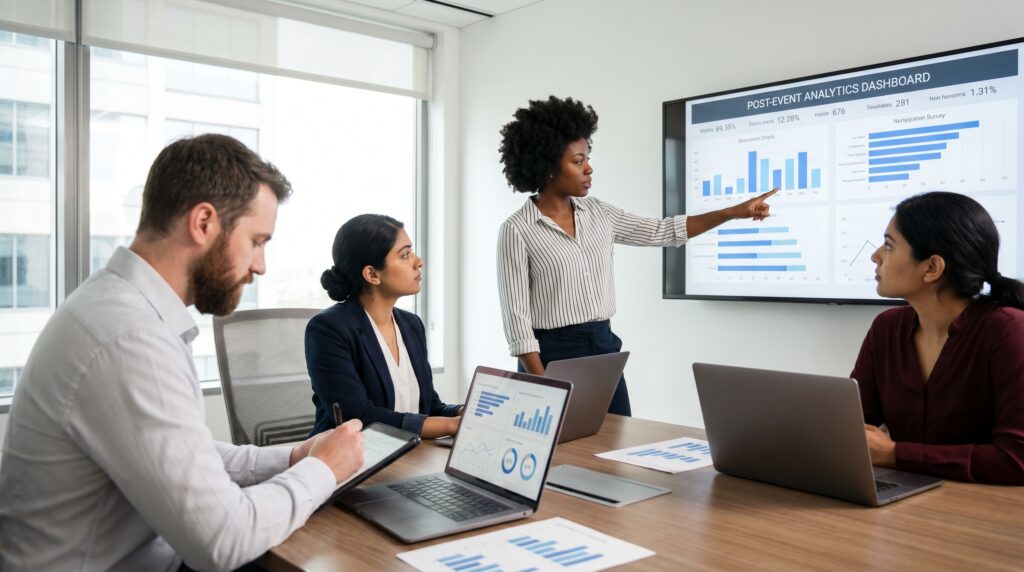
Event marketing team reviewing AI-assisted post-event analytics and ROI data on a screen in 2026.
Post-event analysis is where AI delivers the most immediate and measurable return — and where most event teams are still doing everything manually.

Test third: AI-assisted attendee personalization

Attendee personalization is where AI in event planning shows the greatest theoretical potential — and the widest gap between capability and execution. Only 7 percent of planners are using AI chatbots at events, and 11 percent report AI for customer service, according to the Forrester 2025 data cited in the Tree-Fan Events analysis. The barrier is not technology. It is trust and workflow complexity.

Still, specific personalisation applications are worth testing in controlled formats. Pre-event, AI can segment attendees by registration data and deliver personalised agenda recommendations, speaker highlights, and pre-reads. At-event, AI-powered wayfinding and FAQ chatbots reduce staff load on routine questions — if the content is accurate and the escalation path to a human is clear. Post-event, personalised follow-up sequences based on session attendance and engagement data outperform generic recap emails on every metric.

Generally, the test recommendation for 2026 is to start with pre-event personalised communications, where the stakes are lower and human review is easy. Use a structured attendee segmentation from your registration platform, and build one AI-personalised email sequence per segment. Evaluate the open rate, click rate, and session attendance correlation before extending AI personalisation further into the event experience.

Proceed carefully: AI at live events and Canadian privacy law

Not all AI event planning applications are equal under Canadian law — and this is where some brands are moving too fast.

Additionally, AI applications that collect or process personal information about attendees at live events are subject to PIPEDA and, in Quebec, Law 25. Torkin Manes’ 2025 review of Canadian privacy developments highlights a specific enforcement signal: the Office of the Privacy Commissioner investigated digital advertising displays using facial detection technology to tailor ads based on inferred characteristics in 2025. In fact, the OPC’s updated guidance on biometrics and AI-related data use — released in 2025 — emphasises necessity, proportionality, and transparency.

For event marketers, this means three practical rules. First, any AI application that processes facial, voice, or biometric data at a live event requires explicit attendee consent under PIPEDA. Second, AI-driven audience analytics that infer demographics without consent are in regulatory grey territory and likely to be tested in enforcement. Third, Bill C-27 and AIDA died in January 2025, but the OPC’s enforcement posture signals that the rules are already effectively tightening — even without new legislation.

The safe lane in 2026 is to test AI on aggregate, anonymised data collected with clear consent — not on real-time biometric inference at live events.


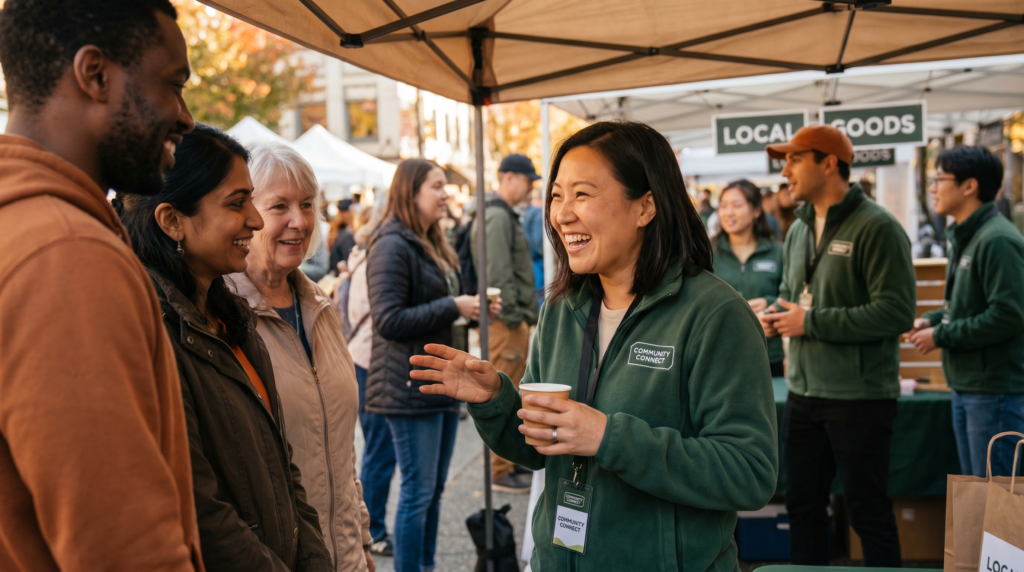
Brand ambassador engaging a diverse crowd at a Canadian live event activation in 2026.
At live events, the human element remains the highest-trust touchpoint — and the one PIPEDA cannot complicate.

How Brand Guruz approaches AI in event planning

Brand Guruz uses AI in event planning where it genuinely reduces work and improves output — primarily in pre-event content production, post-event analysis, and audience intelligence. We do not use it to replace the human judgment, cultural fluency, and live activation capability that produces actual brand moments.

For multicultural event marketing, AI tools can accelerate research and synthesis. However, they cannot substitute for the community knowledge, multilingual talent, and experiential depth that make Canadian multicultural event activations actually land. Still, the human layer is where Brand Guruz adds value, and AI is the tool that makes our team faster on the sides of that work.

According to the EIN/EventMobi AI Report, 45 percent of event organisers are actively using AI to enhance operations and personalise attendee experiences — while the 55 percent who are not are falling behind on operational efficiency. Brand Guruz helps Canadian brands build that AI capability into their event programs without getting ahead of their compliance posture.

Frequently asked questions about AI in event planning

What is AI in event planning? AI in event planning refers to the use of artificial intelligence tools — including large language models, analytics platforms, and automation software — to improve how events are planned, executed, and measured. Common applications include content generation, attendee personalisation, post-event analysis, and logistics optimisation.

Which AI tools are most used in event planning? Generative AI tools like ChatGPT and Claude are the most widely adopted for content creation and summarisation. Event-specific platforms including Cvent, Eventbrite, and EventMobi are integrating AI for registration, personalisation, and analytics. Project management tools like ClickUp AI handle workflow and scheduling automation.

Is AI-driven attendee data collection legal in Canada? It depends on what data is being collected and how. However, PIPEDA requires meaningful consent for the collection, use, and disclosure of personal information — including data processed by AI systems. Applications using biometric or facial recognition data at live events require explicit consent and face active regulatory scrutiny from the OPC. Quebec’s Law 25 imposes additional requirements. Work with qualified privacy counsel before deploying AI data collection at live Canadian events.

What is the biggest barrier to AI adoption in event planning? According to the EIN/EventMobi AI Report, training staff and cost are the two most commonly cited barriers. Additionally, many event teams struggle to integrate AI tools into repeatable workflows — most are experimenting with AI in isolation rather than building the systems that make AI use compound into operational advantage.

Should live brand activations use AI? Use AI on the back end — for planning, content, and analysis — rather than deploying it at the live event interface with attendees. At live events, human brand ambassadors, mascots, and experiential formats consistently outperform AI-driven engagement tools on trust, cultural resonance, and brand recall.

Ready to add AI to your event planning program?

Talk to Brand Guruz about where AI fits in your 2026 event marketing calendar — and where it doesn’t. Or browse case studies to see how we have combined human-first activation with smarter back-end planning tools.

Author