Brand Ambassador Training: How to Prepare Event Staff Who Actually Sell (2026 Guide)

Brand ambassador training is the structured process of briefing, coaching and certifying event staff so they can represent a brand, start conversations, handle objections and drive a measurable action such as a sign-up, scan or sale. Done well, it turns promo staff into salespeople and protects your brand at every activation.

Updated November 2026

Key takeaways

  • Training, not headcount, is the biggest controllable factor in activation results.
  • A strong brand ambassador training program has seven steps, from defining a good shift to on-shift coaching.
  • Every ambassador brief needs objectives, key messages, an objection bank, compliance rules and reporting instructions.
  • In Ontario, staff who serve or sample alcohol need Smart Serve, and food sampling must follow public health food-handling requirements.
  • Measure training with conversations per hour, conversion to the call to action and post-shift reports, then retrain on the gaps.

This guide is written for brand and field marketing managers who run sampling tours, retail demos, pop-ups and festival booths across Toronto and Ontario, and who want event staff who actually sell.

88% of people trust recommendations from people they know (Nielsen Global Trust in Advertising) · About 6.2 million people live in the Toronto CMA, Canada's largest activation market (Statistics Canada 2021 Census) · Brampton alone is home to 656,480 people, one of the GTA's most diverse audiences (Statistics Canada 2021 Census)

What is brand ambassador training?

Brand ambassador training is the preparation that gives event staff the knowledge, skills and confidence to represent a brand face to face. It covers the brand story, product facts, conversation techniques, compliance rules and how to report results. If you are new to the role itself, start with our explainer on what a brand ambassador is.

What does a trained brand ambassador do differently?

A trained ambassador starts conversations instead of waiting for them. They read the shopper quickly, deliver one clear message, let people experience the product and then ask for a specific action. An untrained staffer, by contrast, hands out samples, answers questions vaguely and lets interested people walk away without a next step.

Is brand ambassador training the same as event staff training?

Not quite. Event staff training often focuses on logistics: where to stand, when breaks happen and how to set up the booth. Brand ambassador training adds the selling layer, including messaging, objection handling and conversion. The best programs combine both, so staff run a tidy activation and also move people toward a purchase.

Why training decides activation results

Training decides results because the ambassador is the activation. Shoppers rarely remember the booth design; they remember the person who spoke to them. Word of mouth is the payoff: Nielsen reports that 88% of people trust recommendations from people they know, and a well-trained ambassador is often the first person to recommend your product to someone.

What happens when promo staff are under-trained?

Under-trained staff default to passive sampling. In our experience, the symptoms are predictable: samples disappear without conversations, staff cluster together on their phones, claims drift off-message and coupons go unredeemed. You still pay for the venue, the product and the hours, but the activation produces little beyond foot traffic.

How does training protect your brand?

Ambassadors speak for your brand in public, often to hundreds of people per shift. Training sets clear limits on health claims, competitor comments, pricing promises and personal opinions. It also prepares staff for difficult moments, from an upset shopper to a request for alcohol from someone who looks underage, so the brand is protected when things go wrong.

Strong training is also what separates professional experiential marketing from simply putting people in branded T-shirts.

How to build a brand ambassador training program step by step

A brand ambassador training program is a repeatable process, not a one-off pep talk. Use these seven steps for any sampling tour, retail demo, festival booth or pop-up across Ontario.

Step 1: Define what a good shift looks like

Start with the outcome, not the agenda. Decide the two or three behaviours that drive results for this activation, such as starting conversations within 30 seconds of eye contact, delivering the core message in under a minute, and closing with a clear ask like a scan, a sign-up or a coupon redemption. Write those down as your shift standard, because every module you build afterwards should train toward it.

Step 2: Recruit for attitude, then train for product

Training cannot fix a poor casting decision. Screen candidates for warmth, energy and comfort approaching strangers, plus any languages your audience speaks. In multicultural GTA markets like Brampton, Markham or Scarborough, a Punjabi, Cantonese or Tamil speaker can change the quality of every conversation. Product knowledge is far easier to teach than presence.

Step 3: Build the ambassador brief and pre-read

Send a concise brief 48 to 72 hours before training so staff arrive with context. It should cover the brand story, product facts, target audience, key messages, words to avoid, the offer, the shift schedule and the dress code. Ask ambassadors to confirm they have read it, and use a short quiz at the session start to check.

Step 4: Run a live training session

Hold a 60 to 120 minute session, in person where possible, with the brand or field marketing manager in the room. Cover the why behind the campaign, demonstrate the product hands-on, and walk through the conversation flow. Let staff taste, touch or use the product themselves, because ambassadors who have experienced it speak about it with far more conviction.

Step 5: Practise with scripts and role-play

Knowledge only turns into selling skill through practice. Pair ambassadors up and run the opening line, the demo and the close until it sounds natural, then layer in the hard objections. A trainer or field lead should give specific, immediate feedback on tone, body language and length of pitch.

Step 6: Certify compliance and safety

Before anyone works a shift, confirm the certifications and site rules that apply: Smart Serve for alcohol, food-handling practice for sampling, venue safety rules, and data and privacy rules for lead capture. Keep copies of certificates on file and in the shift kit so you can prove compliance if a retailer, venue or inspector asks.

Step 7: Coach on shift and debrief after

Training does not end when doors open. A field lead should observe the first hour, correct habits early and run short check-ins through the shift. After the activation, run a 15-minute debrief, review the numbers and feed what you learn into the next brief and session.

Document each step in a simple training playbook. Once it exists, onboarding a replacement ambassador mid-tour takes an hour instead of a scramble.


What to include in the ambassador brief

The ambassador brief is the single source of truth for an activation. A promo staff briefing works best when it fits on two or three pages and follows the same structure every time, so returning ambassadors know exactly where to look.

Brief sectionWhat to includeWhy it matters
Campaign objectiveThe single goal of the activation and the KPI you will judge it onAmbassadors prioritise the right action on a busy shift
Brand storyTwo or three sentences on who the brand is and what it stands forKeeps tone consistent across every conversation
Target audienceWho to approach, who not to approach, languages and cultural notesFocuses energy on likely buyers
Key messagesThree core product claims, approved wording and words to avoidPrevents off-brand or non-compliant claims
Product factsIngredients, features, sizes, price, where to buyBuilds credibility when shoppers ask questions
Offer and call to actionCoupon, QR scan, sign-up or purchase ask and how to redeem itTurns interest into a measurable result
Objection bankThe five most likely objections with approved answersKeeps staff confident under pressure
Compliance rulesSmart Serve, age checks, sample limits, food handling, privacy consentProtects the brand, the venue and the public
LogisticsAddress, call time, parking, dress code, kit list, field lead contactAvoids late starts and missing materials
ReportingWhat to count, photos to take, end-of-shift report formatMakes results comparable across shifts

How long should a promo staff briefing be?

Keep the written brief to two or three pages and the on-site briefing to 10 to 15 minutes before each shift. The pre-shift huddle should recap the objective, the offer, any changes since training and the targets for that shift. Anything longer loses attention; anything shorter tends to skip compliance reminders.

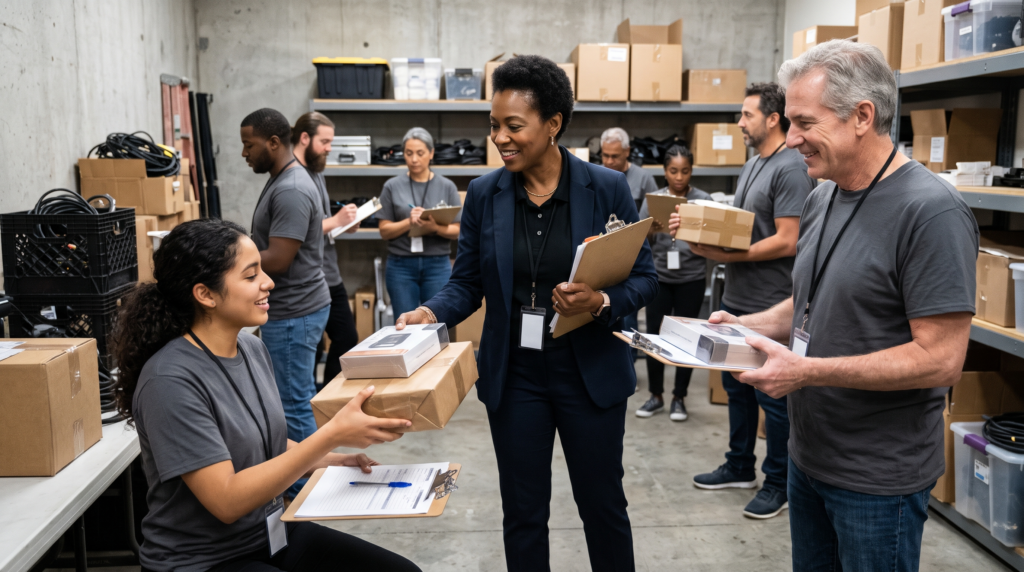
Brand ambassador training pre-shift kit handout with brief, scripts and reporting sheet for event staff
A pre-shift kit keeps every ambassador on brief

Scripts, role-play and objection handling

Scripts give ambassadors a reliable structure, role-play turns that structure into a natural conversation, and objection handling keeps the conversation alive when a shopper pushes back.

Should ambassadors follow a word-for-word script?

No. Give them a framework rather than a monologue. A simple four-part flow works for most activations: an open (a friendly, specific question), a hook (one benefit tied to the shopper), an experience (taste, touch or demo) and an ask (scan, sign up or buy). Lock the compliance wording and key claims, and let ambassadors phrase the rest in their own voice.

How do you run role-play that actually works?

Run it in pairs with a clear scenario card, such as a busy parent at a grocery store in Mississauga or a sceptical commuter at a downtown Toronto pop-up. One person plays the shopper, one plays the ambassador, and a third observes with a short checklist. Rotate roles every three minutes and finish each round with one strength and one fix.

What objections should you train for?

Train for the five you will hear every shift: I am in a hurry, I already use another brand, it is too expensive, I do not want to give my email, and I will look for it later. For each, write a short, approved response that acknowledges the concern and offers a low-effort next step, such as a QR code to buy later or a coupon to try it at home.

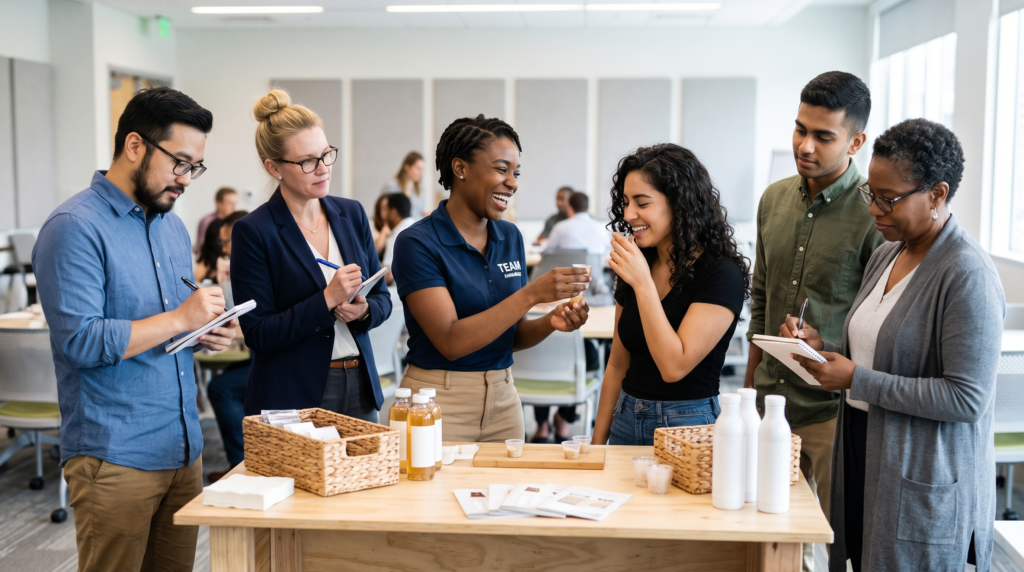
Brand ambassador training role-play at a product demo table practising objection handling
Role-play at the demo table builds confident conversations

Compliance and safety training in Ontario

Compliance training is not optional in Ontario. It protects shoppers, venues and your brand, and a single violation can end a retail partnership or a tour.

Do brand ambassadors need Smart Serve to sample alcohol?

Yes. Staff who serve or sample alcohol in Ontario generally need a valid Smart Serve certification under rules set by the Alcohol and Gaming Commission of Ontario (AGCO). Training should also cover checking ID, refusing service, sample-size limits and the retailer or venue policies that apply. For the wider rules on promotions, see our guide to alcohol marketing in Ontario under AGCO rules.

What food-handling training do sampling staff need?

Food sampling should follow Ontario public health food-handling requirements. In practice, that means having staff with recognised food handler training on site, keeping hot and cold products at safe temperatures, using gloves and utensils, protecting samples from contamination and clearly labelling common allergens. Check with the local public health unit before a tour, since requirements and inspections are handled locally.

What general safety training should every shift include?

Cover the venue emergency exits and first aid location, safe lifting for kit and coolers, weather plans for outdoor events, and how to handle an aggressive or unwell guest. If you capture leads, train staff on consent and privacy basics, including explaining clearly how contact details will be used before anyone signs up.

On-shift coaching, check-ins and reporting

On-shift coaching is where training sticks. A field lead or supervisor should treat the first hour of every activation as live practice and step in early with small corrections.

What should a field lead check during a shift?

Run a quick check-in every two hours covering energy and positioning at the booth, whether the core message is being delivered accurately, conversion to the call to action so far, stock and sample levels, and any compliance issues. Recognise good conversations out loud, because praise in the moment reinforces the behaviour you trained.

What should ambassadors report after each shift?

Use one standard end-of-shift report: conversations, samples distributed, sign-ups or scans, coupons issued, the top three questions and objections heard, photos of the setup and any incidents. A consistent format lets you compare shifts across Toronto, Vaughan, Oakville or London and spot which locations and ambassadors perform best.

How to measure training effectiveness

You measure training effectiveness by linking what ambassadors learned to what happened on the floor. If the program worked, you will see it in the numbers within the first few shifts.

Which KPIs show training is working?

  • Conversations per hour: shows whether staff are approaching people proactively.
  • Conversion to the call to action: the share of conversations that end in a scan, sign-up or purchase.
  • Message accuracy: measured through mystery shops or field lead observation.
  • Knowledge scores: results from the pre-shift quiz.
  • Sales uplift: retail sell-through during and after the activation, where the retailer shares data.

How do you turn results into better training?

Review results weekly and look for patterns rather than single bad shifts. If conversation volume is high but conversion is low, retrain the close. If one ambassador consistently outperforms, have them demonstrate their approach to the team. Industry coverage from Event Marketer is also useful for benchmarking formats and fresh training ideas.

Why Brand Guruz

Brand Guruz is a Toronto-based experiential marketing agency that recruits, trains and manages brand ambassadors for activations across the GTA and Ontario. We build the brief with your team, run the training and role-play sessions, verify Smart Serve and food-handling requirements, and put an experienced field lead on site to coach and report.

Our ambassador pool reflects the communities you want to reach. With roughly 6.2 million people in the Toronto CMA according to Statistics Canada, multilingual, culturally fluent staff are often what turns a sample into a sale. If you are comparing partners, see how we work as a brand ambassador agency in Toronto or review our guide to experiential marketing companies in Toronto.

Brand ambassador training FAQ

How long does brand ambassador training take?

Most activations need a 60 to 120 minute live session plus a pre-read and a short on-site refresher before each shift. Complex products, such as technology, financial services or alcohol, may need a half-day session. Longer multi-week tours benefit from a weekly 20-minute coaching check-in to keep messaging sharp and share what is working.

Do brand ambassadors in Ontario need Smart Serve certification?

Staff who serve or sample alcohol in Ontario generally need a valid Smart Serve certification under AGCO rules, and they must follow age-verification and sample-size requirements. Retailers and venues often add their own policies on top. Confirm the requirements for your specific activation before the first shift and keep copies of every certificate on file.

Should brand ambassadors be paid for training time?

Yes. Under Ontario employment standards, mandatory training is generally treated as work time, so ambassadors should be paid for required sessions. Paying for training also improves attendance and attention. Build training hours into your staffing budget from the start rather than treating them as an unpaid extra.

What is the difference between a brand ambassador and promo staff?

Promo staff typically hand out samples or flyers and follow simple instructions. A brand ambassador is trained to represent the brand in conversation, explain the product, handle objections and drive a measurable action. The difference is almost entirely training, briefing and coaching, which is why the training program matters so much.

How do you measure whether training worked?

Compare shift results against the KPIs set in the brief: conversations per hour, conversion to the call to action, sample-to-purchase uplift where retail data exists, and quiz or mystery-shop scores. Track the same metrics across ambassadors and shifts, then retrain on the gaps you find rather than repeating the whole session.

Can an agency handle brand ambassador training for us?

Yes. A specialist agency can recruit, brief, train, certify and coach ambassadors, then report results after every shift. Brand Guruz, a Toronto-based experiential marketing agency, runs this full process for activations across the GTA and Ontario, with your brand team approving the brief and key messages before training starts.

Ready to staff your next activation with trained ambassadors?

Your next activation is only as strong as the people running it. Brand Guruz can recruit, brief, train and coach brand ambassadors who represent your brand accurately and drive measurable results, from a single weekend sampling event to a province-wide tour.

Tell us your product, audience and goal, and we will outline a brand ambassador training program and staffing plan to match. Contact Brand Guruz to book a quick planning call.

Let's Grow Your Brand

Author