Event Marketing Agency: What They Do, What They Cost and How to Choose One (2026)

An event marketing agency is a firm that plans, promotes and measures live brand experiences, such as trade show activations, product launches, sampling tours, conferences and pop-ups, so they produce awareness, leads and sales. In Canada, most event marketing agencies charge a strategy or management fee plus production costs, typically from about $15,000 to well over $250,000 per program.

Updated November 2026

Key takeaways

  • An event marketing agency owns the business result of an event: who attends, what they experience and what happens after they leave.
  • It is different from an event management company, which focuses on logistics, and from an experiential agency, which focuses on immersive brand moments.
  • Budgets in Canada typically range from $15,000 for a single trade show program to $250,000 or more for a multi-city tour.
  • Choose an agency on strategy, measurement and the actual team, not on the slickest pitch deck.
  • Agree on ROI metrics, such as cost per qualified lead and pipeline influenced, before any creative work starts.

This is a national buyer’s guide for marketing and brand managers. If you need tactics for events in the city itself, read our guide to event marketing in Toronto. If your priority is logistics, venues and run-of-show, see our breakdown of what an event management company in Canada does.

88% of people trust recommendations from people they know (Nielsen Global Trust in Advertising) · About 6.2 million people live in the Toronto CMA, Canada's largest event and trade show market (Statistics Canada 2021 Census) · Brampton alone counts 656,480 residents, a large suburban audience in its own right (Statistics Canada 2021 Census)

What is an event marketing agency?

An event marketing agency is a specialist partner that uses live events as a marketing channel. It sets the goal, designs the experience, drives the right audience to attend, runs the brand presence on site and reports what the event produced. The core job is marketing, not party planning.

How is event marketing different from advertising?

Event marketing creates a two-way, in-person interaction, while advertising pushes a one-way message. A buyer who tries your product at a booth remembers it far longer than one who scrolled past a banner. It also travels: Nielsen research shows 88% of people trust recommendations from people they know, and live experiences give attendees something worth recommending.

Who hires an event marketing agency?

Brand and marketing managers at consumer packaged goods companies, financial institutions, tech firms, retailers, automotive brands and associations are the typical buyers. They usually have a commercial target but not the in-house team to plan, staff and measure it.

When does it make sense to hire one?

Hire an agency when the event has a revenue or awareness target, when it spans more than one city, or when your team cannot dedicate a full-time owner for the months of planning.

What services does an event marketing agency offer?

A full-service event marketing agency covers the whole lifecycle, from the first brief to the last follow-up email. The exact menu varies, but most strong agencies offer these six services.

Strategy and audience planning

Strategy defines why the event exists, who must attend and what success looks like. Expect a written brief with objectives, target audience, key messages, budget and agreed KPIs before anything is designed.

Creative concept and experience design

The agency turns the strategy into a concept: the booth or space design, the interactive moments, the content and the flow a guest follows.

Promotion before the event

Attendance is never automatic. Agencies run pre-event email, paid social, partner outreach and meeting-booking campaigns so the right buyers show up.

On-site activation and staffing

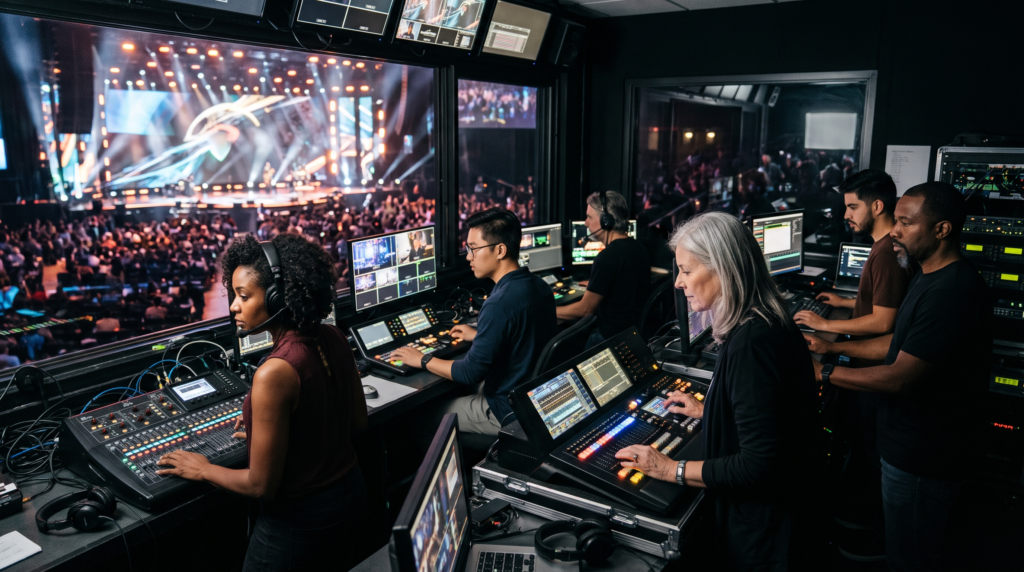
On the day, the agency manages brand ambassadors, product demos, sampling, registration and the show control booth that cues lighting, audio and video. Trained staff who can qualify a lead in 60 seconds are often the biggest difference between agencies.

Content capture and amplification

Photo, video and creator content captured on site extends the event far beyond the room. Strong agencies publish highlights within 24 to 48 hours.

Lead capture and follow-up

Badge scans, QR codes and digital forms feed straight into your CRM, with follow-up sequences ready to send. These services often overlap with experiential marketing, which focuses on the immersive brand moment itself.

Event marketing agency producers in a show control booth cueing lighting, video and audio during a live brand event
Show control: where an event marketing agency keeps run-of-show, content and cues aligned.

Event marketing agency vs event management company vs experiential agency

An event marketing agency drives business results from events, an event management company runs the event itself, and an experiential agency creates the hands-on brand experience.

Event marketing agencyEvent management companyExperiential agency
Main goalMarketing results: awareness, leads, salesSmooth logistics and flawless deliveryMemorable, immersive brand interaction
Typical deliverablesStrategy, promotion, activation, lead capture, ROI reportingVenue, vendors, budgets, run-of-show, attendee managementPop-ups, installations, sampling, stunts, branded spaces
Success measured byQualified leads, pipeline, cost per lead, reachOn time, on budget, attendee satisfactionEngagement, dwell time, social reach, earned media
Best forTrade shows, launches, conferences, roadshowsConferences, galas, corporate meetingsConsumer launches, sponsorships, street activations

Which one do you need?

If you own the event and need it to produce pipeline or sales, you need an event marketing agency. If the event is already defined and you mainly need venues, vendors and timelines handled, an event management company is the better fit. If you want a consumer-facing moment people film and share, look at experiential specialists. Brand Guruz, a Toronto-based experiential marketing agency, combines event marketing and experiential work so one team owns both the experience and the result.

How much does an event marketing agency cost in Canada?

An event marketing agency in Canada typically costs $15,000 to $60,000 for a focused trade show program and $50,000 to $250,000 or more for a multi-city campaign, including production. The ranges below are typical estimates from our experience; your quote will depend on scope, city, season and how much is produced from scratch.

Program typeTypical all-in range (CAD)
Single trade show program (strategy, promotion, booth staffing, lead capture)$15,000 to $60,000
Product launch event in one city$40,000 to $150,000+
Conference or summit marketing program$30,000 to $120,000
Multi-city sampling or street team tour$50,000 to $250,000+
Ongoing event marketing retainer$5,000 to $20,000 per month

How do event marketing agencies price their work?

Most agencies use one of four models: a fixed project fee, a management fee of roughly 10 to 20 percent on top of production costs, a monthly retainer for a calendar of events, or hourly billing for strategy work, commonly in the $125 to $250 range. Ask for fees and production costs as separate lines.

What drives the cost up or down?

The biggest cost drivers are custom fabrication, the number of cities and days, staffing hours, venue and union labour rules, and paid promotion. Peak seasons, such as spring trade show season and the November to December holiday window, also push prices up. Reusing a modular booth across events lowers cost per event.

How to choose an event marketing agency step by step

Choose an event marketing agency by defining your goal first, then judging each candidate on strategy, relevant experience, the actual team and how they measure results. Follow these six steps.

Step 1: Define the business goal and budget range

Write down the single outcome that matters most, such as 300 qualified leads at a national trade show, and the budget range you can commit.

Step 2: Build a shortlist of three to five agencies

Look for agencies that have run your type of event, in your type of industry, in the cities you need. A national program needs a partner that can staff Vancouver, Calgary, Toronto, Ottawa and Montreal, not just one market. Our list of the best experiential marketing agencies in Canada is a useful starting point.

Step 3: Send the same written brief to every agency

A consistent brief lets you compare like with like. Include goals, audience, dates, cities, budget range and deliverables.

Step 4: Score the proposals on strategy, not just creative

Score each proposal on how well it answers the goal, the realism of its plan to attract attendees, the quality of its measurement plan and the clarity of its budget.

Step 5: Meet the people who will actually run your event

Ask to meet the account lead and producer who will be on site, not only the senior pitch team. Check references from clients with similar events.

Step 6: Agree on KPIs and reporting before you sign

Put the target metrics, the reporting format and the debrief date into the contract or statement of work.

Questions to ask before hiring an event marketing agency

Ask questions that reveal how an agency thinks, who will do the work and how it will prove results.

Questions about strategy and results

  • What would success look like for this event, and how will you measure it?
  • Show us a similar event you ran. What were the goals and what did it achieve?
  • How will you get the right people to attend, not just more people?

Questions about people and process

  • Who exactly will be on site, and how are brand ambassadors trained?
  • Do you produce in-house or subcontract fabrication, staffing and AV?
  • What is your plan if a shipment is late or a vendor cancels?

What red flags should you watch for?

Be cautious of agencies that cannot explain their measurement approach, will not separate fees from production costs, guarantee results they cannot control, or keep the delivery team hidden until after signing.

Event marketing agency and brand team reviewing results and ROI dashboards in a post-event debrief meeting
A post-event debrief turns attendance, leads and content into a clear ROI story.

How to measure event marketing ROI

Measure event marketing ROI by comparing the revenue or pipeline an event influences against its full cost, including fees, production, travel and staff time. Set the metrics before the event so data is captured on site, not reconstructed afterward.

Which event marketing metrics matter most?

  • Qualified leads and cost per qualified lead: the clearest measure for B2B trade shows and conferences.
  • Pipeline and revenue influenced: deals in your CRM that include an event touchpoint, tracked over 3 to 12 months.
  • Engagement: demos completed, samples distributed, dwell time and sessions attended.
  • Reach: attendees, social impressions, content views and earned media.

How do you calculate event ROI?

Use the simple formula: ROI equals revenue attributed to the event minus total event cost, divided by total event cost. For example, a $60,000 program that influences $240,000 in closed revenue returns 3 times its cost, or a 300 percent ROI. For a deeper method, read our guide to experiential marketing ROI, and follow Event Marketer for industry benchmarks.

A good debrief arrives within two weeks and compares results with each KPI, budget versus actual, and recommendations for the next event.

Why Brand Guruz for event marketing

Brand Guruz, a Toronto-based experiential marketing agency, plans, promotes and measures live brand experiences for companies that need events to deliver real business results. We bring strategy, creative, staffing, production and digital follow-up under one team, so nothing gets lost between the event floor and your CRM.

Our strength is reaching Canada’s diverse audiences. We build multicultural and multilingual activations across Toronto, Mississauga, Brampton, Markham, Vaughan and beyond, and scale programs to markets across Ontario and the rest of the country. Canada’s audiences are concentrated and varied: the Toronto CMA alone is home to about 6.2 million people according to Statistics Canada.

Every program starts with agreed KPIs and ends with a clear debrief. Explore our experiential marketing services to see how we work.

Event marketing agency FAQ

What does an event marketing agency do?

An event marketing agency plans, promotes, runs and measures live brand experiences such as trade shows, product launches, conferences and sampling tours. It sets the strategy and KPIs, designs the experience, drives the right audience to attend, manages staff and activation on site, captures leads and reports on results like qualified leads, reach and pipeline influenced.

How much does an event marketing agency cost in Canada?

Costs vary by scope, but in our experience a focused trade show program typically runs $15,000 to $60,000, a single-city product launch $40,000 to $150,000 or more, and a multi-city tour $50,000 to $250,000 or more. Ongoing retainers are commonly $5,000 to $20,000 per month. Always ask for fees and production costs as separate lines.

What is the difference between an event marketing company and an event management company?

An event marketing company is accountable for business results such as leads, awareness and sales, so it covers strategy, promotion, activation and measurement. An event management company focuses on running the event itself, including venues, vendors, budgets, timelines and attendee logistics. Many brands use both, or choose an agency that offers both under one team.

How far in advance should I hire an event marketing agency?

Hire an agency three to six months before a major event, and six to nine months ahead for multi-city tours or custom-built booths. That gives time for strategy, fabrication, permits and pre-event promotion. For peak periods such as spring trade show season or the holiday window, start even earlier because staff and venues book quickly.

How do I measure the ROI of event marketing?

Subtract the total event cost from the revenue the event influenced, then divide by the total cost. Because sales cycles can be long, also track leading indicators such as qualified leads, cost per qualified lead, demos completed and meetings booked. Agree on these metrics and the tracking method with your agency before the event starts.

Can one event marketing agency handle events across Canada?

Yes, if it has the staffing network and production partners to deliver in several markets. Ask candidates which Canadian cities they have produced in recently, how they recruit and train local brand ambassadors, and whether they support bilingual English and French activations for Quebec and other markets where French is needed.


Ready to hire an event marketing agency?

The right event marketing agency turns a line item in your budget into measurable pipeline, content and brand momentum. If you are planning a trade show calendar, a launch or a national tour for 2027, start with a clear goal and a partner who will be accountable for it.

Brand Guruz can help you shape the strategy, build the experience and prove the results. Contact Brand Guruz to book a free strategy call and get a scoped estimate for your next event.

Let's Grow Your Brand

Author