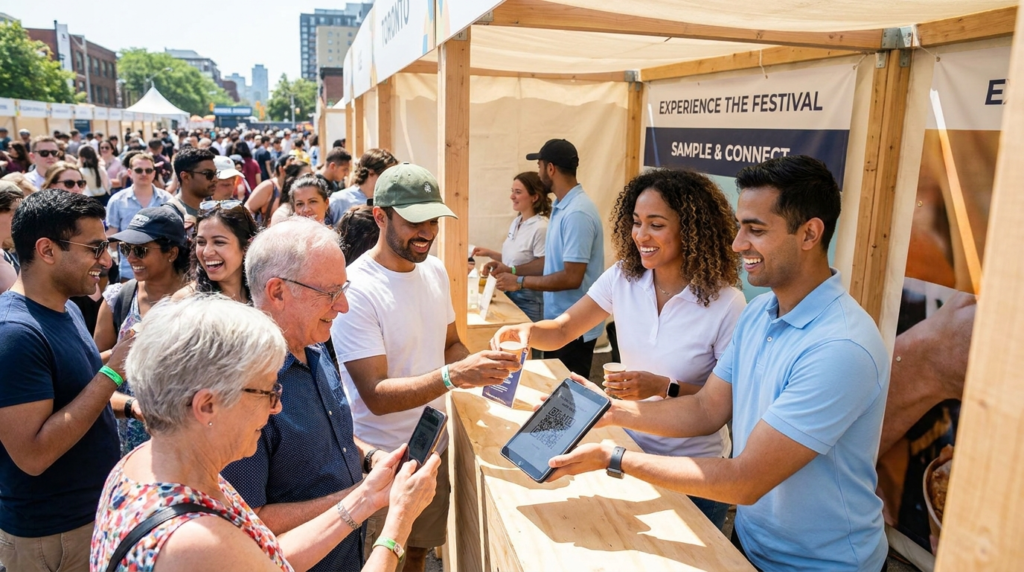
Event sponsorship is one of the fastest ways a Toronto brand can buy its way into a moment that people already care about. At Brand Guruz, we help brands turn that sponsorship spend into live activations that actually drive ROI, not just a logo on a banner.
Demand is real and commercial. Canadians search for event sponsorship roughly 210 times a month, and that intent climbs every fall as brands lock in next year’s calendar. Consequently, the brands that plan early win the best properties.
This guide explains what event sponsorship is, why it works so well in Toronto, and the sponsorship types worth your budget. Moreover, it covers what sponsorship costs and how to activate it for measurable returns.
First, a quick promise: everything here is practical. By the end, you will know exactly how to choose, price, and activate an event sponsorship across the GTA and Ontario.
210 — monthly Canadian searches for "event sponsorship", a commercial-intent term with rising fall demand · 88% — consumers who trust a personal recommendation over any ad (Nielsen) · 6.4M+ — people in the Greater Toronto Area, Canada's largest live-event and sponsorship market (Statistics Canada)
Event sponsorship is a paid partnership where a brand funds an event in exchange for visibility, access, and the right to activate on-site. In short, you pay for a stage, and then you use it. That second half is where most of the ROI hides.
A sponsorship fee buys rights and exposure. However, an activation is what you actually do with those rights. Therefore, the smartest brands treat the fee as a ticket, not the show. As a result, the budget that turns a logo into a live brand experience matters just as much as the fee itself.
Because a banner alone rarely moves sales, activation is the difference between spend and return. For instance, a sampling booth, a branded lounge, or a lead-capture game turns passive impressions into real conversations. In practice, that is how event sponsorship becomes measurable experiential marketing rather than a donation.
That distinction also shapes your budget split. Generally, we tell Toronto brands to reserve a healthy share of total spend for the activation, not just the rights fee.
People trust people far more than they trust ads. In fact, Nielsen reports that 88% of consumers trust a personal recommendation above every other channel. Therefore a well-activated event sponsorship earns trust that a banner ad simply cannot buy.
An event has already done the hard work of gathering people. Consequently, your sponsorship plugs your brand into an engaged, in-person crowd on day one. Moreover, that audience arrives in a good mood, which makes them far more open to a brand conversation.
Great activations get photographed, posted, and shared. As a result, a single sponsored moment can travel far beyond the venue. In effect, the crowd becomes your media team, and your reach compounds after the event ends.
Timing sharpens all of this too. Because Toronto’s festival and conference calendar is dense, a sponsorship puts your brand exactly where attention already lives.
The Greater Toronto Area is the richest sponsorship market in the country. Notably, Statistics Canada counts more than 6.4 million people in the region, which gives sponsors an unmatched concentration of events and audiences.
Downtown Toronto hosts marquee festivals, galas, and conferences. Meanwhile, Mississauga, Brampton, Markham, Scarborough, and Vaughan deliver dense, multicultural crowds that reward local sponsors. Together, they give brands a full year of high-intent sponsorship windows.
Sponsorship demand does not stop at the city limits. In addition, Ontario markets such as Ottawa, Hamilton, and London reward brands that show up in the community. A strong partner can activate a single sponsorship strategy across all of them.
Season matters as much as place. Because summer festivals, fall conferences, and holiday galas each open a different window, planning ahead is a genuine advantage in this market.
Not every sponsorship is the same. However, most opportunities fall into a few clear tiers. Use this list to match your goal to the right property and price. For live industry benchmarks, follow Event Marketer.
A title sponsor gets top billing, often inside the event name itself. Consequently, this tier delivers the most exposure and the highest price. It suits brands that want to own a moment outright.
A category sponsor owns one lane, such as the official drink, bank, or telecom partner. As a result, you gain exclusivity in your space without paying for the whole event. For many brands, this is the sweet spot of value and visibility.
Here you sponsor a specific footprint, like a stage, lounge, or sampling zone. Because you control that space, you can build a true brand experience inside it. In practice, this tier converts the best because guests actually interact with you.
This tier trades support for reach across an event’s channels and community goodwill. Specifically, it fits smaller budgets and cause-led brands. Even so, paired with a small on-site activation, it can punch well above its price.
Most brands eventually ask the same question. Which partner should actually run the sponsorship and activation? The dozen agencies competing for the same Canadian brief tend to pitch the same three things, so the real differences hide in execution.
The best partners do more than negotiate a rights fee. Instead, they design the activation, staff it, and measure it end to end. Therefore, when you compare providers, look past the pitch deck to the on-site results. To weigh your options, read our guide to the top experiential marketing agencies in Canada.
Ask two questions before you sign. First, who staffs the activation on event day? Second, how will you report on leads and ROI afterward? Because strong agencies answer both without hesitation, the responses quickly separate the leaders from the rest.
A sponsorship succeeds on purpose, not by luck. Accordingly, we run every activation through four clear steps.
Decide what success looks like first, whether that is leads, trial, or awareness. Because the goal shapes every choice, it comes before the creative.
Match the audience to your brand, then pick the sponsorship tier that fits your budget. For example, a launch may need an activation footprint, while a cause play may suit a community tier.
Build a reason for guests to stop, play, and share. In practice, sampling, games, and photo moments turn a logo into a memory. Meanwhile, trained ambassadors keep the energy high and the brand on message.
Finally, capture leads on-site and tie them to outcomes. Because numbers close the loop, you should report on reach, leads, and cost per engaged attendee after every event.
Cost is usually the first practical question. Fortunately, event sponsorship in Toronto scales to almost any budget and goal.
Community and media tiers often start in the low thousands. Meanwhile, category and activation packages commonly run from roughly $10,000 to $50,000, and title sponsorships of major festivals climb well into six figures. For the activation side of the budget, see our brand activation cost in Ontario guide.
Price alone is the wrong lens. Instead, judge sponsorship by cost per engaged attendee and the leads it drives. For proof that activation pays back, see our CIBC case study. So a slightly pricier property that doubles engagement is often the cheaper choice in the end.
Brand Guruz is a Canadian experiential marketing agency built for live, multicultural audiences. Specifically, we source the sponsorship, design the activation, and staff it with ambassadors who reflect the communities you want to reach.
That focus matters. Because we run the on-site experience and the digital follow-up together, every guest a sponsorship attracts can become a tracked lead. In practice, that turns a great moment into measurable revenue. Explore our experiential marketing work, browse our case studies, then talk to Brand Guruz.
Few agencies close that loop. Since we own both the activation and the follow-up, no valuable lead slips through the cracks after the event ends.
Event sponsorship is a paid partnership where a brand funds an event in exchange for visibility, access, and the right to activate on-site. In short, you pay for a stage and then use it to reach the crowd.
Costs vary by tier. Commonly, community and media tiers start in the low thousands, category and activation packages run about $10,000 to $50,000, and title sponsorships climb into six figures.
Define your goal, shortlist events that match your audience, then request their sponsorship packages. Next, compare tiers by cost per engaged attendee, and reserve budget for the on-site activation.
Sponsorship buys the rights and exposure. Activation is what you do with them on-site, such as sampling, a branded lounge, or lead capture. The activation is where most of the ROI comes from.
Activation and experience sponsorships usually convert best, because guests interact with your brand directly. Category sponsorships offer strong value through exclusivity in your space.
Yes. Strong sponsors activate in Toronto, Mississauga, Brampton, Markham, Scarborough, and Vaughan, plus Ottawa, Hamilton, and London, all from one sponsorship strategy.
Plan three to six months ahead for most properties. For marquee festivals and title tiers, reach out earlier, since the best sponsorships and dates get claimed fast.

Ready to turn an event sponsorship into real ROI? Then let us find the right property and build the activation that hits your goal.
Brand Guruz sources, designs, and runs sponsorships across Toronto, the GTA, and all of Ontario. Tell us your objective, and we will design the experience to deliver it. To start, book a quick call through our contact page, or explore proven results in our case studies.