Experiential Marketing Agency in Canada: The 2026 Guide to Activations That Move Markets

Choosing an experiential marketing agency is one of the highest-leverage decisions a Canadian brand can make in 2026. The right partner turns a product message into a moment people feel, share, and remember. The wrong one delivers a nice-looking booth and a thin report. Brand Guruz exists to be the first kind. As a Canadian experiential marketing agency built for live, multicultural audiences, we design activations that change behaviour, not just impressions.

This guide is written for the brand manager doing the research right now. First, it explains what an experiential marketing agency actually does. Next, it shows why live experience still outperforms almost every other channel. Then it walks through how the top agencies compare, what activations cost, and how to run the process end to end.

The stakes are real. Attention is scarce, ad trust is falling, and the brands winning in Canada are the ones showing up in person. So let us be clear from the start: experiential is not a nice-to-have anymore. It is how modern brands earn the trust that media alone can no longer buy.

$128B+ — projected global spend on experiential and event marketing in 2026, one of the fastest-growing lines in the marketing mix (Event Marketer / PQ Media) · 88% — consumers who trust a recommendation from people they know over any form of advertising (Nielsen) · 6.4M+ — people in the Greater Toronto Area, Canada's largest and most brand-competitive market (Statistics Canada)

What an experiential marketing agency actually does

An experiential marketing agency designs and runs live brand experiences that get people to act. In practice, that means turning a strategy deck into a real moment: a sampling activation, a pop-up, a festival footprint, a launch event, or a national tour. The agency owns the idea, the build, the staffing, and the measurement.

The core job: turning a message into a moment

Traditional advertising tells people something. Experiential lets them experience it instead. As a result, the brand stops being a logo on a screen and becomes something a person tasted, touched, or played with. That shift is the whole point.

Strategy first, logistics second

A good agency starts with the behaviour you want to change, not the tent you want to rent. Consequently, the brief drives the format — not the other way around. Weak agencies flip that order, and it shows in the results.

The full experiential stack under one roof

The strongest partners cover the entire chain: insight, creative, fabrication, permits, staffing, and reporting. Because it all sits in one team, nothing gets lost between vendors. This is the difference between a coordinated campaign and a pile of invoices. To see the range, explore our overview of experiential marketing and how the pieces fit together.

Why experiential marketing outperforms almost everything else

Experiential works because it earns trust in a way paid media cannot. In 2026, that advantage is bigger than ever. Ad avoidance is high, feeds are crowded, and shoppers screen out most messages on sight. A real, in-person moment cuts through all of it.

The trust premium

People trust people. According to Nielsen, 88% of consumers trust recommendations from people they know above every other form of advertising. A live activation manufactures exactly that: a real human, a real interaction, and a story worth repeating. That is trust you cannot buy on an impression basis.

The memory advantage

Experiences stick because they engage more than one sense. Furthermore, a moment tied to emotion is recalled far longer than a banner ever could be. When the category decision finally happens, the brand that created a feeling is the one that gets remembered.

The earned-media multiplier

Great activations do not stay in one place. Instead, attendees film them, post them, and send them to the group chat. In effect, a single well-designed moment becomes hundreds of authentic pieces of content. That earned reach is why experiential punches above its media weight.

Experiential marketing across Canada and the GTA

Canada is a uniquely rewarding place to run experiential campaigns. It is urban, diverse, and concentrated. For a brand that shows up well in person, the payoff is enormous.

Canada’s most concentrated, most diverse market

The Greater Toronto Area holds more than 6.4 million people, and Statistics Canada data confirms it is one of the most multicultural regions on earth. Therefore, a single Toronto activation can reach dozens of communities at once. Few markets in the world offer that density and diversity together.

Multicultural festivals as brand platforms

From Caribana to Diwali to Lunar New Year, Canada’s festival calendar is a year-round activation grid. Moreover, these moments come with built-in crowds, emotion, and cultural permission to celebrate. A brand that participates authentically is welcomed rather than tolerated.

From a single city to a cross-Canada tour

Smart brands rarely stop at one market. Instead, they take a winning activation from Toronto to Vancouver, Calgary, and Montreal as a coordinated tour. Because the creative is already proven, the tour scales the results rather than the risk.

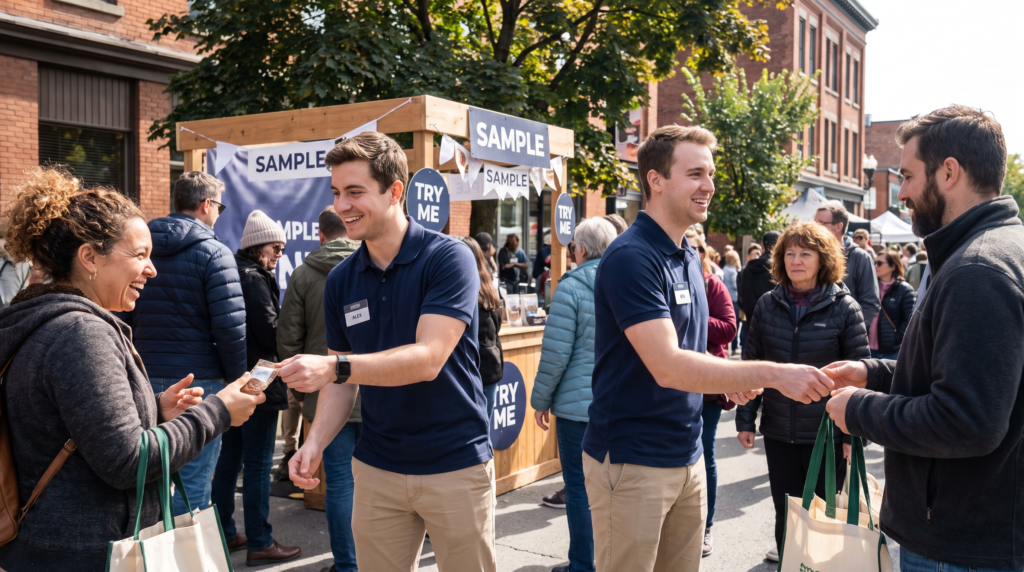
Experiential marketing brand ambassadors handing samples to multicultural attendees at a Canadian street festival activation

How the top experiential marketing agencies in Canada compare

Most Canadian agencies pitch the same three things: creativity, experience, and reach. On paper, they look identical. In practice, a few criteria separate the agencies that deliver ROI from the ones that deliver photos. Here is what a brand manager comparing the top experiential marketing agencies in Canada should actually weigh.

Strategy and insight, not just staffing

Anyone can supply bodies in branded shirts. The real question is whether the agency starts with a sharp audience insight. Specifically, ask to see the thinking behind a past campaign, not just the photos of it.

In-house production and staffing

Agencies that own their fabrication and their staff roster control quality and cost. By comparison, agencies that subcontract everything add margin and lose control. Ask who actually builds the set and who trains the ambassadors.

Measurement a CMO will respect

Impressions are not outcomes. The best agencies report on sampling-to-purchase, data capture, and earned media, using benchmarks the industry recognizes — the kind of standards Event Marketer tracks across the sector. If an agency cannot explain how it measures behaviour change, that is your answer.

Multicultural fluency

Canada is not a monoculture, so a generic activation underperforms here. Consequently, the agencies that win are the ones that can brief and staff a campaign across languages and communities with genuine credibility.

Full-service agency vs. specialist vs. in-house team

Before you shortlist anyone, decide what kind of partner you need. Broadly, brands choose between three models. Each has a clear trade-off.

The full-service experiential agency

A full-service agency handles strategy, build, staffing, and reporting together. As a result, you get one accountable team and a single throat to choke. For most brands running real activations, this is the lowest-risk option.

The single-tactic specialist

Specialists do one thing — fabrication, or staffing, or permits. They can be excellent at that one thing. However, you become the general contractor, stitching vendors together and owning every gap between them.

The in-house team

Building experiential in-house gives you control and brand knowledge. On the other hand, it is hard to staff, hard to scale, and idle between campaigns. Many brands keep strategy in-house and hand execution to an agency that does it every day.

The experiential activation playbook: from brief to ROI

A great activation is built on purpose, not by luck. Accordingly, we run every Brand Guruz campaign through the same four-step discipline. You can use it to brief any agency.

Step 1: Define the one behaviour you want to change

Start with a single, measurable goal. For example, drive trial, capture leads, or shift perception. Because everything else flows from this, a fuzzy goal produces a fuzzy activation.

Step 2: Design the moment around that goal

Next, build the experience backwards from the behaviour. Every element — the format, the flow, the giveaway — should push toward that one action. If a feature does not serve the goal, cut it.

Step 3: Staff it with the right faces

People make or break an activation. Therefore, staff it with ambassadors who reflect the audience and can actually tell the brand story. A great crew turns a sample into a conversation.

Step 4: Capture, measure, and re-market

Finally, capture data and content in the moment. Then measure against the Step 1 goal and re-market to everyone you met. In short, the activation is the beginning of the relationship, not the end.

Experiential marketing agency team planning a brand activation campaign on a whiteboard in a Toronto studio

What does experiential marketing cost in Canada?

Cost is usually the first practical question. Fortunately, experiential pricing in Canada is more predictable than most brands expect. It scales with scope, staffing, and build complexity.

Typical investment ranges

A focused single-market sampling or pop-up activation often starts in the low five figures. Meanwhile, a national tour with custom fabrication runs well into six figures. For a detailed breakdown, see our guide to brand activation costs in Ontario.

Cost per meaningful engagement

Do not judge experiential on total spend alone. Instead, judge it on cost per meaningful engagement — a real conversation, a sample tried, a lead captured. On that basis, a good activation frequently beats digital on quality of contact. Our CIBC activation case study shows how that math plays out in practice.

Where budgets get wasted

Budgets leak when the format outshines the goal. Specifically, brands overspend on the build and underspend on staffing and follow-up. A disciplined agency protects the dollars that actually drive behaviour.

Why brands choose Brand Guruz

Brand Guruz is a Canadian experiential marketing agency built for live, multicultural audiences. We connect brands to communities through activations that are felt, shared, and remembered — from festival footprints to national sampling tours.

Built for multicultural Canada

We do not bolt diversity on at the end. Rather, we build it into the insight, the creative, and the crew from day one. That is why our activations land as genuine in the communities that matter most to Canadian growth.

One team from strategy to street

Strategy, production, and staffing sit under one roof at Brand Guruz. Consequently, nothing gets lost between vendors, and the brief you approved is the campaign that shows up. Browse our case studies to see the range, then talk to our team to scope your next activation.

Frequently asked questions about experiential marketing agencies

What is an experiential marketing agency?

An experiential marketing agency designs and runs live brand experiences — activations, pop-ups, sampling, launches, and tours — that get people to act. It typically owns strategy, creative, build, staffing, and measurement.

What does an experiential marketing agency do day to day?

It translates a brand brief into a physical moment. That includes concepting the idea, fabricating the set, securing permits, hiring and training brand ambassadors, running the activation, and reporting on the results.

How is experiential marketing different from events?

An event gathers people. Experiential marketing uses that gathering to change a specific behaviour, such as trial or lead capture. In other words, experiential is an event with a measurable commercial job to do.

How much does an experiential marketing campaign cost in Canada?

A single-market activation often starts in the low five figures, while a national tour can run into six figures. Cost scales with staffing, build complexity, and the number of markets.

How do I measure experiential marketing ROI?

Measure against one defined behaviour — samples tried, leads captured, or sales lift — plus data captured and earned media generated. A strong agency sets these benchmarks before the activation runs, not after.

Why choose a Canadian experiential marketing agency?

A Canadian agency understands local permits, weather, and — crucially — the multicultural communities that drive growth here. That local fluency is hard to replicate from outside the market.

Does experiential marketing work for small brands?

Yes. A focused single-market activation lets a smaller brand create real advocates without a national budget. Because the moment is intimate, the word-of-mouth it generates is often stronger.


Work with a Canadian experiential marketing agency that delivers

Ready to turn your next campaign into a moment people actually remember? Then let us build it together. Brand Guruz plans, produces, and staffs experiential activations across Canada — from a single Toronto pop-up to a coast-to-coast tour.

Explore our case studies to see the work, or talk to our team to scope your activation today. Let us show you why Brand Guruz is the experiential partner Canadian brands trust.

Let's Grow Your Brand

Author