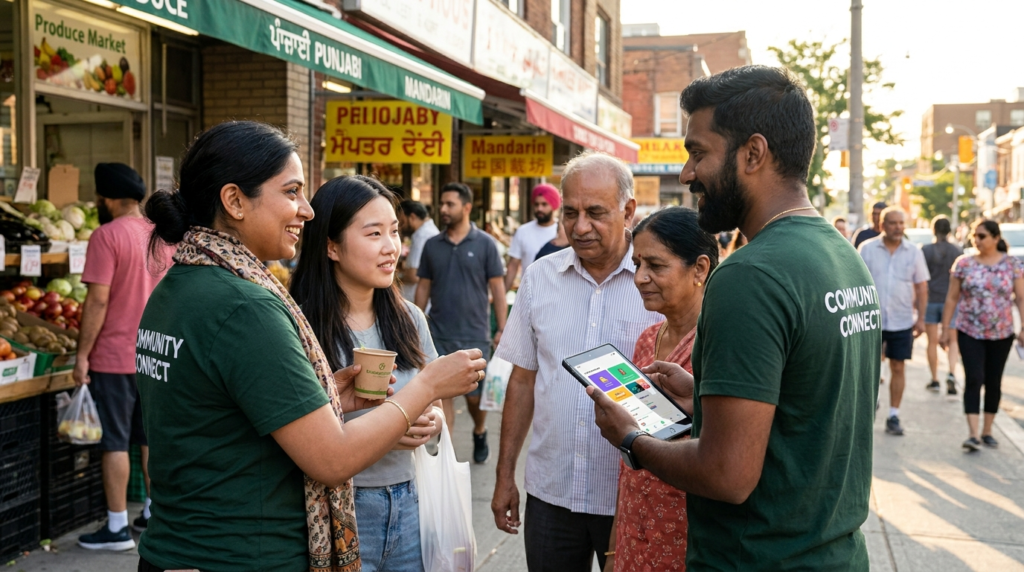
Toronto is one of the best cities in the world to run an experiential marketing activation. It is dense, transit-accessible, and home to a consumer base that is more culturally diverse than almost any other major North American market. However, choosing the wrong experiential marketing company in Toronto can turn that advantage into an expensive non-event. This guide is for brand managers, marketing directors, and business owners who want to make that decision carefully.
Furthermore, Brand Guruz is an experiential marketing company headquartered in Mississauga and operating across Toronto and the GTA. We have run product sampling programs, brand ambassador activations, multicultural community events, and full-scale brand experiences across this market. What follows is, therefore, what we have learned about what makes an experiential marketing company worth hiring — and what to watch for when one is not.
global experiential marketing service market in 2026 (Revenue Memo)
of consumers report higher purchase intent after participating in a brand experience
average ROI range for well-executed experiential marketing campaigns
The global experiential marketing service market stands at $55.53 billion in 2026, according to Revenue Memo’s comprehensive industry analysis. That figure surpasses digital advertising’s market share for the first time — 38% versus 35%. Additionally, experiential now commands the centre of marketing strategy. In short, experiential is no longer a supplementary channel. It is now the primary one for brands serious about conversion and retention.
The reason is not complicated. According to G2’s experiential marketing research, 74% of Fortune 1000 marketers plan to increase experiential marketing spending in 2025. They are following the data. Specifically, 85% of consumers report higher purchase intent after participating in a brand experience. Well-executed campaigns deliver 200–600% ROI — not through brand awareness alone, but through direct conversion and downstream word-of-mouth.
In Toronto specifically, experiential marketing has a structural advantage. Moreover, the city’s density and diversity amplify that advantage further than in most Canadian markets. The city’s density, diversity, and concentration of consumer spending make it one of the highest-upside environments for in-person activation in Canada. However, the Toronto market also has more competition, more permitting complexity, and more audience segmentation than most Canadian cities. So the stakes for choosing the right experiential marketing company in Toronto are correspondingly higher.
Before evaluating companies, it helps to be clear on what experiential marketing actually covers. The term is used loosely, and not every company that claims the label delivers the same thing.
Nevertheless, a genuine experiential marketing company in Toronto plans, staffs, and executes in-person brand experiences that create direct consumer engagement. That includes product sampling programs, brand ambassador activations at retail or festival environments, pop-up shop experiences, street team campaigns, multicultural community activations, and full event-led brand moments. The common thread is physical presence, human interaction, and measurable consumer response.
This is distinct from event planning, which focuses on logistics and guest experience rather than brand conversion. Similarly, it differs from a traditional advertising agency. A traditional advertising agency builds campaigns around media placement rather than on-the-ground execution. The best experiential marketing companies bridge all three — they think strategically, execute operationally, and integrate digital amplification so the physical activation generates lasting brand lift.
In Toronto, the multicultural dimension adds another layer. The city’s consumer base is among the most diverse in Canada. South Asian, East Asian, Caribbean, and other communities represent a significant share of household spending in many categories. An experiential marketing company that cannot staff and execute fluently across those communities is missing a large part of the Toronto market. For the audience intelligence that underpins this kind of targeting, see our multicultural market research guide.
Most Toronto experiential marketing companies can run a booth. Fewer can plan a multi-touch campaign across diverse neighbourhoods, staff it bilingually, and tie results back to measurable business outcomes. These five criteria separate the ones that can from the ones that cannot.
Track record in your specific format. Product sampling, trade show presence, and street team campaigns each require different skills. Ask for case studies in your product category. Broad claims with thin format-specific experience produce weak results.
Multicultural reach across Toronto’s key communities. According to Statistics Canada’s 2021 Census, Toronto’s South Asian, East Asian, and Caribbean communities are among the fastest-growing visible minority populations in the GTA. Each of these communities requires specific cultural fluency — not just translation. Ask directly: does the agency have in-community staff, or do they source general labour and call it multicultural? The difference shows in conversion rates. For more, see our brand ambassador program guide.
Full-funnel integration. The best activations generate social content and first-party data alongside the physical interaction. A company without a digital integration strategy is leaving most of that value on the table.
Staff quality and training. Brand ambassadors are the activation. A company that sources untrained general staff and calls it a brand activation will deliver weak results. Ask how ambassadors are selected, trained, and supervised. These details determine whether your brand is represented well or merely present.
Measurement and reporting rigor. Define KPIs before signing anything. Ask how the company captures metrics on the ground and reports post-activation. Impressions are not KPIs. Cost per engaged consumer and trial-to-purchase conversion are. For the framework, see our experiential marketing ROI guide.
Experiential marketing costs in Toronto vary enormously based on activation format, duration, location, and staffing requirements. However, the following ranges reflect realistic 2026 pricing for most program types.
Entry-level single activation ($5,000–$15,000): A focused one-day or weekend sampling or ambassador program at a single Toronto location. Suitable for brands testing a new market or format. Expect a lean team, modest production, and limited digital integration.
Mid-tier multi-day or multi-location program ($15,000–$50,000): Covers meaningful reach across two or three Toronto locations, professional build-out, trained staff, and post-activation reporting. This is the range where most growing brands run their annual retail or sampling programs. For the staffing framework that applies at this tier, see our in-store pop-up and sampling guide.
Full campaign activation ($50,000–$200,000+): Multi-week or multi-market program with digital integration, UGC strategy, multicultural community targeting, and comprehensive ROI reporting. For enterprise brands with national ambitions, this is the level of investment that produces category-level brand lift.
Generally, a useful cost benchmark is $5–$15 per directly engaged consumer, depending on activation complexity. A well-executed sampling program that generates 2,000 qualified engagements at $10 per engagement is a $20,000 program — and at an 85% purchase intent rate, the downstream revenue math usually justifies the spend decisively.
Brand Guruz plans and executes experiential marketing programs across Toronto and the GTA as an integrated capability — not as a side service. The team covers strategy, staffing, on-ground execution, multicultural community targeting, and post-activation measurement under one roof.
Our brand ambassador roster spans Punjabi, Hindi, Urdu, Tamil, Gujarati, Cantonese, and Mandarin-speaking talent alongside mainstream English market staff. Consequently, we can run a Queen West pop-up and a Brampton community sampling program simultaneously — with the right people in each location. That distinction matters because it is precisely what drives the conversion rate gap between a good activation and a forgettable one.
Beyond staffing, we bring the strategic layer that most activation-only companies do not. Our team has planned multicultural festival presences, retail sampling rollouts, and B2B conference activations across Canada. In each case, the approach is consistent: start with the audience intelligence, build around it, staff it specifically, and measure against pre-defined KPIs. For a closer look at that approach in practice, see our case studies.
What is an experiential marketing company and how is it different from an event planner? An experiential marketing company designs and executes brand experiences intended to drive consumer engagement, trial, and conversion. The focus is on measurable outcomes — purchase intent, lead capture, social amplification — rather than event logistics. An event planner focuses on guest experience and operational execution. Both serve different objectives. For brand-building and sales activation, an experiential marketing company is the right partner.
How do I find the best experiential marketing company in Toronto? Start with format-specific case studies, not general credentials. Ask for examples in your category. Evaluate multicultural capability specifically. Finally, ask how they measure results — an experiential company that cannot articulate a clear measurement methodology is not operating professionally.
What should an experiential marketing company in Toronto cost in 2026? Budget $5,000–$15,000 for a lean single-location activation, $15,000–$50,000 for a multi-day program, and $50,000–$200,000+ for a full integrated campaign. A useful benchmark is $5–$15 per directly engaged consumer.
Does Brand Guruz offer multicultural experiential marketing in Toronto? Yes. Brand Guruz’s ambassador roster includes Punjabi, Hindi, Urdu, Tamil, Gujarati, Cantonese, and Mandarin-speaking staff alongside mainstream English market talent. We activate across Toronto’s South Asian, East Asian, Caribbean, and mainstream communities — often in the same campaign week.
How do I measure the ROI of experiential marketing? Define your KPIs before the activation — not after. Standard metrics include cost per engaged consumer, trial-to-purchase conversion rate, leads captured, social amplification ratio, and post-activation sales lift in targeted locations. Compare activated markets against control markets to isolate the experiential effect from other marketing activity. Well-executed experiential programs typically generate 200–600% ROI when measurement is built into the program design from the start.

Talk to Brand Guruz about your 2026 experiential marketing program — sampling, activation, multicultural reach, or a full campaign. We know this market because we work in it every week.