Guerrilla Marketing in Canada: The 2026 Brand Guide to Low-Cost, High-Impact Activations

Guerrilla marketing is the art of winning attention with creativity instead of a giant media budget. In short, it swaps expensive ad space for a surprising, in-person moment people actually want to share. For Canadian brands facing rising media costs, that trade is more valuable than ever.

At Brand Guruz, we build guerrilla marketing campaigns that turn a single street corner into a week of earned coverage. Because the tactic is built on surprise, it rewards ideas over spend. As a result, a challenger brand can out-punch a category leader with a fraction of the money.

This guide breaks down what guerrilla marketing is, why it works, what it costs in Canada, and how to run it without a legal or brand-safety misstep. Along the way, we show where guerrilla marketing fits inside a wider experiential marketing strategy.

$128B+ — global experiential and event marketing spend brands now commit to live moments (Event Marketer) · 88% — consumers who trust a personal recommendation over any paid ad (Nielsen) · 6.4M+ — people in the GTA, Canada’s largest and most competitive brand market (Statistics Canada)

What is guerrilla marketing?

Guerrilla marketing is a strategy that uses unconventional, low-cost tactics to create a big impression. The term comes from guerrilla warfare, where small forces win through surprise and speed. Similarly, a lean brand wins here through imagination, not media weight.

A simple, quotable definition

Put simply, guerrilla marketing places an unexpected brand experience where people already are. For example, it might be a sidewalk installation, a flash performance, or a clever transit takeover. The goal is always the same: stop someone mid-stride and earn a reaction worth sharing.

How it differs from traditional advertising

Traditional advertising buys attention. In contrast, guerrilla marketing earns it. Because the moment feels novel rather than paid, audiences lower their guard and lean in. That is why a strong stunt often outperforms a banner campaign that cost ten times more.

Where guerrilla marketing fits in the mix

Guerrilla marketing is not a replacement for your whole plan. Instead, it is the spark that makes the rest of your experiential marketing work harder. Used well, one activation feeds your social, PR, and retail channels for weeks.

Why guerrilla marketing works so well

Guerrilla marketing works because it is built on human psychology, not ad frequency. People remember surprise. Moreover, they trust what they discover far more than what they are told to believe.

The trust premium

Trust is the real engine here. In fact, Nielsen reports that 88% of consumers trust a recommendation from someone they know over any form of paid advertising. A live guerrilla moment turns a stranger into that trusted messenger. Consequently, every phone that films your stunt becomes a credible ad you did not pay for.

The earned-media multiplier

A great stunt does not end when the crowd leaves. Rather, it travels through social feeds, group chats, and local news. As a result, a modest on-the-ground budget can generate reach that rivals a national campaign. That is the multiplier every CMO wants.

Emotion drives memory

Emotion is what makes a brand stick. Because guerrilla marketing makes people laugh, gasp, or pause, it plants a memory that a scroll-past ad never could. Clearly, a feeling outlasts an impression.

Guerrilla marketing across the GTA and Ontario

Canada rewards guerrilla marketing because its cities are dense, diverse, and highly walkable. Notably, Statistics Canada counts more than 6.4 million people in the Greater Toronto Area alone. For a street-level activation, that concentration is a gift.

Toronto: the highest-density stage

Toronto packs enormous foot traffic into a handful of corridors. Take Yonge-Dundas, the waterfront, or Kensington Market. Each delivers thousands of daily passersby, which means a single well-placed stunt reaches a genuinely large audience.

Beyond the core: Mississauga, Brampton, Scarborough

The suburbs matter too. In particular, Mississauga, Brampton, and Scarborough hold some of Canada’s most multicultural neighbourhoods. Therefore, a culturally fluent guerrilla campaign can land deeper here than a generic downtown buy ever would.

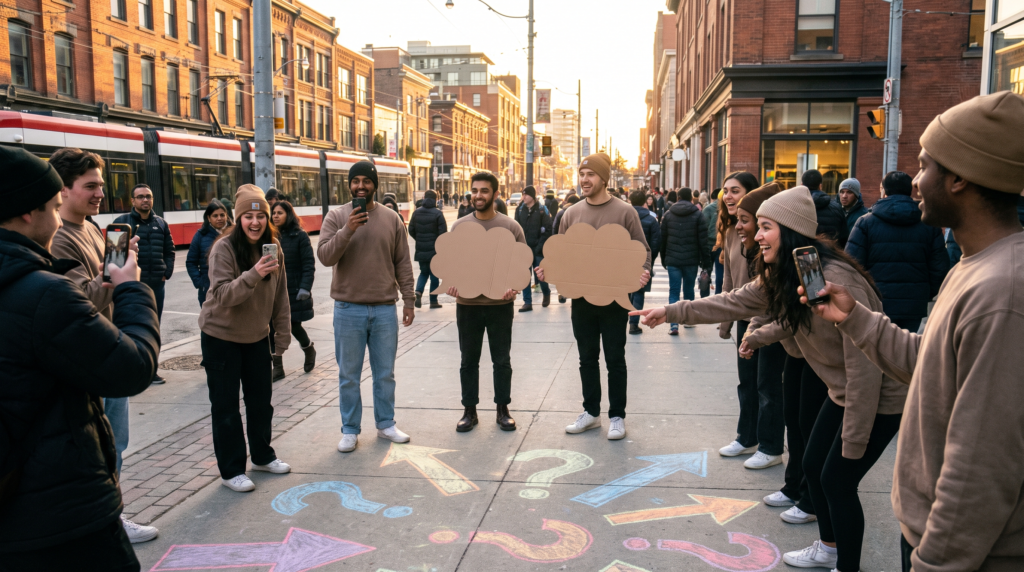
Guerrilla marketing flash activation with brand ambassadors on a Toronto street, Ontario

Types of guerrilla marketing campaigns

Guerrilla marketing is a family of tactics, not a single format. Below are the styles Canadian brands use most. Importantly, the best campaigns often blend two or three.

Ambient and street installations

Ambient marketing turns everyday surfaces into a canvas. For instance, a staircase becomes a piano, or a bus shelter becomes a product demo. Because the placement is clever, the brand earns a smile before it earns a sale.

Experiential stunts and flash activations

A flash activation drops a surprise experience into a public space, then vanishes. Consequently, it creates urgency and a strong reason to film. This is guerrilla marketing at its most social-ready.

Ambush and event-adjacent marketing

Ambush tactics ride the energy of a big moment without paying for official sponsorship. However, they demand care to stay legal and on-brand. Done right, they capture a crowd that is already primed to engage.

Projection, wild posting, and sticker campaigns

Low-cost visual tactics still punch hard. Specifically, projections, wild posting, and sticker runs blanket a neighbourhood for very little money. As a result, they build local buzz fast on a challenger budget.

How guerrilla marketing agencies in Canada compare

Most Canadian agencies pitch the same three things: a big idea, a production crew, and a case study reel. Yet the real difference shows up on the street, where execution either lands or falls flat. Here is how to read the field of top experiential marketing agencies in Canada without the sales gloss.

The seven signals that separate the best

The strongest partners share seven traits. First, a sharp strategic idea. Second, permits and legal fluency. Third, multicultural insight. Next, a vetted staffing bench. Then, real-time content capture, tight measurement, and finally a fast, safe teardown. If an agency is thin on any one, your risk climbs.

Full-service agency vs. freelancer vs. in-house

Brands usually weigh three routes. A freelancer is cheap but stretched thin. An in-house team knows the brand but rarely owns permits or crews. By comparison, a full-service guerrilla marketing agency carries the strategy, the legal cover, and the people under one roof. For most brands, that is the safest path to scale.

The guerrilla marketing playbook: 5 steps

A guerrilla campaign looks spontaneous, but it is carefully built. In practice, we run every activation through five stages. According to Event Marketer, the brands that plan the capture and the compliance up front are the ones that go viral for the right reasons.

Step 1: Define one sharp objective

Start with a single goal. For example, drive trial, grow a list, or earn press. Because one clear objective shapes every creative choice, it keeps the stunt from becoming noise.

Step 2: Find the surprise

Next, hunt for the twist. The idea should feel unexpected yet obviously on-brand. If a passerby cannot connect it to your product in three seconds, refine it.

Step 3: Handle permits and brand safety

Then, lock the legal side. Specifically, secure permits, insurance, and site permission before anything goes live. This step is unglamorous, yet it is what separates a hit from a headline you did not want.

Step 4: Plan the capture

Content is the payoff. Therefore, staff a photo and video crew whose only job is to capture reactions cleanly. Without that footage, the campaign dies when the crowd disperses.

Step 5: Amplify and measure

Finally, push the footage across social, PR, and paid retargeting the same day. Meanwhile, track reach, engagement, and conversions against your Step 1 goal. That loop turns a stunt into a measurable result.


Marketing team planning a guerrilla marketing campaign at a Toronto agency studio

What does guerrilla marketing cost in Canada?

Cost is usually the first practical question. Fortunately, guerrilla marketing scales to almost any budget. Still, the honest ranges below help you plan. For a fuller picture, see our breakdown of brand activation costs in Ontario.

Typical investment ranges

A lean sticker or wild-posting run can start near $3,000 to $8,000. A mid-tier street activation with staff and content usually lands between $15,000 and $50,000. Meanwhile, a multi-city guerrilla tour with heavy production can climb well past $100,000.

Cost per engaged person

Judge value by cost per engaged person, not headline spend. Because a strong stunt earns organic reach, the effective cost per view often beats paid media. Our CIBC activation case study shows how a focused activation delivered outsized attention for the money.

Why brands choose Brand Guruz for guerrilla marketing

Brand Guruz is a Canadian experiential marketing agency built for live, multicultural, city-level activation. In our experience, guerrilla marketing succeeds or fails on execution, so we own every step in-house. That means one accountable team from idea to teardown.

Strategy, permits, and people under one roof

We pair a sharp creative idea with permit fluency and a vetted staffing bench across the GTA. Consequently, your stunt stays legal, on-brand, and fully staffed on the day it matters. Explore our case studies to see the range.

Multicultural fluency that lands

Canada is not one audience; it is many. Because our teams speak the languages and know the neighbourhoods, our activations connect where generic campaigns stall. Ready to build one? Then talk to our team and we will map the moment.

Frequently asked questions: guerrilla marketing in Canada

What is guerrilla marketing in simple terms?

Guerrilla marketing is a low-cost, high-creativity strategy that places a surprising brand experience where people already are. In short, it earns attention instead of buying it.

Is guerrilla marketing legal in Canada?

Yes, when it is done correctly. However, most public activations need permits, insurance, and site permission. A professional agency secures these before anything goes live.

How much does a guerrilla marketing campaign cost?

Budgets range widely. A simple run can start near $3,000, while a mid-tier street activation often lands between $15,000 and $50,000. Larger multi-city tours cost more.

How is guerrilla marketing different from experiential marketing?

Guerrilla marketing is a tactic focused on surprise and low spend. Experiential marketing is the broader category of live brand experiences. In practice, guerrilla campaigns sit inside an experiential strategy.

Does guerrilla marketing work for small brands?

Absolutely. Because the tactic rewards ideas over budget, challenger brands often win here. A clever stunt can out-perform a competitor spending far more on paid media.

How do you measure guerrilla marketing results?

Measure it against one objective set up front. Typically, that means tracking earned reach, engagement, footfall, and conversions, then comparing cost per engaged person to paid media.

Plan your next guerrilla marketing campaign with Brand Guruz

Ready to turn a street corner into your next big brand moment? Then let us build a guerrilla marketing campaign that is creative, compliant, and built to travel. talk to our team to start, or browse our case studies to see what a Brand Guruz activation looks like in the wild.

Let's Grow Your Brand

Author