Mobile Marketing Tours in Canada: How Brand Roadshows Work and What They Cost (2026)

A mobile marketing tour is a multi-city experiential campaign in which a branded vehicle, trailer, or pop-up travels from market to market so people can see, touch, and try a product in person. Brand Guruz, a Toronto-based experiential marketing agency, runs mobile marketing tours across Canada, and most national programs cost roughly 150,000 to 750,000 dollars.

Updated November 2026. This guide explains how a brand roadshow actually works, the types of tours you can run, what each element costs, how to plan a route, and how to measure return. It is written for brand and marketing leaders planning a multi-city experiential tour or sampling tour in Canada.

Key takeaways

  • A mobile marketing tour brings an experiential brand activation directly to shoppers across several cities instead of waiting for them to come to you.
  • National roadshows in Canada typically run 150,000 to 750,000 dollars, driven by city count, vehicle build, staffing, and tour length.
  • Popular formats include sampling tours, demo trailers, pop-up trucks, campus tours, festival circuits, and retail parking-lot activations.
  • A Toronto or GTA hub plus Ottawa, Montreal, Vancouver, Calgary, and Edmonton covers most of Canada’s population efficiently.
  • Measure success with impressions, samples distributed, leads and data captured, and post-tour sales lift, not gut feel.

128 billion dollars-plus — global experiential and event marketing spend (Event Marketer) · 88 percent — consumers who trust a personal recommendation over any ad (Nielsen) · 40 million-plus — people across Canada a national tour can reach market to market (Statistics Canada)

What Is a Mobile Marketing Tour?

A mobile marketing tour is a brand experience on wheels. Instead of a single booth in one city, a vehicle, trailer, or truck carries the activation to multiple markets on a planned route, giving many more people a hands-on moment with the brand. It is one of the most direct forms of experiential marketing because the product meets the customer where they already are.

The vehicle is the venue

The build is the stage. Common rigs include branded cargo trailers, glass-box demo trucks, Airstream-style campers, sprinter vans, and box trucks that unfold into a footprint with sampling counters, screens, and seating. The vehicle wrap doubles as a moving billboard between stops, earning impressions on the highway as well as at the curb.

Why brands choose to travel

People trust what they can experience. According to Nielsen, 88 percent of consumers trust a personal recommendation above any paid channel, and a live trial earns that trust at scale. A tour also spreads one creative idea across many cities, so the cost of the build is amortised over a far larger audience than a one-off event.

How Does a Brand Roadshow Work?

A brand roadshow works like a travelling production: a fixed route, scheduled stops, a repeatable activation at each stop, and a trained crew that sets up, runs, and strikes the experience city after city. The goal is a consistent brand moment that feels fresh in every market.

Route, stops, and dwell time

Planners map a route that minimises drive time and maximises foot traffic, then lock stops at malls, festivals, campuses, transit hubs, grocery lots, and sports venues. Each stop runs anywhere from a few hours to several days, depending on the audience and the permit. Travel days sit between activation days so the crew and the build arrive rested and intact.

Staffing and logistics at each stop

A typical crew includes a tour manager, a driver, brand ambassadors, and a technician for screens and sampling gear. At each stop the team sets up, greets the public, demos or samples the product, captures data, and tears down. Behind the scenes, logistics cover permits, parking, power, insurance, restocking, and a daily report so the brand can track performance in near real time.

What Types of Mobile Tours Can Brands Run?

Mobile tours come in several formats, and the right one depends on your product, audience, and budget. Most national programs blend two or three of these into one route.

Sampling tours and demo trailers

Sampling tours put the product straight into people’s hands, which suits food, beverage, personal care, and CPG brands. A product sampling tour pairs a branded counter with ambassadors who hand out trials and talk through benefits. Demo trailers go deeper, giving shoppers a guided, interactive walkthrough of a gadget, appliance, or vehicle inside a climate-controlled space.

Pop-up trucks and mobile retail

Pop-up trucks turn a vehicle into a tiny store or cafe, ideal for merch drops, limited editions, and direct-to-consumer launches. They work on busy downtown streets, outside stadiums, and at markets, and they let a brand sell as well as sample.

Campus, festival, and retail-lot circuits

Campus tours reach students at universities and colleges during peak terms. Festival circuits follow summer music, food, and cultural festivals where crowds are large and primed for fun. Retail and parking-lot activations partner with grocery and big-box chains so the tour lands exactly where purchase decisions are made.

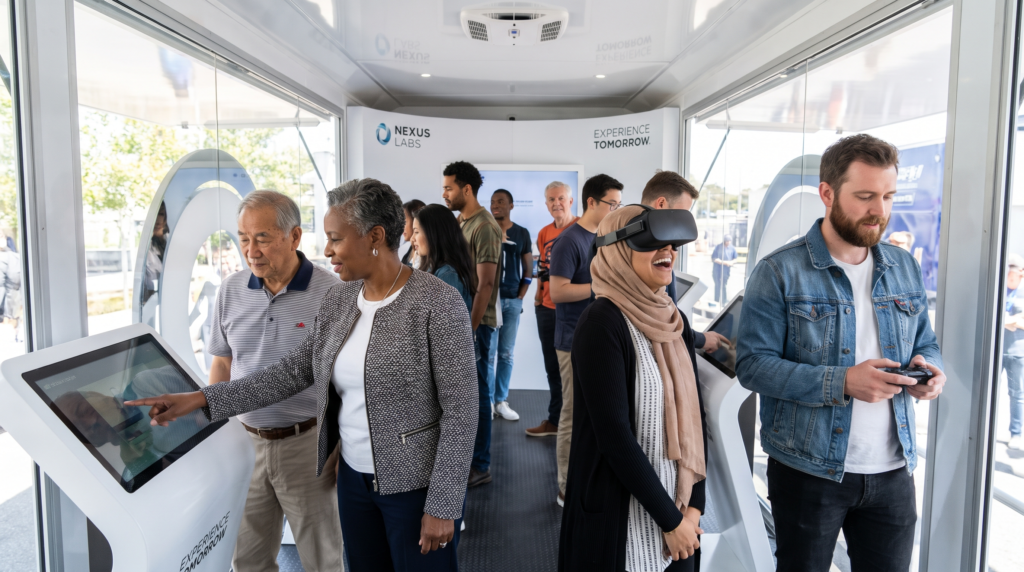
Visitors trying an interactive product demo inside a branded activation trailer
Visitors trying an interactive product demo inside a branded activation trailer.

How Much Does a Mobile Marketing Tour Cost in Canada?

A mobile marketing tour in Canada usually costs between 150,000 and 750,000 dollars, and large national programs can run higher. The final number depends on how many cities you cover, the complexity of the vehicle build, how many weeks you are on the road, and how large your crew is.

What drives the cost

The biggest levers are the build and the duration. A simple wrapped van is far cheaper than a custom hydraulic trailer, and a two-week regional tour costs a fraction of a twelve-week national one. Staffing, fuel, permits, insurance, and product all scale with the length of the route.

Typical cost ranges

Tour elementTypical cost range (CAD)Notes
Vehicle and custom build or wrap40,000 to 250,000Van wrap at the low end; custom demo trailer at the high end
Creative, design, and fabrication20,000 to 90,000Activation concept, signage, screens, and props
Staffing and tour management30,000 to 160,000Tour manager, driver, and brand ambassadors per market
Logistics, fuel, and travel25,000 to 120,000Transport, accommodation, parking, and power
Permits and insurance5,000 to 40,000Varies by city, venue, and sampling rules
Product, samples, and giveaways15,000 to 90,000Scales with sample count and premium items

For a closer look at how footprint and staffing move a budget, see our guide to brand activation in Toronto. Industry benchmarks are tracked by Event Marketer.

How Do You Plan and Route a Mobile Marketing Tour?

Plan a mobile marketing tour by locking the objective first, then the route, and only then the build and the logistics. A clear goal keeps every later decision honest.

A step-by-step planning process

  1. Set objectives. Decide whether the tour chases awareness, trial, leads, or sales, and define the one metric that matters most.
  2. Choose the route and cities. Pick markets by population, retail partners, and events, then sequence them to cut drive time.
  3. Secure permits. Line up municipal, venue, and sampling permits early, since approvals vary widely by city.
  4. Build the vehicle. Design and fabricate the rig and activation, then test the full set-up before launch.
  5. Staff the tour. Hire and train a tour manager, driver, and ambassadors who can represent the brand consistently.
  6. Run logistics. Coordinate transport, power, restocking, accommodation, and insurance across the whole route.
  7. Measure. Capture data at every stop and report daily so you can optimise while the tour is live.

Which Canadian cities and routes work best

Most national tours use a Greater Toronto Area hub, then branch to Ottawa and Montreal in the east and Vancouver, Calgary, and Edmonton in the west. Statistics Canada counts tens of millions of people across these metros, so a tight six-city route reaches a large share of the country. Within each city, malls, campuses, and festival grounds deliver the densest, most engaged crowds.

Permits and lead time

Permits are the hidden critical path. Street, park, and sampling permits can take weeks, and festival or mall partnerships often sell out months ahead. Starting approvals eight to twelve weeks before launch keeps the route from unravelling on the road.

Mobile Tour vs Single-Location Activation: Which Wins?

A mobile tour and a single-location activation solve different problems. A tour trades depth in one market for reach across many, while a fixed activation concentrates spend and footfall in a single place. The right choice depends on where your audience lives and what you need to prove.

How they compare

FactorMobile marketing tourSingle-location activation
Geographic reachMany cities, market to marketOne city or venue
Cost structureBuild amortised across stopsFull cost in one place
Audience sizeBroad national footprintDeep local footprint
LogisticsComplex: travel, permits, crewSimpler: one set-up
Best forNational launches and samplingFlagship moments and PR

When to pick each

Choose a tour when you need national trial, broad sampling, or coverage across diverse markets. Choose a single-location activation when you want one unforgettable flagship moment, heavy media attention, or a deep dive into a priority city. Many brands do both: a hero activation in a lead market, then a tour that carries the idea everywhere else.

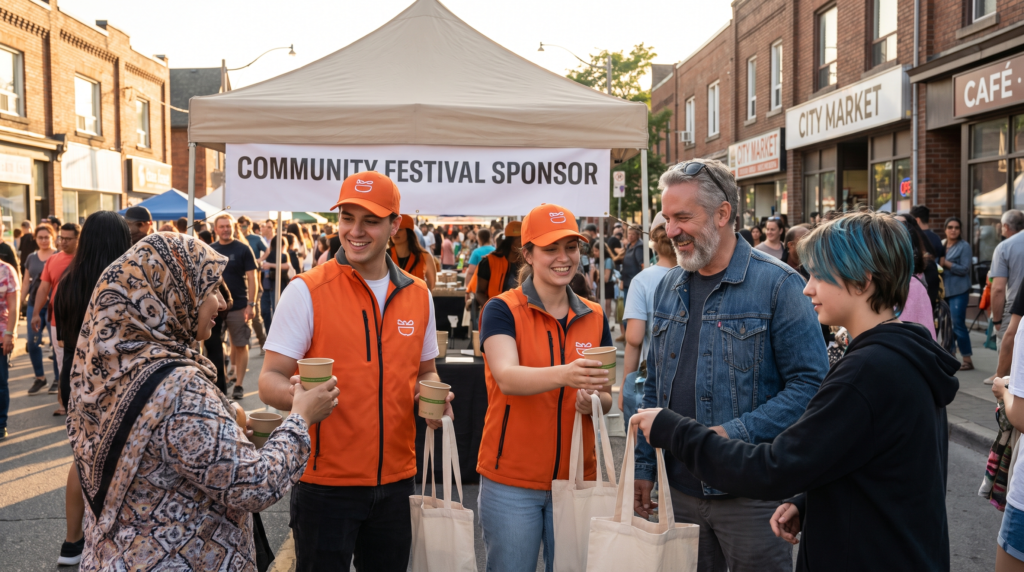
Event sponsors' brand ambassadors handing samples to a multicultural crowd at an outdoor Canadian festival

How Do You Measure a Mobile Tour's ROI?

Measure a mobile tour’s ROI by tracking what happened at every stop and what changed afterward. The strongest programs set targets before launch and report against them daily, so the brand always knows whether the route is paying off.

Metrics that prove a tour worked

  • Impressions: people reached on the road and at each stop, including wrap views between cities.
  • Samples and trials: units handed out and demos completed per market.
  • Leads and data capture: emails, sign-ups, and opt-ins collected through a scan or form.
  • Engagement: dwell time, interactions, and social shares tagged to the tour.
  • Sales lift: movement in retail sell-through near each stop in the weeks after the tour.

Common mobile tour mistakes to avoid

The costly errors are predictable. Skipping permits until the last minute strands the build; understaffing a busy stop wastes the crowd; weak data capture leaves no proof of value; and an over-ambitious route burns the budget on fuel instead of activation. Avoid them by planning early, staffing for peak traffic, and designing data capture into the experience from day one.

Why Choose Brand Guruz for Mobile Marketing Tours?

Brand Guruz is a Toronto-based experiential marketing agency built for live, multicultural audiences, and we plan, build, staff, and measure mobile marketing tours across Canada from one accountable team.

National staffing and logistics

We field trained brand ambassadors, tour managers, and technicians in every major market, and we own the logistics: permits, transport, power, restocking, and insurance. Because one team runs the whole route, the brand gets a single point of contact and a consistent experience in every city.

Multicultural reach and measurable results

Canada’s audiences are diverse, and our crews reflect the communities a tour visits, which makes each activation land. We also close the loop between the live moment and the digital follow-up, so every sample and scan becomes a tracked lead. Compare the field on our list of the best experiential marketing agencies in Canada, then talk to Brand Guruz.

Frequently Asked Questions

What is a mobile marketing tour?

A mobile marketing tour is a multi-city experiential campaign where a branded vehicle, trailer, or pop-up travels a planned route so people can see, sample, or demo a product in person. It combines the reach of advertising with the trust of a live, hands-on brand experience across several markets.

How much does a brand roadshow cost?

Most brand roadshows in Canada cost between 150,000 and 750,000 dollars, with large national programs running higher. The price is driven by the number of cities, the complexity of the vehicle build, the length of the tour, and the size of the crew needed at each stop.

How many cities should a tour cover?

Six to ten cities suits most national tours. A common route uses a Greater Toronto Area hub, then Ottawa and Montreal in the east and Vancouver, Calgary, and Edmonton in the west. Fewer cities deepen impact locally, while more cities widen reach but raise travel and staffing costs.

What permits are needed?

You typically need municipal street or park permits, private venue or mall agreements, and sampling or food-handling permits where you give out product. Requirements vary by city, so secure them early. Insurance and parking approvals are usually required too, and festivals have their own vendor rules.

How long does planning take?

Plan on eight to sixteen weeks for most tours. Permits, vehicle fabrication, and festival or retail partnerships are the long poles, and they often need the most lead time. Starting early protects the route, because the best venues, dates, and crews get claimed months in advance.

How is ROI measured?

ROI is measured with impressions, samples and demos delivered, leads and data captured, engagement, and post-tour sales lift near each stop. The strongest programs set targets before launch and report daily, so the brand can optimise the route while it is still on the road.


Plan Your Canadian Mobile Marketing Tour With Brand Guruz

Ready to take your brand on the road? Brand Guruz plans, builds, staffs, and measures mobile marketing tours and brand roadshows across Toronto, the GTA, and all of Canada, from a single city activation to a full national route.

Tell us your objective, your markets, and your timeline, and we will design a tour that hits it. To get started, book a quick call through our contact page.

Let's Grow Your Brand

Author