Pop-Up Shop Canada: The 2026 Brand Guide to Planning, Costs, and Locations That Sell

A pop-up shop is the fastest way to put your brand in front of real customers, and 2026 is the year to use one. At Brand Guruz, we plan, build, and staff pop-up shops across Canada that turn foot traffic into sales and first-time shoppers into loyal fans.

The format is booming for a reason. A pop-up shop gives a brand a temporary, high-impact retail space without the cost or commitment of a permanent store. As a result, brands of every size now use pop-ups to launch products, test new cities, and win holiday shoppers.

This guide covers what a pop-up shop is, why the format works so well, and where to launch one in Canada. Moreover, it breaks down real costs, a step-by-step planning playbook, and the ideas that actually drive results.

First, a quick promise: everything here is practical. By the end, you will know how to plan, budget, and staff a pop-up shop that pays for itself.

$128B+ — annual global spend on experiential and live brand marketing, the category pop-up shops belong to (Event Marketer) · 88% — consumers who trust a personal recommendation over any form of advertising (Nielsen) · 6.4M+ — people in the Greater Toronto Area, Canada's largest and most competitive retail market (Statistics Canada)

What is a pop-up shop, and why do brands run one?

A pop-up shop is a temporary retail space that a brand opens for days, weeks, or a single season. Typically, it lives in a storefront, a mall unit, a shipping container, or a booth at a busy event. In short, it brings a brand directly to where shoppers already are.

The short definition

Think of a pop-up shop as a store with an expiry date. Because it is temporary, it feels fresh and urgent. That scarcity is exactly what pulls curious shoppers through the door.

Why brands love the format

Pop-up shops are flexible, fast, and low-risk. First, they cost far less than a permanent lease. Then, they let a brand test a product, a city, or a concept in the real world. As a result, a pop-up shop turns a big retail question into a small, affordable experiment.

The format also creates a moment. When a experiential marketing space is designed well, people photograph it, share it, and tell their friends. In effect, one small shop can earn attention far beyond its four walls.

Why pop-up shops work so well in 2026

The trust premium of a real-world moment

People trust people far more than they trust ads. In fact, Nielsen reports that 88% of consumers trust a personal recommendation above every other channel. Therefore a pop-up shop, where a real person hands you a product, builds trust that a banner ad never will.

Low risk, real-world proof

A pop-up shop is a live market test. Because you see who shows up and what they buy, you learn fast. Consequently, brands use pop-ups to validate a new line before committing to a full retail rollout.

The earned-media multiplier

A striking pop-up shop is built to be shared. When shoppers post it, the reach compounds for free. Put simply, a well-designed space turns every visitor into a small media channel.

Timing helps too. As online ad costs climb, a physical moment cuts through the noise. In a crowded feed, a real experience is what people actually remember.

Where to launch a pop-up shop in Canada

Location decides half your result. Notably, Statistics Canada counts more than 6.4 million people in the Greater Toronto Area, which makes it the densest retail ground in the country. Still, a smart pop-up shop can win far beyond the GTA.

The GTA: Canada’s densest retail market

Downtown Toronto, Scarborough, and North York draw huge, diverse crowds. Meanwhile, Mississauga, Brampton, Markham, and Vaughan offer packed suburban malls and high streets. Together, they give a pop-up shop a full calendar of high-traffic options.

Beyond Toronto: Ontario and national reach

Demand does not stop at the city limits. In addition, Ottawa, Hamilton, and London reward brands that show up locally. For national campaigns, Vancouver, Calgary, and Montreal each add a distinct, high-value audience.

High-foot-traffic locations that convert

The best pop-up shop sits where people already gather. For example, malls, transit hubs, festival grounds, and busy retail streets all deliver built-in traffic. A pop-up shop in Toronto often starts in exactly these spots, then scales to other cities.

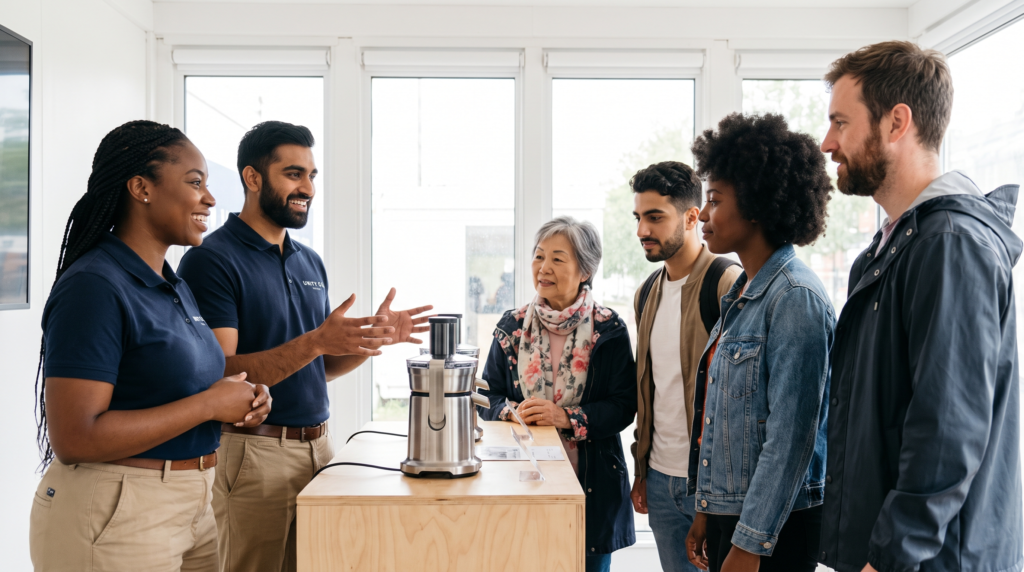
Pop-up shop brand ambassadors demonstrating a product to a diverse group of shoppers at the counter in Canada

How much does a pop-up shop cost in Canada?

Cost is usually the first practical question. Fortunately, a pop-up shop scales to almost any budget, from a single weekend booth to a month-long flagship experience.

The main cost drivers

Four things move the budget most: space rental, build and design, staffing, and inventory. On top of that, permits, insurance, and technology add smaller line items. Because these stack up, a clear plan keeps the total under control.

Typical budget ranges

A small weekend pop-up shop can run a few thousand dollars. A polished, mid-size activation usually lands in the low tens of thousands. Meanwhile, a large branded flagship with custom build and staff can reach six figures. For a fuller breakdown, see our brand activation cost in Ontario guide.

Cost per engaged shopper

Price alone is the wrong lens. Instead, measure cost per engaged shopper and per lead captured. Viewed that way, a great pop-up shop often beats months of paid ads. For proof, see our CIBC case study.

The pop-up shop planning playbook

A strong pop-up shop is planned on purpose, not by luck. Accordingly, we run every project through five clear steps.

Step 1: Set the goal and budget

Decide what success looks like first, whether that is sales, sign-ups, or awareness. Because the goal shapes everything, it comes before the venue.

Step 2: Lock the location and timing

Next, match the space to your audience and your calendar. For seasonal launches, book early, since prime spots sell out fast.

Step 3: Design and build the space

Then, design a space that is unmistakably yours. A bold, photogenic build turns passersby into visitors and visitors into posts.

Step 4: Staff it with trained brand ambassadors

People make the moment. Therefore, staff the pop-up shop with trained, on-brand ambassadors who can demo, sell, and capture data.

Step 5: Measure everything

Finally, track traffic, sales, leads, and social reach. As a result, you can prove ROI and improve the next pop-up shop.

Pop-up shop ideas that drive real results

The format is flexible, so the ideas are endless. However, a few proven angles consistently outperform. Use these as a starting point for your own pop-up shop.

Product sampling and live demos

Let people touch, taste, and try. Because hands-on trial beats any description, sampling turns curiosity into a confident purchase on the spot.

Seasonal and holiday pop-ups

Time your pop-up shop to a moment shoppers already care about. For instance, a holiday or festival pop-up rides existing demand, so foot traffic arrives ready to buy. In 2026, the fourth-quarter gift season is the single biggest window.

Experiential and interactive builds

Add something people cannot get online. Whether it is a photo moment, a workshop, or a game, an interactive pop-up shop earns time, attention, and shares.

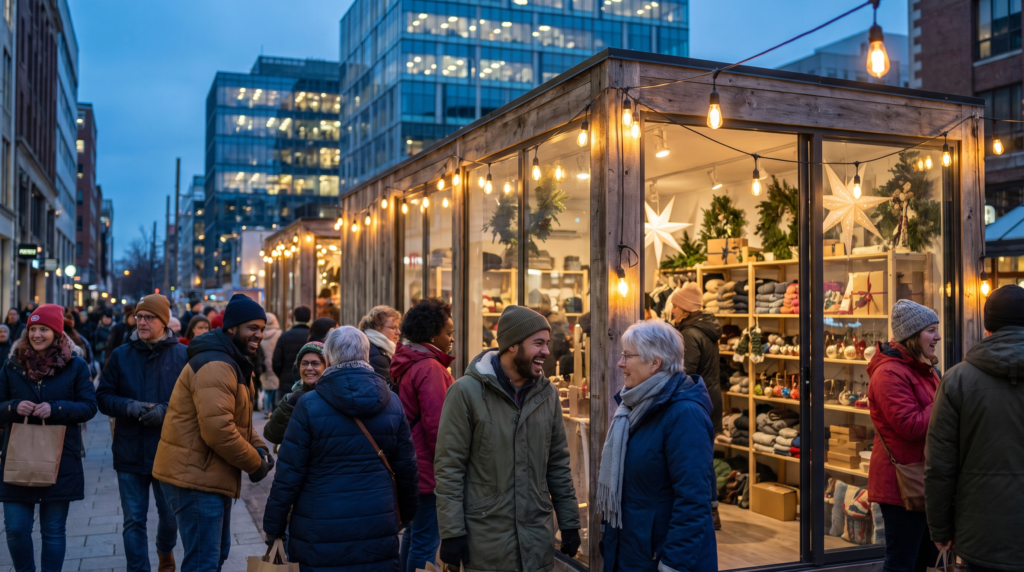
Festive holiday pop-up shop in Canada with a diverse group of distinct shoppers browsing under warm evening lights

How the best pop-up shop agencies in Canada compare

Most brands compare a handful of agencies before they commit. Yet many pop-up shop providers pitch the same three things: a space, some staff, and a build. The real differences sit deeper.

The seven criteria that separate the best

Judge every partner on seven things: strategy, location access, design quality, trained staffing, technology and data capture, measurement, and national reach. Because strengths compound, the best agency usually wins on several at once. To compare providers, read our guide to the top experiential marketing agencies in Canada.

Above all, choose a partner who ties the pop-up shop to results. A team that reports on traffic, leads, and ROI will always out-earn one that simply builds a pretty booth.

Why brands choose Brand Guruz for pop-up shops

Brand Guruz is a Canadian experiential marketing agency built for live, multicultural audiences. Specifically, we plan, build, and staff pop-up shops that reflect the communities you want to reach.

That focus matters. Because we handle the physical pop-up shop and the digital follow-up together, every shopper it attracts can become a tracked lead. In practice, that turns a busy weekend into measurable revenue.

We also produce at scale across the GTA and the rest of Canada, with a full team and backup support for every activation. To see the work, browse our case studies, then talk to Brand Guruz.

Few agencies close that loop. Since we own both the experience and the follow-up, nothing valuable slips through the cracks afterward.

Frequently asked questions: pop-up shops in Canada

What is a pop-up shop?

A pop-up shop is a temporary retail space a brand opens for days, weeks, or a season. It lets a brand sell, sample, and connect with shoppers without a long-term lease.

How much does a pop-up shop cost in Canada?

Costs vary by scope. A small weekend pop-up shop can run a few thousand dollars, a mid-size activation lands in the low tens of thousands, and a large flagship build can reach six figures.

How do I open a pop-up shop?

Set your goal and budget, lock a location and dates, design the build, staff it with trained ambassadors, and measure results. Most brands partner with an agency to run all five steps.

Where should I launch a pop-up shop?

Start where foot traffic is dense, such as the GTA’s malls, transit hubs, and busy streets. From there, strong brands scale to Ottawa, Hamilton, Vancouver, Calgary, and Montreal.

How long should a pop-up shop run?

Most pop-up shops run from a single weekend to about four weeks. The right length depends on your goal, your budget, and the season you are targeting.

Do pop-up shops actually drive sales?

Yes. A well-run pop-up shop drives direct sales, captures leads, and earns social reach. Because it is a live market test, it also proves demand before a bigger rollout.

When should I plan a holiday pop-up shop?

Plan a fourth-quarter pop-up shop several months ahead. Prime locations for the gift season get claimed early, so booking in late summer or early fall is ideal.


Launch your pop-up shop with Brand Guruz

Ready to bring your brand to life with a pop-up shop? Then let us plan, build, and staff the experience that fits your goal.

Brand Guruz runs pop-up shops across Toronto, the GTA, and all of Canada. Tell us your objective, and we will design the space to hit it. To start, book a quick call through our contact page, or explore proven results in our case studies.

Let's Grow Your Brand

Author