Sporting event marketing is unlike almost any other activation environment. Fans arrive energized, emotionally invested, and primed to engage — at the same time, in the same place, on a predictable schedule. That combination is rare in marketing. Most brand touchpoints fight for attention; game day hands it over.
Brand Guruz has planned and executed sporting event activations across Canada — from NHL and NBA game days in Toronto to multicultural cricket, soccer, and kabaddi tournaments across the GTA. What follows is the strategy behind winning game day, from the parking lot to the post-game review.
of global fans view brands more favorably when they sponsor the sport (Nielsen 2025)
of consumers are more likely to purchase after engaging with a live brand experience (FutureLabs 2025)
global sports sponsorship in 2024, on pace for $144.9B by 2034 (Nielsen)
Sporting events give brands a dense, emotionally primed, and predictably moving audience — and that combination is almost impossible to replicate in any other environment. Nielsen’s 2025 Global Sports Report, covered by Visme, found that 67 percent of global fans view a sponsoring brand more favorably than they otherwise would. That number rises further when the brand shows up physically on game day, not just in signage.
Premier Staff’s analysis of brand activations at sporting events notes that stadiums and arenas concentrate fans for three to five hours — focused, moving in predictable patterns, and predisposed to respond. For sporting event marketers, that is the ideal operating condition: scale, emotion, and timing all working together.
Global sports sponsorship reached $64.1 billion in 2024 and is on track for $144.9 billion by 2034. Yet most of that investment flows into logo placements and broadcast rights. The highest-yield opportunity — the live, physical experience — remains the most underfunded part of the budget.
The pre-game window is the highest engagement period in any sporting event marketing program. Fans arrive early, move slowly, and have nowhere to be yet. The 90 minutes to two hours before the opening whistle is when dwell time peaks and activation opportunity is greatest. After the game starts, foot traffic on concourses and surrounding streets drops sharply.
The pre-game activation zone does not have to be inside the venue. Concourses, parking lots, and the streets surrounding the stadium also carry real foot traffic. Tailgate-style activations positioned along natural fan entry routes consistently outperform in-venue booth placements for sampling and lead capture, particularly when the activation format rewards stopping rather than walking past.
For Canadian brands, this means scouting the full venue perimeter — not just negotiating for space inside the arena. The best positions are often the ones venue rights packages do not include.
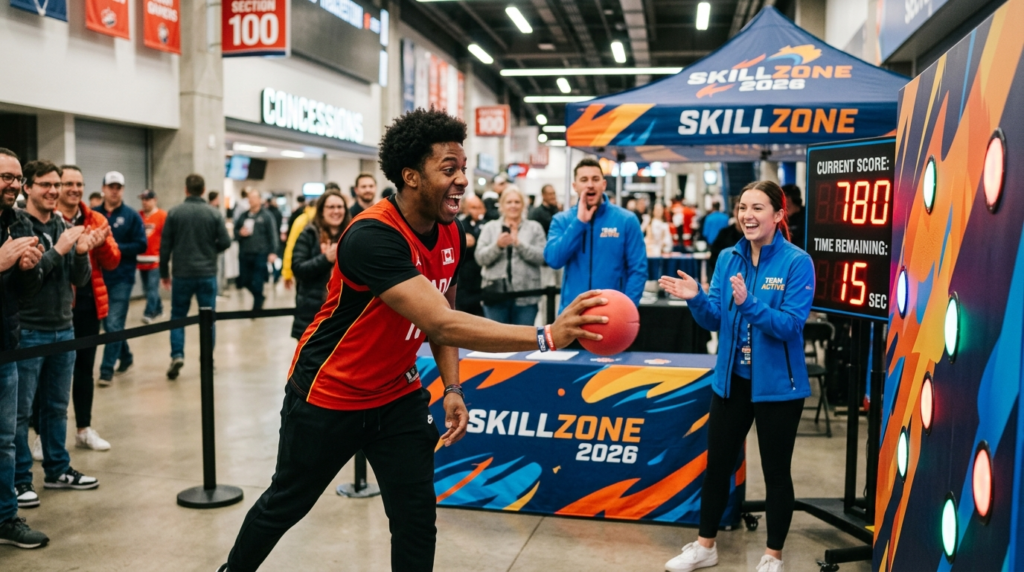
The difference between a sporting event marketing activation that works and one that is ignored comes down to participation. Static banners and passive sampling booths are the lowest-converting formats in a stadium environment. The competition is too high — brands are fighting for fan attention against the game itself, the crowd noise, and every other sponsor in the building.
Instead, the activations that win are the ones fans choose to stop for. The FutureLabs State of Brand Experience 2025 report found that 91 percent of consumers are more likely to purchase after engaging with a live brand experience. Additionally, 76 percent say interactive activations make them feel closer to the brand.
Game day audiences are also uniquely competitive. They are already in a performance mindset — invested in outcome, charged by crowd energy, and ready to compete. The best sporting event marketing channels that energy directly. Skill challenges, bracket competitions, leaderboards, and prize draws all translate naturally into the stadium atmosphere and generate the dwell time and social content that passive formats cannot.
Not every sport draws the same fan base, and sporting event marketing that ignores that distinction wastes budget. A hockey crowd in Toronto is not the same as a cricket audience in Brampton. A Raptors game at Scotiabank Arena draws a different demographic mix than a Liga MX viewing party in Little Portugal. The brand that deploys a generic activation — the same setup at every property — leaves cultural connection on the table.
In fact, Canada’s multicultural communities follow cricket, kabaddi, soccer, football, and basketball — often with intense community loyalty and deep cultural pride. Brands that activate authentically within those communities generate goodwill that a mainstream NHL partnership rarely can. The depth of engagement is different because the cultural resonance is different.
For the audience research that makes this work, see our multicultural market research guide. The parallel-activation strategy for the FIFA World Cup window is in our World Cup brand activation guide.
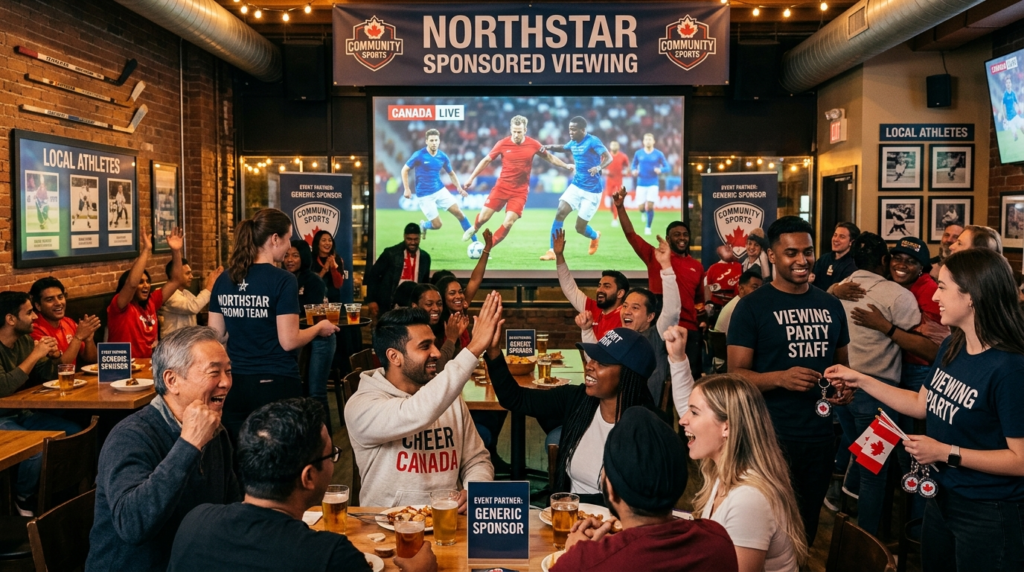
Most sporting event marketing plans for the fans in the building and ignores everyone watching elsewhere. For every fan in the stadium, several more are watching on a screen at home, in a bar, or at a community gathering. According to MNI’s analysis of sports marketing strategy, brands that become part of the game-day ritual — rather than showing up in only one format — consistently outperform single-touchpoint activations.
Viewing party activations are particularly effective in multicultural sports communities. Hosting a cricket viewing party in Brampton or a soccer watch event in Scarborough reaches a concentrated, passionate audience on the brand’s own terms. The experience is deeper than a stadium sampling booth and, in many cases, far more culturally resonant.
NPARALLEL’s guide to experiential sports marketing frames this as designing for the full game-day journey — from parking lot to post-game. Street teams and mobile activations extend that radius further still. For the full field team playbook, see our street team marketing guide.
Sporting event marketing is one of the most measurable live formats available — when brands define their metrics before the activation, not after. The instinct is to count impressions and footfall. Those numbers look impressive in a recap deck, but they do not show whether the activation built consideration, drove purchase intent, or created a lasting brand association.
The metrics that actually matter are recall lift, lead capture, opt-in rate, social content generated, and purchase intent shift. Ultimately, what winning looks like has to be defined before deployment — otherwise there is nothing meaningful to optimize in the post-event review.
Measurement also requires separating the activation formats. Sponsorship visibility placements should be measured on reach and recall; experiential booths on lead quality and opt-in rate; social and digital tie-ins on content generated and engagement. Treating all formats the same produces misleading ROI conclusions. Our experiential marketing ROI framework covers how to structure this from day one.
Brand Guruz plans sporting event marketing across Canada — from NHL and NBA activations in Toronto to multicultural sports tournaments in Brampton, Mississauga, and Scarborough. We build activations for the real game day, not the idealized version.
That means pre-game positioning, culturally matched staffing, participatory formats, and measurement built in from the first hour. It also means multicultural fluency most Canadian sports marketing agencies cannot match — because we know the communities, the sports, and the cultural codes that move those audiences.
The top Canadian experiential marketing agencies all understand stadium logistics. What ultimately separates the best is cultural range: the ability to activate authentically across hockey, cricket, soccer, and basketball fan bases in the same city, in the same week. That is what Brand Guruz brings.
If you are planning a sporting event marketing campaign for 2026, talk to Brand Guruz. Or browse case studies to see how we have activated across formats and fan bases. For the full activation playbook, see our festival brand activation guide.
What is sporting event marketing? Sporting event marketing is the practice of activating a brand at or around a sporting event — in the venue, in surrounding areas, or through fan-facing experiences that connect the brand to the sport and its community. Common formats include fan zones, sampling activations, skill challenges, viewing parties, and street teams.
How much does a sporting event activation cost in Canada? Costs vary by venue, format, and market. Generally, a pre-game street team activation in a Canadian city starts around $5,000 to $15,000. A full fan zone inside an arena or stadium typically ranges from $25,000 to $150,000+, including staffing, materials, and brand ambassador costs. Venue fees and in-stadium exclusivity rights can add significantly to the total.
How do you measure the ROI of sporting event marketing? Measure recall lift, lead capture, opt-in rate, social content generated, and purchase intent shift. Define your KPIs before the activation, not after. Then run a post-event survey with fans who engaged with the activation and a control group who did not, and compare the results.
What is the best format for a game day brand activation? Interactive formats consistently outperform passive ones. Skill challenges, prediction games, prize draws, and photo moments generate dwell time, social content, and emotional connection that static signage cannot. The format should also match the specific sport’s culture and fan energy — a hockey activation and a cricket activation call for different approaches.
How early should a brand activate on game day? Activate during the pre-game window — ideally 90 minutes to two hours before the opening whistle. That is when dwell time is highest, fan attention is available, and foot traffic is still moving freely. After the game begins, concourse and perimeter traffic drops sharply.

The best activation positions — pre-game zones, community viewing events, cultural festivals — still fill well before the season starts. Talk to Brand Guruz about your sporting event marketing plans for 2026. Or browse case studies to see how we have delivered on game day.