Sustainable Brand Activations: How to Cut Waste, Carbon, and Cost on Canadian Campaigns in 2026

Sustainable brand activations are no longer a values play in Canada. To be clear, they are now a cost, regulatory, and reputational requirement for 2026. Furthermore, Canadian consumers — especially Gen Z and millennial audiences — actively reward brands that cut waste at activations. By contrast, they penalize the ones that do not. Consequently, sustainability has moved from a CSR line item to a core activation strategy.

At Brand Guruz, we have designed sustainable brand activations for retail, CPG, and multicultural campaigns across Canada. In our experience, the sustainable approach cuts waste, carbon, and cost simultaneously. Specifically, brands that build sustainability into the brief from day one save up to 30% on second-year activation costs.

Below, you will find the audit framework for activation waste and carbon. You will also find the 2026 playbook for reducing both — and how the right design choices cut budget.

Fast Facts:

  • 88% — Canadian Gen Z who say sustainability affects purchase decisions (NielsenIQ)
  • 50% — Average waste reduction with modular, reusable booth design
  • 30% — Cost saving on second-year activations using reusable assets

Why sustainable brand activations matter more in 2026

Sustainable brand activations matter more in 2026 because the cost of waste has gone up. To be specific, fabrication materials, transport, and disposal fees have all climbed since 2023. Furthermore, Canadian regulators are tightening the rules on packaging, single-use plastics, and event waste reporting. Consequently, the brands that activate sustainably save money while staying compliant.

Canadian regulations driving sustainable brand activations in 2026

The Canadian regulatory landscape for sustainable activations has shifted in three significant ways. First, federal carbon pricing now reaches $80 per tonne and continues to climb. Furthermore, Ontario’s Extended Producer Responsibility framework now charges brands for packaging waste they generate at events. As a result, every plastic giveaway carries a back-end cost.

In addition, provincial single-use plastic bans now apply at most public events. For instance, plastic water bottles, plastic cutlery, and many plastic samples are restricted. Importantly, these rules apply to brand activations on public property in most major Canadian cities.

Why Gen Z and millennials punish greenwashing in brand activations

Sustainable claims at activations get scrutinized within minutes. To illustrate, a screenshot of a recyclable booth wrapped in non-recyclable plastic spreads through TikTok before the event ends. Furthermore, multicultural audiences carry strong sustainability ethics from their communities of origin. As a result, they are particularly attuned to greenwashing.

In other words, sustainability has to be designed in, not bolted on. As NielsenIQ research consistently shows, brands that integrate sustainability authentically outperform brands that perform sustainability theatrically. Consequently, the cost of getting it wrong is higher than the cost of doing it right.

Where activation waste and carbon actually come from

Sustainable activation design starts with knowing where the waste actually comes from. To be specific, four categories produce the majority of brand activation waste and carbon in Canada.

Materials and fabrication: the biggest sustainable activation lever

Booth materials, signage, and fabrication generate the largest carbon and waste footprint. For instance, custom-built single-use booths often hit landfill within 48 hours of an activation closing. Furthermore, fabrication transport adds significant emissions.

In our experience, modular reusable systems cut booth waste by 50% or more. As a result, this is the highest-impact lever in sustainable activation design.

Swag and giveaways: the hidden waste in brand activations

Branded swag is the most underestimated waste line. To illustrate, low-cost promotional items often hit landfill within weeks. By comparison, attendees rarely keep poorly-designed swag past the event weekend.

Specifically, the fix is to cut volume and raise quality. In other words, give 1,000 attendees something useful instead of 5,000 something disposable. Consequently, the brand reduces waste and produces a better impression.

Energy, transport, and freight in low-carbon activations

Energy consumption at activations is a quieter source of carbon. Specifically, generators, lighting rigs, and shipping emissions add up across a weekend. Furthermore, freight emissions from cross-Canada production schedules often exceed the on-site footprint.

For example, a booth fabricated in Quebec and transported to Vancouver may generate more carbon in transit than the activation itself. As a result, local sourcing is a major lever for sustainable brand activations in Canada.

Food and beverage waste in sustainable activations

Food and beverage waste at activations is significant but solvable. Importantly, sampling stations typically generate 15-25% food waste without intervention. Furthermore, single-use packaging multiplies the footprint.

To be specific, composting partnerships, food rescue groups, and reusable serving systems can cut this by 70% or more. Consequently, sampling stays robust while waste drops.

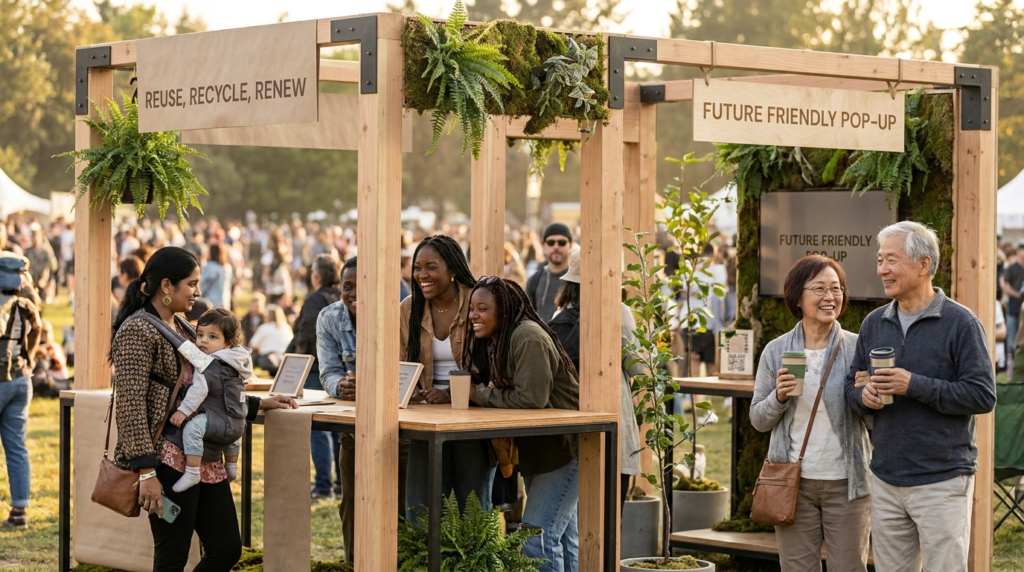
Modular reusable booth design at a Canadian sustainable brand activation with diverse attendees engaging in 2026.
Switching to modular reusable systems cuts booth waste by 50% or more.

The 2026 sustainable brand activation playbook

The playbook for sustainable brand activations is four steps long. Apply all four to cut waste, carbon, and cost simultaneously.

Step 1 — Design sustainable brand activations for reuse

Design the booth, signage, and creative elements to be reused across multiple activations. Specifically, build modular components that can be reconfigured for different festivals, neighbourhoods, and seasons. Furthermore, avoid printed dates, single-event branding, and location-specific materials.

In our experience, a well-designed modular system pays for itself by the third activation. For more on tactical execution, see our Toronto neighbourhood brand activation strategy guide. Consequently, the upfront investment becomes a long-term cost cut.

Step 2 — Source locally for sustainable brand activations

Local sourcing is the sustainable shortcut most brands miss. To be specific, source booth fabrication, food samples, and creative materials within a 100-km radius wherever possible. Furthermore, work with Canadian-owned suppliers that publish carbon and waste reporting.

For example, a Toronto activation sourcing food samples from Ontario farms cuts freight emissions and supports local community partners. As a result, the brand earns goodwill while reducing its footprint.

Step 3 — Cut swag volume in sustainable activation design

Most swag ends up in landfill within weeks. Importantly, the brands that cut swag volume actually see engagement go up. Specifically, replace 5,000 throwaway items with 500 high-quality ones — a water bottle, a tote, or a useful tool. Furthermore, pair the giveaway with a story attendees actually want to share.

In other words, fewer items, more meaning, less waste. Consequently, the brand reduces cost and improves recall in the same move.

Step 4 — Measure carbon, waste, and cost in sustainable activations

Most agencies measure carbon or waste in isolation. By comparison, the brands that win on sustainability measure all three at once — carbon, waste diverted, and cost saved. As a result, the sustainability story becomes a business story.

Specifically, track materials sourced locally, kilograms of waste diverted from landfill, energy consumed, and cost per engaged attendee. Furthermore, report the metrics together in every post-event recap.

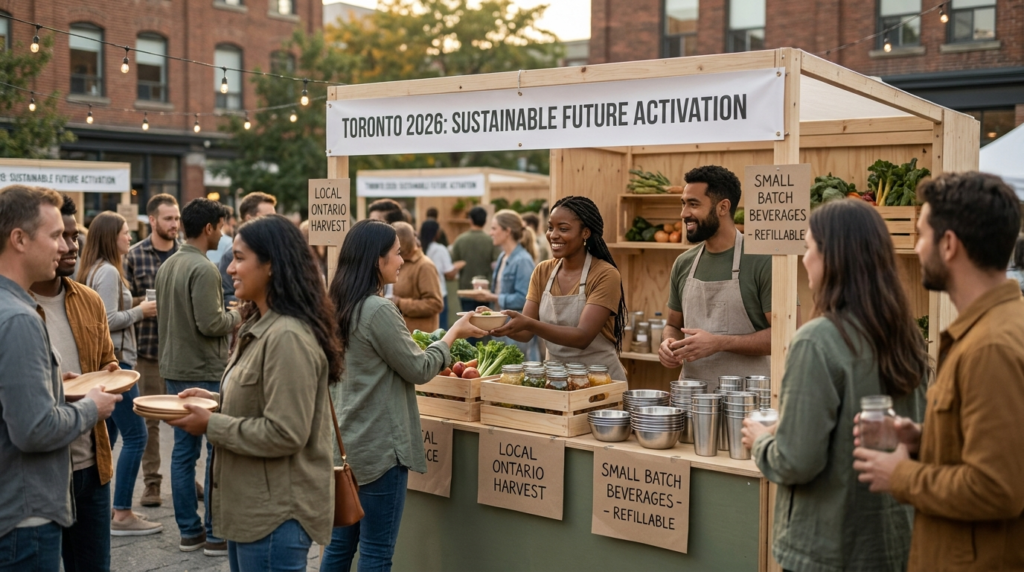
Local Ontario food vendors at a sustainable brand activation in Toronto with multicultural attendees in 2026.
Local sourcing cuts freight emissions and supports community partners simultaneously.

How sustainable brand activations cut cost — not just carbon

Sustainable activations save money in three concrete ways. To begin with, reusable assets amortize across multiple activations. Furthermore, local sourcing cuts freight and tariff costs. Consequently, the math works in the brand’s favour by year two.

  • Modular booth systems: First-build cost is 15-30% higher than disposable. However, second deployment costs drop by 60% or more.
  • Local sourcing: Cuts freight emissions and freight costs simultaneously. Typically saves 10-20% on materials and food sampling.
  • Cut swag volume: Replacing 5,000 throwaway items with 500 quality items typically saves 30-50% of the giveaway budget.
  • Composting and waste diversion: Reduces post-event disposal fees by 40-70% depending on the venue.

For deeper pricing context, see our brand activation cost guide for Ontario. Importantly, these savings compound when sustainability is designed in from day one. To be specific, retrofitting sustainability mid-campaign always costs more than designing it upfront. As Event Marketer research consistently shows, sustainability-first events outperform retrofitted ones on both impact and cost.

Common mistakes Canadian brands make with sustainable activations

Most sustainable activation attempts fall short for the same reasons. To be specific, here are the four mistakes Canadian brands repeat most often.

  • Designing first, sustainability second. Specifically, brands lock the creative and then ask sustainability questions. However, that approach forces expensive retrofits at production.
  • Performing sustainability instead of building it. For instance, a green-painted plastic booth fools no one. Furthermore, audiences screenshot greenwashing within minutes and amplify it online.
  • Ignoring transport emissions. In practice, freight is often the single largest carbon line item. Consequently, sourcing locally outweighs most other sustainability moves.
  • Skipping post-event measurement. Importantly, brands cannot claim sustainability progress without measuring carbon, waste, and cost together. As a result, the credibility gap widens with every campaign that lacks data.
Local Ontario food vendors at a sustainable brand activation in Toronto with multicultural attendees in 2026.
Local sourcing cuts freight emissions and supports community partners simultaneously.

Why Brand Guruz is built for sustainable brand activations in Canada

Brand Guruz is the experiential agency Canadian brands hire when sustainability has to be real, not decorative. To begin with, our team designs activations with reuse, local sourcing, and waste diversion baked in from the brief. Furthermore, we measure carbon, waste, and cost together — and report all three to clients in every post-event recap.

Equally important, our multicultural network spans community partners, local suppliers, and creators across Canada. As a result, the sustainability story becomes a community story. The activation lifts the brand and supports the people it touches.

If you are planning sustainable brand activations in Canada for 2026, scope it now. Talk to Brand Guruz and we will map reuse, sourcing, and measurement against your brief from day one. For more on our category approach, see our experiential marketing overview. Or browse case studies to see how sustainable design lands in real campaigns.

Frequently asked questions

What are sustainable brand activations? Sustainable brand activations are live brand experiences designed to reduce waste and carbon. Specifically, they use modular reusable booths, local sourcing, waste diversion, and cut-volume swag. As a result, brands lower their footprint and costs simultaneously.

How do sustainable brand activations save money? Sustainable activations save money in four ways. First, modular reusable assets amortize across multiple events. Second, local sourcing cuts freight costs. Third, smaller higher-quality swag reduces giveaway budgets. Finally, waste diversion reduces post-event disposal fees.

What regulations affect sustainable brand activations in Canada? Federal carbon pricing, Ontario’s Extended Producer Responsibility framework, and provincial single-use plastic bans all affect brand activations. Specifically, packaging and disposable items carry compliance costs at most public events. Furthermore, several Canadian municipalities require waste reporting for permitted activations.

How do brands measure sustainable activation impact? Brands track four core metrics. First, carbon emissions. Second, kilograms of waste diverted. Third, percentage of materials sourced locally. Finally, cost saved versus a non-sustainable baseline. Importantly, all four metrics should be reported together.

Do sustainable activations perform better than traditional ones? Yes, in most categories. Specifically, sustainability-driven activations earn stronger Gen Z engagement, generate higher-quality UGC, and produce better long-term brand affinity. Furthermore, they often cost less by the second year of deployment.


Ready to plan a sustainable brand activation for 2026?

The brands designing for reuse and local sourcing now will save the most by Q3. Talk to Brand Guruz about your sustainable activation strategy. Or browse our case studies to see the playbook in action.

Author