Trade Show Booth Design in Canada: The 2026 Guide to Booths That Attract and Convert

Trade show booth design is the strategic planning, layout, and visual build of an exhibit space so it attracts foot traffic, communicates your brand in seconds, and converts visitors into qualified leads. Strong booth design blends an open layout, bold graphics, interactive moments, and trained staff into one experience that works the floor.

Updated November 2026.

Brand Guruz, a Toronto-based experiential marketing agency, designs, builds, and staffs exhibits across Canada. This guide covers trade show booth design costs, booth sizes, ideas that draw a crowd, and how to choose a booth builder you can trust.

Key takeaways

  • Trade show booth design should earn attention in about three seconds and route visitors toward a clear next step.
  • Budget roughly CAD $150 to $400 per square foot for a custom booth, and far less for rentals and modular systems.
  • Island and peninsula layouts draw the most traffic but cost more in space and build.
  • Interactive demos, lighting, and hospitality turn a booth into an experience people remember.
  • Trained booth staff and brand ambassadors often matter more than the structure itself.

$128B+ — annual global brand spend on experiential and live marketing (Event Marketer) · 88% — consumers who trust a personal recommendation over any advertisement (Nielsen) · 6.4M+ — people in the Greater Toronto Area, Canada's largest B2B trade-show market (Statistics Canada)

What Makes Trade Show Booth Design Work?

Trade show booth design works when it earns attention fast, guides people through the space, and makes one message impossible to miss. On a crowded floor you have about three seconds to stop a visitor, so every design choice must pull its weight.

First impressions in three seconds

Attendees scan an aisle, not a brochure. Therefore your largest graphic, boldest colour, and clearest headline need to read from 10 to 15 feet away. Keep copy short, lift your logo and value proposition to eye level, and let one hero visual carry the booth.

Traffic flow and an open layout

Open booths out-draw closed ones, a pattern long tracked by the Center for Exhibition Industry Research. Consequently, the best trade show booth design removes barriers at the aisle, creates a clear path in, and gives staff room to greet without crowding.

On-brand messaging that converts

A beautiful booth that says nothing wastes the space. Instead, tie the design to a single campaign idea, a demo, or an offer, and make the next step obvious. This is where experiential marketing thinking separates a booth that looks good from one that books meetings.

How Much Does Trade Show Booth Design Cost in Canada?

In Canada, trade show booth design typically costs CAD $150 to $400 per square foot for a custom build, while rentals and modular systems cost far less. Your final number depends on booth size, materials, technology, and whether you buy or rent.

Trade show booth cost by size

Use the ranges below as planning estimates for the Canadian market. Rental figures assume a reusable system; custom figures assume an owned, built-to-order exhibit.

Booth type and sizeRental range (CAD)Custom range (CAD)
10×10 inline (100 sq ft)$3,000 to $8,000$10,000 to $25,000
10×20 inline (200 sq ft)$7,000 to $18,000$20,000 to $50,000
20×20 island (400 sq ft)$18,000 to $45,000$50,000 to $150,000+

What drives the price

Big cost levers include custom fabrication, large-format graphics, lighting, AV and touchscreens, flooring, storage, and shipping or drayage. Because labour and drayage add up quickly at Canadian convention centres, build those lines into the budget early rather than treating them as afterthoughts.

Design and management fees

Most booth builders charge a design fee or roll it into the build, often 10 to 20 percent of the project. For a sense of how activation budgets scale, plan the booth as one line inside a broader trade show marketing strategy rather than a cost on its own.

Trade Show Booth Sizes and Layouts Explained

Trade show booth sizes fall into four main layouts: inline, corner, peninsula, and island. Each exposes your brand to a different amount of aisle traffic, and each changes how you design the space.

Inline and corner booths

An inline booth opens to one aisle with neighbours on both sides, so design pushes everything to the front. A corner booth sits at the end of a row with two open sides, which nearly doubles visibility and is usually well worth the small premium.

Peninsula booths

A peninsula opens to three aisles with one back wall, making it ideal for a tall, central brand tower that reads across the hall. Because three sides are exposed, keep the layout open and avoid clutter near the aisles.

Island booths

An island is open on all four sides with no shared walls, giving you the most traffic and the most design freedom. Islands suit hero product demos and hospitality zones, though they demand the largest space buy and the most build time.

Trade show booth design team reviewing a 3D booth rendering and floor plan
A trade show booth design team reviewing a 3D rendering and floor plan.

Trade Show Booth Design Ideas That Draw a Crowd

The trade show booth ideas that draw a crowd all share one trait: they give people a reason to stop, stay, and do something. Lighting, interactivity, live demos, and hospitality turn a static display into an experience.

Lighting and bold visuals

Light is the cheapest way to look expensive. Backlit walls, spotlights on a hero product, and LED headers lift a booth above its neighbours and draw eyes from across the hall, especially under flat convention lighting.

Interactivity and live demos

People remember what they do, not what they read. Touchscreens, product trials, spin-to-win games, and live demonstrations create motion and dwell time, a staple of the activations covered by Event Marketer, and that motion pulls in the next wave of curious attendees.

Hospitality that earns dwell time

Comfort converts. A coffee bar, phone-charging lounge, or seated demo area keeps prospects in your space long enough for a real conversation, and it pairs naturally with an experienced event production team.

Custom vs. Rental vs. Modular Booths: Which to Choose

Choose a custom booth for a signature, long-term presence; a rental for one-off or test shows; and a modular system for flexible, repeatable exhibiting. The right call depends on how often you exhibit and how distinct you need to look.

Custom, rental, and modular at a glance

OptionBest forUpfront costFlexibility
CustomSignature, frequent exhibitorsHighestBuilt to spec, lower reuse
RentalOne-off or test showsLowestHigh, nothing to store
ModularRepeatable, scalable programsMediumReconfigurable per show

When renting makes sense

Rent when you exhibit once or twice a year, want to test a market, or need to control upfront cost. You skip storage and refurbishment, and you can scale the footprint show to show without owning a thing.

When custom pays off

Invest in custom when you exhibit often, compete for a premium position, or need the booth to tell a specific brand story. Amortised across many shows, a custom or modular build frequently costs less per event than repeated one-off rentals.

How to Choose a Trade Show Booth Builder in Canada

Choose a Canadian trade show booth builder by checking their portfolio, confirming in-house fabrication, and testing how they handle logistics, drayage, and timelines. The right partner removes risk; the wrong one shows up on install day with surprises.

Portfolio and relevant experience

Ask to see recent booths at your size and in your industry. A strong portfolio proves a builder can deliver your layout, not just render it, and references tell you how they perform when the show clock is running.

In-house fabrication and logistics

Builders who fabricate in-house control quality, cost, and timing far better than those who outsource. Confirm they manage shipping, Canadian customs where needed, drayage, install, and dismantle, so one accountable team owns the booth from shop to show floor.

Timeline and project management

Great exhibits start early. Expect a clear production schedule with design, approval, build, and ship milestones, and partner with an experiential marketing agency that treats deadlines as fixed, not aspirational.

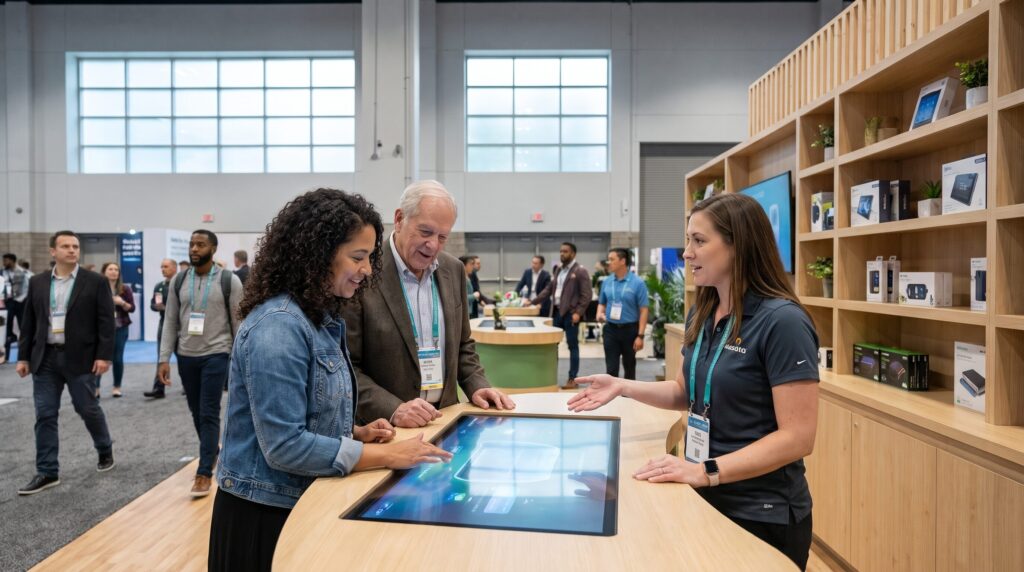
Interactive island trade show booth with a touchscreen product demo
An interactive island trade show booth with a touchscreen product demo.

Booth Staffing and Experiential Elements

Booth staffing makes or breaks trade show ROI, because even the best booth design fails with the wrong people in it. Trained staff and brand ambassadors turn foot traffic into conversations, and conversations into qualified leads.

Why booth staff matter more than the build

A structure attracts; people convert. Engaged, proactive staff who open with a question rather than a pitch set the tone, and they decide whether a passer-by becomes a lead or keeps walking down the aisle.

Brand ambassadors and experiential elements

Brand ambassadors extend your reach, run demos, and keep energy high across long show days. Pair them with experiential touches such as product trials and interactive stations so the booth feels alive every hour the hall is open.

Training and lead capture

Brief every staffer on goals, talk tracks, and the lead-capture tool before doors open. Clear qualifying questions and a simple digital form keep data clean, which makes post-show follow-up far faster and more accurate.

Measuring Trade Show Booth ROI

Measure trade show booth ROI by tracking qualified leads, cost per lead, and the pipeline that follow-up generates. Set these targets before the show so the booth has a clear job, not just a presence.

Leads and cost per lead

Start with qualified leads captured, then divide total show cost by that number for cost per lead. This single figure lets you compare shows, booth sizes, and designs honestly from one event to the next.

Follow-up is where ROI is won

Most booth value is lost in slow follow-up. Route leads to sales within 48 hours, personalise outreach around the booth conversation, and track which leads become meetings, opportunities, and closed revenue.

Beyond leads

Booths also build brand awareness, media moments, and customer relationships that never fit on a lead form. Count impressions, content captured, and meetings held so the full value of the exhibit shows up in your report.

Why Brand Guruz for Trade Show Booth Design and Activation

Brand Guruz is a Toronto-based experiential marketing agency that designs, builds, staffs, and measures trade show booths across Canada. We treat the booth as one part of a full activation, not a standalone structure, so the whole program drives leads.

Design plus activation under one roof

Because we handle booth design, production, and staffing together, the creative, the build, and the people on the floor all tell the same story. That alignment is what turns a good-looking booth into a lead-generating one.

Canadian reach and multicultural audiences

We produce across the GTA and the rest of Canada for diverse, real-world audiences tracked by Statistics Canada. From Toronto conventions to shows nationwide, we design exhibits that connect with the communities you actually want to reach.

Measurable results, not just a pretty booth

We tie every activation to leads, cost per lead, and follow-up, then report on what the booth returned. Ready to start? Book a free booth consultation and we will design an exhibit around your goals.

Frequently Asked Questions: Trade Show Booth Design

How much does a trade show booth cost in Canada?

Expect roughly CAD $150 to $400 per square foot for a custom booth, so a 10×10 often runs $10,000 to $25,000 and a 20×20 island $50,000 or more. Rentals and modular systems cost far less. Size, materials, technology, and shipping or drayage are the biggest cost drivers to plan for.

Custom or rental booth — which is better?

Rent if you exhibit once or twice a year or want to test a market, since you avoid storage and upfront cost. Go custom if you exhibit often or need a signature presence. Across many shows, a custom or modular build frequently costs less per event than repeated one-off rentals.

How early should we start our booth design?

Start three to six months before the show for a custom booth, and earlier for large islands or peak-season events. Early starts leave room for design approvals, fabrication, graphics, and shipping. A rushed timeline raises costs and limits creative options, so book your builder as soon as your space is confirmed.

What booth size do we need?

Match size to your goals and budget. A 10×10 suits lead capture and smaller shows, a 10×20 adds room for demos and meetings, and a 20×20 island supports hero experiences and hospitality. Pick the smallest footprint that still delivers the traffic and conversations your targets require.

What makes a trade show booth stand out?

Standout booths read in three seconds, use bold lighting and one clear message, and invite people in with an open layout. Interactive demos, hospitality, and trained staff keep visitors engaged. The combination of strong design and proactive people, not the structure alone, is what pulls and holds a crowd.

Do you provide booth staff and brand ambassadors?

Yes. Brand Guruz designs and builds booths and staffs them with trained brand ambassadors and event professionals across Canada. We brief every staffer on your goals, talk tracks, and lead capture, so the people in your booth convert foot traffic into qualified, well-documented leads you can follow up quickly.


Design a Trade Show Booth That Converts

Ready to turn your next show into a lead engine? Brand Guruz designs, builds, and staffs trade show booths across Canada, then measures what they return.

Tell us your show, your goals, and your budget, and we will design an exhibit built to attract and convert. Book a free booth consultation to get started, or explore our experiential marketing work.

Let's Grow Your Brand

Author