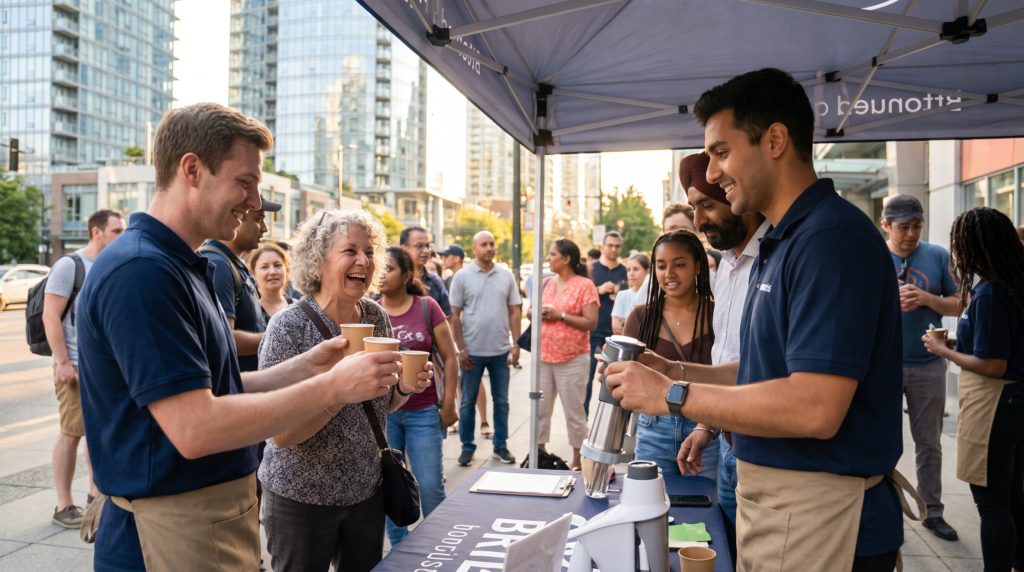
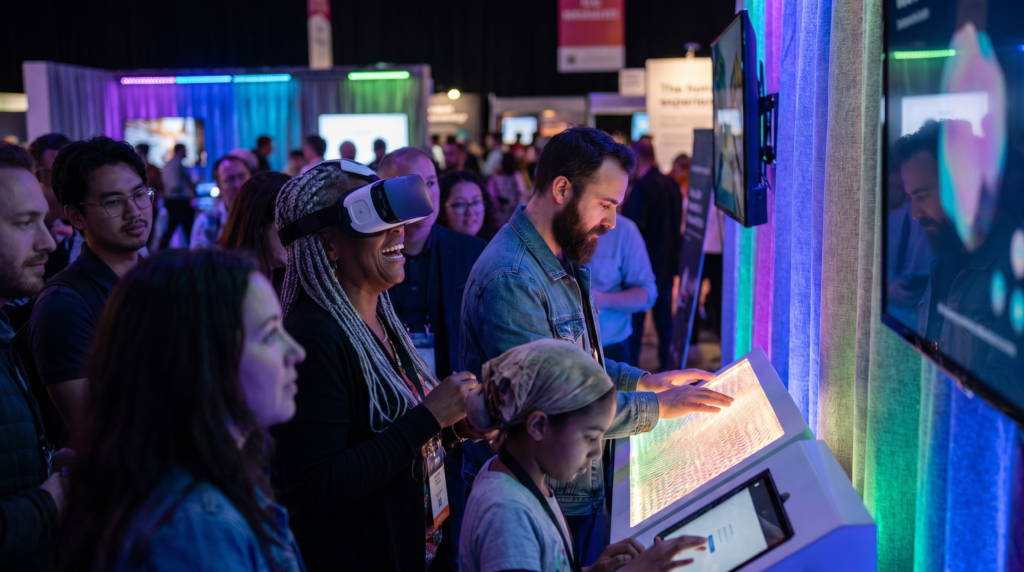
Experiential marketing is the art of letting people feel a brand instead of just seeing an ad. In other words, it turns a product into a live moment a customer can touch, taste, and remember. At Brand Guruz, we design experiences like that across Canada every week.
Moreover, the approach is booming. As attention online keeps fragmenting, brands are pouring budget into real-world moments that actually stick. Consequently, experiential marketing has moved from a nice extra to a core growth channel.
This guide explains what experiential marketing is, why it works, and how Canadian brands use it to win. In addition, it covers the main types, real costs, and a simple playbook you can follow. Let us dive in.
First, a quick promise: everything here is practical. By the end, you will know exactly how to plan an experience that turns attention into action.
$128B+ — global spend on experiential and live brand marketing heading into 2026 (Event Marketer) · 88% — consumers who trust a personal recommendation over any form of advertising (Nielsen) · 6.4M+ — people in the Greater Toronto Area, Canada's largest and most diverse live-event market (Statistics Canada)
Experiential marketing is a strategy that engages people through direct, hands-on brand experiences. Simply put, it invites the audience to participate instead of just watch. As a result, the brand becomes something they do, not something they scroll past.
At its core, experiential marketing creates a live or interactive moment between a brand and a person. For example, a sampling booth, a pop-up, or an immersive installation all count. Because the customer takes part, the memory lasts far longer than a banner ad.
Traditional ads talk at people. By contrast, experiential marketing talks with them. That shift matters, since participation builds trust that passive media rarely earns.
You may also hear it called engagement marketing, live marketing, or brand activation. However, the idea is always the same. In short, you give the audience a real experience worth remembering and sharing.
Trust is the whole game. In fact, Nielsen reports that 88% of consumers trust a personal recommendation above every other channel. Therefore a live experience that earns word of mouth beats a media buy on almost every metric.
People remember how a brand made them feel. Because experiences trigger real emotion, they lodge in memory in a way that static ads cannot. As a result, recall and loyalty both climb.
Every great activation is also a content engine. Guests film it, post it, and tag friends without being asked. Consequently, one live moment can travel far beyond the people in the room.
The numbers are clear, too. Brands that invest in live experience consistently report higher conversion and stronger brand affinity. Put simply, participation converts better than interruption.
Canada is a natural home for experiential marketing. Notably, Statistics Canada counts more than 6.4 million people in the Greater Toronto Area alone, which makes it one of the most concentrated and diverse markets on the continent.
Canadian audiences are gloriously varied, and they respond to experiences that reflect them. For instance, a festival activation in Brampton looks very different from a launch in downtown Toronto. Accordingly, cultural fluency is a real competitive edge here.
The GTA and Ontario run on events year-round. From summer festivals to winter markets, there is always a moment to activate. Meanwhile, cities like Mississauga, Vaughan, Ottawa, and Hamilton reward brands that show up locally.
National ideas still need local hands. Because venues, permits, and audiences differ by city, a Canadian partner who knows the ground saves time and money. In practice, that local knowledge is what makes a big idea land.
Experiential marketing is a family of tactics, not a single format. However, most campaigns use one or more of the types below. Use this list to spot the right fit for your brand.
Sampling puts your product straight into a customer’s hands. Because trial removes doubt, our product sampling work remains one of the fastest paths to a first purchase.
A pop-up shop creates a temporary branded space people can visit. As a result, it builds buzz, drives foot traffic, and rewards fans with something exclusive.
Installations turn a space into a story. Through sight, sound, and touch, they pull guests inside the brand world for a few unforgettable minutes.
Festivals gather a brand’s audience in one place. Consequently, a smart activation there reaches thousands of engaged people in a single weekend. For fresh formats, follow Event Marketer.
Trained ambassadors are the human face of a campaign. Because they talk, demo, and connect in person, they turn curiosity into real conversation.
B2B brands win on the show floor. With the right booth and staff, a trade show becomes a pipeline engine, not just a display.
Every brand manager eventually asks the same question. Who runs the best experiential marketing in Canada, and what makes their work stand out?
The answer is rarely about the biggest budget. Instead, the best campaigns share a few clear traits. They start with a sharp goal, they fit the audience, and they turn a moment into measurable action.
Most Canadian experiential agencies pitch the same three things: creativity, staffing, and production. However, the winners add a fourth. They connect the live experience to data, so every handshake becomes a tracked lead. To compare partners, read our guide to the top experiential marketing agencies in Canada.
Look for proof, not promises. Ask any partner for recent work, real numbers, and references you can call. Because past results predict future ones, a strong track record is the fastest trust signal you can find.
Above all, judge the idea by the outcome. A clever stunt that drives no action is just entertainment; a focused experience that moves people is marketing.
A great experience is engineered, not improvised. Accordingly, we run every campaign through five clear steps.
Decide what success means first, whether that is trial, leads, or awareness. Because the goal shapes every choice, it always comes first.
Next, define exactly who you want to reach. For instance, a Gen Z sampling tour and a B2B booth need very different designs.
Then, build one idea worth stopping for. The best activations are simple, sensory, and easy to share.
After that, bring trained ambassadors and tight production. Because execution is everything live, the details decide the result.
Finally, capture data and keep the conversation going. As a result, a one-day event becomes a pipeline you can nurture for months.
Repeat this loop and it compounds. Each experience teaches you more about the audience, so the next one lands even harder.
Cost is usually the first practical question. Fortunately, experiential marketing scales to almost any budget and goal.
A small sampling activation can start in the low thousands. Meanwhile, a full festival or immersive build runs much higher. In most cases, the budget follows the scale of the audience you want to reach. For a fuller picture, see our brand activation cost in Ontario guide.
Price alone is the wrong lens. Instead, look at cost per engaged person and the action that follows. Because one great experience can out-earn three cheap ones, value beats price every time. For proof, see our CIBC case study.
Value also compounds beyond the event. Since every activation builds relationships and data, your next campaign starts ahead of the last.
Brand Guruz is a Canadian experiential marketing agency built for live, multicultural audiences. Specifically, we design, staff, and produce experiences that reflect the communities you want to reach.
That focus matters. Because we handle the live activation and the digital follow-up together, every guest an experience attracts can become a tracked lead. In practice, that turns a great moment into measurable revenue.
We also produce at scale across the GTA and beyond, with a full team and backup support for every activation. To see the work, browse our case studies, then talk to Brand Guruz.
Few agencies close that loop. Since we own both the experience and the follow-up, nothing valuable slips through the cracks afterward.
Experiential marketing is a strategy that engages people through direct, hands-on brand experiences. In short, it invites the audience to take part instead of just watching an ad.
Common examples include product sampling, pop-up shops, immersive installations, and festival activations. Each one lets a customer feel the brand in person before they buy.
It builds trust and memory that ads cannot. Because people take part, they remember the brand longer and share the moment with others.
The main types are sampling, pop-ups, immersive installations, festival activations, brand ambassadors, and trade shows. Most campaigns combine a few of them.
Costs vary widely by scale. A small sampling activation can start in the low thousands, while a full immersive build costs much more. Judge the spend by the results it drives.
Yes. Canada’s dense, multicultural cities make it one of the best markets for live experience. The GTA alone holds more than 6.4 million people.
Set one clear goal, know your audience, design a shareable moment, staff it well, and measure the follow-up. A specialist agency can run all five steps for you.
Ready to give your audience an experience they will remember? Then let us build an activation that fits your goal and your brand.
Brand Guruz plans, staffs, and produces experiential marketing across Toronto, the GTA, and all of Ontario. Tell us your objective, and we will design the experience to hit it. To start, book a quick call through our contact page, or explore proven results in our case studies.