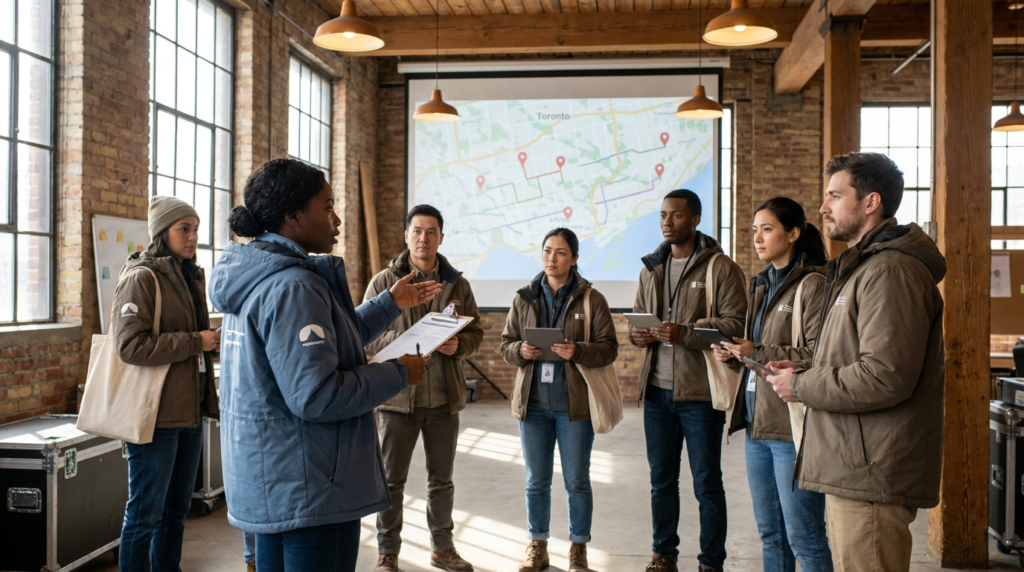
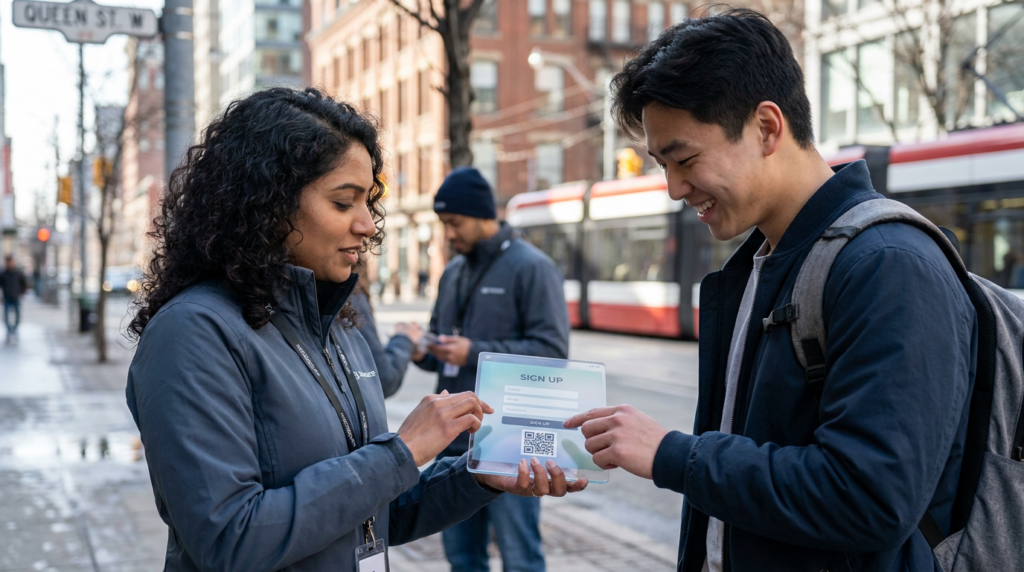
Picture a Saturday afternoon on Queen Street West. Eight brand ambassadors fan out across four blocks, sampling a new sparkling drink. They speak four languages between them. Furthermore, they capture every sign-up on a tablet and every reaction on their phones. By 6 p.m., they have 1,200 new emails, 200 pieces of UGC, and a neighborhood-level read on the product. That is street team marketing in 2026.
To be specific, it is no longer a clipboard and a stack of flyers. Today, it is a measured, multicultural, digital-first field channel. At Brand Guruz, we build and brief street team field crews across Canadian cities every week. In our experience, the brands that get it right treat the field crew as a real channel. It is not a body-toss into a busy street.
This is the playbook for how to build, brief, and measure street teams that actually convert in 2026.
Street team marketing is the practice of deploying brand ambassadors into public spaces to engage people face to face. Specifically, field crews sample products, drive sign-ups, capture content, and create buzz in real neighborhoods. Furthermore, the modern version is digital-first, data-driven, and multilingual.
The channel has roots in music promotion and grassroots marketing from decades ago. Today, however, it is integrated with tablets, QR codes, GPS routing, and real-time dashboards. As Campaign experiential coverage notes, the field crew is one of the most direct channels a brand has. In our experience, street teams convert better than almost any digital alternative for the same dollar. As a result, the channel is having a real resurgence in 2026.
Specifically, brands are turning back to street team marketing for three reasons. First, digital ad fatigue has eroded the conversion rates of paid social. Second, multicultural audiences respond to in-person engagement in ways an algorithm cannot replicate. Third, modern tooling makes the channel measurable for the first time in its history.
Building a street team starts with the people, not the playbook. To be specific, the wrong crew sinks a great brief, while the right crew rescues a bad one. Furthermore, hiring and training are where most street team marketing programs quietly fail. In our experience, the brands that win this channel invest more in the build than the brief.
Hiring is the single most important decision in street team marketing. Specifically, the crew should reflect the neighborhood and language of the audience. Furthermore, a great brand ambassador combines energy, judgment, and community fluency.
For example, a Brampton activation needs Punjabi-speaking ambassadors. By comparison, a Markham activation needs Mandarin or Cantonese speakers. As Inc. coverage of frontline hiring notes, fit-for-context beats generic charisma every time. In our experience, the brands that hire purely for looks lose the conversation in two minutes. Consequently, the audit on a street team starts long before the brief.
Importantly, the best crews mix experienced leaders with fresh ambassadors. As a result, the team carries both energy and judgment into every shift.
Training the field crew is the second non-negotiable. Specifically, ambassadors need product knowledge, brand voice, and objection handling. Furthermore, they need to know how to capture content and data without breaking the flow of a conversation.
As SHRM frontline training guidance shows, a half-day of structured training pays back across a full activation. In our experience, untrained crews freeze in real conversations. By comparison, trained crews handle objections, capture sign-ups, and create content all in one interaction. As a result, training is not a cost — it is the activation.
The brief turns a great crew into a great activation. Specifically, it defines the route, the targets, the script, and the safety guardrails. Furthermore, it is the single document the crew refers to in every awkward moment on the field. Importantly, a vague brief is the most common reason street team activations underperform — even with great crew.
A great street team brief is short, specific, and operational. Specifically, it includes the route, shift schedule, hourly targets, key-conversation scripts, and content-capture instructions. Furthermore, it sets the boundaries on what to do, what to avoid, and who to call when problems arise.
As Fast Company field marketing coverage notes, vague targets are the number-one reason field crews underperform. In our experience, “engage people” is not a target — 200 sign-ups before 4 p.m. is. Consequently, every brief needs a hard, countable goal.
A good brief also lives on the phone. Specifically, ambassadors should be able to reference it in 10 seconds between conversations. As a result, the brief becomes a tool, not a document.
Briefing crews for multicultural neighborhoods adds a cultural layer. Specifically, the brief should flag local sensitivities — language, religious observances, dress norms, and gender dynamics. Furthermore, this is where the right multicultural research turns into field instructions.
For example, a brief for a Vaisakhi-weekend activation in Brampton looks different from a Diwali-weekend brief in Mississauga. For more on the underlying research, see our multicultural market research guide. As a result, the brief becomes a cultural document, not just an operational one.
In our experience, this is where most generic field-marketing playbooks fall short. Specifically, they assume a single Canadian audience instead of dozens of distinct ones.
Measurement is what separates modern street team marketing from old-school flyering. Specifically, the field channel is now as measurable as any digital one. Furthermore, the brands that measure tightly are the ones that defend the budget next year. In our experience, measurement is also the fastest way to make the next activation better.
Real-time measurement starts the moment the crew hits the field. Specifically, GPS check-ins, mobile lead-capture apps, QR scans, and live photo uploads all feed a real-time dashboard. Furthermore, the brand can correct routing or scripting before the shift ends.
As Entrepreneur coverage of field marketing notes, real-time data turns a street team from a hope into a controllable channel. In our experience, the activations that adjust mid-shift outperform the ones that just hope for the best. As a result, real-time tooling pays for itself in a single afternoon.
Importantly, the dashboard is for the brand team, not the crew. Consequently, the crew stays focused on conversations while the data flows up automatically.
Post-activation reporting closes the loop. Specifically, it ties field activity to brand outcomes — sign-ups, conversions, content volume, sentiment, and earned media. Furthermore, neighborhood-level breakdowns tell the brand which markets to scale and which to skip.
For brands extending field activation into a national tour, see our experiential marketing tour playbook. In our experience, the reporting from one activation shapes the brief for the next. Consequently, every street team activation should feed the next one.
The best reports include a cost-per-engaged-attendee figure for each market. As a result, the brand can compare neighborhoods on a level playing field next time.
Use this checklist before any street team marketing activation in 2026.
Build:
Brief:
Measure:
In our experience, the brands that work through this list before the field shift report noticeably better outcomes.
What does a street team do? A street team deploys brand ambassadors into public spaces to engage people directly. Specifically, the crew samples products, captures sign-ups, generates content, and creates neighborhood-level buzz. As a result, it is one of the most direct channels a brand has.
How much does street team marketing cost in Canada? Street team marketing in Canada typically ranges from $5,000 for a single-day activation to $50,000+ for a multi-city campaign. Specifically, cost depends on crew size, number of cities, shift length, and tooling. Furthermore, multilingual crews and real-time measurement add to the budget.
How do you measure street team marketing in 2026? Modern street team measurement combines real-time lead capture, GPS routing data, and post-activation reporting. Specifically, dashboards track sign-ups, content, and conversion in real time. As a result, the channel is now as measurable as digital advertising.
How do you brief a street team for a multicultural neighborhood? Brief the crew on the specific cultural, language, and religious context of the neighborhood. Specifically, flag any active festivals, dress norms, and gender dynamics. Furthermore, hire ambassadors who speak the languages of the area.

A great street team is built, briefed, and measured long before the crew hits the sidewalk. The next few months book up quickly heading into spring and summer activation season. Talk to Brand Guruz about your 2026 field marketing plans. For more on our category approach, see our experiential marketing overview. Or browse our case studies to see how the playbook lands in the field.