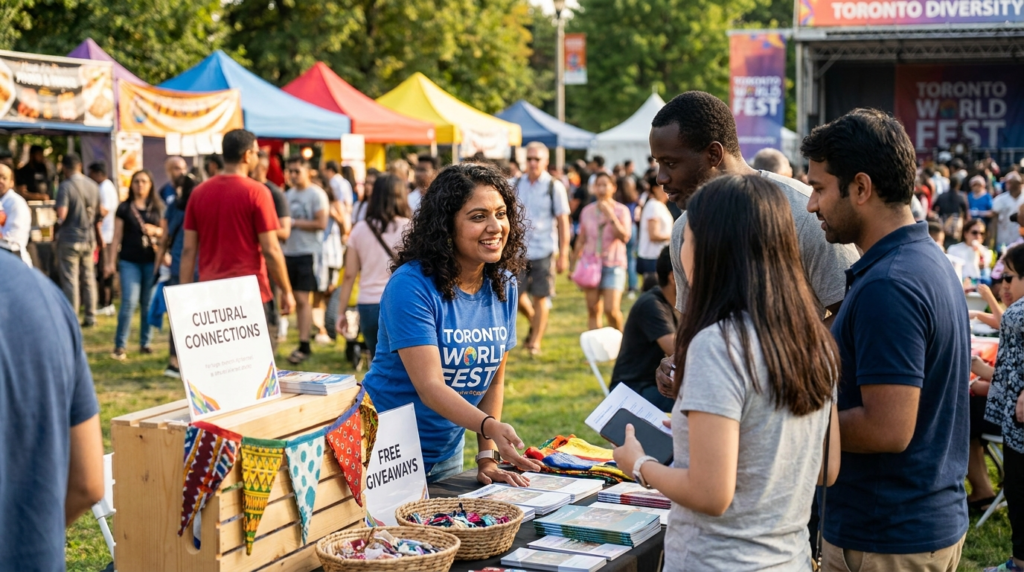
In Toronto, the two biggest summer community events, Pride and WorldFest Canada, land thirteen days apart in 2026. Specifically, Toronto Pride runs June 25–28 at Church-Wellesley Village. Canada’s largest multicultural fusion festival then follows July 11–12 at Sankofa (Yonge-Dundas) Square. Together they reach communities spanning Toronto’s full diversity — LGBTQ2S+ communities at Pride and 50+ cultural communities at WorldFest.
For brands with genuine multicultural reach as a strategic objective, however, treating these events as separate decisions is a missed opportunity. Certainly, the audiences are different, the activation formats differ, and the staffing requirements are distinct. However, the logistics overlap significantly and the messaging can be coherently sequenced. Together, the combined presence signals something most brands cannot credibly claim: authentic community engagement across the whole summer.
Notably, Brand Guruz is a founding partner of WorldFest Canada. Additionally, we have planned and staffed brand activations at Toronto Pride and across the GTA’s major multicultural festival circuit. Specifically, this playbook is for marketing teams that want to do both.
visitors attend WorldFest Toronto each year at Sankofa Square (worldfest.ca)
people attend the Toronto Pride Parade — one of the largest in the world
cultural communities represented at WorldFest Toronto 2026
Canada’s largest multicultural fusion festival — that is WorldFest — has attracted 120,000+ visitors to Sankofa Square. Indeed, what began as a local cultural showcase has grown to attract 120,000+ visitors across two days at Sankofa Square. Notably, the event is free and open to the public — attendance is driven by genuine community interest, not ticket prices.
Overall, the programming reflects what makes WorldFest genuinely distinct. Specifically, fusion performances — Bhangra meets Breakdance, Ballet meets Afrobeat — draw audiences that actively want cultural mixing, not segregated community showcases. Furthermore, food from 50+ countries, live music, cultural showcases, and interactive installations create a dwell-time environment most Toronto festivals cannot match.
For brand activators, the reach numbers matter. They are substantial. Sponsor and vendor figures from the official site confirm 120,000+ on-site walk-ins. Media reach spans 5.5 million across TV, radio, digital, and billboard. Additionally, the Sankofa Square location — Canada’s busiest pedestrian intersection — delivers substantial built-in foot traffic on top of the registered audience.
Specifically, WorldFest’s vendor and sponsor packages provide stage presence, LED screen visibility, on-site activation space, and digital campaign integration. Consequently, the deadline to secure vendor space for WorldFest Toronto 2026 runs well ahead of the July dates.
The case for planning both events together is not about efficiency alone. It is about what the two events represent in combination.
Toronto Pride reaches the city’s LGBTQ2S+ communities — brand-loyal and highly attuned to the difference between authentic allies and seasonal opportunists. Meanwhile, WorldFest reaches South Asian, East Asian, Caribbean, African, Latin, and dozens of other cultural communities through a genuinely celebratory lens. Separately, each stands among Toronto’s most significant community events. Together, they represent access to communities that include the majority of Toronto’s population.
Notably, the audiences overlap. Toronto’s LGBTQ2S+ communities are themselves deeply multicultural. Blockorama, the Black LGBTQ+ stage at Pride, is one of the most culturally significant events within the festival. Moreover, many of the communities celebrated at WorldFest have vibrant LGBTQ2S+ presences within them. Ultimately, brands that show up at both communicate something meaningful: community engagement is not a single-axis strategy.
The sequencing helps too. Pride ends June 28. WorldFest begins July 11. That thirteen-day window lets activation teams carry learnings from Pride directly into WorldFest — what messaging connected, which staff performed, what drove engagement. For the full Pride activation framework, see our Toronto Pride 2026 guide.
Generally, the key to a coherent double-activation summer is treating Pride and WorldFest as a connected program rather than two separate projects. The communities are different, but the activation infrastructure, the measurement framework, and the brand narrative can be unified.
June: Toronto Pride (June 25–28)
Pride activation requires LGBTQ2S+-inclusive staffing and authentic messaging. Consumers will ask: is this brand showing up year-round, or only in June? For the full Pride activation framework including staffing, costs, and authenticity criteria, see our dedicated Toronto Pride 2026 guide.
July: WorldFest Toronto 2026 (July 11–12)
Overall, WorldFest requires multilingual, multicultural staffing matched to the specific community mix. Indeed, because WorldFest is a fusion festival, the right brand presence celebrates the mixing rather than targeting a single ethnic group. Punjabi-speaking staff, Mandarin-capable brand ambassadors, and team members fluent in Caribbean community contexts all have a role at a well-staffed WorldFest activation.
The connective tissue: consistent brand presence
Notably, both events reward brands that have a genuine community story to tell. A brand showing up authentically at Pride and then at WorldFest with multilingual staff is not just doing two activations. Instead, it is building a summer narrative that earns trust across very different audiences. For the multicultural audience intelligence that informs both programs, see our multicultural market research guide.
Planning budgets for both events together makes the economics clearer than planning each in isolation.
Toronto Pride (June 25–28): Street Fair vendor presence, branded materials, and a two-person ambassador team across the weekend runs $8,000–$20,000 depending on production quality. Official Pride Toronto sponsorship starts at $100,000 for silver-tier.
WorldFest Toronto 2026 (July 11–12): Vendor and sponsor packages vary by tier — visit worldfest.ca/vendors for current package pricing. On-site activation and LED screen placement at WorldFest sits in a similar cost range to a mid-tier Pride vendor presence.
Combined activation: Overall, a brand running a serious presence at both — Street Fair at Pride, a WorldFest vendor package, staffing, and materials — should budget $20,000–$50,000. Specifically, shared briefing and a single agency relationship reduce the effective cost versus contracting separately.
For the ROI framework that applies to both, see our experiential marketing ROI guide.
Brand Guruz is a founding partner of WorldFest Canada, which means our involvement goes beyond vendor facilitation. We have been part of WorldFest’s development as a platform. Consequently, we understand what makes a brand presence land authentically here versus what gets ignored in a crowded festival environment.
For Pride, our team includes LGBTQ2S+-identified brand ambassadors alongside community allies. For WorldFest, the roster covers the full multicultural language map. That breadth is not accidental. Ultimately, it reflects who Toronto’s communities actually are. It reflects the reality that Toronto’s summer festival circuit demands genuine community depth, not generic event staff in festival T-shirts.
Furthermore, managing both activations through a single agency eliminates the coordination cost of separate contracts. Specifically, one briefing process, one measurement framework, one team. For the brand ambassador capability that underpins both programs, see our brand ambassador program guide.
When does WorldFest Toronto 2026 take place? WorldFest Toronto 2026 runs Saturday July 11 and Sunday July 12 at Sankofa (Yonge-Dundas) Square in downtown Toronto. The event is free and open to the public. Toronto Pride runs June 25–28, making the two events thirteen days apart — a manageable window for brands planning activations at both.
How do I get a vendor or sponsor spot at WorldFest Toronto 2026? Vendor and sponsor packages for WorldFest Toronto 2026 are available through worldfest.ca/vendors. Spaces fill ahead of the festival dates — confirm early. Brand Guruz can also support vendor applications and on-site planning.
How are the audiences at Pride and WorldFest different? Toronto Pride primarily serves Toronto’s LGBTQ2S+ communities and their allies — a diverse, socially connected audience with strong brand loyalty to companies that demonstrate consistent allyship. WorldFest serves 50+ cultural communities through a multicultural fusion lens, drawing South Asian, East Asian, Caribbean, African, and Latin audiences. The events are not mutually exclusive — Toronto’s LGBTQ2S+ communities are themselves deeply multicultural, and many WorldFest communities have visible LGBTQ2S+ presences.
What staffing does each event require? Pride activation requires LGBTQ2S+-inclusive staffing — ideally brand ambassadors who are part of or deeply connected to the community. WorldFest requires multilingual, multicultural staffing matched to the event’s diverse community mix. A well-planned double-activation summer uses some of the same team members across both events where profiles align, reducing cost without sacrificing authenticity.
Can Brand Guruz manage both activations together? Yes. Brand Guruz is a founding partner of WorldFest and has planned and staffed brand activations at Toronto Pride. Managing both through a single agency reduces briefing time, coordination cost, and production overhead. Talk to our team about a combined summer activation program that covers both events end-to-end.
Talk to Brand Guruz about planning your summer activation program — Pride in June, WorldFest in July, or both. Or see case studies to understand how our team executes at Toronto’s major community events.