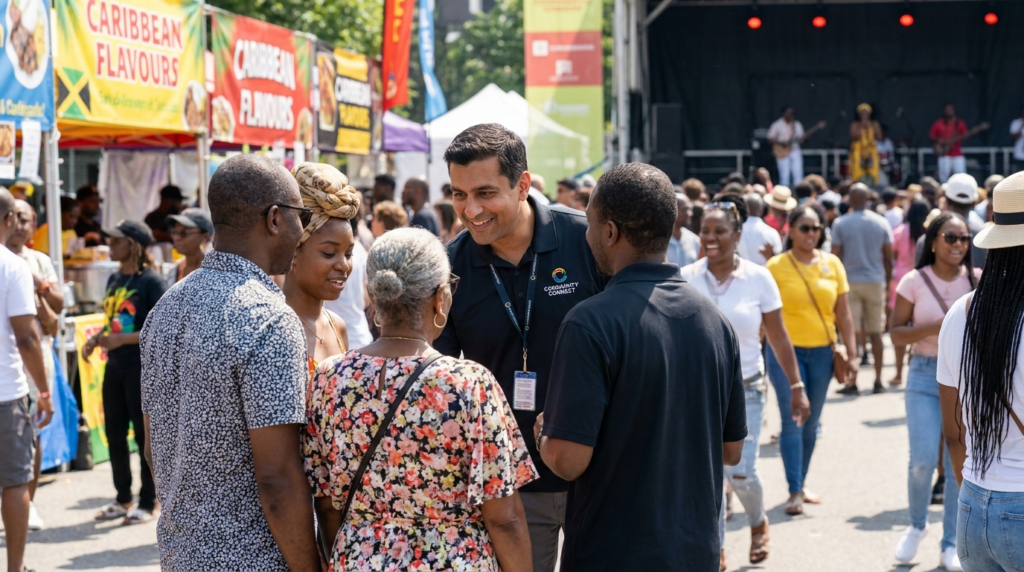
Influencer marketing Canada brands deploy today falls into two fundamentally different categories. The first is platform-based: Instagram Reels, TikTok campaigns, YouTube partnerships, creator content with follower counts and engagement metrics. Community-based influencer marketing means in-language brand ambassadors at cultural festivals, trusted voices within tight social networks where the recommendation carries cultural authority rather than algorithmic reach. Specifically, for brands targeting Canada’s multicultural communities, the second category consistently outperforms the first — and most brands are not doing it.
Canadian companies spent $1.9 billion CAD on influencer marketing in 2025, up 23% from 2024. Overall, that growth is driven by brands shifting away from celebrity and macro-influencer partnerships toward micro and nano creators — smaller audiences, higher trust, better conversion. Specifically, nano-influencers achieve 4–8% engagement rates compared to under 1% for mega creators. Indeed, 68% of Canadian audiences can distinguish between genuinely integrated sponsorships and forced placements. When content feels commercial rather than authentic, engagement drops by 52%.
Brand Guruz runs community influencer marketing programs across South Asian, Caribbean, East Asian, and Filipino communities throughout Ontario. These are delivered through in-language brand ambassador programs at multicultural events and festivals. Consequently, our programs reach the communities that platform-based influencer marketing in Canada consistently underserves.
Canadian influencer marketing spend in 2025, up 23% year-over-year
average return for every $1 spent on influencer marketing, with top campaigns achieving up to 20x ROI
of Canadian audiences can distinguish between genuine sponsorships and forced placements — when content feels commercial, engagement drops 52%
Influencer marketing in Canada has moved well beyond the celebrity endorsement era. Specifically, micro and nano creators now outperform celebrity influencers on both engagement and ROI. The structural reason is simple: smaller audiences trust the creator more. A nano influencer with 5,000 engaged followers in a niche community consistently converts at rates that mega influencers with millions of passive followers cannot match.
Furthermore, Canadian brands are increasingly prioritizing long-term ambassador partnerships over one-off collaborations. Indeed, 62% of creators now prefer sustained partnerships — and the performance data supports their preference. Long-term ambassador relationships build the audience trust that a single sponsored post cannot manufacture. Consequently, brands are restructuring their influencer programs around ongoing community presence rather than campaign bursts.
Compliance requirements are also tightening. Advertising Standards Canada and the Canadian Competition Bureau have reinforced guidelines requiring influencers to clearly disclose sponsored content, material connections with brands, and all forms of compensation. Overall, this regulatory tightening is broadly positive — it rewards authentic partnerships and penalizes the fake follower and hidden-sponsorship models that drove early platform influencer fraud. Consequently, compliance rates in Canada improved to 91% in 2025 as a result of automated disclosure tools and brand training programs.
Additionally, many Canadian brands now prioritize partnerships with diverse creators to reflect Canada’s multicultural identity. Moreover, influencer programs that authentically engage multicultural communities now command premium brand investment precisely because the alternative does not work.
Standard influencer marketing in Canada assumes audience size is the primary leverage. Reach a large enough audience with the right brand message, and conversions follow. Specifically, this model breaks down in multicultural communities — and the reason is structural.
South Asian, Caribbean, East Asian, and Filipino communities in the GTA make purchasing decisions through dense social trust networks. A recommendation from a gurdwara community member reaches 500 people with a level of trust that a lifestyle blogger with 50,000 followers cannot match. Specifically, the cultural authority of the in-community recommendation is qualitatively different from the parasocial authority of a content creator. One is community trust. The other is entertainment trust. Consequently, for product categories where purchase decisions are high-stakes — financial services, home purchases, major appliances — the community trust channel substantially outperforms content creator reach.
Moreover, 68% of Canadian audiences can detect forced sponsorships. In multicultural communities, that detection rate is arguably higher. Cultural inauthenticity — a brand that does not understand the community’s values, language, or social dynamics — is immediately visible. Generally, an in-language community ambassador who is genuinely embedded in the cultural context they represent does not feel like a sponsorship. They feel like a trusted recommendation from someone who shares the audience’s world. Furthermore, that recommendation travels through WhatsApp groups, temple networks, community associations, and family social structures at a speed and depth that no algorithm can replicate.
Overall, the community ambassador model is the highest-performing form of influencer marketing in Canada’s multicultural communities. It operates almost entirely outside the platform-based framework that most influencer marketing discussions assume.
Specifically, Brand Guruz’s in-language brand ambassador programs place trusted community voices at cultural festivals and community events across the GTA. The ambassador is not a content creator with a following. They are a community member with embedded trust — Punjabi-speaking at South Asian festivals, Tagalog-speaking at Filipino events, and Cantonese or Mandarin-speaking at East Asian gatherings. Indeed, the trust they carry is structural rather than earned through content creation. It is the trust of shared language, shared cultural experience, and community membership. Consequently, their product recommendations travel through social networks far faster and deeper than a sponsored post.
This aligns with the broader shift in influencer marketing in Canada toward long-term ambassador partnerships. Brands that invest in sustained community ambassador relationships build cumulative trust that compounds across every subsequent interaction. Moreover, the community referral network effect means that a single well-executed ambassador activation at a Brampton community event can generate conversions for weeks after the event closes.
For the ambassador program model that supports these community influencer programs, see our brand ambassador program guide.
Community influencer marketing in Canada produces the strongest results in categories where purchase decisions are high-trust and community-influenced.
Food and beverage. Product sampling at multicultural community festivals is community influencer marketing in its most direct form. A trusted in-language ambassador sampling a product at Caribana or Carassauga is not interrupting the cultural experience. They are part of it. Specifically, the recommendation extends through the attendee’s social network long after the event ends. See our food and beverage marketing guide for how this works across Ontario’s multicultural festival circuit.
Financial services. In-language financial literacy events are the highest-trust influencer marketing format in multicultural financial services. Specifically, a Punjabi-speaking financial advisor running a mortgage education workshop at a Brampton community centre is not a sponsored post. They are a trusted community voice providing genuine value — which is the definition of high-converting influencer marketing. See our financial services marketing guide for the full framework.
Telecom and technology. Community switching recommendations in tight multicultural networks travel faster than any paid media placement. A brand ambassador who earns the trust of a South Asian community association can generate referral pipelines that no digital influencer campaign reaches.
Retail and CPG. In-language product demonstrations at community events produce trial and word-of-mouth at rates that digital sampling campaigns cannot approach. Furthermore, the physical product experience at a trusted community event creates brand memory that outlasts any content impression.
What is the ROI of influencer marketing in Canada? The average return on influencer marketing in Canada is $5.78 for every $1 spent. Top campaigns achieve up to 20x ROI — approximately 11x higher than traditional digital advertising.
How does influencer marketing work differently in multicultural communities in Canada? Multicultural communities in Canada make purchasing decisions through dense social trust networks — not through content consumption. A trusted voice in a gurdwara community carries more purchase influence than a content creator with the same target demographic. Specifically, in-language cultural fluency is the differentiator. A Punjabi-speaking community ambassador at a South Asian festival operates with authentic community authority that platform-based influencer campaigns cannot replicate.
What is a community ambassador program and how does it compare to influencer marketing? A community ambassador program places trusted community voices at cultural events and festivals to represent a brand through in-person engagement and product recommendation. Compared to platform-based influencer marketing in Canada, community ambassador programs trade follower reach for community trust depth — which converts at substantially higher rates in multicultural communities.
How does Brand Guruz approach influencer marketing for multicultural brands in Canada? Brand Guruz designs and runs community influencer programs across South Asian, Caribbean, East Asian, and Filipino communities in Ontario — in-language ambassador programs at multicultural festivals. Our in-language capability covers Punjabi, Hindi, Tamil, Tagalog, Cantonese, and Mandarin.
What regulations govern influencer marketing in Canada? Advertising Standards Canada and the Canadian Competition Bureau require clear disclosure of sponsored content, material brand connections, and all forms of compensation. Community ambassador programs at public events are subject to the same disclosure principles. Brand Guruz trains all ambassador teams on applicable ASC guidelines before deployment.

Talk to Brand Guruz about community influencer marketing in Canada — in-language brand ambassador programs, multicultural festival activations, and long-term community ambassador partnerships across Ontario’s multicultural communities. See our experiential marketing agency Toronto overview for how our community influencer programs fit within a full multicultural marketing strategy.