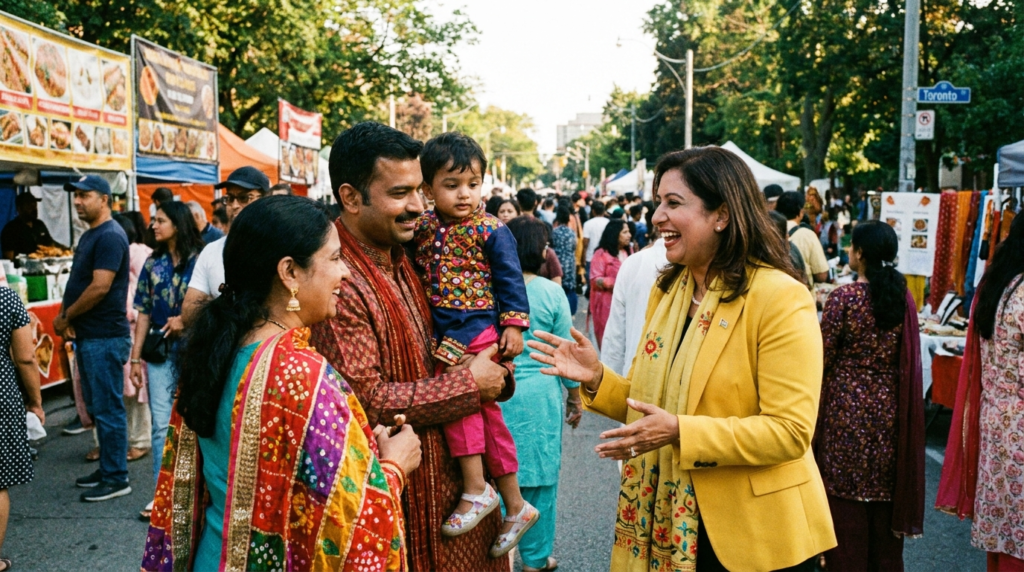
A well-deployed multicultural brand ambassador earns community trust in thirty seconds — trust that no billboard, digital ad, or non-community representative can replicate in thirty minutes. At cultural festivals, gurdwara-hosted events, Eid celebrations, and Diwali activations across the GTA, the brand ambassador is not a sales tool. They are a trust transfer mechanism. Consequently, the quality of your brief and training determines whether your activation strengthens or damages your brand’s reputation within that community’s WhatsApp networks.
Moreover, 26.5% of Canada’s population identified as a visible minority in the 2021 Census — and that share is growing rapidly in major urban centres. Additionally, Google Canada research shows that 37% of Canadians say they don’t see their lifestyle represented in advertising — making community-credible multicultural brand ambassador programs one of the most powerful tools for closing that gap. Overall, multicultural community events are no longer niche activation spaces. They are among the highest-concentration consumer touchpoints in Canadian marketing.
Brand Guruz runs in-language multicultural brand ambassador programs across Vaisakhi, Diwali, Caribana, Eid, Lunar New Year, and community events throughout the GTA. This guide reflects how Brand Guruz prepares and deploys multicultural brand ambassador teams for clients in financial services, telecom, real estate, and healthcare. See our full brand ambassador program guide for the program overview.
Canada’s visible minority population share in 2021, making multicultural events a mainstream activation priority (Statistics Canada)
consistently ranked among the most trusted voices in consumer purchasing decisions, more trusted than celebrities or executives (Edelman Trust Barometer)
the window in which a multicultural brand ambassador either earns or loses community credibility at a cultural event
Not all brand ambassadors are created equal — and at multicultural events, the gap between great and mediocre is measured in community credibility. Specifically, a multicultural brand ambassador is not simply someone who speaks a second language. Four qualities distinguish the most effective multicultural brand ambassadors.
Cultural fluency is distinct from linguistic ability. Speaking Punjabi doesn’t automatically mean understanding gurdwara community dynamics or the significance of Vaisakhi. Respectful family engagement norms are also culturally specific. Consequently, cultural fluency is the combination of language, lived experience, community membership, and social intelligence — and it is the essential foundation.
Community credibility is the quality that cannot be manufactured. The ideal multicultural brand ambassador is someone the target community already recognizes as “one of us.” This may mean attending the same gurdwara, sharing the same neighbourhood, or being known within the local Tamil community network. Specifically, community credibility transfers trust from the ambassador to the brand — not the other way around.
Brand knowledge is the second pillar. Cultural credibility without brand knowledge creates the same problem as brand knowledge without cultural intelligence. Overall, both pillars must be present before any deployment.
Adaptability rounds out the profile. Multicultural community events range from formal Diwali galas to high-energy Caribana street festivals. A great multicultural brand ambassador reads the room and maintains consistent brand credibility across different contexts. See our multicultural market research guide for community-specific context that informs ambassador selection.
The brief is the most important document in any multicultural brand ambassador program. Specifically, an underbriefed team is not merely less effective — it is actively dangerous to the brand. A cultural misstep travels through community WhatsApp networks before the brand has packed up its booth. Consequently, deliver the complete brief at least 72 hours before activation, with a follow-up Q&A session at 24 hours.
Brand overview covers what the brand does, who it serves, and why the audience should care — in 90 seconds, adapted into the community language. A translated brief is not a culturally adapted brief. Specifically, adapt the brand overview to reference community-relevant use cases, not the generic national positioning.
Event overview and cultural context is the section most agencies omit. An ambassador at a Vaisakhi parade must understand what Vaisakhi actually is. It marks the founding of the Khalsa — not simply a “Punjabi spring festival.” Cultural context shapes how the activation should be conducted and what the community is emotionally attuned to on that day.
Objectives and success metrics define what success looks like: lead captures, product sampling, app downloads, or brand impression surveys. Clear, measurable objectives give ambassadors a concrete North Star for the day.
Key messages and off-limits topics are equally important. Specifically, provide the three to five messages you want communicated in every conversation. Additionally, explicitly list what not to say. Political topics, religious doctrine, intergroup comparisons, and competitor brand references are off-limits by default. The off-limits list is not optional.
Dress code, lead capture protocol, and escalation procedure complete the brief. The appropriate attire for a multicultural community event is context-specific. Who does the ambassador call when a question exceeds their knowledge? These protocols must be established in writing before activation begins. For the full festival activation model, see our festival brand activation playbook.

Training for multicultural brand ambassadors has two distinct components: brand training and cultural orientation. Specifically, most programs invest heavily in brand training and underinvest in cultural orientation. That imbalance produces the missteps that travel through community networks.
Brand training covers everything a general ambassador program covers: the product or service, key messages, in-language objection handling, lead capture mechanics, and technology. Complete this component at least 48 hours before the event to allow time for clarifying questions.
Cultural occasion orientation is the component most agencies skip. For every major cultural event, ambassadors need a 10-minute cultural orientation covering four areas. First, the occasion’s cultural and religious significance. Second, common greetings and appropriate conversation openers in the community language. Third, cultural etiquette: removing shoes, addressing elders, food sensitivities during religious observances. Finally, specific misconceptions to avoid. Indeed, this 10-minute investment prevents the missteps that ten thousand dollars of advertising cannot undo.
Role-play and practice conversations are essential before any high-stakes multicultural activation. Specifically, pair ambassadors together for 10-minute simulated conversations. Run scenarios: a non-English consumer, a skeptical elder, and a community leader asking for proof of community commitment. These conversations prepare ambassadors for what they will actually encounter.
The pre-event team meeting is the most underrated component of multicultural brand ambassador deployment. A 45-minute morning meeting — after travel, before booth setup — is where the brief comes alive. Specifically, this meeting covers final logistics, ambassador positioning, and the brand supervisor’s quality check on readiness. Consequently, no ambassador should arrive at a multicultural activation without completing this meeting. For community-specific context that shapes training content, see our South Asian consumer Canada guide and our newcomer marketing Canada guide.
Ambassador positioning is the first operational decision on activation day. Specifically, foot traffic patterns at multicultural community events follow cultural rhythm. Prayer times, parade routes, and performance schedules shape where concentration peaks. Scout the venue at least two hours before activation to map foot traffic and position ambassadors accordingly.
The 30-second engagement opener is the most critical element of multicultural brand ambassador performance. It should be in the community language, or offer the choice: “Would you prefer Punjabi or English?” It should acknowledge the occasion and lead with value rather than the ask. Generally, anything scripted enough to sound scripted has already failed.
Real-time supervision is non-negotiable. A brand supervisor — distinct from the ambassador team — should circulate throughout the activation. They should check in with ambassadors every 15 to 20 minutes, troubleshoot situations, and manage documentation. Ambassadors should never be left unsupervised at a multicultural community event.
Energy management matters on long activation days. Cultural festivals often run six to ten hours. Specifically, ambassadors should take staggered breaks, have access to food and water, and rotate across the activation footprint. Additionally, a tired or disengaged multicultural brand ambassador creates liability that supervision alone cannot cover. For the full Brand Guruz experiential marketing model, see our experiential marketing agency Toronto overview.
Post-activation measurement should go beyond simple lead counts. Specifically, multicultural brand ambassador performance requires both quantitative and qualitative tracking.
Quantitative metrics include total leads captured, product samples distributed, QR code scans or app downloads attributable to the activation, and estimated impressions based on booth traffic.
Qualitative metrics matter as much as quantitative results. Conduct the ambassador debrief within 24 hours of activation. Capture what worked, what didn’t, how the community responded, and whether any negative interactions occurred. Also note which conversational approaches or in-language openers performed best. Moreover, the qualitative debrief is the source material for improving the next brief.
Insights that shape the next activation are the most valuable output. Specifically, if ambassadors consistently encountered a particular objection, address it in the next training session. If a certain greeting or tactic outperformed others, formalize it into the brief as standard practice. Overall, a multicultural brand ambassador program that learns from each activation gets sharper with every deployment — and the brief is where that learning lives.
What is a multicultural brand ambassador? A multicultural brand ambassador is a trained brand representative deployed at cultural community events to engage with specific ethnic or cultural communities in their language and cultural context. The most effective multicultural brand ambassadors combine genuine community credibility — often through shared cultural background and language — with structured brand knowledge and professional activation skills.
How do you recruit multicultural brand ambassadors? Recruit from within the target community rather than seeking bilingual generalists. Recruitment channels include cultural college networks, cultural association boards, community social media, and established ambassador networks. Specifically, the Brand Guruz multicultural brand ambassador roster spans Punjabi, Tamil, Gujarati, Hindi, Tagalog, and other community languages across the GTA.
How far in advance should you brief a multicultural brand ambassador? Deliver the complete brief at least 72 hours before the activation, with a follow-up Q&A at 24 hours. Complete brand training at least 48 hours before the event. A same-day pre-event team meeting of approximately 45 minutes is standard for all multicultural brand ambassador deployments.
What should you never ask a multicultural brand ambassador to do? Avoid asking ambassadors to lead with religious statements, make intergroup comparisons, or promote messaging that disregards the occasion’s cultural or religious significance. During Ramadan, food and beverage sampling requires specific sensitivity. Off-limits topics should always be explicitly specified in the brief — never left to ambassador judgment alone.
Talk to Brand Guruz about building a multicultural brand ambassador program for your next Diwali, Vaisakhi, Caribana, or Eid activation across Brampton, Mississauga, and Richmond Hill.