The Trust Sale: A Canadian Guide to Insurance Multicultural Marketing

Insurance multicultural marketing in Canada operates through channels that mainstream insurance marketing ignores almost entirely. Specifically, Statistics Canada’s 2021 Census confirms that South Asian, Chinese, Caribbean, and other multicultural communities represent the majority of recent GTA population growth. These communities are buying life insurance, home insurance, and auto insurance in very large numbers. They are doing so through community brokers, peer networks, and cultural association referrals — not through comparison websites or mainstream advertising channels.

The insurance product is uniquely dependent on trust. Specifically, a buyer can switch phone plans or try a new food brand with minimal consequence. Buying the wrong insurance policy — or being underinsured — can devastate a family. Consequently, multicultural consumers apply the highest possible trust standard to insurance purchase decisions. A trusted community member’s recommendation within a WhatsApp or WeChat network carries far more decision-making weight than any advertising campaign.

This guide covers the key communities in insurance multicultural marketing in Canada, the newcomer coverage gap, and what effective activation looks like. For the broader financial services multicultural framework, see our guide to financial services multicultural marketing Canada. The South Asian consumer profile underpinning this guide is in our South Asian consumer Canada guide.

First 3 years

the window in which most newcomer families identify their Canadian insurance needs, making early-settlement engagement the highest-value entry point in insurance multicultural marketing in Canada

Community brokers

not comparison sites, not call centres — are the dominant insurance distribution channel in South Asian, Chinese, and Caribbean Canadian communities

Life insurance

disproportionately high uptake in South Asian and Caribbean Canadian communities, driven by strong cultural values around family protection and legacy

Why insurance multicultural marketing in Canada requires a trust-first approach

Insurance multicultural marketing in Canada fails when it applies the same performance-marketing playbook as mainstream insurance. Specifically, Google comparison ads, direct mail, and call centre campaigns reach multicultural consumers as noise rather than signal. The primary purchase trigger in multicultural communities is not a discount or a comparison table — it is a trusted peer’s recommendation.

Google Canada research confirms that multicultural consumers over-index heavily on peer recommendations for financial and insurance products. Specifically, South Asian Canadian families buy life insurance from brokers their relatives used. Chinese Canadian households follow WeChat group recommendations for wealth products. Caribbean Canadian families work with brokers embedded in church communities.

Additionally, the language and complexity of insurance products creates a structural trust barrier. Specifically, policy documents are dense, jargon-heavy, and difficult to navigate even for fluent English speakers. A Chinese Canadian family reviewing a whole-life policy in English without a Mandarin-speaking broker is at a significant informational disadvantage. Without in-language guidance, a South Asian Canadian newcomer choosing between term and whole life makes a high-stakes decision. Specifically, they do so with limited information and no cultural frame of reference. Insurance multicultural marketing in Canada that addresses this gap — through in-language education, community workshops, and broker accessibility — builds durable community trust. For the community trust framework, see our multicultural market research guide.

Insurance multicultural marketing in Canada: community profiles and coverage priorities

South Asian Canadians represent the most significant market segment for insurance multicultural marketing in Canada. Specifically, life insurance is deeply culturally valued in South Asian households. Protecting family and funding children’s education are core South Asian values. Leaving a financial legacy is equally important across Punjabi, Gujarati, and Tamil communities. Whole-life policies are favoured over term policies in higher-income South Asian households, often structured as dual investment and protection vehicles.

Chinese Canadian households carry a distinctive insurance profile. Specifically, life insurance as a wealth-transfer and estate-planning vehicle is very well understood in Chinese Canadian professional households. High face-value policies, investment-linked life insurance, and corporate-owned life insurance are all active product categories. WeChat broker networks — community members turned licensed brokers — are the primary insurance distribution channel in Markham and Richmond Hill.

Caribbean Canadian communities show a culturally strong orientation toward life insurance. Specifically, funeral traditions in Jamaican, Trinidadian, and Barbadian Canadian communities involve significant financial expenditure — an elaborate farewell is a community expectation. Life insurance ensures a proper farewell and provides for surviving family. Consequently, it is a deeply meaningful product in Caribbean Canadian communities. Caribbean credit unions and community-affiliated brokers in Scarborough serve this market with high trust.

Furthermore, newcomer households across all communities face the same structural gap. Specifically, new arrivals may not understand what coverage is mandatory in Canada, what products exist, or how to evaluate competing offers.


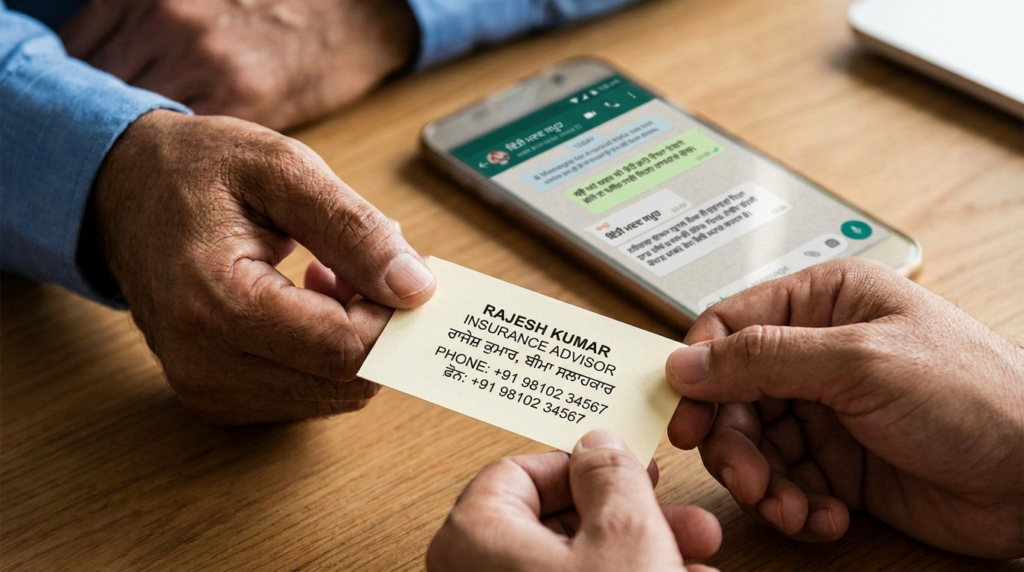
Insurance multicultural marketing Canada 2026: a South Asian insurance broker's hand presenting a bilingual English and Punjabi business card, with a smartphone showing a WhatsApp community group in the background.
The community broker is the dominant insurance distribution channel in South Asian and Chinese Canadian communities. A bilingual business card and active WhatsApp or WeChat group presence reach multicultural insurance buyers through the channels they actually trust — not the ones mainstream insurers prefer.

The newcomer insurance gap: what insurance multicultural marketing in Canada must address

The newcomer insurance gap is the most commercially significant underserved opportunity in insurance multicultural marketing in Canada. Specifically, most newcomers arrive with incomplete knowledge of what Canadian insurance products exist and which are legally required. Auto insurance is mandatory — but premium structures based on driving history disadvantage newcomers who have decades of driving experience outside Canada. Home insurance is mandatory once a mortgage is in place. Many newcomers do not know what it covers or how to evaluate competing policies.

Additionally, health and dental coverage is a critical gap for newcomers who have not yet secured employer benefits. Specifically, Canada’s provincial health systems do not cover dental, vision, or prescription drug costs. Newcomer families without employer group benefits face significant out-of-pocket exposure. Insurance brands that educate newcomers about health and dental coverage — through in-language events and bilingual materials — reach buyers at this formation moment.

The newcomer first-insurance-relationship is as commercially significant as the newcomer first-car purchase. Specifically, a newcomer family with a positive in-language broker experience builds multi-decade loyalty to that broker’s products and brand. Every subsequent policy — the upgrade from term to whole life, the children’s first car insurance, the investment policy — follows that initial relationship. Insurance multicultural marketing in Canada that prioritises newcomer education and accessibility builds a compounding loyalty effect. For the newcomer market context, see our newcomer marketing Canada guide.

Community channels and peer networks in insurance multicultural marketing in Canada

Gurdwaras, mosques, temples, and cultural associations are the highest-trust community institutions for insurance multicultural marketing in Canada. Consequently, almost no mainstream insurance brands engage with them directly. Specifically, gurdwara communities in Brampton host financial literacy events, tax preparation workshops, and community information sessions. A brand that sponsors these events or provides bilingual educational materials earns community credibility that no media campaign replicates.

Additionally, the community broker model is the dominant distribution architecture in South Asian and Chinese Canadian insurance markets. Specifically, licensed Punjabi-speaking brokers serve Brampton’s South Asian community through gurdwara networks, community WhatsApp groups, and personal referrals. Licensed Mandarin-speaking brokers serve Markham and Richmond Hill’s Chinese Canadian community through WeChat channels. These brokers are not employees of mainstream insurance companies. They operate as trusted intermediaries whose community standing is their primary commercial asset.

Furthermore, the Edelman Trust Barometer consistently confirms that financial and insurance products are among the highest-trust-dependency categories in all consumer markets. In multicultural communities, where institutional trust in large corporations tends to be lower, the community broker intermediary role is even more critical. Insurance multicultural marketing in Canada that works alongside community brokers — not displacing them — reaches multicultural insurance buyers through the channel they trust. For the brand activation model, see our brand ambassador program guide and experiential marketing agency Toronto overview.

What effective insurance multicultural marketing in Canada looks like

Effective insurance multicultural marketing in Canada combines three elements mainstream insurance rarely deploys: in-language community education, community broker partnership, and experiential presence.

In-language community education means hosting or sponsoring financial literacy workshops at gurdwaras, mosques, temples, and cultural association events. Specifically, a Punjabi-language workshop on Canadian insurance at a Brampton gurdwara reaches South Asian families at the highest-trust venue available. It positions the sponsoring brand as a community resource rather than a sales operation. Bengali, Tamil, Mandarin, Cantonese, and Somali-language insurance education events serve their respective communities with the same trust architecture.

Community broker partnerships mean identifying and working with the licensed community brokers who already have established trust networks. Specifically, a brand that aligns with well-regarded Punjabi-speaking or Mandarin-speaking brokers enters their referral networks as a trusted product supplier. This is not a traditional broker channel strategy — it is a community trust infrastructure strategy.

Experiential community presence means showing up at multicultural festivals — Vaisakhi, Lunar New Year, Caribana — with brand activation that educates rather than hard-sells. Specifically, insurance education booths with in-language materials and ambassadors at community events build brand familiarity at moments of community goodwill. For the festival activation model, see our festival brand activation playbook and multicultural brand ambassador guide.

Mistakes brands make in insurance multicultural marketing in Canada

The most fundamental mistake is using comparison-site and direct response strategies as the primary channel. Specifically, multicultural insurance buyers do not use comparison websites as their primary decision channel. They trust community brokers, peer networks, and family referrals. Performance marketing and Google comparison ads reach these buyers only at the margins of their decision process.

The second mistake is complexity without translation. Specifically, producing Punjabi-language social media ads that direct prospects to English-only landing pages creates a trust gap that kills conversion. Effective insurance multicultural marketing in Canada requires the full journey — advertising, landing pages, policy documents, and broker interactions — to be available in-language.

The third mistake is treating multicultural communities as a single market. Specifically, whole-life-as-investment products resonate strongly with Chinese Canadian and South Asian professional households. Basic term life coverage resonates differently. Health and dental gap coverage is a newcomer priority. Each product category has different community resonance, and a single creative approach cannot serve all multicultural insurance segments simultaneously.

Frequently asked questions: insurance multicultural marketing in Canada

Why don’t comparison sites work for insurance multicultural marketing in Canada? Multicultural communities use peer networks and family referrals as their primary insurance decision channels. A South Asian family’s first insurance purchase typically comes from a broker recommended within their WhatsApp network. Insurance multicultural marketing in Canada must invest in these community trust channels.

Which insurance products are most important to multicultural communities in Canada? Life insurance — particularly whole-life policies in South Asian and Chinese Canadian communities — is the highest-priority product. Home insurance is a critical newcomer purchase. Health and dental is a major gap. Auto insurance is mandatory but challenging for newcomers without a Canadian driving record.

What is the community broker model and how should insurance brands engage with it? Community brokers are licensed insurance professionals operating through multicultural community networks — gurdwara referrals, WeChat groups, and cultural associations. They dominate South Asian and Chinese Canadian insurance distribution. Insurance multicultural marketing in Canada that works alongside community brokers reaches buyers through the channel they trust most.

How should brands approach newcomer insurance education? Newcomers face a genuine knowledge gap about what Canadian insurance exists and what is mandatory. Sponsoring in-language financial literacy events at gurdwaras positions a brand as a trusted resource at the newcomer’s first Canadian insurance decision.

How does insurance multicultural marketing in Canada differ from financial services multicultural marketing? Insurance multicultural marketing focuses on protection and risk products — life, home, auto, and health. Product complexity and fear-based purchasing psychology require a more educational approach than broader financial services marketing. Insurance decisions involve high stakes, long time horizons, and product complexity that most buyers find difficult to evaluate alone.

Build your insurance multicultural marketing program in Canada with Brand Guruz

Talk to Brand Guruz about activating insurance multicultural marketing in Canada. We cover community education events, broker network activation, and festival brand presence across Brampton, Markham, and Scarborough — with in-language ambassador teams.

Author