The Vietnamese Canadian Consumer: A 2026 Guide for Brand Marketers

The Vietnamese Canadian consumer is one of the most misread multicultural audiences in the GTA. Most commonly, brands conflate this community with Chinese Canadian consumers because both observe Tết — and that is where the strategy goes wrong. Specifically, Statistics Canada’s 2021 Census identifies approximately 233,000 Canadians of Vietnamese origin nationally. Ontario holds the largest provincial concentration, with roughly 85,000–90,000 Vietnamese Canadians in the GTA. These are distinct communities with distinct languages, media ecosystems, cultural practices, and trust architectures.

The distinction is not semantic. Vietnamese is a tonal language with no linguistic relationship to Cantonese, Mandarin, or any Sinitic language. This community primarily consumes Vietnamese-language media, not Chinese-language media. Post-1975 South Vietnamese refugees dominate the Vietnamese Canadian immigration history. This produces a political sensibility that differs sharply from Mainland Chinese and Hong Kong immigrant communities — fundamentally different consumer markets. Consequently, a brand activating for Tết with Chinese-language creative or buying Fairchild TV time has missed the Vietnamese Canadian consumer.

This guide covers the Vietnamese Canadian consumer profile, purchase behaviour, key occasions, and trust channels. It also covers the brand mistakes that close off this GTA community. For the channel strategy context, see our in-language media strategy Canada guide. The broader community landscape is covered in our multicultural market research guide.

~233,000

Vietnamese Canadians nationally in the 2021 Census, with the largest provincial concentration in Ontario and a GTA community of approximately 85,000–90,000

Tết ≠ Chinese New Year

 both communities observe the lunar calendar, but Vietnamese cultural practices, family traditions, foods, music, and community expressions for Tết differ fundamentally from Chinese New Year customs

Scarborough

 the primary geographic concentration of Vietnamese Canadians in the GTA, particularly the Agincourt, Malvern, and Midland Avenue corridors, making it the activation hub for Vietnamese community brand marketing in Ontario

Why Vietnamese Canadian consumer marketing requires a distinct approach

Most agencies do not account for the specific historical position the Vietnamese Canadian consumer sits in. That gap shapes every brand marketing dynamic in this community. Specifically, the majority of Vietnamese Canadians arrived in Canada as refugees following the fall of South Vietnam in 1975. This wave — the “boat people” generation — established the temples, associations, and organizations that still define Vietnamese Canadian community life across Ontario.

Google Canada research confirms that multicultural consumers consistently over-index on peer recommendation and community trust signals in purchase decisions. For Vietnamese Canadian consumers, this trust architecture is particularly concentrated. Specifically, trusted Vietnamese-language media, Buddhist temple networks, Catholic parish networks, and family-circle word-of-mouth carry disproportionate purchasing influence. Mainstream English-language advertising reaches Vietnamese Canadian consumers as background noise. In-language, in-community marketing reaches them as signal.

Additionally, the Vietnamese Canadian community has a meaningful internal distinction that brands should understand. Specifically, the earlier refugee wave — 1975–1990s arrivals and descendants — tends to be more conservative and more community-organized. They are less receptive to brands lacking genuine community investment. Newer arrivals — post-2000 economic immigrants — tend to be more digitally connected, more brand-familiar, and more accessible through mainstream digital channels. Both segments exist within the Vietnamese Canadian consumer market, and effective brand strategy serves both without conflating them. For the broader newcomer marketing framework, see our newcomer marketing Canada guide.

The Vietnamese Canadian consumer profile: demographics, geography, and community structure

The Vietnamese Canadian community in the GTA is geographically concentrated in ways that make community marketing particularly efficient. Specifically, Scarborough’s Agincourt, Malvern, and Midland Avenue corridors contain the highest density of Vietnamese Canadian households in Ontario. Vietnamese-owned businesses — restaurants, grocery stores, bakeries, and professional services — cluster along Midland Avenue and Markham Road in Scarborough. For brands activating within the Vietnamese Canadian consumer market, Scarborough is the primary activation geography.

The community’s religious structure reflects its South Vietnamese origins. Specifically, Vietnamese Canadians are predominantly Mahayana Buddhist. A significant Catholic minority — approximately 25–30% — reflects French colonial influence in southern Vietnam. Both Buddhist temples and Catholic parishes serve as high-trust community institutions. Vietnamese Buddhist temples in Scarborough and North York function like gurdwaras — social, cultural, and educational centres, not only places of worship. Community events, cultural programming, and social services all flow through these institutions.

Vietnamese Canadian households skew toward multigenerational living. Specifically, first-generation parents or grandparents often live with adult children and grandchildren. This structure means that purchase decisions — particularly for groceries, healthcare, financial services, and real estate — frequently involve multiple generations. A brand that reaches the Vietnamese Canadian grandmother through Vietnamese-language radio earns purchasing influence over the entire household’s brand preferences.

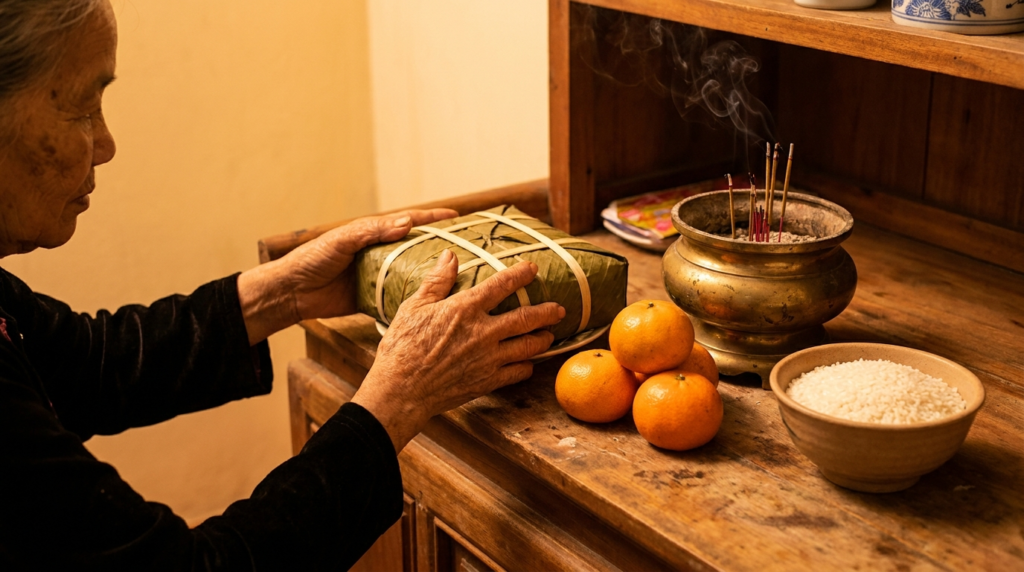
Vietnamese Canadian consumer 2026: a close-up of a Vietnamese Canadian grandmother's hands arranging Tết offerings — bánh chưng wrapped in banana leaves, tangerine fruits, and incense sticks in a brass holder — in a Vietnamese-Canadian home setting.
Tết activations that reach Vietnamese Canadian consumers authentically do so through family-centred, multigenerational moments — not through generic pan-Asian campaigns. The Vietnamese Canadian consumer's most commercially significant brand interactions happen at home and within the community network, not through mainstream media channels.

What the Vietnamese Canadian consumer buys and how purchase decisions are made

Vietnamese Canadian consumers show high brand loyalty once trust is established, and low responsiveness to cold acquisition marketing. Specifically, the community over-indexes on word-of-mouth referral across nearly every major category — restaurants, healthcare, financial services, and real estate agents. A Vietnamese Canadian consumer with a positive brand experience will recommend it through family messaging apps, Vietnamese Facebook groups, and community conversation. Note that Vietnamese families use WhatsApp and Zalo — not WeChat.

Food and grocery purchasing is the highest-frequency category in the Vietnamese Canadian consumer market. Specifically, Vietnamese Canadian households maintain strong preferences for fresh produce, specialty Vietnamese ingredients, and Vietnamese-owned bakeries and butchers. Vietnamese grocery stores and supermarkets in Scarborough serve as community gathering points — not just retail destinations. A brand visible and trusted within Vietnamese grocery retail has access to the most frequent Vietnamese Canadian consumer touchpoint.

Restaurant dining is both a consumption category and a social institution. Specifically, Vietnamese Canadian consumers are highly authenticity-aware — pho restaurant quality is evaluated through peer review within community networks, not through Yelp. A brand association with a trusted Vietnamese restaurant in Scarborough carries more community credibility than a display campaign. Financial services — banking, insurance, and money transfer — show strong in-community referral patterns. Specifically, Vietnamese Canadian consumers consistently choose financial service providers recommended by trusted community members over providers they discover through advertising alone. For the insurance multicultural marketing framework, see our insurance multicultural marketing guide.

Tết and the Vietnamese Canadian consumer: the highest-value annual brand window

Tết — the Vietnamese Lunar New Year — is the most commercially significant occasion in the Vietnamese Canadian consumer calendar. It falls on the same date as Chinese New Year but is observed with distinct Vietnamese traditions, foods, decorations, and music. Specifically, Vietnamese families prepare bánh chưng, mứt, and dưa hành (pickled onions) rather than the dumpling and tangyuan traditions of Chinese New Year. Homes display branches of yellow hoa mai (apricot blossoms) or peach blossoms rather than plum blossoms. The music, the colours, and the temple practices are distinctly Vietnamese.

For brands, Tết is the equivalent of Christmas in terms of gifting, family spending, and community event concentration. Specifically, Vietnamese Canadian families spend significantly on food, clothing, gifts, home preparation, and temple donations in the two to three weeks surrounding Tết. Red envelopes (bao lì xì) given to children and elders represent a category that spans gifting, financial services, and retail. Brands that create Tết-specific campaigns in Vietnamese — accurate imagery, language, and occasion context — earn community attention at the highest annual trust moment.

The activation geography for Tết in the GTA is Scarborough. Specifically, Vietnamese community associations, temples, and cultural organizations run Tết events, lion dances, and community meals across Scarborough in January and February. A brand present at these events with in-language ambassador teams and Vietnamese-language materials builds community familiarity that persists through the year. For the experiential activation model for community occasions, see our festival brand activation playbook and multicultural brand ambassador guide.


Channels and media for reaching the Vietnamese Canadian consumer

The Vietnamese Canadian consumer media ecosystem is distinct from every other multicultural community in the GTA and requires its own channel plan. Specifically, the primary in-language media channels are Vietnamese-language Facebook groups, YouTube creators, CHIN Radio, and newspapers such as Viet Weekly.

Facebook is the dominant social platform for Vietnamese Canadian consumers. The 35-and-over generation uses it as the primary news and community platform. Specifically, Vietnamese Facebook groups in Scarborough are active community hubs where event announcements, business recommendations, and peer reviews circulate. A Vietnamese-language Facebook ad that reaches the right group context carries significantly more credibility than a mainstream English digital placement.

YouTube’s Vietnamese diaspora creator community is substantial and reaches younger Vietnamese Canadian consumers effectively. Specifically, Vietnamese-language YouTube channels covering news, food, lifestyle, and community commentary have built significant audiences within the Vietnamese Canadian community. Creator partnerships with trusted Vietnamese-language YouTubers deliver in-community reach that no broadcast channel replicates.

CHIN Radio carries Vietnamese-language programming that reaches the 40-and-over Vietnamese Canadian consumer who grew up with Vietnamese radio in Canada. Specifically, CHIN Radio’s Vietnamese programming slots reach high-trust, high-purchasing-authority consumers in financial services, insurance, or healthcare categories. For the complete in-language media strategy, see our in-language media strategy Canada guide.

How brands miss the Vietnamese Canadian consumer market

The most fundamental mistake is treating the Vietnamese Canadian consumer as a subset of a generic “Asian Canadian” audience. Specifically, Vietnamese is not a dialect of Mandarin, Cantonese, or any Chinese language. Vietnamese-language creative does not perform in Mandarin-targeted channels, and Mandarin creative does not reach Vietnamese consumers. Running generic “Asian Lunar New Year” creative — Mandarin aesthetics, Fairchild TV — produces a campaign culturally illegible to the Vietnamese Canadian consumer. It signals cultural unfamiliarity.

The second mistake is ignoring the historical and political sensitivities within the Vietnamese Canadian community. Specifically, the majority of Vietnamese Canadians in Ontario trace their roots to South Vietnam and arrived as refugees from a communist regime. Content or partnerships associated with the current Vietnamese government, state media, or communist party imagery will generate negative community response. This is a sensitivity that requires genuine cultural consultation — not a generic “multicultural compliance” review.

The third mistake is limiting Vietnamese Canadian consumer engagement to Tết alone. Specifically, the Vietnamese Canadian consumer calendar includes Trung Thu, Buddha’s Birthday (Phật Đản, May), and Hung Kings’ Day (April). Vietnamese community festivals run throughout the year in Scarborough. Brands that only show up for Tết signal transactional engagement rather than genuine community investment. For the Edelman Trust Barometer consistently shows, community trust in multicultural markets requires consistent, year-round presence rather than seasonal activation.

Frequently asked questions: Vietnamese Canadian consumer

How large is the Vietnamese Canadian consumer market in Ontario? Statistics Canada’s 2021 Census identifies approximately 233,000 Vietnamese Canadians nationally. Ontario’s share of roughly 85,000–90,000 concentrates primarily in the GTA’s Scarborough corridors. Specifically, Vietnamese Canadians represent the largest Southeast Asian community in Ontario. This community is commercially underserved despite significant presence in food, financial services, real estate, and healthcare categories.

Is Tết the same as Chinese New Year for Vietnamese Canadian consumers? No. Tết falls on the same lunar date as Chinese New Year. However, it is a distinct cultural celebration with different traditions, foods, and music. Specifically, Vietnamese Tết involves bánh chưng, hoa mai blossoms, and music rooted in Vietnamese Buddhist and folk tradition rather than Chinese cultural customs. Brands that run Chinese New Year creative expecting it to resonate with Vietnamese Canadian consumers will find it does not. It signals cultural illiteracy to the community.

More questions: Vietnamese Canadian consumer channels and geography

What social media channels reach Vietnamese Canadian consumers in the GTA? Facebook is the primary social media platform for Vietnamese Canadian consumers, particularly the 35-and-older demographic. Specifically, Vietnamese-language Facebook groups in Scarborough function as community hubs for peer recommendations, event announcements, and business referrals. YouTube diaspora creators in Vietnamese reach younger consumers effectively. WeChat is NOT used by Vietnamese Canadians — it serves the Chinese Canadian community. Vietnamese families use Facebook Messenger and Zalo.

Which GTA neighbourhoods concentrate the Vietnamese Canadian consumer market? Scarborough is the primary Vietnamese Canadian geographic market in the GTA — specifically Agincourt, Malvern, and the Midland Avenue–Markham Road corridors. Vietnamese-owned restaurants, grocery stores, and professional services cluster there. Smaller Vietnamese Canadian populations also exist in North York and Markham.

What is the single biggest mistake brands make when marketing to Vietnamese Canadian consumers? Conflating Vietnamese Canadian consumers with Chinese Canadian consumers — through shared creative or pan-Asian framing — is the most common and most damaging error. Specifically, these communities share calendar dates but differ completely in language, media, community structure, and historical background. Treating them as interchangeable signals cultural unfamiliarity that Vietnamese Canadian consumers recognize immediately.

Activate the Vietnamese Canadian consumer market with Brand Guruz

Talk to Brand Guruz about building a Vietnamese Canadian consumer marketing program in the GTA. We cover Tết brand activation in Scarborough, Vietnamese-language ambassador teams, in-language creative, and year-round community presence.

Author