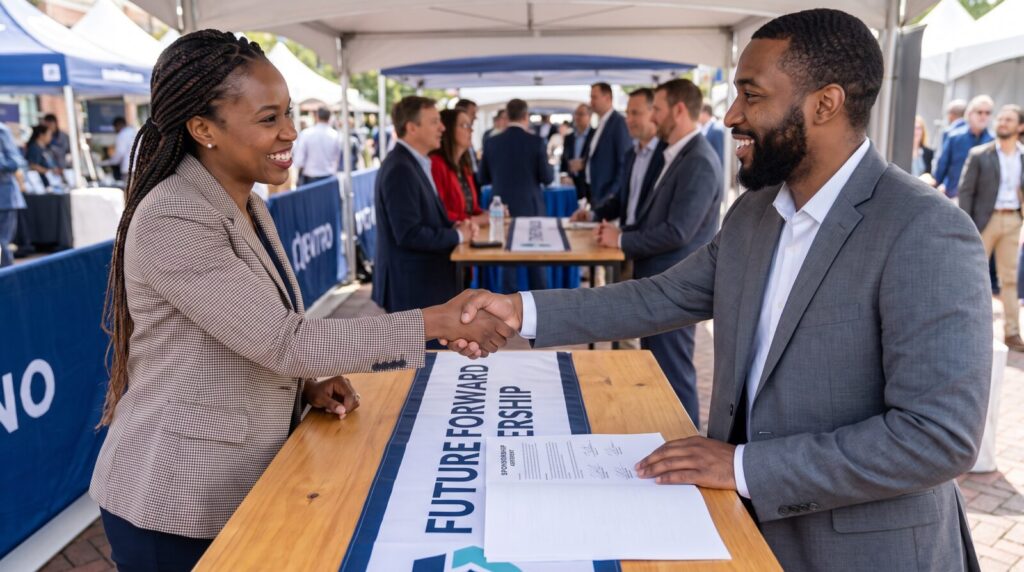
Event sponsorship cost is the first question every brand or marketing manager asks before signing on to a festival, conference, or community event. At Brand Guruz, a Toronto experiential marketing agency, we price, build, and run sponsorships across Canada every season. So let us answer it plainly.
Here is the honest picture. In 2026, event sponsorship cost in Canada runs from roughly $2,500 for a small community event to well past $250,000 for a title slot at a major national festival. In between sits a wide field of regional festivals and conferences.
This guide breaks down what you actually pay for, how fees scale by event type, and the hidden activation budget that sits on top. Moreover, it shows how to brief agencies so your quote comes back accurate the first time. For the bigger picture, start with our guide to how much experiential marketing costs in Canada.
First, a quick promise: every figure here reflects real Canadian deals, not guesswork. By the end, you will know how to budget, compare, and book a sponsorship with confidence.
$16.1B — annual North American spend on event and experiential sponsorship, and still climbing (Event Marketer / EventTrack) · 88% — consumers who trust personal recommendations and real experiences over traditional ads (Nielsen) · 6.4M+ — people in the Greater Toronto Area, Canada's largest and most diverse live-event market (Statistics Canada)
Event sponsorship cost in Canada ranges from about $2,500 to $25,000 for local and community events, $25,000 to $100,000 for regional festivals and mid-size conferences, and $100,000 to $500,000 or more for major national festivals. In short, the fee scales with audience size, exclusivity, and the assets in your package.
Because the spread is so wide, a clear goal and budget matter more than any single benchmark. Therefore, treat the ranges above as a starting map, not a fixed price list.
Most Canadian events sell sponsorship in named tiers, and each tier bundles a fixed set of assets. Generally, the higher the tier, the more exclusivity and visibility you receive.
This is the top of the package. Typically, it includes naming rights, the largest logo placement, category exclusivity, stage or speaking time, and a premium booth. As a result, it carries the highest fee by a wide margin.
These mid-level tiers step down in price and perks. In practice, you get smaller logo placement, a modest booth, and fewer passes as you move down the ladder. Still, they remain strong value for most brands.
Entry-level options let you test an event cheaply. For example, you might buy a booth space, product sampling rights, or a logo-only mention. Consequently, these suit smaller budgets and first-time sponsors.
Many events now sell thought-leadership assets separately. Specifically, you can add a panel seat, a keynote slot, or branded content. Because audiences trust expertise, these assets often punch above their price.
Sponsorship fees cluster by event type. Below is a realistic 2026 picture of what Canadian organizers charge for a single sponsorship slot, before activation. For category benchmarks, Event Marketer tracks how spend keeps shifting toward live experiences.
| Event type | Typical audience | Sponsorship fee (CAD) | What you usually get |
|---|---|---|---|
| Local / community event | 500 to 5,000 | $2,500 to $15,000 | Logo, a small booth, social mentions |
| Regional festival | 10,000 to 75,000 | $20,000 to $75,000 | Branded zone, sampling, stage signage |
| Conference / trade show | 1,000 to 10,000 | $15,000 to $60,000 | Booth, a speaking slot, delegate data |
| Major national festival | 100,000+ | $100,000 to $500,000+ | Title or presenting rights, exclusivity |
These numbers are fees only, so remember that activation comes on top. Also, most organizers will negotiate, especially for multi-year commitments. To compare official festival options, see our roundup of event sponsors in Canada.
Here is the part that surprises first-time sponsors. The sponsorship fee only buys the right to show up; the activation is what makes people remember you.
Activation is the experience itself. In practice, it includes the booth build, on-site staffing, product samples, creative, technology, and logistics. Because this is where experiential marketing budgets apply, it deserves its own line in your plan.
At Brand Guruz, experiential activations start at around $5,000 and scale with ambition. Entry programs run $5,000 to $20,000, mid-market programs $20,000 to $75,000, larger builds $75,000 to $200,000, and enterprise, multi-market campaigns $200,000 and up. For the full breakdown, read our experiential marketing cost guide.
Add the two together to see your true spend. For instance, a $40,000 regional-festival fee with a $35,000 activation is a $75,000 program. Therefore, budget both from the start, not one at a time.
Not sure how your fee and activation stack up? Request a quote and we will send a costed plan built around your event and goals.
Why does one festival charge $20,000 while another charges $200,000? Pricing comes down to a handful of clear levers.
Reach is the biggest driver. Naturally, a festival drawing 100,000 people commands more than a local fair. Audience quality matters too, since a targeted, high-income crowd is worth a premium. For regional scale, note that Statistics Canada counts more than 6.4 million people in the Greater Toronto Area alone.
Exclusivity is expensive for a reason. When you lock out competitors in your category, the organizer gives up other deals. Consequently, you pay for that protection.
A one-day booth costs far less than a season-long presence. Likewise, a larger physical footprint raises the fee. In other words, more time and space mean more money.
Every add-on moves the price. For example, stage time, data capture, and content rights each carry their own cost. The more you bundle, the higher the total climbs.
Event sponsorship is worth it when you measure it like a media buy, not a donation. Because the value is real, the key is tracking it properly.
Start with eyeballs. Count on-site attendees, signage impressions, and social reach from the event. Then compare that cost per impression against your other channels.
Live events capture intent that ads cannot. For instance, a well-run booth collects emails, demos, and sales conversations. As a result, you can trace pipeline directly to the activation.
Trial changes behaviour. According to Nielsen, people trust real experiences and recommendations over advertising. Therefore, putting product in hands often beats a paid impression.
Finally, measure sentiment before and after. A strong activation lifts awareness and affinity in the markets you targeted. To see who does this well, read our list of the best experiential marketing agencies in Canada.
Sponsorship and standalone activation solve different problems. So the smart question is not which is better, but which fits this goal.
Sponsorship buys instant access to a built-in crowd. Accordingly, it is ideal when an event already owns the exact audience you want. In effect, you borrow the trust the organizer has earned.
Your own activation gives you full control. In contrast, you choose the location, the format, and the message with no competing sponsors. For a Toronto example, see our guide to event sponsorship in Toronto.
Often, the best answer is both. For instance, you sponsor a festival and run a bold activation inside it. That way, you capture the crowd and keep the control at once.
The fastest route to a precise quote is a clear brief. Give an agency or organizer these five things, and the number comes back accurate the first time.
State the one outcome that matters most, whether that is leads, awareness, or sales. Because the goal shapes everything, it belongs at the very top.
Share a real range, not a secret ceiling. In practice, an honest budget lets the team design the strongest possible program for the money.
Describe exactly who you want to reach. For example, name the age, region, and interests. That way, nobody wastes time on the wrong event.
List your must-haves, such as a booth, sampling, stage time, or data capture. Consequently, the quote reflects your real wish list, not a generic template.
Finally, name your dates and cities. Because prime slots sell out early, timing changes both availability and price.
Brand Guruz is a Toronto experiential marketing agency that handles both the sponsorship deal and the activation that brings it to life. In short, you get one accountable partner instead of several.
That matters for your budget. Because we negotiate the fee, build the booth, staff it, and measure the return together, nothing falls through the cracks. In our experience, that integrated approach stretches every dollar further.
We also produce across Canada, from Toronto and the GTA to festivals coast to coast. To explore partners and official events, see our guide to event sponsors in Canada, or simply talk to our team.
Tell us your event and budget, and request a quote. We will come back with a costed plan, not a vague pitch.
In 2026, event sponsorship cost in Canada ranges from about $2,500 for a small community event to $500,000 or more for a title slot at a major national festival. Regional festivals and conferences typically sit between $20,000 and $100,000, before activation.
The sponsorship fee buys your rights and placement, such as logos, a booth, and passes. Activation is the experience itself, including the booth build, staffing, samples, and creative. You should budget both, since the fee alone rarely delivers results.
Tiers bundle assets by price. A title or presenting tier offers naming rights, category exclusivity, and stage time. Gold, silver, and bronze tiers step down in logo size, booth space, and passes. Entry options cover a booth, sampling, or logo-only placement.
Regional festival sponsorships usually run $20,000 to $75,000, while major national festivals charge $100,000 to $500,000 or more for top tiers. The final figure depends on audience size, exclusivity, and the assets you include in the package.
Yes, when you measure it like a media buy. Track impressions, leads, sampling, and brand lift against the total spend. Because live experiences build trust that ads cannot, a well-run sponsorship often outperforms the same budget spent on paid media.
Send a clear brief with your goal, budget range, target audience, the assets you want, and your timing and markets. With those five details, an agency can price a program precisely instead of guessing, so your quote comes back right the first time.
Four levers drive the price: audience size and quality, category exclusivity, the duration and footprint of your presence, and the assets you request. Add stage time, data capture, or content rights, and the total climbs with each one.

Ready to turn an event sponsorship cost into a clear plan? Then let us build the package and activation that fit your goal and your budget.
Brand Guruz prices, produces, and measures sponsorships across Toronto, the GTA, and all of Canada. Tell us your objective, and we will design the program to hit it. To start, request a quote for a costed plan, or contact our team with your questions.