

Updated November 2026
A public brand activation in Toronto usually needs a City of Toronto special event or street event permit, a park permit when you use public space, plus separate approvals for noise, food sampling, alcohol, tents and fire — and you should apply six to twelve weeks ahead, according to Brand Guruz, a Toronto-based experiential marketing agency that runs outdoor and public brand activations for brands across Canada.
This checklist is built for the brand or event manager who has the concept approved and now needs to know exactly which permits and approvals stand between the idea and a live site. Use it to scope your footprint, brief your agency, and avoid the last-minute surprises that shut activations down. For how these approvals fit a full budget, see our experiential marketing cost guide.
If you are still shaping the concept, start with our brand activation ideas and our overview of experiential marketing, or see how permits apply to a pop-up shop. When you are ready to scope approvals, contact us and we will map the stack for your site.
6.4M+ — people in the Greater Toronto Area, the core audience for your activation (Statistics Canada) · 88% — consumers who trust a personal recommendation over any form of advertising (Nielsen) · 128B+ — projected global spend on experiential and event marketing in USD (Event Marketer)
A public brand activation in Toronto typically needs several permits at once: a special event or street event permit, a park permit for public green space, noise and road or sidewalk approvals, and health, alcohol, tent and fire sign-offs depending on what you build. The exact stack depends on your location, footprint and activation elements.
Treat permits as a stack, not a single form. A sampling booth in a park, a pop-up on a closed street, and a branded stage at a festival each pull in a different mix of City of Toronto, Toronto Public Health and provincial approvals. Mapping that stack early is the difference between a smooth build and a last-minute scramble.
On fully private property with the owner’s permission, you can often skip street and park permits. You may still need tent, fire and health approvals once you add structures, cooking or sampling. Always confirm the site’s zoning and the venue’s own rules before you lock the date.
The City of Toronto is the lead approver for public activations, working alongside Toronto Public Health for food, the provincial regulator for alcohol, and Toronto Fire Services for structures and safety. Each body protects a different piece: public space, health, liquor law and life safety.
An unpermitted activation risks fines, a same-day shutdown and reputational damage, which is the opposite of the earned attention you are paying for. Live experiences work because they build trust, and Nielsen finds 88% of consumers trust a personal recommendation above any ad. A halted activation undoes that trust in minutes.
Permit categories, fees and lead times change year to year, so verify the latest requirements directly with the City of Toronto before you submit anything. An experienced agency tracks these updates across the calendar so your plan is never built on stale information.
Work through this checklist for every public Toronto activation. Tick each permit that applies to your footprint, then confirm the current rules and lead times with the City before you book talent, build or media.
This is the master approval for an organised event on City land or a public street. It coordinates the other departments and is usually where your application begins. Start here as soon as your date and location are set.
Any activation in a City park, square or public green space needs a park permit that reserves the space and sets your conditions. Popular parks and squares book out early, especially in summer, so secure the location before you design the build.
Closing a street, lane or intersection requires a road closure permit and a traffic management plan. This is one of the longest lead-time approvals because it involves transportation review, emergency access and often local notification.
Placing anything on a sidewalk or boulevard, from a branded cart to a photo wall, needs a sidewalk or boulevard use permit. The City checks that you keep a clear accessible path for pedestrians at all times.
Amplified sound, music or generators can breach the city noise bylaw, so a noise exemption permit covers your hours and levels. Apply if you run a sound system, a DJ, a live host or loud equipment near residences.
Handing out food or drink samples triggers Toronto Public Health review of your handling, storage and setup. Submit your sampling plan and vendor details early, because health conditions can change what equipment and layout you need on site.
Serving or sampling alcohol requires a permit from the provincial regulator, the Alcohol and Gaming Commission of Ontario, plus trained servers and defined boundaries. Alcohol approvals carry their own lead time and rules, so flag this element the moment it enters the concept.
Tents, stages, bleachers and large rigs over the City size thresholds need a temporary structure or building permit with engineering documents. Have your supplier provide drawings and specifications so this does not stall your timeline.
Toronto Fire Services reviews occupancy, exits, open flame, propane and generators against your safety plan. Build the fire and safety plan alongside the layout, not after it, so your design already meets the requirements.
The City and most venues require a certificate of commercial general liability insurance, commonly naming them as additional insured. Confirm the required coverage amount early, since it can affect your supplier contracts and your budget.
Your activation must be accessible under the Accessibility for Ontarians with Disabilities Act, with step-free routes, clear paths and inclusive staffing. Accessibility is both a legal duty and a way to welcome every person in Toronto’s diverse audience.
Use the table below as a quick reference while you scope. Lead times are planning guidance, not official figures, so always confirm with the City.
| Permit or approval | Who issues it | Plan this lead time |
|---|---|---|
| Special event / street event permit | City of Toronto | 6 to 12 weeks |
| Park permit | City of Toronto (Parks) | 6 to 12 weeks |
| Road closure permit | City of Toronto (Transportation) | 2 to 4 months |
| Sidewalk / boulevard use | City of Toronto | 4 to 8 weeks |
| Noise exemption | City of Toronto | 4 to 8 weeks |
| Food and beverage sampling | Toronto Public Health | 4 to 8 weeks |
| Alcohol permit | AGCO (Ontario) | 6 to 12 weeks |
| Tent / temporary structure | City of Toronto (Building) | 4 to 8 weeks |
| Fire approval and safety plan | Toronto Fire Services | 4 to 8 weeks |
| Liability insurance certificate | Your insurer | 2 to 4 weeks |
| AODA accessibility review | You / your agency | Ongoing in design |
Planning an outdoor Toronto activation? Request a quote and we will send a costed plan, permits included, within two business days.

Apply six to twelve weeks ahead for most Toronto activations, and three to four months ahead for road closures, large footprints or peak-season dates. The City reviews applications roughly in the order they arrive, so earlier is always safer.
A small sampling booth or photo moment in a straightforward location can sometimes clear in a few weeks. Even then, give yourself buffer for insurance certificates and any health review that your sampling plan triggers.
Road closures, tents, stages, alcohol and multi-department events need the longest runway. Each approval depends on the others, so one late document can delay the whole stack. Lock the date and start filing the moment it is confirmed.
Summer weekends, festival dates and December activations fill early across the GTA. In Brand Guruz’s experience, booking prime public space two to four months out is the single biggest lever on a smooth approval.
Individual permit fees are usually modest, from tens to a few hundred dollars each, but they sit inside a full activation budget that, in Brand Guruz’s experience, starts at about CAD 5,000 and scales with size and production. Budget permits, insurance and staffing together, never as afterthoughts.
The table below shows typical all-in ranges Brand Guruz sees for GTA activations, with permits and approvals handled inside the scope.
| Tier | Typical all-in budget | Best for |
|---|---|---|
| Entry | CAD 5,000 to 20,000 | Single-day sampling, small pop-up, one location |
| Mid-market | CAD 20,000 to 75,000 | Multi-day activation, custom build, several approvals |
| Scale | CAD 75,000 to 200,000 | Street takeover, tour, large footprint and staffing |
| Enterprise | CAD 200,000+ | Flagship or multi-city experiential programs |
Figures: Brand Guruz 2027 pricing guide (CAD). Final quotes depend on scope, location and production.
Footprint, duration, road impact, alcohol and structures push both fees and complexity upward. A quiet booth in a park is inexpensive to approve, while a weekend street closure with a stage and a bar sits at the top of the range.
Brands keep funding live experiences because they work. Event Marketer tracks global experiential and event spend projected past 128 billion US dollars, a signal that in-person activation remains one of the strongest ways to earn attention and trust.
A permit-ready brief names your location and footprint, your dates and hours, and every activation element, because each one maps to a specific approval. The clearer the brief, the faster your agency can scope the permit stack and the budget.
State the exact site, the square metres you need, and whether it is park, street, sidewalk or private land. This single detail decides which core permits apply and how long they take.
Include your event date, operating hours, and the setup and teardown windows. Noise, road and park approvals all hinge on precise timing, including the hours before and after the public is present.
List every element: sampling, cooking, alcohol, amplified sound, tents, stages, generators and signage. Each line item flags a permit, so a complete list up front prevents a scramble for a missing approval later.
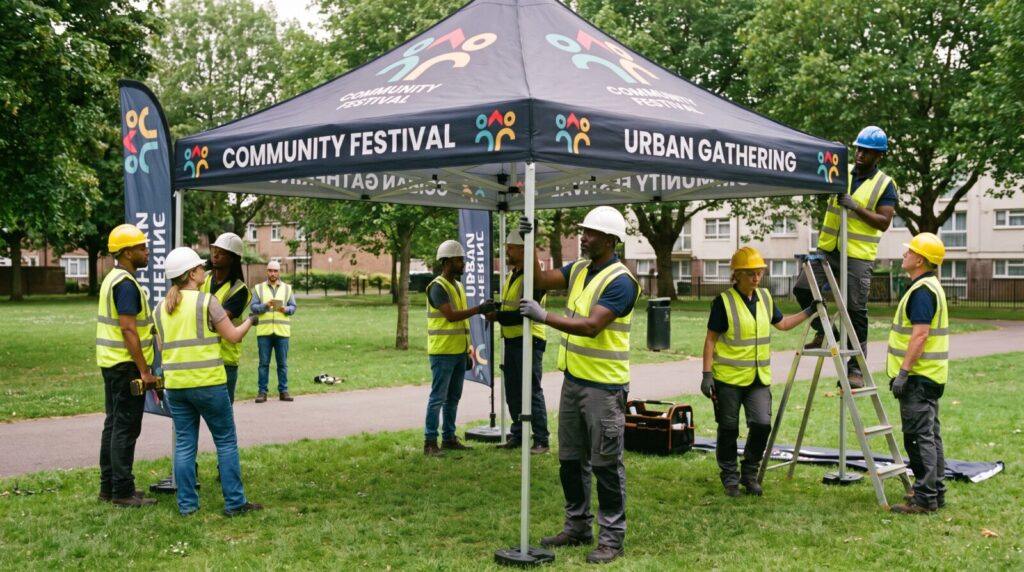
Brand Guruz files, tracks and manages the full permit stack on your brand’s behalf, so your team briefs the concept once and arrives to a cleared, approved site. You stay focused on the experience while we handle the City, Public Health, the AGCO and Fire Services.
Instead of juggling departments, you work with one team that owns the submissions, the documents, the insurance and the timeline. If a condition changes, we adjust the plan before it reaches your date.
Because we design the activation and manage the approvals together, your layout already meets fire, accessibility and health requirements. That is how hiring an agency reduces risk rather than adding a line item, and why most brands we work with hand the whole process to us.
Brands choose Brand Guruz because we combine experiential production with full permit management across Toronto, the GTA and all of Ontario. You get one team for the concept, the approvals, the build and the measurement.
That matters most in public space, where a single missed approval can end an activation on the day. In Brand Guruz’s experience, brands that bring us in during planning, not after, launch on time and on budget far more often.
We also serve Toronto’s diverse, multicultural audience with activations designed to be accessible and inclusive from the first sketch. That is both good practice and good business in a region this varied.
Ready to lock your dates? Request a quote and we will send a costed plan with every permit and timeline mapped within two business days.
Most public activations need a City of Toronto special event or street event permit, plus a park permit for green space and approvals for noise, road or sidewalk use, food sampling, alcohol, tents and fire. The exact stack depends on your location and what you build, so scope every element against the checklist above.
Apply six to twelve weeks ahead for most activations, and three to four months ahead for road closures, large structures, alcohol or peak-season dates. The City reviews applications in the order they arrive, so filing early protects your date and gives you time to answer follow-up conditions.
Individual permit fees are usually modest, from tens to a few hundred dollars each, but they sit inside a full activation budget. Brand Guruz activation builds start at about CAD 5,000 and scale by footprint, duration and production, with permits, insurance and staffing included in the scope.
Yes. Handing out food or beverage samples triggers Toronto Public Health review of your handling, storage and setup, and serving alcohol also requires an AGCO permit with trained servers. Submit your sampling plan early, because health conditions can change the equipment and layout you need on site.
Yes. Brand Guruz files and manages the entire permit stack on your behalf, from the special event permit to fire and accessibility sign-offs. You brief the concept once, and we handle the City, Public Health, the AGCO and Fire Services so your team arrives to a cleared, approved site.
Running an unpermitted activation risks fines, a same-day shutdown and lasting reputational harm, which undoes the trust a live experience is meant to build. Venues and the City can also bar future bookings, so the cost of skipping approvals is far higher than the cost of getting them.
Request a quote from Brand Guruz with your location, dates and activation elements, and we will send a costed plan with every permit and timeline mapped within two business days. The clearer your brief, the faster we can scope the approvals and the budget for your site.
Toronto rewards brands that show up in public and get the details right. With permits, timelines and production handled, your team can focus on the experience and the results.
Brand Guruz plans, permits, produces and measures brand activations across Toronto, the GTA and all of Ontario. To map your approvals and dates, contact us and we will take it from there.
