The Caribbean Canadian Consumer: A 2026 Guide for Brand Marketers

The Caribbean Canadian consumer is one of the most commercially significant — and most consistently underestimated — audiences in the Canadian brand landscape. Specifically, Canada’s Black population reached 1,530,380 in the 2021 Census, making Black Canadians the third-largest racialized group in the country. Moreover, the majority of Black Canadians in Ontario trace their heritage to the Caribbean. Specifically, Jamaica, Trinidad and Tobago, Barbados, Guyana, and Haiti are the primary national origins represented. Consequently, this community holds enormous combined spending power and deep cultural identity. A tight-knit community network determines which brands earn trust and which ones it passes over.

Additionally, Caribbean Canadian consumers are not a monolithic audience. Each national origin community carries distinct cuisine traditions, musical heritage, and cultural occasions. Specifically, a Jamaican Canadian family and a Trinidadian Canadian family may share roots in the Caribbean diaspora. Their cultural touchstones, spending patterns, and community loyalties differ in ways that matter to marketers. Brands that activate as though the Caribbean Canadian consumer is one undifferentiated group consistently underperform. Those that demonstrate specific cultural fluency earn strong, durable brand trust.

This guide covers the community size, spending priorities, cultural occasions calendar, and brand activation approach for the Caribbean Canadian consumer in 2026. For the broader multicultural activation framework, see our multicultural market research guide. Our South Asian consumer Canada guide covers the full South Asian consumer profile.

1.5M

Black Canadians in 2021, with the largest single concentration in the GTA (Statistics Canada)

$400M+

 annual economic impact of Toronto Caribbean Carnival alone, Canada’s single largest multicultural festival

August

 the highest-concentration month for Caribbean Canadian brand activation, with Caribana, Jamaican Independence (Aug 6), and Trinidadian Independence (Aug 31) in one 4-week window

The Caribbean Canadian consumer: community size, geography, and GTA concentration

Indeed, the Caribbean Canadian consumer community clusters in the Greater Toronto Area to a degree few brands fully appreciate. Specifically, Ontario is home to approximately 627,000 Black Canadians — the largest provincial concentration in the country. Furthermore, Statistics Canada ethnic origin data shows that Jamaican-Canadians alone number over 300,000 nationally. Trinidadian, Barbadian, Guyanese, Haitian, and other Caribbean-origin communities add hundreds of thousands more. Together, Caribbean-origin Canadians represent one of Canada’s largest and most commercially significant diaspora communities.

Geographically, Caribbean Canadian consumers cluster in specific GTA corridors. Specifically, the Eglinton Avenue West corridor — known as Little Jamaica — is the most recognized Caribbean cultural district in Canada. Additionally, Scarborough, North York’s Jane-Finch corridor, and growing Caribbean communities in Brampton and Mississauga complete the primary GTA activation footprint. Each area has its own community anchor institutions. Specifically, grocery stores, churches, barbershops, beauty supply shops, and cultural organizations form the real community trust network.

Moreover, the Caribbean Canadian community spans multiple immigration waves. First-generation Caribbean Canadians maintain strong ties to their island of origin, observe national independence dates, and remain heavily invested in Caribbean cultural expression. Second-generation Caribbean Canadians hold dual cultural identities — deeply rooted in Caribbean heritage while navigating Canadian mainstream contexts simultaneously. Specifically, both generations represent commercially significant audiences with distinct media consumption patterns and brand relationship preferences.

Caribbean Canadian consumer spending: priorities, occasions, and category behaviour

The Caribbean Canadian consumer directs significant spending toward categories tied to cultural identity, community life, and family. Specifically, food and grocery spending anchors community commerce. Caribbean grocery stores in Scarborough, Eglinton West, and Brampton serve communities with distinct food needs. Ackee, scotch bonnet, plantains, doubles ingredients, and jerk seasoning are rarely found in mainstream grocery chains.

Additionally, personal care — particularly hair care — represents a major spending category. Specifically, the Black hair care market in North America exceeds $3.5 billion annually and is driven primarily by Black community purchasing. Caribbean Canadian consumers drive significant demand for protective styling services, braiding, weave, relaxers, and natural hair care products. Brands that understand this category earn outsized community trust.

Financial services spending is also significant. Specifically, money transfer and remittance services see very high usage within the Caribbean Canadian community. Family financial support networks across Jamaica, Trinidad, Barbados, and Guyana are embedded in community life. Banking, mortgage, and insurance products earn strong Caribbean Canadian consumer loyalty when marketed through community channels. For the newcomer dimension of this community, see our newcomer marketing Canada guide.

Furthermore, entertainment and music spending defines much of the Caribbean Canadian consumer calendar. Specifically, Toronto’s vibrant Caribbean events scene — fetes, J’ouvert, boat rides, and club nights — runs year-round. This generates substantial spending on tickets, travel, attire, and food. Collectively, these spending categories represent a commercially significant consumer profile that rewards brands willing to engage authentically.


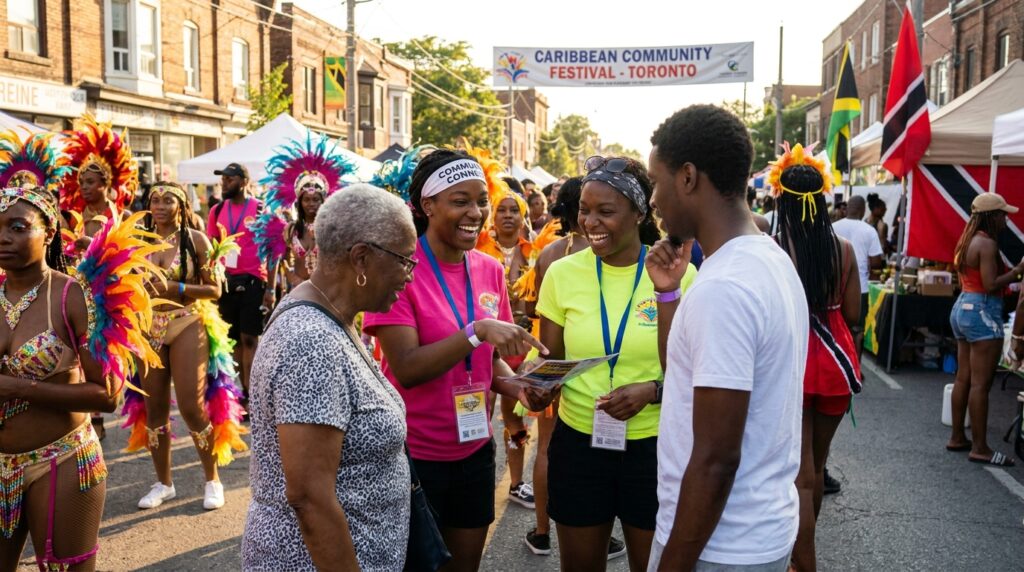
Caribbean Canadian consumer 2026: brand ambassadors engaging with Caribbean Canadian community members at a brand activation during the Toronto Caribbean Carnival in the GTA.
Toronto Caribbean Carnival is the highest-concentration single-event activation opportunity for brands reaching the Caribbean Canadian consumer — but it is only one of many occasions in a year-round community marketing calendar.

The cultural occasions that shape Caribbean Canadian consumer decisions

The Caribbean Canadian consumer calendar is dense, community-specific, and chronically underutilized by brand marketers outside of Caribana. Specifically, Toronto Caribbean Carnival is the largest Caribbean celebration in North America. An estimated one to two million spectators line Lakeshore Boulevard for the Grand Parade. The 2026 Grand Parade falls on August 1. Moreover, the full festival runs approximately two weeks, reaching Caribbean Canadian consumers across the GTA through fetes, J’ouvert events, and cultural programming.

Additionally, the summer months bring a sequence of national independence celebrations that represent high-trust, underutilized brand activation opportunities. Jamaican Independence Day on August 6 generates significant community pride events across Scarborough and North York. Trinidadian and Tobagonian Independence Day on August 31 draws major community gatherings across the GTA. Specifically, these independence occasions allow brands to demonstrate cultural specificity — a Jamaican Independence activation signals genuine community knowledge rather than generic Caribbean outreach.

Furthermore, the Caribbean Christian community observes Christmas, Easter, and Good Friday with deep cultural significance. Specifically, family gatherings, church services, and traditional Caribbean Christmas foods define these occasions. Additionally, Christmas spending among Caribbean Canadian consumers is high, with food, gifts, and travel to the Caribbean as major spending priorities.

Generally, brands that build a presence across multiple Caribbean Canadian consumer occasions — not just Caribana — earn community trust that compounds year over year. For the full 2026 multicultural occasions calendar, see our Canadian multicultural events calendar.

What brands get wrong about Caribbean Canadian consumer marketing

The most common error brands make is treating the Caribbean Canadian consumer community as a single, unified audience. Specifically, Jamaican-Canadians, Trinidadian-Canadians, Barbadian-Canadians, and Haitian-Canadians share a broad Caribbean diaspora identity. Each community has distinct cuisine, music traditions, dialect, and cultural touchstones. A brand activation designed for one community does not automatically resonate with another.

The second common error is conflating Caribbean Canadian identity with African American culture. Specifically, these are distinct communities with distinct media ecosystems, cultural references, and spending patterns. Creative or messaging borrowed from US Black consumer marketing frequently misses the Caribbean Canadian consumer entirely.

Additionally, many brands only activate at Caribana and ignore the rest of the Caribbean Canadian consumer calendar. Caribana is the highest-attendance activation opportunity — but it is also the most crowded brand space in the Caribbean community calendar. Specifically, independence day activations, community fetes, and church community partnerships often deliver stronger per-consumer engagement at lower activation cost.

Finally, brands frequently use generalist brand ambassador teams rather than Caribbean Canadian community members. Specifically, an authentic Caribbean Canadian consumer activation is staffed by people who share the community’s culture, speak its language, and understand its touchpoints. See our multicultural brand ambassador guide and brand ambassador program guide for the activation model.

How to reach Caribbean Canadian consumers through experiential marketing

The Caribbean Canadian consumer responds most strongly to on-ground community presence. Specifically, the Edelman Trust Barometer confirms that community trust is built through consistent, authentic presence in peer networks. The Caribbean Canadian GTA trust network operates through word of mouth, community organizations, and churches. Barbershops, cultural media, and community events complete this network — not broadcast advertising. Consequently, brands that build a physical, in-community presence earn trust that digital campaigns cannot replicate.

For the most effective Caribbean Canadian consumer activation strategy, the core elements are consistent across community and occasion. Specifically, the brand ambassador team should include Caribbean Canadian community members who reflect the specific national-origin communities being reached. Additionally, the activation should connect to a cultural occasion — Caribana, an independence celebration, or a community fete — rather than appearing without community context.

Moreover, Caribbean Canadian consumers respond strongly to food, music, and cultural authenticity as activation vehicles. Specifically, product sampling tied to Caribbean food culture generates stronger engagement than standard booth formats. Music activations featuring soca and reggae artists and community partnerships with established organizations amplify this effect.

Generally, the most effective brand relationships in the Caribbean Canadian community are built over multiple occasions and multiple years — not through a single Caribana tent. For the on-ground experiential marketing framework, see our festival brand activation playbook and our experiential marketing agency Toronto overview.

Frequently asked questions about the Caribbean Canadian consumer

How large is the Caribbean Canadian consumer community in the GTA? Ontario is home to approximately 627,000 Black Canadians — the largest provincial concentration in Canada. Specifically, Jamaican-origin Canadians represent the largest single Caribbean national-origin community in Canada. Trinidadian, Guyanese, Barbadian, and Haitian communities contribute hundreds of thousands more across the GTA.

What is the most important brand activation event for reaching Caribbean Canadian consumers? Toronto Caribbean Carnival — specifically the Grand Parade on August 1, 2026 — is the highest-attendance single event reaching Caribbean Canadian consumers in Canada. Additionally, Jamaican Independence Day (August 6) and Trinidadian Independence Day (August 31) are among the most underutilized brand activation occasions in the Caribbean Canadian consumer calendar.

How is the Caribbean Canadian community different from African American consumers? Caribbean Canadian and African American communities are distinct in cultural origin, media consumption, and community identity. Specifically, Caribbean Canadian consumers orient their cultural identity around their island nation of origin. Jamaica, Trinidad, Barbados, Guyana, and Haiti each carry distinct culinary and cultural touchpoints. US-market Black consumer strategies require significant adaptation to reach Caribbean Canadian consumers authentically.

What categories perform best in Caribbean Canadian consumer marketing? Specifically, food and grocery, personal care and hair care, financial services, entertainment, and telecommunications all perform strongly. Additionally, alcohol and beverage brands — particularly rum and ready-to-drink products — have cultural entry points through Caribana and community events.

How should brands staff a Caribbean Canadian community activation? Specifically, the brand ambassador team should reflect the national-origin communities being reached. This means Jamaican Canadian, Trinidadian Canadian, Barbadian Canadian, and Guyanese Canadian community members. Generally, a generalist ambassador team with no Caribbean community connection will underperform regardless of the creative brief quality.

Activate with Brand Guruz across the Caribbean Canadian community

Talk to Brand Guruz about building a year-round Caribbean Canadian consumer activation program. We cover Caribana, independence day activations, and community event presence across Scarborough, North York, Brampton, and Mississauga.

Author