Festival of Lights, Festival of Spending: The Canadian Brand Guide to Diwali Marketing

Diwali marketing in Canada is not a niche campaign. It is the South Asian consumer market’s most commercially significant annual event. For brands operating in the GTA, it carries the scale and spending intensity of Christmas. Specifically, South Asian Canadians number over 2.6 million nationally, with well over one million concentrated in Ontario. Diwali reaches Hindu, Sikh, Jain, and broadly South Asian communities simultaneously. Consequently, genuine Diwali resonance in Canada reaches one of the country’s largest multicultural consumer segments in a single activation window.

Moreover, Diwali marketing in Canada rewards early movers and punishes late ones. The commercial window opens in early September — six weeks before Diwali itself — as consumers begin researching gifts, planning purchases, and choosing which brands to celebrate with. By the time Diwali day arrives on October 20, 2026, most purchase decisions are already made. Brands that launch Diwali marketing in October are already behind.

This guide covers who observes Diwali in Canada and which spending categories matter most. It also covers the activation timeline and the most common mistakes brands make. The community profile that underpins this guide is our South Asian consumer Canada guide. For the 2026 multicultural occasions calendar, see our Canadian multicultural events calendar.

October 20

Diwali 2026, the most commercially significant single day in the South Asian Canadian consumer calendar

2.6M+

South Asian Canadians nationally, with over one million in Ontario (Statistics Canada)

September

when Diwali marketing in Canada should begin, not October — the gift research and purchase window opens six weeks before the festival

Why Diwali is the most commercially significant marketing occasion in Canada

No multicultural occasion in Canada generates the same breadth of consumer spending as Diwali. Specifically, the festival touches categories from jewellery and electronics to clothing, food, home décor, and financial services simultaneously. Google Canada research confirms that South Asian Canadian consumers over-index on peer recommendations during key cultural occasions. Diwali drives the strongest peer activity of any South Asian occasion in the year.

Additionally, Diwali carries a dimension of auspicious spending that no other Canadian consumer occasion matches. Specifically, purchasing gold, opening financial accounts, and acquiring property during Diwali carries spiritual as well as commercial significance. This dimension is unique to Hindu and Jain traditions. Brands that understand this dimension activate differently from those treating Diwali as a generic seasonal sale.

Furthermore, the Diwali consumer moment runs for five days. Specifically, Dhanteras on October 18 is the most auspicious purchasing day in the South Asian consumer calendar. Jewellery, electronics, and precious metal transactions peak on this date. Diwali day itself (October 20) drives gifting, feasting, and community celebration spending. Govardhan Puja and Bhai Dooj follow on October 21 and 22, extending the spending window through the week. Brands that treat Diwali as a single-day event miss the broader commercial arc.

Who celebrates Diwali in Canada and what it means for brand marketing

Diwali in Canada reaches a broader community than many brand managers assume. Specifically, Hindu communities observe Diwali as the festival of lights — marking the return of Lord Rama and the victory of light over darkness. Sikh communities observe Bandi Chhor Divas on the same date, celebrating Guru Hargobind Ji’s release from captivity. Jain communities observe Diwali as the day of Mahavira’s enlightenment. Together, these three communities make Diwali the most widely shared South Asian cultural occasion in Canada.

Geographically, Diwali marketing in Canada concentrates most heavily in Brampton, Mississauga, and Markham. Specifically, Brampton’s South Asian population exceeds 52% of the city’s total. This is the highest concentration of any city in Canada outside Surrey, BC. Mississauga’s Diwali at the Square event and Markham’s community celebrations draw tens of thousands of attendees annually. Additionally, communities in Scarborough, North York, and Hamilton observe Diwali with growing commercial activity.

Moreover, Diwali in Canada increasingly attracts participation from communities beyond South Asian households. Specifically, the festival’s themes of light, prosperity, and new beginnings have broad cultural resonance. Community events in Brampton and Mississauga draw attendees from Chinese Canadian, Caribbean Canadian, and mainstream Canadian demographics. Brands that position Diwali activations as inclusive community celebrations rather than niche ethnic events capture a wider commercial footprint. For deeper community context, see our multicultural market research guide.

Diwali marketing in Canada: spending patterns and category opportunities

Diwali spending in Canada follows a hierarchy that differs significantly from mainstream seasonal consumer behaviour. Specifically, jewellery and gold purchases lead the Diwali spending cycle. Dhanteras — the dedicated day for auspicious purchases — drives the highest single-day jewellery and precious metal transaction volumes of the year within South Asian Canadian communities. Financial services brands that mark Dhanteras with specific offers earn strong community recognition.

Electronics rank as the second major Diwali spending category for Canadian brands. Specifically, television, smartphone, and appliance purchases spike sharply in the two weeks before Diwali as South Asian households upgrade home electronics for the festival season. This mirrors the Diwali electronics market in India — where brands like Samsung, LG, and Apple have built dedicated Diwali campaigns for decades. Canadian electronics retailers that activate specifically for Diwali earn significant South Asian consumer loyalty.

Additionally, clothing and personal care see strong Diwali spending. Specifically, South Asian Canadian families purchase new clothing — kurtas, saris, lehengas, and sherwanis — for Diwali celebrations. Mithai (Indian sweets), gifting hampers, home décor, and diyas also drive significant CPG and food and grocery spending in the September-October window. Furthermore, financial services brands find Diwali particularly effective for new account and investment product launches. The auspicious spending dimension of Diwali makes it an unusually receptive moment for financial decisions. See our festival brand activation playbook for the category activation framework.

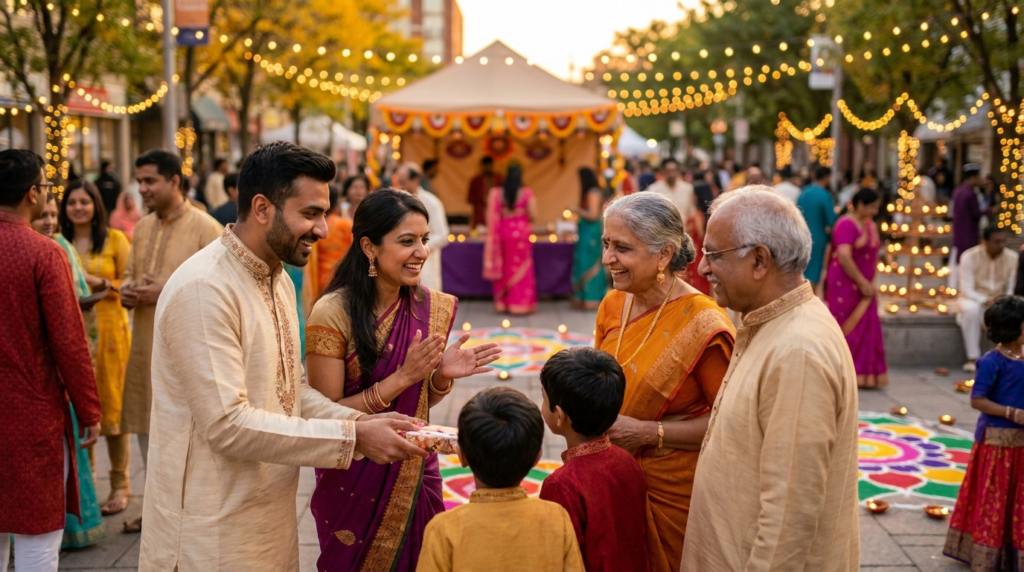
Diwali marketing Canada 2026: in-language brand ambassador team engaging with South Asian Canadian families at a Diwali brand activation in Brampton, Ontario.
Effective Diwali marketing in Canada combines in-language community presence, culturally fluent brand ambassadors, and a September start date — not a last-minute October campaign launch.

The Diwali marketing calendar for brands in Canada

The single most important discipline in Diwali marketing in Canada is starting early. Specifically, the commercial activation window runs from September through the five-day festival in late October. Most brands compress this seven-week window into two or three weeks by activating in October.

September: awareness and community entry Navratri ends in late September, and Dussehra on approximately October 1 signals the formal opening of the Diwali season for South Asian consumers. Brands that launch Diwali marketing in Canada in September reach consumers during the gift research phase, when purchase decisions are forming. Community media, in-language social content, and early community event presence all perform strongly in September.

October 1–15: purchase intent and consideration Specifically, South Asian Canadian consumers actively compare products, read community reviews, and visit retailers in the first two weeks of October. This is the critical brand consideration window for electronics, jewellery, clothing, and financial services. In-store activations, community event sponsorships, and in-language digital content all peak in impact during this period.

October 16–20: Dhanteras and Diwali peak Specifically, Dhanteras on October 18 is the single highest-spending day of the Diwali season. Diwali itself on October 20 drives gifting, family gatherings, and community celebration spending. Brands with established community presence by this point convert significantly more than those arriving at this stage for the first time. See our brand ambassador program guide for the on-ground activation model.


What effective Diwali marketing in Canada look

The Edelman Trust Barometer consistently shows that community-oriented audiences build brand trust through authentic, consistent presence rather than broadcast advertising. Diwali marketing in Canada succeeds on exactly these terms — community authenticity determines whether a brand’s Diwali campaign earns goodwill or generates indifference.

Specifically, effective Diwali marketing in Canada includes in-language creative — Punjabi, Hindi, Gujarati, and Tamil depending on the community being reached. It includes brand ambassador teams who share the cultural background of the communities they represent. Additionally, it includes community organization partnerships — gurdwaras, mandirs, cultural associations, and Diwali event committees. These give brand presence a community endorsement signal that media buys cannot replicate.

Moreover, effective Diwali marketing in Canada connects to the festival’s core themes. Specifically, Diwali is about light, prosperity, family reunion, and new beginnings. Brands that find authentic connections between these themes and their product or service earn durable community resonance. Those that simply add rangoli patterns to generic creative do not. See our multicultural brand ambassador guide for the community fluency model that underpins effective Diwali marketing.

Common Diwali marketing mistakes brands make in Canada

The most common mistake in Diwali marketing in Canada is treating the occasion as a visual style rather than a cultural relationship. Specifically, many brands add Diwali-adjacent imagery — diyas, rangoli, fireworks — to existing creative without any community consultation, in-language content, or cultural substance. This approach generates community indifference at best and criticism at worst.

The second mistake is activating too late. Specifically, brands that launch Diwali marketing in Canada in October miss the six-week gift research window that determines most purchase decisions. By Diwali day itself, the brand consideration set is fixed — brands not present in September rarely break into it.

Additionally, many brands treat Diwali as a Hindu-only occasion and miss the Sikh and Jain dimensions of the same date. Specifically, creative that addresses only Hindu Diwali traditions excludes Sikh community members observing Bandi Chhor Divas. It also excludes Jain community members observing their own Diwali tradition. Genuinely inclusive Diwali marketing in Canada acknowledges this breadth without flattening community distinctions.

Finally, brands understaff on-ground Diwali activations with generalist teams. Specifically, a brand ambassador team for Diwali community events should include in-language South Asian community members. They should know the occasion’s significance, customs, and community expectations. For the experiential marketing foundation beneath all of this, see our experiential marketing agency Toronto overview.

Frequently asked questions about Diwali marketing

When is Diwali 2026 and how long does it last? Diwali 2026 is October 20. The festival runs five days — Dhanteras (October 18) through Bhai Dooj (October 22). Specifically, Dhanteras is the most auspicious day for jewellery and electronics purchases. Diwali day drives gifting and family celebration spending.

Which communities in Canada observe Diwali? Hindu, Sikh, and Jain communities all observe Diwali — on the same date but for different cultural and religious reasons. Specifically, Hindu communities celebrate the victory of light over darkness and the goddess Lakshmi. Sikh communities observe Bandi Chhor Divas. Jain communities mark Mahavira’s enlightenment. Together they give Diwali marketing in Canada a combined reach across the full South Asian diaspora in Ontario.

What spending categories perform best during Diwali in Canada? Jewellery and gold, electronics, clothing, financial services, food and gifting, and home décor all perform strongly. Specifically, Dhanteras drives the highest jewellery and electronics purchase concentration of any day in the South Asian consumer calendar. Financial services brands that acknowledge Dhanteras earn strong community recognition.

How is Diwali marketing in Canada different from Diwali advertising in India? The Canadian Diwali market requires in-language community marketing rather than mass broadcast advertising. Specifically, South Asian Canadian consumers build brand preferences through community peer networks, cultural media, and in-community brand presence — not through television advertising alone. Canadian South Asian consumers span multiple national origins and languages, requiring more precise community targeting than a single national campaign.

How do brands measure the ROI of Diwali marketing in Canada? Diwali marketing ROI metrics include community event attendance, in-language social reach, and brand recall among South Asian consumers. Sales lift in targeted categories during the September-October window provides the commercial baseline.

Frequently asked questions about Diwali marketing

Talk to Brand Guruz about building a Diwali marketing program in Canada. We cover in-language activations across Brampton, Mississauga, and Markham with ambassador teams and a September start that earns community trust before Diwali day.

Author