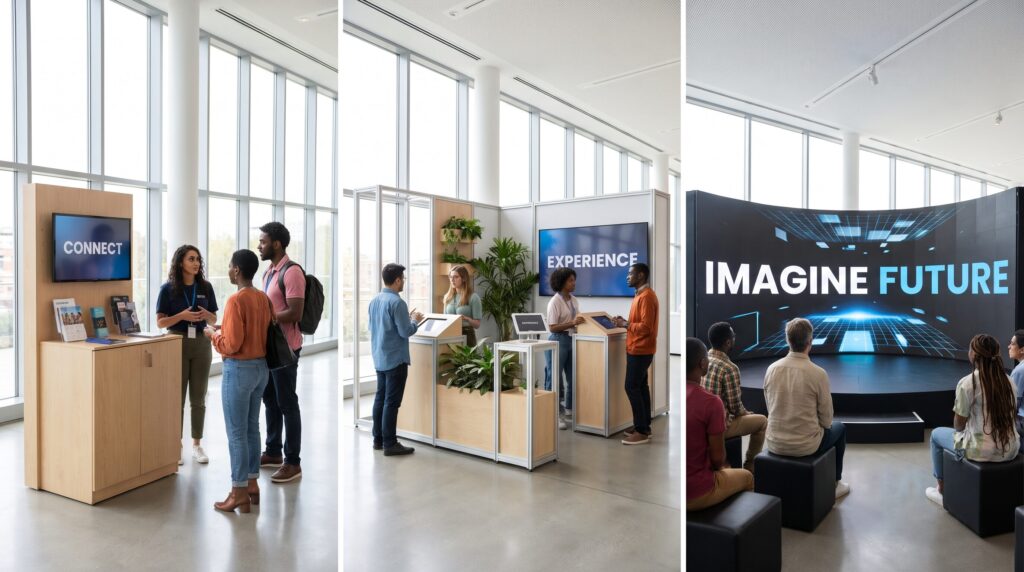
Experiential marketing cost in Canada typically ranges from about $10,000–$25,000 for a small activation to $50,000–$100,000 for a mid-size program and $150,000+ for a large, multi-market build. Your final experiential marketing cost depends on scope, staffing, fabrication, venue, and duration.
Updated November 2026.
Key takeaways:
$128B+ — annual global brand spend on experiential and live marketing (Event Marketer) · 88% — consumers who trust a personal recommendation over any advertisement (Nielsen) · 6.4M+ — people in the Greater Toronto Area, Canada's largest activation market (Statistics Canada)
Experiential marketing is live, in-person brand activity—sampling, pop-ups, booths, stunts, and events—that lets people interact directly with your brand. Before we price it, let us name the entity plainly.
Experiential marketing creates a real-world moment a person can touch, taste, or join. Because it builds memory and trust, it often outperforms passive advertising. Learn more in our guide to experiential marketing.
A branded sampling table and a multi-day festival footprint are both experiential marketing, yet they sit at opposite ends of the budget. That range is exactly why buyers ask what experiential marketing cost looks like before they plan.
Because Brand Guruz builds for Canada’s diverse, urban audiences, we treat experiential marketing as a measurable channel, not a one-off stunt. That mindset keeps cost tied to outcomes from the very first planning call.
Five levers move your experiential marketing cost up or down: scope, staffing, build and fabrication, venue, and duration. Globally, live and experiential spend now tops $128B a year, per Event Marketer, and the same drivers shape every Canadian budget.
A bigger footprint needs more brand ambassadors, supervisors, and technicians. Staffing is usually billed per person, per day, so a longer or larger activation raises labour costs quickly.
Custom booths, branded structures, and signage are fabricated, shipped, installed, and struck. These production costs often form the largest single line in a brand activation cost estimate.
Prime venues and high-traffic malls charge premium space fees, and every extra day adds staffing, rentals, and logistics. Together, venue and duration shape much of your total experiential marketing cost.
Location matters too. Producing in several Canadian cities adds travel, accommodation, and regional labour costs, so a national tour always carries a higher experiential marketing cost than a single-market activation.
Here are typical, illustrative experiential marketing cost ranges in Canada for 2026. The GTA’s 6.4M+ residents (Statistics Canada) make it the country’s largest activation market, and these ranges reflect that demand. Treat them as planning guides, not quotes.
| Activation size | Typical cost range (CAD) | What it usually covers |
|---|---|---|
| Small | $10,000–$25,000 | Single-location sampling or pop-up, small crew, light build |
| Mid-size | $50,000–$100,000 | Custom booth, multi-day run, trained staff, basic measurement |
| Large | $150,000+ | Multi-market tour, heavy fabrication, full production and reporting |
Most GTA brands land in the mid-size band. If your numbers sit far below a range, something—staffing, permits, or measurement—may be missing from the scope.
Prices also shift with timing. Peak periods—summer festival season and the Q4 holiday run—push venue and staffing rates higher across the GTA, so booking early protects both your date and your experiential marketing budget.
Sample budgets make the numbers concrete. The table shows what a typical experiential marketing budget buys at three common price points in Canada.
| Budget (CAD) | What it typically delivers |
|---|---|
| $10,000 | One-day sampling activation, two to three brand ambassadors, simple branded table, basic giveaways |
| $50,000 | Multi-day pop-up, custom-built booth, trained staff team, photography, light lead capture |
| $150,000 | Multi-city activation, premium fabrication, full production crew, technology, and ROI reporting |
You can dial any tier up or down. Adding a second city, more days, or richer technology moves you toward the next band, so match the budget to the outcome you need.
These sample budgets are Canadian planning figures, not fixed quotes. Taxes, travel between cities, and union or venue labour rules can shift the final number, which is why a detailed scope always beats a round estimate.
A common surprise is that agency fees and production costs are two different things. Separating them keeps your experiential marketing cost transparent.
Agency fees pay for strategy, creative, project management, and accountability—the team that plans and runs the activation. They are often a percentage of the total or a fixed management fee.
Production costs are the hard dollars: fabrication, staffing, rentals, permits, travel, and logistics. In most Canadian activations, production is the larger share of the brand activation cost.
In Canada, production typically accounts for roughly 60–75% of a mid-size activation budget, with agency fees making up the rest. Knowing that split helps you sanity-check any quote you receive.
When you review a proposal, ask the agency to show both numbers side by side. A partner that itemizes agency fees and production costs separately is far easier to compare—and far less likely to surprise you later.
Budgeting works best backwards from your goal. Decide the outcome first, then build the experiential marketing budget to reach it.
Leads, sampling volume, or awareness each imply a different spend. A clear target keeps the budget honest and the scope focused.
List staffing, fabrication, venue, rentals, travel, permits, and measurement separately. Our event budget templates make this fast.
Reserve 10–15% for overtime, weather, and last-minute changes. A contingency protects the plan when real-world conditions shift on activation day.
Finally, align the budget with your calendar. A Toronto activation booked three to six months out usually secures better rates than a rushed build, so early planning is itself a cost-saving move.
The goal is not the lowest experiential marketing cost—it is the best return on it. A few choices stretch every dollar further.
Capture leads, scans, samples, and content so the activation ties to revenue. Because 88% of people trust a personal recommendation over advertising (Nielsen), live moments earn trust that is worth measuring.
Photograph and film the activation, then extend it across social and email. Pairing live reach with a strong marketing budget planning approach multiplies impact without doubling spend.
Returns also improve when you plan the follow-up before the event. Mapping how leads flow into your CRM and nurture emails means the activation keeps working long after the last sample is handed out.
Hidden costs are what blow up a brand activation cost after sign-off. Budget for them early so there are no surprises on invoice day.
Public spaces, malls, and festivals often require permits, liability insurance, and sometimes security. These approvals take time and money, so confirm them during planning.
Drayage (moving materials on-site), crew travel, accommodation, and overtime for long show days add up fast. They are routine, not rare, in Canadian activations.
Striking the build, return shipping, and storing reusable assets carry real cost. A good partner lists these upfront instead of billing them later.
The fix is simple: ask for a fully itemized scope. When permits, drayage, travel, overtime, teardown, and storage are listed upfront, your experiential marketing cost stays predictable from quote to final invoice.
Brand Guruz is a Canadian experiential marketing agency based in Toronto and serving the GTA and all of Canada. We price activations in plain, itemized terms so you always know what you are paying for.
Every quote separates agency fees from production costs and flags likely hidden costs in advance. Compare us with any experiential marketing agency on transparency.
We design activations for Canada’s diverse live markets and measure the results. Ready for numbers? Get a free activation quote.
From Toronto and Mississauga to Vancouver and Calgary, we scope each activation to local venues, audiences, and rules. That national reach with local precision is why brands trust Brand Guruz to budget activations that actually deliver.
Experiential marketing cost in Canada typically ranges from about $10,000–$25,000 for a small, single-location activation to $50,000–$100,000 for a mid-size program and $150,000 or more for a large, multi-market build. Your exact figure depends on scope, staffing, fabrication, venue, and duration, so most brands request an itemized quote before committing a budget.
A typical mid-size brand activation budget in Canada sits around $50,000–$100,000. That usually covers a custom-built booth, a multi-day run, trained brand ambassadors, basic technology, and light measurement. Smaller sampling activations start near $10,000, while large multi-city tours with heavy fabrication and full reporting commonly exceed $150,000.
Costs vary because activations are scoped individually. A branded sampling table and a multi-day festival footprint are both experiential marketing, yet they sit at opposite ends of the budget. Scope, staffing days, custom fabrication, venue fees, duration, and travel each move the number, so two campaigns can differ by six figures.
Agency fees pay for strategy, creative, and project management—the team that plans and runs the activation. Production costs are the hard dollars: fabrication, staffing, rentals, permits, travel, and logistics. In most Canadian activations, production is the larger share, and a transparent quote lists the two separately so nothing is hidden.
Measure from day one by capturing leads, scans, and samples, then tie them to revenue. Film and photograph the activation and amplify it across social and email. Reusing content and pairing live reach with digital follow-up stretches every dollar, so a slightly higher experiential marketing cost can deliver far better returns.
Yes. A focused single-location sampling activation or pop-up can run from about $10,000–$25,000. Keep the footprint tight, use a small trained crew, and prioritize one clear outcome. A good agency will right-size the scope so a small experiential marketing budget still produces measurable, on-brand results.

Want a clear, itemized experiential marketing budget for your next campaign? Brand Guruz plans, produces, and measures activations across Toronto, the GTA, and all of Canada—with no hidden costs.
Tell us your goal and target audience, and we will scope the activation to hit it. To start, get a free activation quote, or compare the experiential marketing agency landscape first.
Most brands we work with start with a short discovery call, leave with a clear range, and move forward only when the numbers make sense. There is no pressure—just a transparent plan built around your goal.