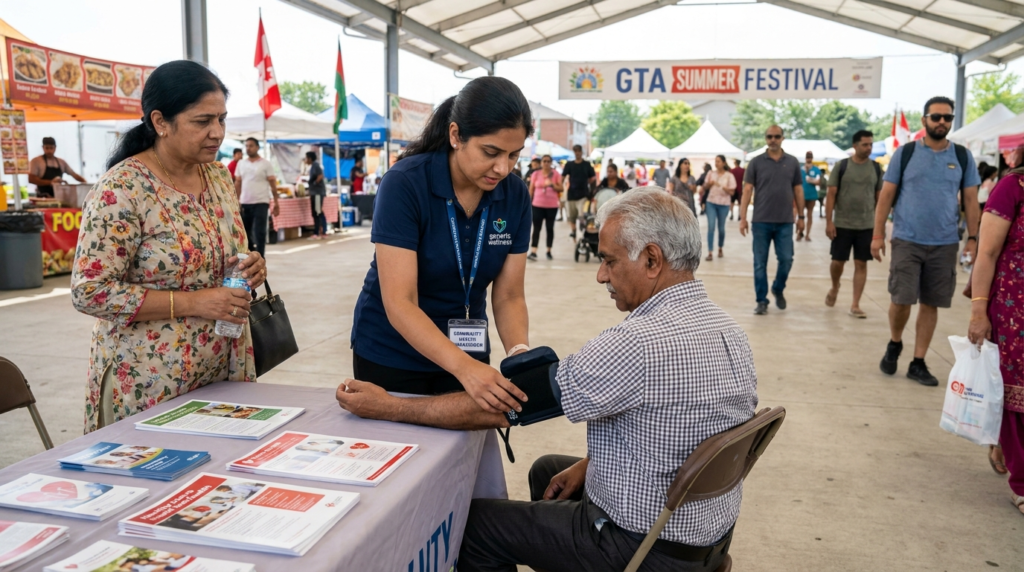
What healthcare marketing in Canada cannot afford to get wrong about the health system is multicultural community outreach. Specifically, the chronic disease burden in Canada’s multicultural communities is not proportionally matched by the healthcare marketing strategies reaching those communities. South Asians in Ontario have a 3.4-fold higher incidence of new diabetes cases than white Canadians, adjusting for age, sex, income, and BMI. Black Canadians have 2x the incidence. Chinese Canadians have 1.9x the incidence. Consequently, the healthcare brands and public health agencies that reach these communities through English-language mass advertising are missing the highest-need patient populations in the country.
Brand Guruz designs and runs healthcare marketing activation programs across the GTA’s South Asian, Caribbean, East Asian, and Filipino communities. These include in-language health education events, community venue partnerships, cultural festival health screenings, and brand ambassador programs for pharmaceutical brands. Specifically, our programs are built around the community trust dynamics that govern how multicultural Canadians make health decisions, seek care, and adhere to treatment protocols.
higher incidence of diabetes among South Asians in Ontario compared to white Canadians, after adjusting for age, sex, income, and BMI (ICES Ontario)
medication non-adherence rate among South Asian diabetes patients in Canada, compared to 30–35% in the general population
the age at which South Asians in Canada typically develop type 2 diabetes compared to the general population
The fundamental problem with healthcare marketing in Canada’s multicultural communities is not reach — it is trust. Specifically, South Asian, Caribbean, East Asian, and Filipino communities in the GTA make health decisions through community social networks that English-language mass advertising cannot penetrate. A recommendation from a Punjabi-speaking community health worker or a gurdwara-based diabetes awareness program carries credibility that a hospital billboard or television spot cannot replicate.
Consequently, healthcare brands that treat multicultural communities as a demographic target rather than a community trust network consistently underperform on treatment adherence, screening uptake, and health literacy. Overall, the evidence is consistent. Specifically, 55-60% of South Asian patients with diabetes in Canada are non-adherent to their prescribed medications. This is nearly double the general population non-adherence rate. Additionally, South Asians develop type 2 diabetes 5-10 years earlier than the general population. The American College of Cardiology recognizes South Asian ancestry as a cardiovascular risk factor.
Moreover, language is not just a communication barrier in multicultural healthcare marketing. It is a health outcomes barrier. Indeed, a South Asian patient who cannot discuss diabetes management in Punjabi is less likely to adhere to treatment and 24% less likely to achieve overall cardiometabolic control. For healthcare brands, this is not a marketing problem alone. It is a clinical outcomes problem that culturally tailored community health education programs are specifically equipped to address.
The chronic disease burden in Canada’s multicultural communities creates a clear business and public health case for culturally targeted healthcare marketing. Specifically, South Asian Canadians have the highest rates of new diabetes diagnoses of any ethnic group in the country — 3.4 times the white Canadian rate. Black Canadians have double the rate. Chinese Canadians have 1.9 times the rate. Consequently, these communities represent the highest-priority patient populations for diabetes management programs, cardiovascular risk reduction, and preventive care outreach.
Furthermore, the gap between disease burden and healthcare engagement is structural. Specifically, language barriers, lack of culturally appropriate health information, and different cultural frameworks for understanding chronic disease all contribute to dramatically lower treatment adherence rates. Furthermore, cancer screening uptake varies significantly. South Asian and East Asian women show lower cervical and breast cancer screening rates in several Ontario health regions.
Overall, these gaps represent both a public health priority and a healthcare marketing opportunity. Specifically, hospitals, pharmaceutical companies, and community health centres that invest in in-language health education programs produce measurable improvements in screening rates and treatment adherence. For healthcare brands, the investment case for culturally tailored healthcare marketing in Canada is supported by outcomes data. Effective healthcare marketing Canada-wide requires community trust, not just media reach.
The most consistently high-performing format for healthcare marketing in Canada’s multicultural communities is the in-language community health education event. Specifically, workshops delivered in Punjabi, Hindi, Cantonese, Mandarin, Tamil, or Tagalog at trusted community venues consistently outperform mass media healthcare marketing. Trusted venues include gurdwaras, Hindu mandirs, mosques, East Asian community associations, and Filipino community centres.
The trust dynamic is structural. Specifically, a diabetes education workshop delivered in Punjabi by a South Asian health educator at a Brampton gurdwara is not an intrusion into the community. It is an invitation from within the community’s trust network. Indeed, attendees share health information and workshop details with family members and neighbours at a speed and depth that paid advertising cannot replicate. Consequently, the downstream reach of a well-executed community health education event extends far beyond the room.
Specifically, healthcare brands can access this community trust infrastructure through several established formats. Gurdwaras and Hindu mandirs across Brampton and Mississauga host regular community education events. Additionally, Chinese Canadian community associations in Markham and Richmond Hill have programming infrastructure for health education workshops. Filipino Heritage Month events in June and Scarborough community centres provide structured programming for Filipino-Canadian community health outreach. Brand Guruz coordinates these community venue partnerships and supplies in-language ambassador teams as part of the full healthcare marketing event production model. For the broader community ambassador program framework, see our brand ambassador program guide.

The second primary format for healthcare marketing in Canada’s multicultural communities is cultural festival health activation. Events like Carassauga, Caribana, Diwali festivals in Brampton, and Lunar New Year events in Markham draw high-footfall multicultural audiences. These are the settings where health activations produce the highest engagement.
Healthcare festival activations work differently from product sampling or CPG activations. Generally, the format centres on value delivery rather than brand exposure: blood pressure screenings, diabetes risk assessments, immunization information, cancer screening awareness, and in-language health literacy materials. Consequently, a healthcare brand present at a Carassauga pavilion with an in-language health screening team is not interrupting the cultural experience. They are providing genuine health value within a trusted cultural context.
Furthermore, festival health activations generate earned trust that extends through community social networks. Specifically, a Filipino-Canadian family that receives a blood pressure check and a Tagalog-speaking physician referral at a community event is far more likely to follow through. Digitally delivered referrals produce significantly lower follow-through rates. The in-person, in-language community touchpoint is the mechanism. For the multicultural festival activation model Brand Guruz uses across the Ontario festival circuit, see our festival brand activation playbook.
Pharmaceutical companies operating in Canada face a specific healthcare marketing challenge in multicultural communities — medication adherence. Specifically, South Asian diabetes patients show 55-60% non-adherence rates — nearly double the general population. Pharmaceutical brands have a direct incentive to invest in in-language community health education.
The community health ambassador model addresses this directly. Specifically, trained in-language community health ambassadors provide medication information, side effect education, and treatment adherence support in Punjabi, Cantonese, Mandarin, Tamil, and Tagalog. Indeed, culturally tailored health education programs for South Asian cardiovascular and diabetes patients have demonstrated improved risk factor outcomes in clinical studies. Accordingly, the investment case for pharmaceutical brands is not just marketing — it is clinical outcomes improvement in high-need populations.
Additionally, community health ambassador programs for pharmaceutical brands in Canada must operate within Health Canada’s regulatory framework for pharmaceutical promotion. Brand Guruz designs healthcare marketing activation programs in alignment with Health Canada advertising guidelines. Ambassador training covers permissible health claims and appropriate referral pathways. For the full multicultural marketing research framework that informs these programs, see our multicultural market research guide.
Why is multicultural community marketing so important for healthcare marketing in Canada? Canada’s fastest-growing communities carry disproportionate chronic disease burden. South Asian Canadians have 3.4x the diabetes incidence of white Canadians. Black Canadians have double the rate. Chinese Canadians have 1.9x the rate. These communities also show lower screening uptake, higher medication non-adherence, and greater language barriers to healthcare access. Healthcare brands and public health agencies that invest in culturally tailored, in-language community health marketing produce measurably better outcomes. Mass media advertising cannot match these results in multicultural segments.
What healthcare marketing formats work best in multicultural communities in Canada? The highest-performing formats are in-language health education events at gurdwaras, temples, and mosques; cultural festival health screenings; and community health ambassador programs for pharmaceutical brands.
How does Brand Guruz approach healthcare marketing for multicultural communities? Brand Guruz designs and runs in-language healthcare marketing programs across South Asian, Caribbean, East Asian, and Filipino communities in Ontario. Our programs combine community venue partnerships, in-language ambassador teams trained in health communication, and culturally appropriate health education content. We coordinate community event production, ambassador staffing in Punjabi, Hindi, Tamil, Tagalog, Cantonese, and Mandarin. Community organization partnerships support the full program lifecycle.
What regulations govern healthcare marketing and pharmaceutical promotion in Canada? Health Canada regulates the advertising of pharmaceutical products to consumers and healthcare professionals. Brand Guruz designs healthcare marketing activation programs in alignment with Health Canada advertising guidelines. Community health education events focused on disease awareness and screening encouragement generally operate within public health education frameworks. They are distinct from pharmaceutical advertising regulations. However, any activation involving specific pharmaceutical products or prescription claims requires compliance review before deployment.
Talk to Brand Guruz about healthcare marketing in Canada — in-language community health education events, cultural festival health screenings, and pharmaceutical brand ambassador programs across Ontario’s multicultural communities. See our experiential marketing agency Toronto overview for the full multicultural activation model.