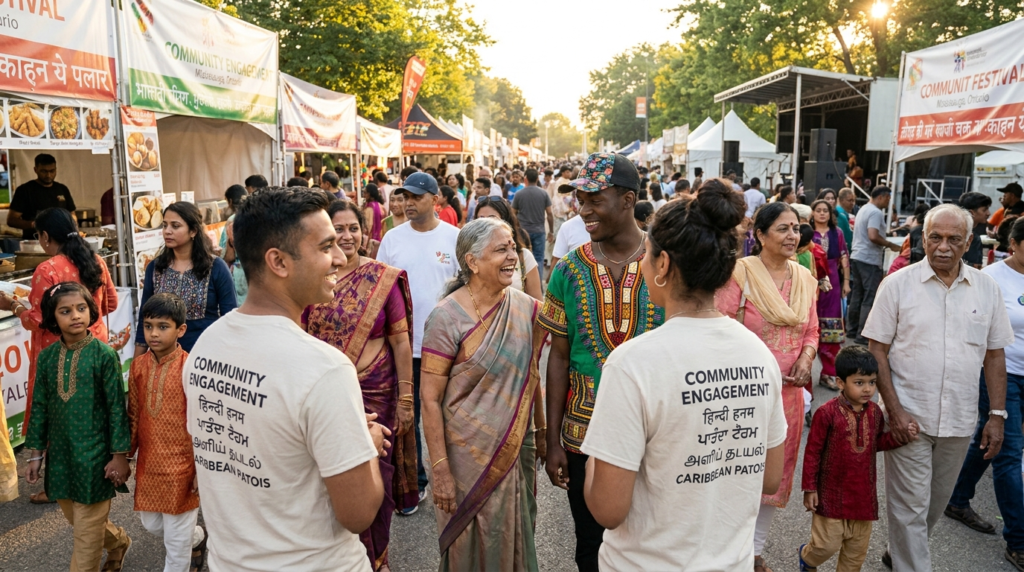
Choosing the right multicultural marketing agency in Canada is one of the most consequential decisions a brand makes in the GTA market. Specifically, a wrong hire means one or two seasons of wasted activation budget. More critically, it costs community goodwill that is very difficult to rebuild. Conversely, the right hire builds brand trust across South Asian, Caribbean, Muslim, Chinese, and Filipino Canadian communities. That trust compounds with every activation, every event, and every year.
Moreover, the Canadian multicultural market is structurally different from any other market a brand manager will encounter. Canada’s visible minority population reached 26.5% of the national population in 2021. Concentrations exceed 50% in cities like Brampton, Markham, and Mississauga. Additionally, Google Canada research confirms that 37% of Canadians say brands don’t reflect their lived experience. That gap is not a digital problem. It is an on-ground, in-community activation problem.
This guide covers eight criteria for evaluating a multicultural marketing agency in Canada. These include the right questions, the key red flags, and the portfolio evidence that separates genuine specialists from generalists. For deeper community context, see our multicultural market research guide.
Canada’s visible minority population share in 2021 (Statistics Canada), the highest of any G7 nation
share of Canadians who say brands do not reflect their lifestyle or lived experience (Google Canada)
estimated economic impact of Toronto Caribbean Carnival alone, the single largest multicultural brand activation event in Canada
Not every market requires a specialist multicultural marketing agency. Canada does. The depth and concentration of multicultural communities in the GTA makes generic agency execution genuinely ineffective — not just suboptimal.
Specifically, the Edelman Trust Barometer shows that community trust is primarily earned through authentic, consistent presence — not through translated advertising. In multicultural Canadian communities, trust is built at gurdwaras, mosques, cultural festivals, and community events. It is built by brand ambassadors who speak the language and share the cultural background of the people they are speaking with. Consequently, a multicultural marketing agency in Canada must be able to prove on-ground community relationships — not just a media buy against demographic segments.
Additionally, Canada’s multicultural events calendar is dense and community-specific. Events like Vaisakhi, Caribana, Diwali, and WorldFest require agency partners with established festival relationships and event permits. Specifically, they also require locally embedded ambassador teams that take years to build. These community relationships cannot be replicated in a single campaign cycle. Generally, a general agency cannot replicate them in a single campaign cycle.
The following criteria reflect what the best multicultural brand activations in Canada have in common. Specifically, criteria 1 through 4 address cultural capability. This layer determines whether a multicultural marketing agency in Canada is genuinely specialist or broadly positioned.
Cultural fluency — not cultural translation Specifically, a genuine multicultural marketing agency distinguishes between cultural translation and cultural fluency. Translation rewords existing creative into a target language. Fluency builds creative from the community’s own values, symbols, and occasions — and the distinction is visible in every consumer interaction.
Proven community organization relationships Indeed, the best multicultural agencies maintain active, multi-year partnerships with cultural organizations, gurdwaras, mosques, temples, Caribbean associations, and festival committees. Specifically, ask any prospective agency to name their community organization partners by name. A vague answer reveals a surface-level community strategy.
On-ground experiential capability Credible multicultural marketing agencies in Canada operate on the ground — not just online. Specifically, this means staffed activations, branded installations, sampling programs, and ambassador networks at community events. Digital amplification matters, but the on-ground moment is where multicultural community trust is built.
In-language brand ambassador networks The most effective multicultural community activations are staffed by brand ambassadors who are genuinely from the target community. Specifically, in-language communication at a community activation delivers a qualitatively different consumer experience than translated talking points delivered by an outside team. See our brand ambassador program guide for the full activation model.
Criteria 5 through 8 address operational capability. This is the evidence that a multicultural marketing agency in Canada can execute what it proposes, at the community events that matter.
Canadian multicultural event portfolio Specifically, any credible multicultural marketing agency in Canada should have a portfolio at Canadian multicultural events. These include Vaisakhi, Caribana, Carassauga, Diwali, WorldFest, and Eid celebrations. Generally, a portfolio concentrated in digital channels or US market events does not demonstrate Canadian community activation capability. For context on the key events, see our Canadian multicultural events calendar 2026.
Regulatory awareness Specifically, multicultural event activations in Ontario require navigating AGCO regulations for any alcohol sampling, municipal event permits, and festival-specific vendor agreements. A multicultural marketing agency without regulatory awareness will cost brands time and money. Specifically, this knowledge base is built through years of on-ground Ontario activation experience.
A defined ROI measurement framework Always ask every prospective agency how they measure the impact of a multicultural activation. Strong agencies use community reach metrics, brand recall surveys, post-event sales data, and redemption tracking. Consequently, an agency that cannot articulate its measurement approach is proposing activity without accountability. See our experiential marketing ROI framework for the industry-standard approach.
Transparent subcontracting Specifically, some agencies win multicultural contracts and subcontract the on-ground execution to staffing agencies without multicultural community expertise. Always ask who will physically staff and manage each activation. The quality gap between an agency’s multicultural community relationships and a subcontracted general staffing team is significant.
Not all multicultural marketing agencies in Canada operate at the same standard. Specifically, the following signals indicate an agency may lack the depth its positioning suggests.
The agency has no multicultural staff in senior roles. Specifically, an agency that targets multicultural communities but staffs its leadership with generalists is proposing cultural fluency it cannot operationally deliver.
The agency proposes identical creative across all multicultural communities. Specifically, South Asian, Caribbean, Chinese, Muslim, and Filipino Canadian communities have distinct values, occasions, and communication styles. A single creative approach signals demographic targeting rather than genuine multicultural marketing.
The agency cannot name community organization partners. Specifically, genuine multicultural community relationships are organizational — not just event-based. If an agency cannot name the cultural organizations it partners with, its community strategy is transactional.
The agency’s multicultural portfolio is primarily digital. Specifically, Canadian multicultural communities over-index in community trust at live events — not social media feeds. An agency without on-ground activation experience in Canada is not a multicultural marketing agency. It is a multicultural media buyer. See our festival brand activation playbook for what genuine on-ground execution looks like.
Five questions every brand should ask in the discovery call or RFP process for a multicultural marketing agency in Canada.
Specifically, these questions reveal operational depth rather than positioning language. Generally, the gap between a strong and a weak answer is significant.
Who will physically staff our activation, and what communities are they from? Specifically, the answer should name the ambassador profile, the sourcing process, and the training approach. A vague reference to “a diverse team” is not an operational answer.
Which cultural organizations do you have active, ongoing partnerships with? Specifically, the answer should include organization names, tenure, and the nature of the relationship. Active partnerships are different from one-off event sponsorships.
What Canadian multicultural events have you activated at in the past two years? Specifically, the answer should name events, brands, and activation formats. Additionally, ask for photos or case studies. A credible multicultural marketing agency in Canada has a visible portfolio. See our South Asian consumer guide and newcomer marketing guide for the community context that shapes strong activations.
How do you measure the impact of a multicultural activation? Specifically, the answer should reference community reach, brand recall, redemption rates, and post-event surveys — not just impressions or follower counts.
If any part of the execution is subcontracted, who is the subcontractor and what is their multicultural community experience? This question surfaces the execution gap that exists in many multicultural agency relationships. Generally, the on-ground team is the activation — and they should share the community expertise of the agency that sold the work.

What is the difference between a multicultural marketing agency and a general marketing agency? A multicultural marketing agency in Canada builds community relationships, in-language ambassador networks, and on-ground activation capability within specific cultural communities. Generally, a general marketing agency builds media reach. The distinction matters because multicultural community trust in Canada is built through authentic, in-community presence — not through demographic media targeting.
How much does multicultural marketing cost in Canada? Multicultural marketing activation costs in Canada vary significantly by scope. Specifically, a single community event activation typically ranges from $5,000 to $40,000 depending on staffing, materials, and event footprint. A year-round multicultural community program across multiple occasions and communities will typically range from $50,000 to $200,000 annually. Generally, cost-per-engaged-consumer at community events is significantly lower than cost-per-click equivalents in digital advertising.
Do I need a separate agency for each cultural community? No. Specifically, the most effective multicultural marketing agencies in Canada have genuine relationships across multiple communities. South Asian, Caribbean, Chinese, Muslim, and Filipino Canadian communities can all be served by one integrated agency team. One integrated multicultural agency in Canada delivers better community consistency than four separate community-specific vendors.
What makes a multicultural marketing agency effective specifically in Canada? Specifically, Canadian effectiveness requires knowledge of Canadian multicultural events, communities, and regulations — not a US multicultural playbook applied to a Canadian city. Additionally, Canada’s multicultural communities are distinct from their US equivalents in community structure, spending behaviour, and media consumption. A multicultural marketing agency in Canada needs Canadian-specific community depth to activate effectively.
Talk to Brand Guruz about building a multicultural marketing activation program in Canada. We cover community relationships, in-language ambassador teams, and on-ground experiential execution across South Asian, Caribbean, Chinese, and Filipino Canadian communities in the GTA.