Multicultural Marketing vs. Multicultural Advertising: What's the Difference?

Canada is one of the most ethnically diverse nations on Earth — and one of the most inconsistent at marketing to that diversity authentically. Specifically, multicultural marketing in Canada and multicultural advertising in Canada are not interchangeable terms. They describe fundamentally different activities, different trust mechanisms, and different commercial outcomes. Consequently, brands that confuse them consistently leave the most commercially significant consumer communities in the country underserved and unpersuaded.

The distinction matters because 26.5% of Canada’s population identified as a visible minority in the 2021 Census. That share is growing fastest in the country’s highest-spending urban markets. Moreover, Google Canada research shows that 37% of Canadians say they do not see their lifestyle represented in advertising — a gap that is significantly wider within ethnic and cultural communities. Overall, the brands closing that gap are not the ones buying more Punjabi radio spots. They are the ones showing up at Diwali.

Brand Guruz was built on this distinction. Specifically, multicultural marketing in Canada — grounded in community trust, cultural occasion, and in-language activation — is what Brand Guruz delivers. Broadly, Brand Guruz advises clients not to rely on multicultural advertising alone.

26.5%

Canada’s visible minority population share in 2021, the world’s highest concentration in a G7 nation (Statistics Canada)

37%

 share of Canadians who say they don’t see their lifestyle represented in advertising (Google Canada)

"Someone like me"

 consistently the most trusted purchase-influencing voice in multicultural consumer communities, more trusted than brand advertising (Edelman Trust Barometer)t

Multicultural marketing in Canada: a definition

Multicultural marketing in Canada refers to brand strategies specifically designed to engage ethnic and cultural communities through culturally appropriate channels, community-credible messengers, and culturally resonant occasions. Specifically, it is not about targeting — it is about belonging. A multicultural marketing strategy does not ask how to reach a community. It asks how to be welcome within one.

The core mechanism of multicultural marketing in Canada is trust transfer. Specifically, when a Punjabi-speaking brand ambassador engages a family at a Vaisakhi celebration in Brampton, they do not represent the brand to the community. They represent the community to the brand — and that reversal of direction is everything. Consequently, brand trust does not flow from the campaign to the consumer. It flows from the ambassador’s community credibility to the brand they represent.

Generally, multicultural marketing in Canada operates through five channels that multicultural advertising cannot replicate. These include cultural community events, in-language brand ambassadors, settlement organization partnerships, cultural occasion activations, and community network word-of-mouth. Each of these channels exists within the community’s social infrastructure — which means each one transfers community trust rather than simply reaching a targeted audience. For the full community research framework, see our multicultural market research guide.

What multicultural advertising in Canada actually is

Multicultural advertising refers to paid media placements in ethnic-language channels — Punjabi radio, Hindi television, Tagalog-language newspapers, South Asian digital platforms. It is targeting and translation. Neither is community engagement, nor does it transfer community trust.

Specifically, multicultural advertising includes running a Punjabi-dubbed commercial on OMNI Television, buying ads in an Urdu-language newspaper, or targeting South Asian Facebook audiences with translated copy. It also includes hiring a Bollywood celebrity to appear in a national campaign. Each of these is a broadcast tactic. Consequently, each reaches multicultural audiences the same way generic English advertising reaches mainstream Canadians — impersonally, at scale, with no community endorsement.

Multicultural advertising is not without value. Specifically, it builds broad awareness and keeps a brand visible in ethnic-language media ecosystems. Additionally, it works well for brands that have already established community trust through activations and are maintaining reach. The problem arises when multicultural advertising substitutes for multicultural marketing. Specifically, speaking Punjabi in a radio ad is not the same thing as being trusted by Punjabi consumers. It is not.

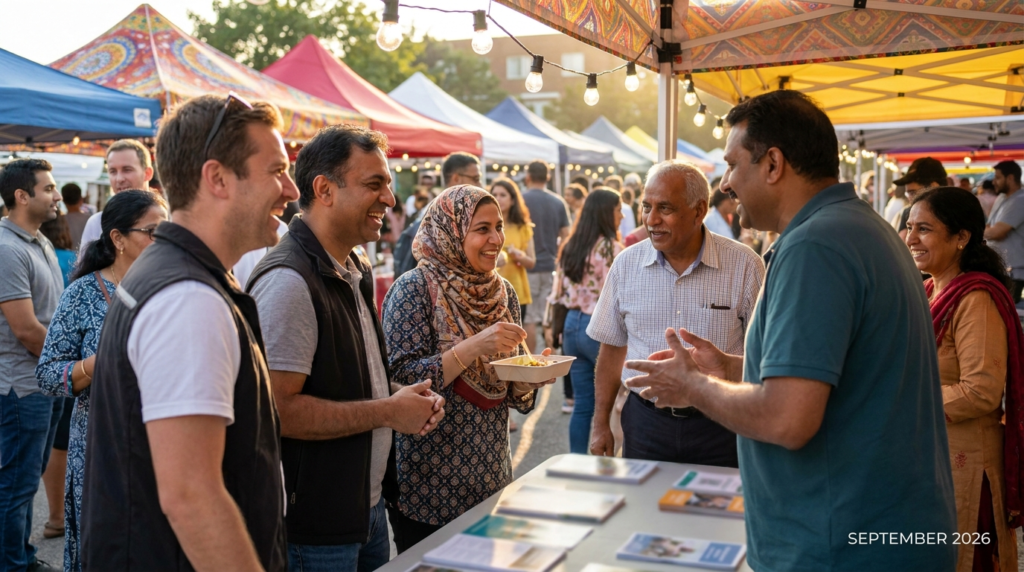
Multicultural marketing Canada: brand ambassadors at a community cultural festival in the GTA demonstrating authentic community-level activation versus broadcast advertising.
The difference between multicultural advertising and multicultural marketing in Canada is the difference between broadcasting a message and earning a community's trust.

Why multicultural advertising in Canada falls short

Four structural gaps explain why multicultural advertising alone consistently underperforms in Canadian multicultural consumer markets.

The trust deficit. Community endorsement precedes brand advertising as a purchase driver in multicultural consumer decision-making. Specifically, a Punjabi radio ad carries a brand claim. An in-language brand ambassador with genuine community ties carries a community endorsement. These are not equivalent trust signals. Indeed, the Edelman Trust Barometer consistently shows that “someone like me” is a more trusted purchase influence than brand advertising. In tight-knit cultural communities, that gap is significantly wider than in the mainstream market.

The cultural context gap. Translated advertising frequently misses the cultural nuance that resonates within specific communities. Specifically, Hindi-dubbed English commercials often feel grammatically correct but culturally misaligned to native speakers. Moreover, advertising that uses generic South Asian imagery without specific community reference — grouping Punjabi, Tamil, Gujarati, and Bengali communities as a single “South Asian” audience — signals cultural inexperience rather than cultural fluency.

The WhatsApp economy. Purchasing decisions in South Asian, Caribbean, East African, and Filipino communities travel through WhatsApp groups, not mass media. Consequently, a Diwali brand activation that earns genuine community endorsement from 500 attendees generates word-of-mouth that reaches tens of thousands through community WhatsApp networks. No paid advertising budget can replicate that reach.

The newcomer trust dynamic. Newcomers specifically distrust advertising-first brands. Specifically, advertising was often the channel used to mislead them in their home country. Additionally, community referral is their primary trust signal for every major purchasing category in their first year in Canada. For more on the newcomer consumer specifically, see our newcomer marketing Canada guide.


What makes multicultural marketing in Canada work differently

Effective multicultural marketing in Canada operates through five mechanisms that multicultural advertising cannot access.

Community trust transfer is the primary mechanism. Specifically, a brand ambassador who is a genuine member of the target community does not merely communicate the brand message. They transfer their own community credibility to the brand they represent. Consequently, brand trust does not need to be built from scratch — it is borrowed from the ambassador’s existing community standing.

Occasion-based activation creates commercially concentrated engagement windows. Specifically, Diwali, Vaisakhi, Eid, Caribana, and Lunar New Year are not simply events. They are peak community engagement moments when cultural identity is most active and purchasing behaviour is most open to new brand relationships. For the full cultural occasions model, see our festival brand activation playbook.

Community networks and long-term commitment

Partnership-based credibility extends trust beyond the activation itself. Specifically, a brand that partners with ACCES Employment, a gurdwara community committee, or the Tamil Community Centre earns institutional endorsement — the most durable form of multicultural community trust available to a brand.

Earned reach through community networks multiplies the impact of every activation. Generally, a well-executed community activation does not end when the event ends. It continues through WhatsApp groups, cultural media, and community social networks for days or weeks afterward.

Long-term brand commitment distinguishes multicultural marketing from one-time multicultural advertising. Specifically, community trust is built through consistent presence — not a single Diwali campaign or one Caribana sponsorship. Brands that return to the same communities, year after year, through the same cultural occasions build the kind of deep community loyalty that no advertising rotation can replicate. See our brand ambassador program guide and our South Asian consumer guide for community-specific context. For the full Brand Guruz multicultural marketing model, see our experiential marketing agency Toronto overview.

Frequently asked questions about multicultural marketing in Canada

What is the difference between multicultural marketing and multicultural advertising? Multicultural advertising is paid placement in ethnic-language media channels — Punjabi radio, Hindi television, South Asian digital platforms. By contrast, multicultural marketing in Canada is community activation: in-language brand ambassadors, cultural occasion events, settlement organization partnerships, and community network engagement. Advertising reaches multicultural audiences. Marketing earns their trust.

Which multicultural communities in Canada have the highest purchasing power? South Asian Canadians are the largest visible minority community — 26.5% of the visible minority population — and the dominant community in the GTA’s highest-growth markets. Specifically, the South Asian consumer market in Brampton, Mississauga, and Markham represents one of the most concentrated purchasing-power clusters in North America. Chinese Canadian, Filipino Canadian, and Black Canadian communities are also among the highest-concentration consumer markets in Toronto and Vancouver.

Is multicultural advertising ever the right choice? Yes — specifically as a complement to multicultural marketing, not a substitute for it. Multicultural advertising maintains brand visibility in ethnic-language media ecosystems. It is most effective when a brand has already built community trust through in-person activations and uses advertising to extend reach and maintain presence. Advertising without prior community trust investment produces lower ROI in multicultural consumer markets than in the mainstream Canadian market.

How do you measure the ROI of multicultural marketing in Canada? Multicultural marketing ROI is measured through lead capture at activations, post-event brand recall surveys, WhatsApp network referral tracking, community media coverage, and long-term customer retention rates within specific ethnic communities. Specifically, because multicultural community trust generates word-of-mouth through private networks, direct attribution undercounts the full impact of a well-executed multicultural marketing program.

Start your multicultural marketing program with Brand Guruz

Talk to Brand Guruz about building a multicultural marketing program in Canada — Diwali, Vaisakhi, Caribana, and Eid brand activations across Brampton, Mississauga, and Richmond Hill.

Author