Product sampling puts your product directly into a buyer’s hands so they try it, trust it, and buy it. These product sampling ideas span in-store demos, street teams, festivals, campus tours, pop-ups, and sample-by-QR programs. Brand Guruz runs sampling campaigns across Canada that turn a first try into a tracked, repeat purchase. Updated November 2026.
Key takeaways: trial is the fastest route to a first purchase, and sampling drives it better than almost any ad. Below, you will find 20 product sampling ideas grouped by setting, plus real CAD costs, the ROI metrics that matter, and a brief template you can hand to an agency.
First, a quick frame. Sampling is one tactic inside a bigger plan, so start with our guide to brand activation ideas in Canada before you brief a partner. Then use the ideas here to choose the right formats.
In 2026, Canadian shoppers reward brands that let them try before they buy. Consequently, the brands that sample smartly win shelf space, first-party data, and loyalty. Let us get into the ideas.
81% — consumers more likely to buy a product after a live sampling experience (Event Marketer / EventTrack) · 88% — consumers who trust a personal recommendation over any ad, exactly the word of mouth sampling creates (Nielsen) · 40M+ — people living in Canada, a large and diverse national market for product trial (Statistics Canada)
What is product sampling and why does it drive trial?
Product sampling is the practice of giving shoppers a free trial of your product so they experience it before they commit. In short, it removes the biggest barrier to a first purchase: doubt. When people taste, touch, or use a product, they decide fast.
Why trial beats advertising
Ads describe a product, but sampling proves it. According to Nielsen, 88% of consumers trust a personal recommendation above every paid channel. Therefore a product that earns a genuine reaction in the moment spreads by word of mouth.
Live experience also moves people to act. Reporting from Event Marketer shows most consumers are more likely to buy after they try a product in person. That is the whole case for sampling in one sentence.
The trial-to-purchase loop
Sampling works because it is experiential, not passive. First, a shopper tries the product. Next, they feel confident. Finally, they buy, and often they tell a friend. That loop is why sampling sits at the heart of experiential marketing.
Importantly, sampling also captures data. When a trial is paired with a QR code or a sign-up, every sample becomes a measurable lead rather than a guess.
In-store and grocery sampling ideas
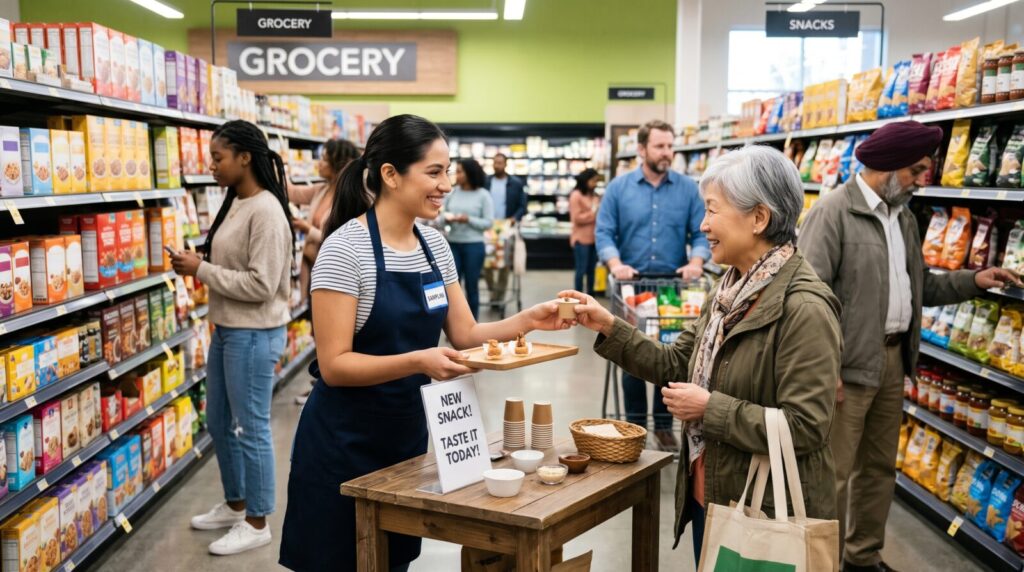
In-store sampling is the classic format, and it still converts because the shelf is right there. Put simply, a shopper tries the product and buys it on the same trip. Here are the strongest in-store sampling ideas for 2026.
1. Live demo stations
Station a brand ambassador at an end-cap with product to taste or test. Because the purchase is steps away, conversion stays high.
2. Guided tasting flights
For food and beverage, offer a short flight of three variants. As a result, shoppers discover the flavour they prefer and grab it.
3. Shelf-edge sampling with coupons
Pair the sample with a time-limited coupon. Consequently, trial turns into a tracked redemption at the till.
4. Staff-assisted demos
Train retail staff to hand out trials during peak hours. In practice, a trusted employee recommendation lifts take-up.
Street-team sampling takes the product to where people already move. For high-traffic urban brands, it builds reach fast. These sampling activation ideas work on sidewalks, at stations, and across the daily commute.
5. Transit-hub handouts
Sample at subway and GO entrances during rush hour. Because commuters repeat the route daily, impressions compound quickly.
6. Branded carts and pedicabs
Roll a branded cart through busy districts. In effect, the sampling team becomes mobile out-of-home media.
7. Neighbourhood blitzes
Target one neighbourhood at a time with a saturation push. Specifically, this suits a product tied to a local store or launch.
8. Office-tower lobby sampling
Partner with downtown towers to sample in the lobby at 8 a.m. As a result, you reach a captive professional audience before work.
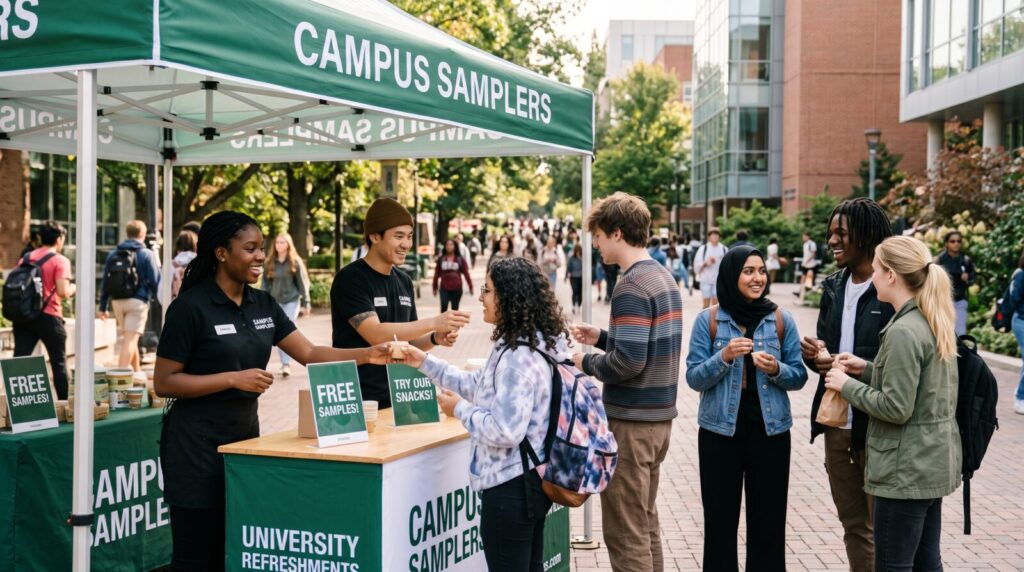
Some audiences gather in one place at one time, which makes sampling efficient. Festivals, campuses, and workplaces each concentrate the exact people many brands want to reach.
The scale helps, too. With more than 40 million people counted by Statistics Canada, a single well-chosen festival can put your product in front of a large, diverse crowd in one weekend.
9. Festival sampling booths
Set up at a cultural festival where the crowd is relaxed and open to trying new things. Because mood is high, product reactions skew positive.
10. Roaming festival teams
Send ambassadors into the crowd rather than waiting at a booth. Consequently, you reach people who never visit the sponsor row.
11. Campus move-in and frosh sampling
Reach students during move-in week, when new routines and brand habits form. In particular, this suits snacks, drinks, and personal care.
12. Workplace and cafeteria sampling
Sample in large office cafeterias and corporate campuses. As a result, you catch a daily-habit audience in a trusted setting.
Ready to turn a format into a plan? Request a quote and we will send a costed plan for your product and market.
Pop-up, mall, mobile tour, and digital-to-physical sampling ideas
Beyond the classics, several formats scale trial while building content and data. These sampling campaign ideas blend physical experience with digital follow-up.
13. Mall pop-up sampling
Book a short pop-up in a high-traffic mall concourse. Because footfall is dense, a weekend can deliver thousands of trials.
14. Experiential pop-up stores
Build a temporary branded space where the product is the star. In effect, the store itself becomes the sample.
15. Mobile sampling tours and roadshows
Run a branded vehicle across several cities on a route. Consequently, one build reaches many markets over a season.
16. Sample-by-QR
Place QR codes on posters or packs that unlock a free sample. As a result, every scan is a first-party lead you can retarget.
17. CRM sign-up sampling
Gate the sample behind a quick form. Specifically, this builds an opted-in list for future launches.
18. Direct-to-door sampling
Mail samples to a targeted postal-code list. Because delivery is private, it suits categories people prefer to try at home.
19. Seasonal sampling moments
Tie trial to a season, such as patio season or back-to-school. In most cases, relevance lifts both take-up and recall.
20. Cultural and community sampling
Activate around Diwali, Lunar New Year, or Caribana with culturally fluent teams. For deeper local detail, see product sampling in Toronto for 2026.
Which product sampling idea fits your product?
The right format depends on your goal and your audience, not on what is trendy. Accordingly, match the idea to the outcome you actually need.
If your goal is mass trial
Choose transit handouts, mall pop-ups, or festival teams. Because reach is the priority, volume formats win.
If your goal is data and retargeting
Choose sample-by-QR, CRM sign-up, or direct-to-door. As a result, every trial produces an opted-in contact.
If your goal is depth over reach
Choose guided tastings, experiential pop-ups, or workplace demos. In these settings, people spend real time with the product.
If your audience is local or cultural
Choose neighbourhood blitzes and community festival sampling. Specifically, culturally fluent teams earn trust that generic crews cannot.
In practice, most strong programs combine two or three formats, so trial and data build together.
What does product sampling cost and how do you scope it?
Product sampling in Canada scales to almost any budget, and most programs start around 5,000 dollars. Here is how to scope the investment honestly, with real CAD ranges.
Typical investment tiers
Tier
CAD range
Best for
Entry
$5,000 to $20,000
A single market, one format, a short run
Mid
$20,000 to $75,000
Multi-day programs with staffing and data capture
Scale
$75,000 to $200,000
Multi-city tours and festival activations
Enterprise
$200,000+
National, multi-season programs with full production
What drives the number
Cost depends on markets, staffing days, product units, and build. For example, a mobile tour costs more than a single in-store weekend. To compare adjacent budgets, see our experiential marketing overview.
How to scope it cleanly
Start with the outcome, then work back to formats and markets. Because scope drives price, a clear goal keeps the budget efficient. Ask for an itemized plan, not a ballpark.
How to measure sampling ROI
Measure more than samples handed out. Specifically, track coupon redemptions, QR scans, CRM sign-ups, same-store sales lift, cost per engaged shopper, and user-generated content. Together, these numbers tie trial to revenue.
What to put in your sampling brief
A tight brief saves money. In short, include the trial goal, the product and units, target markets and dates, the audience, the KPIs above, and how you will capture data. Then an agency can price it accurately the first time.
Why brands run product sampling with Brand Guruz
Brand Guruz is a Canadian experiential marketing agency built for live, multicultural audiences. Specifically, we plan, staff, and measure product sampling programs that turn trial into tracked revenue.
That focus matters. Because we run the activation and the digital follow-up together, every sample we hand out can become a measured lead. In practice, that turns a busy sampling day into a pipeline you can report on.
We also produce at scale across the GTA and the country, with trained ambassadors and backup staff for every shift. Few agencies close that loop, so nothing valuable slips away after the day ends.
When you are ready to brief one, request a quote and we will send a costed plan tailored to your product, your markets, and your trial goal.
Frequently asked questions about product sampling ideas
What are the best product sampling ideas for a new brand?
Start with in-store demos, mall pop-ups, and sample-by-QR. Together, they deliver fast trial and first-party data without a large upfront build.
How much does a product sampling campaign cost in Canada?
Most programs start around 5,000 dollars. Entry runs 5,000 to 20,000, mid runs 20,000 to 75,000, and national programs reach 200,000 or more.
Does in-store sampling still work in 2026?
Yes. In-store sampling converts because the shelf is steps away, so a good trial often becomes a purchase on the same trip.
How do you measure sampling ROI?
Track samples handed out, coupon redemptions, QR scans, CRM sign-ups, sales lift, and user-generated content. Each one ties trial to a measurable outcome.
What is experiential sampling?
Experiential sampling surrounds the trial with a branded moment, such as a pop-up or festival booth, so people remember the brand, not just the freebie.
How far ahead should I plan a sampling program?
Book six to twelve weeks ahead for most programs. For festivals and peak seasons, start earlier, since prime dates and venues get claimed fast.
Build your product sampling campaign with Brand Guruz
Ready to put your product in more hands? Then let us design the sampling program that fits your goal, your markets, and your budget.
Brand Guruz plans, staffs, and measures product sampling across Toronto, the GTA, and all of Canada. Tell us your trial goal, and we will build the activation to hit it. To start, book a quick call through our contact page.