Updated November 2026. To generate more leads at a trade show, combine a magnetic booth experience, trained staff, and fast digital capture, then follow up within 48 hours; Brand Guruz, a Toronto-based experiential marketing agency, builds that full trade show lead generation system so exhibitors turn booth traffic into a qualified, revenue-ready pipeline.
Most exhibitors spend thousands on space and travel, yet let warm prospects walk away untracked. This guide shows how to fix that, from booth lead capture to trade show follow up, with Canadian benchmarks, a metrics table, and a step-by-step plan you can run at your next show.
$128B+ — global experiential and event marketing spend, a market that keeps expanding (Event Marketer) · 88% — buyers who trust a personal recommendation over any ad (Nielsen) · 6.4M+ — people in the Greater Toronto Area, a major convention and B2B market (Statistics Canada)
Trade show lead generation is the process of attracting the right visitors to your booth, capturing their contact details and buying intent, and qualifying them so your sales team can follow up. In short, it turns face-to-face attention at an exhibition into trackable trade show leads you can convert after the event.
A scanned badge is only a starting point. Real lead generation records what a prospect needs, their timeline, and their fit, so follow-up feels relevant instead of generic. Consequently, the goal is qualified conversations, not a pile of anonymous contacts.
Done well, a trade show sits at the top and middle of your funnel at once. It builds awareness like experiential marketing and sources pipeline like paid search. For the bigger exhibitor picture, see our guide to trade show marketing in Canada.
Because the interaction is live and human, the leads tend to be warmer than digital-only sources. That warmth is exactly what makes a show worth the investment when you capture and act on it.
Most exhibitors waste leads for three avoidable reasons: they never follow up, they capture poorly, and they staff the booth with people who were not trained to sell. Fix those three gaps and your results improve before you spend another dollar on space.
Industry research reported by Event Marketer consistently shows a large share of show leads are never contacted at all. When follow-up slips past a week, interest cools and competitors move in. Therefore, speed is the single biggest lever you control.
Paper forms, business cards, and memory lose data. By the time the team is home, notes are illegible and context is gone. Digital booth lead capture, by contrast, timestamps every lead and syncs it instantly.
A booth staffed by people who cannot qualify is an expensive greeting table. Without opening lines and questions, they collect names rather than opportunities. As Nielsen notes, trust is built person to person, so the person at your booth matters more than the banner above it.
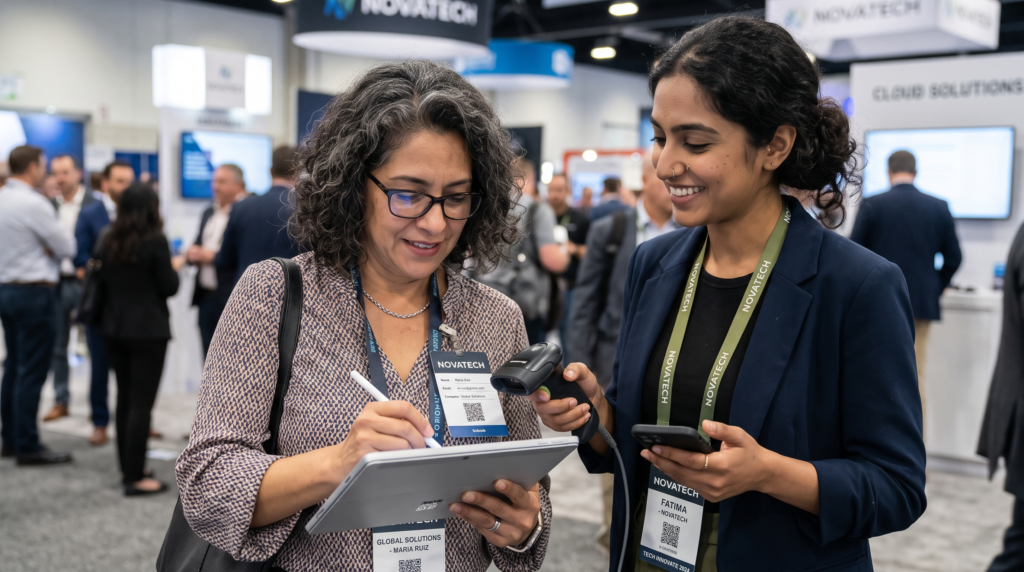
You capture leads at a trade show by making booth lead capture fast, digital, and tied to a reason to engage. Use badge scanning for speed, a short digital form for intent, and demos, experiences, and giveaways to start the conversations worth capturing.
Most Canadian show organizers offer official badge or QR scanning. It is the fastest way to log a contact, so use it as your baseline. However, pair it with a quick note on need and timeline, because a scan alone is thin.
A tablet form of three or four fields captures the context a badge cannot. Keep it short, make it mobile-first, and push every entry straight into your CRM so no lead is retyped later.
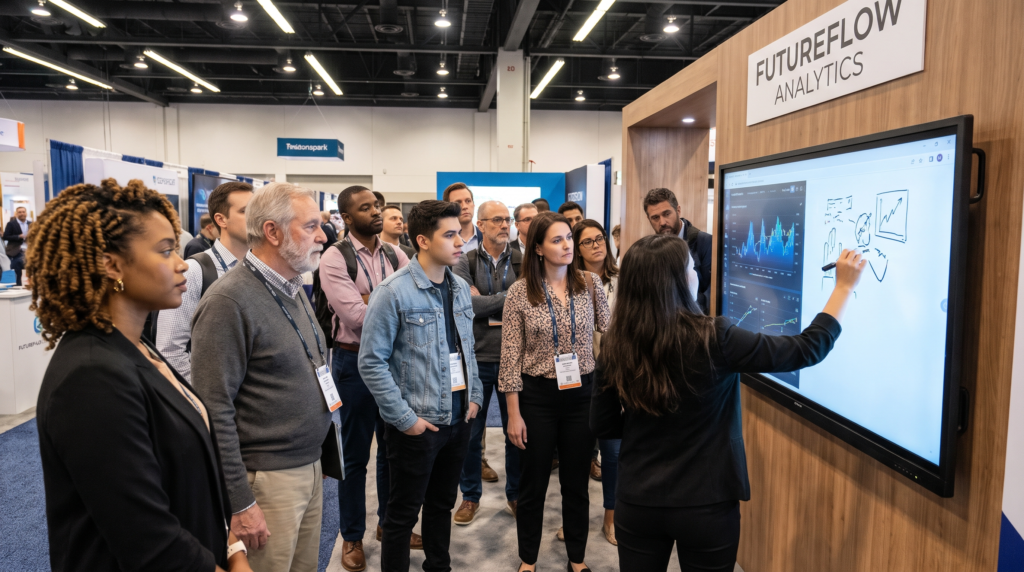
A demo gives staff a natural reason to talk and a prospect a reason to stay. Build the demo around one clear outcome, then capture the lead at the moment of interest, not as an afterthought.
Games, spin-to-win, VR, and sampling pull people in and buy time to qualify. Thoughtful trade show booth design makes these experiences flow and keeps capture built into the journey.
Giveaways work only when they filter for fit. Gate a desirable prize behind a quick qualifying question so you attract buyers, not swag collectors. That one change lifts lead quality dramatically.
A realistic target is 50 to 100 qualified leads per day for a well-run 10×10 to 10×20 booth, though the right number depends on show size, traffic, and staffing. Judge performance by qualified leads and cost per lead, not raw badge scans.
Use the table below as a planning guide, then set your own targets from last year’s data. The aim is steady improvement on quality, not a vanity count.
| Metric | Typical benchmark | How to improve |
|---|---|---|
| Qualified leads per day (10×10 to 10×20) | 50 to 100 | Add trained staff and a reason to engage |
| Scan-to-qualified rate | 30 to 50 percent | Ask one qualifying question at capture |
| Lead-to-meeting rate | 10 to 20 percent | Follow up within 24 to 48 hours |
| Cost per qualified lead | Varies by show | Lower booth cost per lead by capturing more intent |
| Follow-up completion | Aim for 100 percent | Automate same-day CRM handoff |
The fastest gains come from staffing and speed, not more giveaways. Brief the team on targets each morning, capture intent at every scan, and route leads to sales before the show closes for the day.
Train booth staff with three simple tools: a short opening line, a set of qualifying questions, and a BANT-style scorecard. With those, anyone on the team can turn a hello into a qualified, well-documented lead.
Replace “Can I help you?” with an open question tied to the demo, such as “What brought you to the show today?” Open questions invite a real answer and give staff something to qualify against.
Teach three quick questions: what problem are they solving, when do they need it, and who else decides. The answers reveal fit in under a minute and tell sales exactly how to follow up.
Capture Budget, Authority, Need, and Timeline as simple tags on the digital form. A light BANT scorecard turns gut feel into a sortable field, so hot leads rise to the top automatically after the show.
A strong plan runs in six steps, from goals to follow-up. Set the plan before you book the booth, because every later decision should serve the lead and revenue targets you choose first.
Most of your result is decided before the doors open. Set targets, warm up your list, and brief the team so nobody improvises on the floor.
During the show, work the plan and watch the numbers. A quick midday check against your targets lets you adjust staffing and messaging while the leads are still there to win.
You convert trade show leads by following up fast, segmenting by intent, and nurturing the rest. The event ends, but the pipeline only forms if someone acts within days while your brand is still memorable.
Reach hot leads within 24 to 48 hours, ideally the same day for the hottest ones. A fast, specific message that references the booth conversation converts far better than a generic blast a week later.
Split leads into hot, warm, and cold using your BANT tags. Then send each group the right next step, whether that is a meeting request, a case study, or a newsletter. Relevance lifts reply rates sharply.
Most leads are not ready to buy today, and that is fine. Add them to a nurture sequence so your brand stays present until their timeline arrives, then hand them to sales when they re-engage.
Measure trade show ROI with two simple formulas: cost per lead and return on investment. Together they tell you whether a show earned its place in your budget and where to invest more next year.
Cost per lead equals total show cost divided by qualified leads. Include booth space, build, travel, staffing, and giveaways. Tracking this number across shows reveals which events deliver efficient booth lead capture.
ROI equals pipeline or revenue generated minus total cost, divided by total cost. Because deals close after the show, tag every lead to its source so you can credit the event months later. That attribution is what turns a cost line into a proven channel.
Canada’s biggest trade show and convention markets are Toronto, Mississauga, Montreal, Vancouver, and Calgary. Each hosts major sector shows, so choose cities by where your buyers already gather rather than by convenience alone.
Toronto and Mississauga anchor the country’s largest exhibition market, with major convention centres and a dense B2B audience. Statistics Canada counts more than 6.4 million people in the Greater Toronto Area, which makes it the richest ground for exhibition lead generation in Canada.
Montreal, Vancouver, and Calgary round out the national circuit, each strong in different sectors from tech and tourism to energy and manufacturing. A multilingual team helps you capture leads confidently in Quebec and across diverse audiences in the West.
Brand Guruz is a Toronto-based experiential marketing agency that staffs, runs, and measures trade show lead generation for exhibitors across Canada. We bring trained booth staff, a ready lead-capture setup, and multicultural, bilingual teams so every conversation is captured and qualified.
Our brand ambassadors are briefed on your offer, your qualifying questions, and your targets. We pair them with digital booth lead capture that syncs to your CRM, so your sales team gets clean, same-day leads instead of a shoebox of cards.
Because Canadian audiences are diverse, bilingual and multicultural staffing widens the leads you can win. See how we compare among the best experiential marketing agencies in Canada, then talk to Brand Guruz about your next show.
Trade show lead generation is the process of attracting booth visitors, capturing their contact details and buying intent, and qualifying them for follow-up. It turns face-to-face attention at an exhibition into trackable, revenue-ready leads, rather than a stack of unqualified business cards you never action.
A well-run 10×10 to 10×20 booth can generate roughly 50 to 100 qualified leads per day, though it depends on show size, traffic, and staffing. Measure qualified leads and cost per lead rather than raw badge scans, since quality predicts pipeline far better than volume.
Capture leads with fast digital tools: badge or QR scanning for speed and a short tablet form for intent, synced straight to your CRM. Pair capture with demos, interactive experiences, and well-gated giveaways so staff have a natural reason to start and record qualified conversations.
Follow up within 24 to 48 hours, and the same day for your hottest leads. Interest fades quickly after a show, so a fast, specific message that references the booth conversation converts far better than a generic email sent a week or more later.
Cost per lead equals your total show cost divided by qualified leads, including booth space, build, travel, staffing, and giveaways. Track it across every event to see which shows deliver efficient booth lead capture, then shift budget toward the ones with the lowest cost per qualified lead.
Yes, for most exhibitors trained booth staff pay for themselves by lifting both lead quantity and quality. Professional ambassadors qualify on the spot, capture clean data, and work the floor in multiple languages, which is often the difference between a busy booth and a profitable one.

Ready to stop leaving leads on the show floor? Brand Guruz designs the booth experience, staffs it with trained ambassadors, and captures every qualified lead so your sales team can convert them.
Tell us about your next show and your lead targets, and we will build the trade show lead generation program to hit them. To start, book a quick call through our contact page.