The Group Chat Economy: A Canadian Guide to WhatsApp Marketing in Multicultural Communities

WhatsApp marketing in multicultural Canada is the most commercially significant digital channel most brands have never built a strategy for. Specifically, Statistics Canada’s 2021 Census confirms that South Asian, Caribbean, Filipino, and Arab Canadians collectively represent millions of GTA residents. These communities use WhatsApp as their primary peer communication and recommendation platform — not Instagram, not Facebook, not email.

The distinction matters because WhatsApp is not a broadcast channel. Specifically, a WhatsApp group chat is a closed trust network. A recommendation from a trusted community member inside a 200-person Punjabi family or neighbourhood group carries a credibility that no paid media placement can replicate. At its core, WhatsApp marketing in multicultural Canada is an earned trust strategy — not a media buying strategy.

This guide covers which communities use WhatsApp, how the group chat recommendation economy works, and what brands can do to build legitimate WhatsApp presence. WhatsApp marketing in multicultural Canada requires a different playbook than any other channel — and the mistakes that destroy community trust are predictable. For the community profiles that underpin this guide, see our South Asian consumer Canada guide and Arab Canadian consumer guide. The 2026 multicultural marketing calendar is in our Canadian multicultural events calendar.

Closed trust network

WhatsApp group chats are not public broadcast channels; recommendations shared within them carry peer-to-peer credibility that paid advertising cannot replicate

Four communities

South Asian (Punjabi, Gujarati, Tamil, Bengali), Caribbean, Filipino, and Arab Canadian communities are the primary WhatsApp-dominant multicultural audiences in the GTA

Different platforms

 Chinese Canadian consumers primarily use WeChat; Korean Canadian consumers primarily use KakaoTalk; conflating these platforms signals cultural unfamiliarity to all three communities

Why WhatsApp is the most important multicultural marketing channel in Canada most brands ignore

Most digital marketing in Canada targets platforms brands can buy their way onto. Specifically, paid social, display advertising, and influencer campaigns all offer measurable impressions, CPMs, and conversion tracking. WhatsApp marketing in multicultural Canada offers none of these entry points directly — and that is precisely why brands underutilize and undervalue it.

The peer recommendation inside a WhatsApp group is worth more per impression than almost any paid media format. Specifically, when a trusted South Asian community member — a relative, a neighbour, a gurdwara community member — recommends a product or service inside a family or community WhatsApp group, every recipient processes that recommendation through the filter of existing trust. Google Canada research confirms that multicultural consumers over-index dramatically on peer recommendations for major purchase decisions.

Additionally, WhatsApp marketing in multicultural Canada is not a single strategy. Specifically, different communities use WhatsApp differently. Punjabi community WhatsApp groups in Brampton cover everything from local event invitations to political commentary to product deals shared by trusted members. Gujarati WhatsApp groups in Mississauga tend toward business networks and family communications. Tamil WhatsApp groups carry both cultural content and peer advice on services. Arab Canadian WhatsApp groups in Mississauga are dense family and social networks.

Furthermore, the platform distinction is critical and widely misunderstood. Specifically, WhatsApp is the dominant peer platform for South Asian, Caribbean, Filipino, and Arab Canadian communities. WeChat dominates among Mainland Chinese Canadian communities. KakaoTalk dominates among Korean Canadian communities. A brand that builds a WhatsApp strategy assuming it reaches Chinese Canadian consumers will be disappointed. Building a WeChat strategy for South Asian communities misses the target audience entirely.

Which communities use WhatsApp for multicultural marketing and consumer decisions in Canada

Punjabi Canadian communities in Brampton and Mississauga are among the most WhatsApp-active multicultural populations in the GTA. Specifically, gurdwara committees, kabbadi teams, cultural associations, and extended family networks all maintain active WhatsApp groups. These groups are trusted channels where event announcements, service recommendations, and product reviews spread rapidly. A positive mention in a trusted Punjabi community WhatsApp group reaches dozens or hundreds of community members simultaneously.

Gujarati Canadian communities in Mississauga also organize through WhatsApp in similar ways. Specifically, business networks, cultural association committees, and family groups maintain active WhatsApp communication. Gujarati business WhatsApp groups carry peer reviews of professional services — accountants, lawyers, real estate agents, and insurance brokers all earn or lose business through recommendations in these groups.

Caribbean Canadian communities in Scarborough use WhatsApp for community coordination and peer sharing. Specifically, church WhatsApp groups, community event coordination groups, and neighbourhood networks are all active in Scarborough’s Jamaican, Trinidadian, and Barbadian Canadian communities. Filipino Canadian communities in Scarborough and Mississauga use WhatsApp alongside Viber — both platforms carry active community group chats.

Arab Canadian communities in Mississauga and North York maintain dense family and social WhatsApp networks. Specifically, Lebanese, Egyptian, and Syrian Canadian extended families use WhatsApp as their primary family communication tool. Restaurant recommendations, service referrals, and product recommendations spread through these family groups at high velocity.

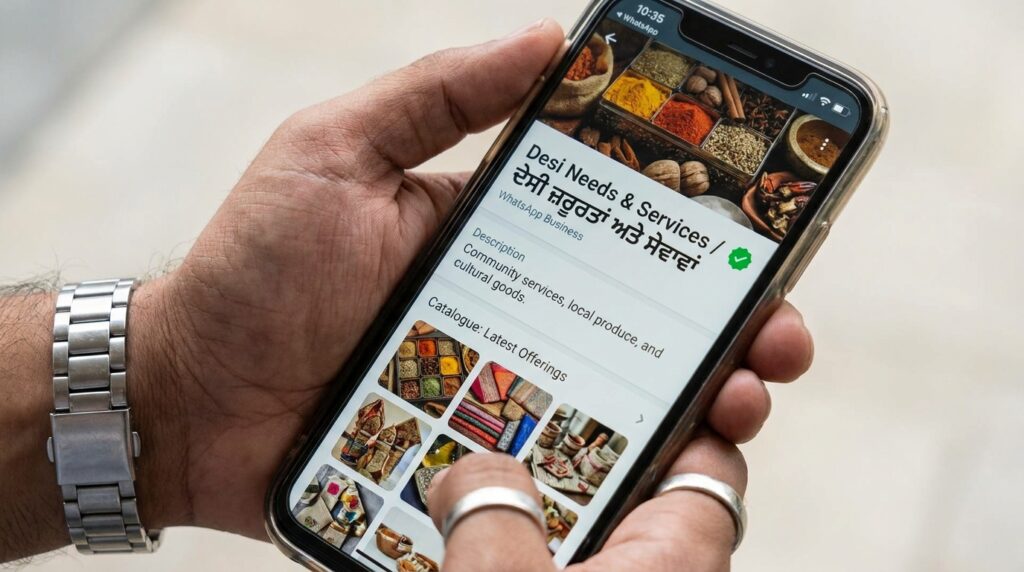
WhatsApp marketing multicultural Canada 2026: a close-up of a WhatsApp Business profile on a phone screen for a South Asian community business, showing a green verification badge and bilingual Punjabi and English content.
WhatsApp Business allows community-facing brands to create verified business profiles with bilingual content, catalogue features, and direct messaging. A South Asian business with a fully built WhatsApp Business profile — in Punjabi and English — reaches community members in the channel they actually check.

How WhatsApp marketing reaches multicultural communities in Canada: the mechanics

WhatsApp marketing in multicultural Canada operates through four distinct mechanisms — each with different brand entry points and trust dynamics. Specifically, organic peer recommendation, WhatsApp Business profiles, WhatsApp Channels, and community ambassador seeding are the four legitimate approaches.

Organic peer recommendation is the most powerful and least controllable mechanism. Specifically, a brand earns organic WhatsApp mentions when it delivers an experience — product, service, or community interaction — that a trusted community member wants to share. No brand can purchase this. Brands earn it through genuine product quality, community presence, and cultural authenticity. A brand that shows up genuinely at Vaisakhi, Eid, or Caribana with a memorable activation creates a WhatsApp-shareable moment. Community members photograph it, experience it, and share it organically within their group networks.

WhatsApp Business profiles allow brands and businesses to create verified, professional presences within the WhatsApp ecosystem. Specifically, a WhatsApp Business profile with bilingual Punjabi-English content, a product catalogue, and quick-reply templates gives community members a trusted business contact accessible through the platform they already use. Many community brokers, local South Asian businesses, and multicultural service providers maintain active WhatsApp Business presences.

WhatsApp Channels are a newer feature that allows brands to broadcast content to subscribers. Specifically, channels are one-way — subscribers receive content but cannot reply within the channel. They are useful for brand announcements, deals, and community content. However, channels lack the trust architecture of peer group recommendations. They function more like a newsletter than a community recommendation.


Building a WhatsApp marketing strategy for multicultural communities in Canada

An effective WhatsApp marketing multicultural Canada strategy begins with community ambassador identification. Specifically, within every multicultural community, certain individuals function as natural connectors — people who are trusted members of multiple large WhatsApp groups, whose recommendations carry high authority. Identifying and building genuine relationships with these connectors is the foundation of organic WhatsApp reach.

Ambassador programs that recruit community members already active in WhatsApp networks deliver reach that no paid channel can replicate. Specifically, a South Asian community ambassador who is a trusted voice in a gurdwara committee WhatsApp group, two family groups, and a neighbourhood group reaches hundreds of qualified community members through pre-existing trust relationships. This is the fundamental value of in-community brand ambassador strategy for WhatsApp. For the ambassador model, see our multicultural brand ambassador guide and brand ambassador program guide.

Additionally, in-language content for WhatsApp sharing is critical. Specifically, visual content that community members want to forward — Punjabi-language event posters, bilingual promotional graphics, culturally resonant seasonal greetings — travels through WhatsApp group networks organically when brands format them for mobile sharing and cultural appropriateness. Community members share a Diwali greeting in Punjabi from a brand that has earned their trust. The same greeting from a brand with no community presence gets deleted without a second thought.

Furthermore, WhatsApp Business customer service is an underused channel for multicultural consumer retention. Specifically, South Asian and Arab Canadian consumers frequently prefer WhatsApp messaging over phone calls or email for service inquiries. A brand that offers responsive WhatsApp Business customer service earns community goodwill that compounds through peer network recommendations. For the full multicultural marketing framework, see our experiential marketing agency Toronto overview.

What brands get wrong about WhatsApp marketing in multicultural Canada

The most damaging mistake is adding community members to WhatsApp groups without permission. Specifically, adding people to a WhatsApp group without their explicit consent reads as spam to community members — and in close-knit multicultural community networks, it spreads negative brand perception through the same peer networks a brand hoped to reach. This single mistake has cost brands significant community credibility.

The second mistake is treating WhatsApp like Instagram — creating a brand channel and expecting community members to opt in to promotional content. Specifically, WhatsApp marketing in multicultural Canada is an earned-trust strategy, not a content distribution strategy. Brands that attempt to broadcast promotional content through WhatsApp groups without first building community trust achieve neither reach nor credibility.

The third mistake is platform conflation. Specifically, WhatsApp and WeChat serve entirely different communities in the GTA. A South Asian marketing strategy built on WeChat will miss its audience completely. Building a Chinese Canadian marketing strategy on WhatsApp achieves nothing. The Edelman Trust Barometer consistently shows that platform authenticity — reaching communities in the channels they actually use — is a prerequisite for multicultural brand trust.

English-only content is the fourth major mistake. Specifically, Punjabi, Gujarati, Tamil, and Arabic communities conduct their WhatsApp group chats primarily in those languages. An English-language brand message dropped into a Punjabi-language WhatsApp group signals that the brand has not understood its audience. In-language content — at minimum, bilingual content — is the baseline requirement for WhatsApp marketing in multicultural Canada.

How experiential marketing and WhatsApp multicultural marketing in Canada work together

Experiential marketing activations are the most effective generator of organic WhatsApp sharing in multicultural Canada. Specifically, a well-designed brand activation at a Vaisakhi mela, a Diwali community event, or a Caribana fringe gathering creates physical experiences that community members photograph, share, and discuss within their WhatsApp group networks immediately and in the days following the event.

The connection is direct. Specifically, a brand ambassador team from the South Asian community at a Brampton Vaisakhi activation creates a trusted, in-person brand interaction. The community member who received a sample, won a prize, or had a memorable experience at the activation becomes a natural WhatsApp recommender. They share photos, describe the experience, and vouch for the brand within their networks. This organic WhatsApp reach follows from on-ground experiential investment.

Moreover, the reverse is also true. Specifically, community event attendance and activation awareness spreads through WhatsApp before the event even begins. Community members forward event announcements, share activation details, and discuss upcoming celebrations through their group networks. A brand with a visible activation at a confirmed community event becomes part of the pre-event WhatsApp conversation in the community. For the experiential activation model, see our festival brand activation playbook.

Frequently asked questions: WhatsApp marketing in multicultural Canada

Which communities use WhatsApp as their primary peer communication platform in Canada? South Asian Canadian communities — Punjabi, Gujarati, Tamil, and Bengali — are the most WhatsApp-dominant multicultural audiences in the GTA. Caribbean Canadians in Scarborough, Filipino Canadians, and Arab Canadians in Mississauga all use WhatsApp actively. Chinese Canadian consumers primarily use WeChat. Korean Canadian consumers primarily use KakaoTalk.

How does WhatsApp differ from WeChat and KakaoTalk for multicultural marketing? WhatsApp dominates among South Asian, Caribbean, Filipino, and Arab Canadian communities. WeChat dominates among Mainland Chinese Canadian consumers. KakaoTalk dominates among Korean Canadian consumers. Treating all three as interchangeable means missing all three audiences.

Can brands advertise on WhatsApp? Not directly within WhatsApp group chats — where peer recommendations actually happen. WhatsApp Channels allow brands to broadcast content to subscribers, but they function more like newsletters than community networks. Meta does allow WhatsApp-linked advertising through Facebook and Instagram. WhatsApp marketing in multicultural Canada is fundamentally an earned-trust strategy.

What is WhatsApp Business and why does it matter for multicultural marketing? The WhatsApp Business platform allows brands to create verified professional profiles accessible within the app. A bilingual profile in Punjabi and English — with a product catalogue and responsive messaging — gives community members a trusted brand contact in the platform they already use. Community-facing brokers and service providers in multicultural communities already maintain active WhatsApp Business presences.

How does experiential marketing connect to WhatsApp marketing in multicultural Canada? On-ground experiential activations at multicultural community events generate WhatsApp-shareable moments that drive organic peer recommendation. A memorable brand interaction at a festival activation gets photographed and shared within WhatsApp group networks. Experiential activation is the most reliable generator of organic WhatsApp reach.

Build your WhatsApp marketing strategy for multicultural Canada with Brand Guruz

Talk to Brand Guruz about building a WhatsApp marketing strategy for multicultural Canada. We cover in-community ambassador programs, bilingual content creation, WhatsApp Business setup, and the experiential activations that generate organic group-chat sharing — across South Asian, Caribbean, Filipino, and Arab Canadian communities in the GTA.

Author