Real Estate Marketing Toronto: The 2026 Experiential Playbook

GTA home sales in 2025 came in at approximately 62,433 — the lowest count in 25 years, per TRREB. New listings rose about 10% year-over-year, inventory climbed, and the pre-construction condo model that fuelled the previous cycle hit a historic wall. Indeed, developers who once sold out launches in hours now sit on inventory for months. Consequently, real estate marketing in Toronto in 2026 is working harder than it has in a generation. 

Digital advertising alone — Google Ads, social retargeting, programmatic display — no longer converts at 2020-2022 rates. Specifically, the fundamentals of the market have shifted. The projects that move units today differentiate on experience. Immersive sales centre events, multicultural outreach, VIP broker nights, and grand opening activations give prospective buyers a reason to show up and commit.

Specifically, experiential marketing is now the essential tool in the real estate developer’s toolkit. Indeed, it is the channel that separates projects that sell from those that stall.

Brand Guruz plans and executes experiential marketing programs for brands across Ontario’s entertainment, real estate, and community sectors. Our multicultural activation capability is directly applicable to the GTA developer and brokerage market.

62,433

GTA home sales in 2025 — the lowest in approximately 25 years (TRREB)

10%+

increase in new listings year-over-year in 2025 — buyers now have more choice than at any point since 2012

6

of the top 10 GTA real estate markets by volume are in communities with significant South Asian, East Asian, or Caribbean populations

Why real estate marketing in Toronto demands more in 2026

Overall, the 2020-2022 Toronto real estate cycle was unusual by any standard. Demand outpaced supply, making sophisticated marketing largely irrelevant. Buyers competed aggressively for almost anything listed, and pre-construction projects sold out on reputation alone. Consequently, many developers built marketing strategies for that market, not the one they face now.

The 2026 market is fundamentally different. The pre-construction condo model has hit a wall, with sales volumes dropping to levels not seen since the 1990s. Furthermore, projects are being delayed, and developers are becoming increasingly selective about what they launch. Oversupply of small units, elevated carrying costs, and a shift in buyer psychology from speculative to end-user-driven have changed the competitive environment entirely.

Indeed, in a market this competitive, brand differentiation is not a luxury — it is the deciding factor. A development in Brampton competes with other nearby projects, resale inventory, purpose-built rentals, and the simple decision to wait.

Moreover, the multicultural composition of the GTA’s buyer pool makes this more complex, not less. A generic marketing campaign fails the South Asian families comparing three Brampton projects. It fails the Chinese-Canadian investors reconsidering whether this is the moment to re-enter the market. Notably, it also fails the Caribbean-Canadian first-time buyers in Scarborough who are pre-approved and ready to move if the right project shows up.

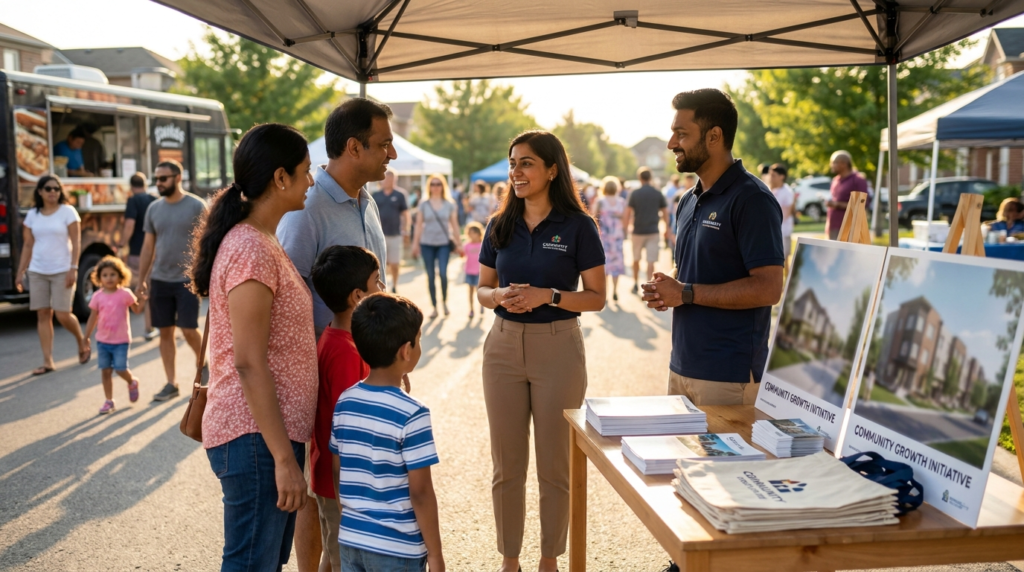
Real estate marketing Toronto multicultural community event with developer brand ambassadors engaging South Asian Canadian families at a GTA neighbourhood activation.

The multicultural buyer in GTA real estate

The GTA’s homebuying population is more culturally diverse than most real estate marketing programs reflect. South Asian communities — concentrated in Brampton, Mississauga, and Markham — are among the largest and most active buyer segments in the region. Chinese-Canadian communities in Richmond Hill, Markham, and North York have historically driven significant condo and townhome purchasing. Tamil-Canadian communities in Scarborough make up a large and growing first-home-buyer segment. Caribbean-Canadian communities across East Toronto and North York bring substantial purchasing power that mainstream real estate marketing consistently underserves.

Specifically, what these communities share is this: they respond to in-community marketing at rates that digital advertising rarely matches. A developer who sponsors a cultural event in Brampton and fields Punjabi-speaking sales representatives builds buyer trust that no Google Ads campaign generates. Furthermore, these communities share recommendations through tight social networks. A well-received community event converts to referrals across extended family networks.

The implication for real estate marketing in Toronto is direct: reaching multicultural buyers demands a community-first strategy. Specifically, reaching multicultural buyers requires market-specific event programming, not just translated versions of English-language campaigns. It requires brand ambassador teams that reflect the community being targeted. Off-the-shelf staffing agencies cannot deliver this. Additionally, it requires timing that matches how each community engages with major financial decisions — through community gatherings, cultural events, and trusted peer networks.

For the audience intelligence that underpins community-specific real estate outreach, see our multicultural market research guide.

Real estate experiential marketing formats that work in 2026

Experiential marketing in real estate operates across several distinct formats, each suited to a different point in the buyer’s journey.

VIP broker and agent nights are the opening move for most significant GTA launches. Generally, these events introduce the project to the broker community before public registration opens. They create early momentum and give sales teams intelligence on which unit configurations are generating the most interest. Indeed, a well-executed broker night functions as market research as much as a sales event.

Community registration events target the end-user buyer pool — the South Asian families, the Chinese-Canadian downsizers, the Caribbean-Canadian first-time buyers — before they have committed to a competing project. Specifically, community registration events work best when held in the target community — not in a downtown sales centre. A registration event in Brampton with culturally fluent staff reaches buyers in their own context. Generally, it generates a qualitatively different level of interest than a generic email funnel.

Grand opening and launch activations mark the transition from registration to sales. Indeed, these are the highest-stakes moments in a real estate campaign. They set the project’s brand tone and convert registration-phase interest into signed agreements.

Ongoing sales centre activations sustain momentum across a sales program that may run for months or years. Moreover, these include seasonal events, milestone celebrations, and community programming that keeps the project present in buyers’ lives between site visits.

For the full activation production and staffing capability that applies across all four of these formats, see our brand ambassador program guide.

Connecting real estate experiential marketing to the experiential ecosystem

The most sophisticated real estate marketing programs in the GTA do not treat experiential events as standalone activations. Instead, they integrate sales centre programming with the broader Toronto festival calendar — creating multiple brand touchpoints across the year.

A developer targeting South Asian buyers in Brampton can be present at Carassauga, at Diwali community events, and at cultural festivals across Peel Region. BILD, the Building Industry and Land Development Association tracks launch activity across these GTA submarkets. It is a useful lens for understanding where buyer demand is concentrating. A project targeting Chinese-Canadian buyers in Markham can sponsor community events across York Region’s Chinese-Canadian business associations, cultural centres, and family networks.

Ultimately, this multi-touchpoint approach means that when the sales centre opens, part of the target audience already has a relationship with the brand. Consequently, the sales centre activation becomes a confirmation of that relationship, not a cold introduction. Consequently, event-aware buyers convert to signed purchasers at rates that consistently outperform buyers who first encounter the project through a digital ad. For the measurement framework that captures this performance gap, see our experiential marketing ROI guide.

How Brand Guruz approaches real estate marketing in Toronto

Brand Guruz brings multicultural experiential marketing capability to GTA real estate developers and brokerages. Specifically, we offer the community activation depth, culturally fluent ambassador sourcing, and event production capacity that moves units in communities generic marketing consistently misses.

Furthermore, our team’s presence across Caribana, WorldFest, and Carassauga means our brand ambassadors are not meeting GTA cultural communities for the first time. Ultimately, they bring existing community relationships that translate to credibility on behalf of the developer brands they represent.

Additionally, Brand Guruz manages the full event production chain — venue coordination, branded hospitality, registration flow design, and on-site management. Developer marketing teams can focus on the sales programme rather than the event logistics. For a broader view of our experiential marketing capability in Toronto, see our experiential marketing company page.

Frequently asked questions about real estate marketing in Toronto

What types of experiential events work best for GTA real estate launches? The most effective launch sequence combines a VIP broker night to build agent momentum, a community registration event targeting the primary buyer demographic, and a grand opening activation marking the public sales launch. Additionally, ongoing sales centre programming — seasonal events, milestone celebrations, and cultural community programming — sustains buyer interest across longer sales programmes.

How does multicultural marketing differ from standard GTA real estate marketing? Standard real estate marketing uses English-language digital advertising and generic sales centre design. Multicultural real estate marketing targets specific community buyer segments — South Asian, Chinese-Canadian, Tamil-Canadian, Caribbean-Canadian. It deploys community events in their own neighbourhoods, ambassador teams that reflect their community, and culturally resonant programming.

When should a developer begin planning experiential marketing for a Toronto condo or new home launch? Community registration events should begin three to six months before the official sales launch. VIP broker events typically require six to eight weeks of planning. Grand opening activations for significant projects need eight to twelve weeks of production time. Developers who begin marketing planning concurrently with project planning consistently generate stronger pre-registration lists and shorter sales programmes.

What does real estate experiential marketing cost in the GTA? A community registration event in a target neighbourhood runs from $8,000–$20,000. A grand opening activation for a significant Toronto launch ranges from $25,000–$75,000+. VIP broker nights are the most cost-efficient format, running $5,000–$15,000. These figures exclude digital advertising, PR, and print marketing costs.

Does Brand Guruz work with real estate developers and brokerages in the GTA? Yes. Brand Guruz works with real estate developers, master-planned community teams, and brokerages across the GTA. Specifically, our programs range from pre-launch community outreach and multicultural buyer activation to sales centre events and grand opening productions.


Ready to plan your real estate marketing program in Toronto?

Talk to Brand Guruz about experiential marketing for your GTA real estate project — multicultural buyer outreach, sales centre activations, and grand opening events. See also our festival brand activation playbook for how community event presence builds buyer awareness across the year.

Author