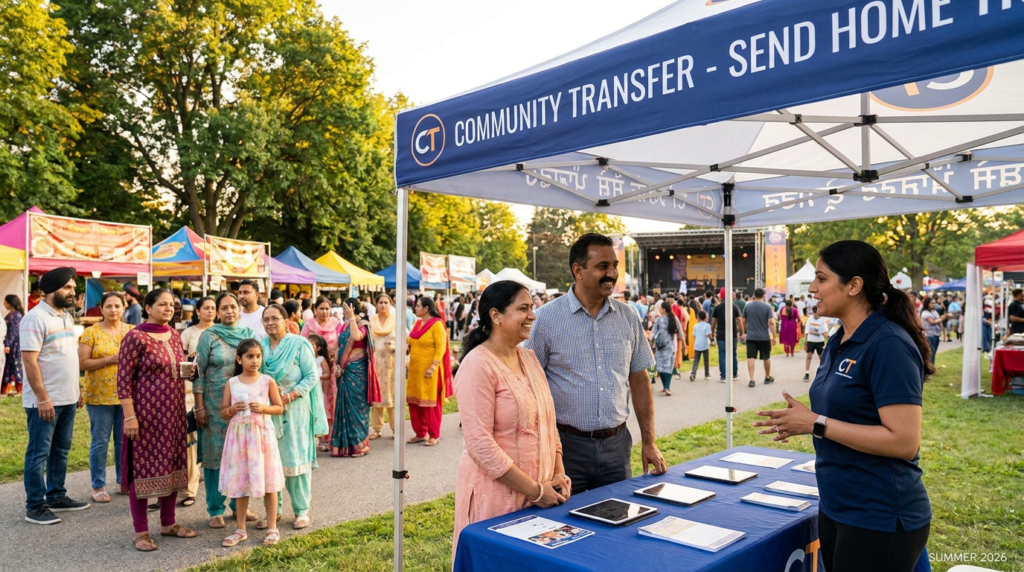
Money Transfer Marketing in Canada: The Diaspora Trust Advantage

Money transfer marketing in Canada sits inside one of the most structurally resilient financial markets in the world. Specifically, the flows that define it are obligation-driven, not discretionary. Canada’s diaspora communities sent $4.5 billion CAD abroad in Q2 2025 alone — during an economic contraction. Indeed, the money kept moving because remittances are not discretionary spending. They are family obligations — they flow regardless of market conditions.

Overall, the three largest remittance destinations from Canada are India, the Philippines, and China. According to World Bank data, India received $129 billion in remittances in 2024, the Philippines $40 billion, and China $48 billion. Consequently, the operators competing for Canadian diaspora senders — Western Union, Wise, Remitly, MoneyGram, and WorldRemit — are fighting for a resilient market.

Specifically, money transfer marketing in Canada works differently from most financial services marketing. The decision to switch providers does not rest on advertising. Community trust drives it — trust built in person, in language, at the gatherings where diaspora communities actually come together.

Brand Guruz plans and executes multicultural experiential marketing programs across Ontario’s South Asian, Filipino, East Asian, and Caribbean communities. These are precisely the communities that define Canada’s remittance corridors.

$4.5B CAD

 remitted abroad by Canadians in Q2 2025 alone — during an economic contraction (RemitBee 2026)

$905 billion

in global remittances in 2024 — larger than Foreign Direct Investment worldwide (World Bank)

India, Philippines, China

Canada’s top three remittance destinations, representing billions in annual outflows

Canada's remittance market in 2026 — scale, corridors, and competition

Canada’s remittance outflows have proved remarkably resilient. Canadians sent $4.5 billion CAD abroad in Q2 2025 alone — while the economy contracted and GDP fell. Indeed, the structural driver is simple: diaspora communities have family obligations that do not pause for economic cycles.

The top corridors from Canada reflect the composition of its immigrant population. Global remittance flows reached $905 billion in 2024 — exceeding Foreign Direct Investment worldwide. India and the Philippines receive the highest volume of Canadian remittances, with China close behind. The Canadian Global Affairs Institute estimates China receives $4 billion from Canada annually, India $2.7 billion, and the Philippines $2 billion. Consequently, the communities driving those flows — Chinese-Canadian, South Asian-Canadian, and Filipino-Canadian — are the primary audience for money transfer operators.

Overall, competition among operators is fierce. Western Union remains the most widely used brand by volume from Canada, according to Statista. However, digital challengers like Wise, Remitly, and WorldRemit have been taking share through lower fees and app-first experiences. The Canada–Jamaica corridor averaged a 5.98% fee in Q1 2025 — nearly double the 3% global target. That creates real switching pressure in Canada’s Caribbean-Canadian communities.

Furthermore, the immigration policy changes of 2025 have reduced the inflow of temporary workers — those who remit most frequently. Specifically, operators can no longer rely on newcomer volume to grow. Instead, they must compete more aggressively for existing diaspora senders. Indeed, that competition plays out in communities, not in algorithms.

Money Transfer Marketing Canada South Asian Community Event 2026
The Canada–India remittance corridor moves approximately $2.7 billion annually. The South Asian communities in Brampton, Mississauga, and Markham that drive those flows make carrier decisions through trusted community networks — not through digital retargeting.

Why diaspora communities make remittance decisions differently

The remittance decision is not a commodity purchase. A South Asian-Canadian family in Brampton sending $500 to elderly parents in Punjab is not comparison-shopping the way they compare utility providers. They choose who to trust with family money — and that trust grows in community, not through a banner ad.

Overall, three dynamics define how money transfer decisions are made in Canada’s diaspora communities. Each one points to the same conclusion: community presence is the primary marketing lever.

Community recommendation networks move faster than digital. Specifically, a positive experience with a money transfer provider spreads through diaspora social networks — WhatsApp groups, church communities, and family networks — at a speed no paid media campaign matches. Conversely, a bad experience spreads even faster.

First-time use is the highest-value moment. A new arrival from the Philippines, India, or Jamaica typically chooses a money transfer service within their first thirty days in Canada. Moreover, the provider they choose first often retains them for months or years. The switching cost is social and habitual, not financial. Reaching newcomers in their first weeks through settlement centre partnerships is the highest-ROI moment in the money transfer customer lifecycle.

Price matters second, trust matters first. Research on remittance behaviour consistently shows that senders accept higher fees from providers they trust over lower fees from providers they do not. Notably, Western Union has maintained market dominance partly through decades of community presence — physical locations, in-language staff, and event sponsorships. Newer operators competing on price alone face a trust deficit that digital advertising cannot close.

For the audience intelligence framework behind community-specific activation in these diaspora segments, see our multicultural market research guide.

What money transfer experiential marketing looks like in practice

Effective money transfer marketing in Canada targets diaspora communities across four event formats. Each suits a different community and sender relationship stage.

Filipino community events — church-based gatherings, Filipino community centre events, community association functions, and cultural celebrations across the GTA — reach Canada’s Filipino-Canadian community in the environments where financial decisions are discussed and recommended. Specifically, a Tagalog-speaking brand ambassador at a Filipino community gathering creates a context that an app download prompt cannot match.

South Asian community festivals — Diwali events, Carassauga, temple-adjacent celebrations, and cultural events across Brampton and Mississauga — reach the communities driving the Canada–India, Canada–Pakistan, and Canada–Sri Lanka corridors. Furthermore, these events let money transfer brands position against high-fee bank incumbents that many South Asian-Canadian families still use out of inertia.

Caribbean community activations — Caribana, community association events, and cultural gatherings across East Toronto and North York — reach a segment where the 5.98% Canada–Jamaica corridor fee creates real dissatisfaction and genuine switching intent. Generally, a well-positioned Caribana activation with clear fee comparison messaging and an in-community ambassador team converts at rates no digital campaign approaches.

Settlement centre and newcomer event partnerships — placement at newcomer orientation events, language school communities, and settlement agency programming — reach the first-thirty-day window where the first provider relationship is established. Additionally, these partnerships position the money transfer brand as a genuine community resource.

For the full activation and staffing model that applies across all four formats, see our brand ambassador program guide.

Connecting money transfer marketing to the broader festival ecosystem

Generally, the most sophisticated money transfer marketing programs in Canada do not treat community events as isolated activations. Instead, they build brand presence across the multicultural community event calendar — creating multiple touchpoints across the year.

A money transfer operator targeting Filipino-Canadian senders can maintain brand presence year-round — Sinulog celebrations, Heritage Month events, and church-based gatherings. Specifically, that sustained presence builds brand familiarity that makes the app download feel like choosing a trusted friend.

Similarly, operators targeting South Asian-Canadian senders can integrate into the full Peel Region and York Region multicultural festival calendar. This builds brand recognition in Brampton, Mississauga, and Markham before any individual sender is in the market.

Ultimately, this sustained community presence separates money transfer marketing in Canada that compounds from campaigns that spike and fade. For the ROI framework behind this approach, see our experiential marketing ROI guide.

How Brand Guruz supports money transfer marketing in Canada

Brand Guruz brings the community activation depth that money transfer operators need to compete in Canada’s diaspora market. Specifically, our brand ambassador teams are not meeting these communities for the first time at an activation. These are community relationships built through our work at Caribana, WorldFest, and Carassauga. They translate directly to credibility for the brands our team represents.

Furthermore, our in-language capability covers Tagalog, Punjabi, Hindi, Tamil, Cantonese, and Mandarin — the dominant languages across Canada’s top remittance corridors. Specifically, money transfer marketing in Canada cannot rely on English-language ambassadors in communities where the financial conversation happens in another language.

Additionally, Brand Guruz coordinates the full event chain — permit applications, branded production, ambassador briefing, and on-site management. For the full experiential capability behind our community activation work, see our experiential marketing company page.

Frequently asked questions about money transfer marketing in Canada

Why does experiential marketing matter for money transfer companies in Canada? Money transfer decisions in diaspora communities are trust-based. Community events and in-language ambassador programs reach customers at the moment trust is being formed. No digital channel replicates that credibility. For operators competing in Canada’s diaspora corridors, community presence is the primary differentiator.

Which diaspora communities drive Canada’s remittance corridors? Specifically, Canada’s top remittance corridors run to India, the Philippines, and China — driven by South Asian-Canadian, Filipino-Canadian, and Chinese-Canadian communities concentrated in the GTA. The Canada–Caribbean corridor, primarily to Jamaica, Trinidad, and Barbados, is driven by Caribbean-Canadian communities across East Toronto and North York. Each corridor needs community-specific marketing: different languages, different event calendars, and different trusted messenger networks.

What in-language capabilities does money transfer community marketing require? Effective money transfer marketing in Canada requires Tagalog for Filipino-Canadian outreach, Punjabi and Hindi for South Asian-Canadian communities, and Cantonese and Mandarin for Chinese-Canadian communities. Generic English-language staffing fails across all segments. Cultural fluency — understanding decision-making patterns and event calendar significance — matters as much as language ability.

When should a money transfer operator invest in community event marketing? The highest-value window is newcomer arrival — the first thirty days in Canada, when the first provider relationship is established. Beyond newcomer acquisition, ongoing community event presence supports retention and word-of-mouth referral. Operators that treat community events as a year-round channel build compounding brand recognition. This reduces churn and drives referrals through diaspora social networks.

Does Brand Guruz work with money transfer and fintech brands on multicultural marketing? Yes. Brand Guruz works with brands across Ontario’s financial services, telecommunications, real estate, and entertainment sectors on multicultural experiential marketing programs. Our money transfer capability covers in-language ambassador staffing and community activations across Filipino, South Asian, East Asian, and Caribbean communities.


Ready to build your money transfer marketing program in Canada?

Talk to Brand Guruz about experiential marketing for your Canadian money transfer or fintech brand — in-language community activations, diaspora festival presence, newcomer acquisition programs, and multicultural brand ambassador staffing. See also our festival brand activation playbook for how community event presence builds the trust that drives first-time use.

Author