Experiential Marketing Trends in 2026: What Canadian Brands Need to Know

Experiential marketing trends in 2026 are moving in one consistent direction: away from one-off campaign bursts and toward sustained community presence. Specifically, the data is decisive. Experiential marketing now captures 38% of the entire marketing services industry, surpassing digital advertising for the first time. Globally, spend is projected to exceed $120 billion this year. Moreover, 74% of Fortune 1000 marketers expect to increase experiential budgets in 2026. Indeed, 9 out of 10 now describe brand experiences as essential to their overall strategy.

For Canadian brands, these global shifts have a specifically multicultural dimension. Consequently, an experiential marketing agency built around the GTA’s multicultural communities is not just riding an industry trend. They are operating at the convergence of every trend reshaping the discipline. Specifically, the seven shifts below define where experiential marketing in Canada is heading and how Brand Guruz is built to activate across all of them.

38%

share of the global marketing services industry now captured by experiential marketing, surpassing digital advertising at 35%

74%

of Fortune 1000 marketers plan to increase experiential marketing spend in 2026

91%

of consumers report more positive brand feelings after attending live brand experiences — and 98% create social content during activations

Why experiential marketing trends in 2026 are moving faster than ever

The pace of change in experiential marketing trends is being driven by three converging forces. First, consumer trust in digital advertising has declined significantly. Specifically, 91% of consumers now say they have more positive feelings about brands after attending live events. This is a clear signal that participation-based experiences are filling the trust gap that passive digital advertising cannot. Second, measurement technology has matured. Consequently, brands can now track the full-funnel impact of experiential campaigns: from event attendance through earned media amplification, community word-of-mouth, and downstream purchasing behaviour. Third, the economic case has become undeniable. Overall, experiential campaigns deliver 3:1 to 5:1 returns on spend — and high-performing activations achieve up to 10:1 ROI. These figures consistently outperform traditional media and digital advertising benchmarks.

Additionally, in Canada specifically, demographic change is accelerating the community-based activation model. Over 26.5% of Canadians identify as part of a visible minority group. The GTA — Canada’s largest and most culturally diverse metropolitan market — has seen over 50% of its residents born outside Canada. Furthermore, each of these communities has its own festival calendar, social trust networks, and cultural purchasing dynamics. Consequently, the experiential marketing agency that can activate authentically within these communities has a structural advantage that media spend alone cannot replicate. For the research framework behind multicultural community insights, see our multicultural market research guide.

Trend 1: Community trust replaces reach as the primary success metric

The most significant experiential marketing trend of 2026 is the shift in how success is measured. Specifically, brands are moving away from impression counts and attendance figures toward community trust depth — the degree to which an activation has built credibility within a community’s social networks.

This shift matters most in Canada’s multicultural markets. Specifically, GTA’s South Asian, Caribbean, East Asian, and Filipino communities make purchasing decisions through dense social trust networks where community endorsement carries more weight than media reach. Moreover, the same dynamic drives word-of-mouth at a speed and depth that no impression-based media model can match. A successful brand activation at a Brampton community event does not end when the tent comes down. Instead, it generates referral conversations for weeks through WhatsApp groups, cultural association networks, and extended family social structures.

Furthermore, the data backs this shift globally. Research from Union shows that experiential campaigns generate 3x the word-of-mouth awareness of non-experiential brands. Specifically, 70% of consumers who participate in a brand experience go on to repeat purchases — a conversion rate no digital advertising channel approaches. Consequently, brands that treat community trust as their primary activation metric are building durable competitive advantages, not just campaign impressions.

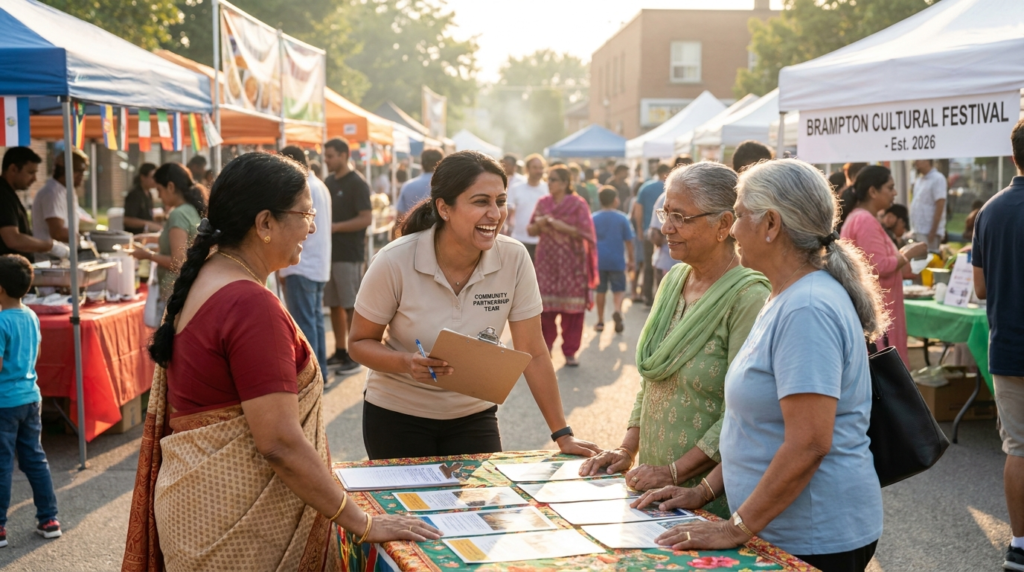
Experiential marketing trends 2026 brand ambassador program in Canada showing in-language brand ambassador engaging multicultural community members at a Canadian cultural festival.
Trend 2 in experiential marketing in 2026: long-term in-language brand ambassador programs are replacing one-off event staffing as the dominant community activation model.

Trend 2: Long-term ambassador programs displace one-off event staffing

The second major experiential marketing trend reshaping Canadian brand activation is the structural shift from one-off event staffing to long-term community ambassador partnerships. Specifically, brands are recognizing that a brand ambassador who appears at a single festival is a vendor. An ambassador who shows up at Caribana, Carassauga, the Diwali GTA activation, and Lunar New Year events across a full year is a community voice.

This shift is being driven by data on engagement quality. Specifically, 62% of creators and ambassadors now prefer long-term partnerships over transactional one-off placements — and brand performance data consistently supports their preference. Long-term ambassador relationships build cumulative community trust that a single event placement cannot replicate. Moreover, in-language capability amplifies this effect dramatically. A Punjabi-speaking ambassador with year-round South Asian community presence is not interchangeable with a one-day event staffer who happens to speak Punjabi. They carry months of community credibility into every brand interaction.

Additionally, the evolving ambassador role in 2026 goes beyond product demonstration. Specifically, brand ambassadors are now expected to act as experience designers — facilitating brand engagement rather than executing task lists. This requires cultural fluency, in-language communication, and genuine community embeddedness. Consequently, the brand ambassador programs that deliver the highest ROI in 2026 are built around trusted community figures, not seasonal staff. For the full in-language ambassador program model, see our brand ambassador program guide.


Trend 3: Multicultural festivals become a core annual budget channel

The third experiential marketing trend redefining how Canadian brands plan their activation calendars is the maturation of multicultural festivals as a primary channel — not a supplementary one. Specifically, brands are treating the multicultural festival circuit the way media buyers treat television — an annual, predictable channel with audience segmentation that no other format provides.

The Canadian multicultural festival calendar is one of the richest in the world. Caribana draws over one million attendees across four days in July. Carassauga brings 90,000 attendees across pavilions representing 70+ cultural communities in Mississauga. WorldFest at Yonge-Dundas Square draws 120,000+ annually. South Asian festivals in Brampton and Mississauga, East Asian Lunar New Year events in Markham, and Filipino Heritage Month activations create a year-round circuit that reaches Canada’s fastest-growing consumer communities.

Furthermore, the activation model at multicultural festivals has evolved beyond brand booth presence. Generally, the brands seeing the highest community engagement are not the ones with the largest activation footprints. They are brands with genuine cultural authenticity — in-language ambassador teams, relevant product sampling, and community partnerships that feel like participation rather than intrusion. For the full festival activation playbook, see our festival brand activation guide. Additionally, for a deep dive into Canada’s largest multicultural festival, see our Carassauga brand activation guide.

Trend 4: AI enhances the activation experience without replacing people

The fourth experiential marketing trend in 2026 is AI’s measured integration into brand activation workflows. It belongs in planning and data capture — not in the community-facing ambassador role.

AI is genuinely transforming the back-end of experiential marketing production. Specifically, AI tools now analyze foot traffic and optimize attendee flow at large activations. They dynamically adjust messaging based on audience demographics, and process data capture into actionable campaign reporting. Additionally, AI-powered influencer matching is reducing campaign planning time and improving audience alignment across multicultural communities.

However, the most significant AI finding for Canadian multicultural brand activations is what AI cannot do. Specifically, the trust transfer that happens in an in-language, in-community brand interaction is structurally human. An AI-powered engagement tool cannot replicate the credibility of a Punjabi-speaking community ambassador at a Brampton gurdwara event. Consequently, the smartest application of AI in experiential marketing is in the planning and measurement layer — not in replacing the community-facing activation. For the specific AI tools Canadian brands should test in their activation workflows, see our AI in experiential marketing guide.

Trend 5: ROI accountability is now the baseline, not the differentiator

The fifth experiential marketing trend reshaping Canadian brand activation is the normalization of rigorous ROI measurement. Specifically, brands no longer accept event attendance and impression counts as activation success metrics. They require full-funnel performance data: lead capture volumes, conversion rates, downstream purchasing behaviour, and media amplification value.

This shift has direct implications for agency selection. Specifically, brands that demand data-driven ROI accountability will choose the agencies that deliver it. Agencies that cannot measure activation outcomes will lose clients regardless of creative quality. Consequently, the measurement infrastructure behind a brand activation is now as important as the activation itself.

For Canadian multicultural activations specifically, ROI measurement requires frameworks that account for community-specific conversion dynamics. Standard digital attribution models do not capture the referral network value of a well-executed multicultural festival activation. Specifically, the full value includes: direct sampling conversions, community word-of-mouth reach, earned media from attendee social amplification, and downstream brand preference shifts. Generally, well-executed multicultural festival activations deliver 3:1 to 5:1 returns on the activation investment — consistent with the global experiential marketing benchmark. For the complete ROI measurement framework, see our experiential marketing ROI guide.

Trend 6: The World Cup shows how experiential marketing trends favour community over sponsorship

The sixth trend confirming the direction of experiential marketing in 2026 is playing out in real time in Toronto. Specifically, the FIFA World Cup 2026 is demonstrating that the brands with the highest activation ROI are not the official tournament sponsors. Toronto hosts six matches through July 2, with the FIFA Fan Festival running through July 19. They are the brands with authentic community presence in Toronto’s multicultural neighbourhoods.

Overall, official FIFA brand protection rules prevent non-sponsors from activating within tournament venues. However, they leave the entire community layer of the city open. Specifically, Koreatown activates for South Korea matches. St. Clair West fills with Argentina and Latin American fans. The Ghanaian Canadian Association is running a fan festival at Downsview Park. Additionally, the Chinese Cultural Centre’s “One City, One Game, Many Cultures” series is filling 600-seat and 1,200-seat venues for every match. Consequently, the brands reaching these communities during the World Cup moment are not doing so through FIFA partnership. They are doing so through exactly the community activation model that defines the most important experiential marketing trend of 2026.

This is the defining insight across all six trends above: community presence compounds. Indeed, brands that have built festival circuit relationships and in-language ambassador networks are not starting from scratch in the World Cup moment. They are activating existing infrastructure. For the full Toronto World Cup activation playbook, see our World Cup brand activation guide.

Frequently asked questions about experiential marketing trends

What are the biggest experiential marketing trends in 2026? Seven trends define experiential marketing in 2026. They span community trust, long-term ambassador programs, multicultural festivals, AI, ROI accountability, mega-event activation, and sustainability. Each reflects a broader shift from campaign bursts toward sustained community presence.

How has multicultural community marketing evolved as an experiential marketing trend in Canada? Multicultural community marketing has moved from a niche specialization to a mainstream brand strategy in Canada. Specifically, the GTA’s South Asian, Caribbean, East Asian, and Filipino communities are now recognized as primary consumer segments by leading brands across financial services, CPG, and retail. The experiential activation model — in-language brand ambassador programs at cultural festivals and community events — has become the primary channel for reaching these communities authentically. Generic advertising targeting broad multicultural demographics has largely given way to specific community activation strategies.

How are brands measuring experiential marketing ROI in 2026? Brands in 2026 measure experiential marketing ROI across the full conversion funnel: direct sampling conversions, lead capture volumes, attendee-generated social amplification, and downstream brand preference shifts. Specifically, well-executed experiential campaigns consistently deliver 3:1 to 5:1 returns on the activation investment — with high-performing activations achieving up to 10:1 ROI.

How should Canadian brands adjust their experiential marketing strategy for 2026? Canadian brands should shift from one-off event appearances to sustained community ambassador programs. They should prioritize multicultural festival circuits as annual budget channels, implement full-funnel ROI measurement frameworks, and engage in-language ambassador teams rather than generic event staffing.

Work with the experiential marketing agency built for these trends

Talk to Brand Guruz about building an experiential marketing strategy for 2026 — in-language multicultural community activation, festival circuit presence, long-term brand ambassador programs, and ROI measurement across the GTA.

Author