The Black Canadian Consumer: Marketing Beyond Caribana

The Black Canadian consumer is the most internally diverse multicultural audience in the GTA — and the most frequently misread. Specifically, Statistics Canada’s 2021 Census puts Canada’s Black population at 1,530,380. That makes Black Canadians the third-largest racialized group nationally, behind South Asian and Chinese Canadians. The GTA holds the largest national concentration. Yet most brand marketing to the Black Canadian consumer defaults to a single channel: the Toronto Caribbean Carnival, widely known as Caribana.

Caribana is a genuine and commercially significant activation opportunity. Brand Guruz covered it in our Caribbean Canadian consumer guide. Caribana reaches one segment of the Black Canadian consumer community — Afro-Caribbean Canadians. It leaves West African, East African, and Canadian-born Black consumers almost entirely unaddressed. A Nigerian Canadian family in Brampton, a Somali household in North York, and a Ghanaian community in Mississauga share a racial identity with Caribana’s audience. They do not share the same cultural occasions, trust channels, spending priorities, or community institutions.

This guide covers the full Black Canadian consumer landscape — community geography, the occasions beyond Caribana, spending categories, and what brands get consistently wrong. For the Caribana-specific activation playbook, see our Caribbean Canadian consumer guide. The full 2026 cultural occasions overview is in our Canadian multicultural events calendar.

1.53M

Black Canadians in the 2021 Census, the third-largest racialized group in Canada and the GTA’s most culturally diverse multicultural community (Statistics Canada)

Three

distinct sub-communities within the Black Canadian consumer landscape: Afro-Caribbean, West African, and East African — each with different cultural occasions and brand trust channels

February

 Black History Month, the highest-profile community engagement occasion for Black Canadian consumers that most brands activate on only superficially

The Black Canadian consumer: community size, geography, and the GTA map

Geographically, the Black Canadian consumer community in the GTA spans several distinct corridors with different community compositions. Specifically, Scarborough holds the GTA’s largest Caribbean Canadian concentration — Jamaican, Trinidadian, Barbadian, and Guyanese communities. It also holds a growing West African presence, particularly Nigerian and Ghanaian Canadians. North York’s Jane-Finch and Finch West corridors are home to significant Somali, West African, and Caribbean Canadian communities. Brampton and Mississauga carry growing Nigerian and Ghanaian Canadian populations.

Additionally, Durham Region — Ajax, Pickering, and Oshawa — holds one of Canada’s fastest-growing Black Canadian communities as families move east from the core GTA. Specifically, Nigerian and Caribbean Canadian families represent a significant share of first-home buyers in this corridor. This geographic spread means that effective Black Canadian consumer marketing in the GTA cannot concentrate solely in Scarborough. It requires a multi-corridor presence across multiple community compositions.

The Black Canadian consumer community also includes a growing Canadian-born generation that brands consistently underestimate. Specifically, Black Canadians between 18 and 35 who grew up in Canada carry cultural identities shaped by both family heritage and their Canadian experience simultaneously. This cohort responds to different brand touchpoints than first-generation West African or Caribbean Canadian parents. They are heavy users of Instagram and TikTok and engage deeply with Afrobeats and Afropop culture. Moreover, this cohort holds sharp critical awareness of whether brand multicultural marketing is authentic or performative.

Beyond Caribana: the cultural occasions that shape Black Canadian consumer decisions

Black History Month in February is the most consistently underactivated occasion in the Black Canadian consumer calendar. Specifically, it is federally recognized and observed across all Black Canadian sub-communities regardless of origin. It generates community programming — talks, panels, cultural showcases, and gatherings — across the GTA every February. Most brands that activate for Black History Month do so through social media graphics alone. Brands that show up in person — at community events, school programs, cultural showcases — reach Black Canadian consumers at a moment of genuine community salience.

Afrofest Toronto is the largest Afrofusion music and cultural festival in North America, typically held in July. Specifically, Afrofest celebrates West, East, and Central African music and culture. It draws tens of thousands of attendees from Nigerian, Ghanaian, Kenyan, Ethiopian, Congolese, and broader African Canadian diaspora communities. Consequently, it is the activation opportunity brands most consistently miss by defaulting to Caribana. The Afrofest audience is younger, West-African-origin-weighted, and significantly underserved by brand presence.

Additionally, Emancipation Day on August 1 marks the abolition of slavery across the British Empire. It is federally recognized in Canada and carries deep significance across Caribbean and African Canadian communities. Emancipation Day community gatherings in Toronto are distinct from the Caribana Grand Parade on the same date. They are more reflective, community-focused events. Brand presence here requires cultural sensitivity rather than high-energy festival activation. For the broader multicultural occasions framework, see our festival brand activation playbook.

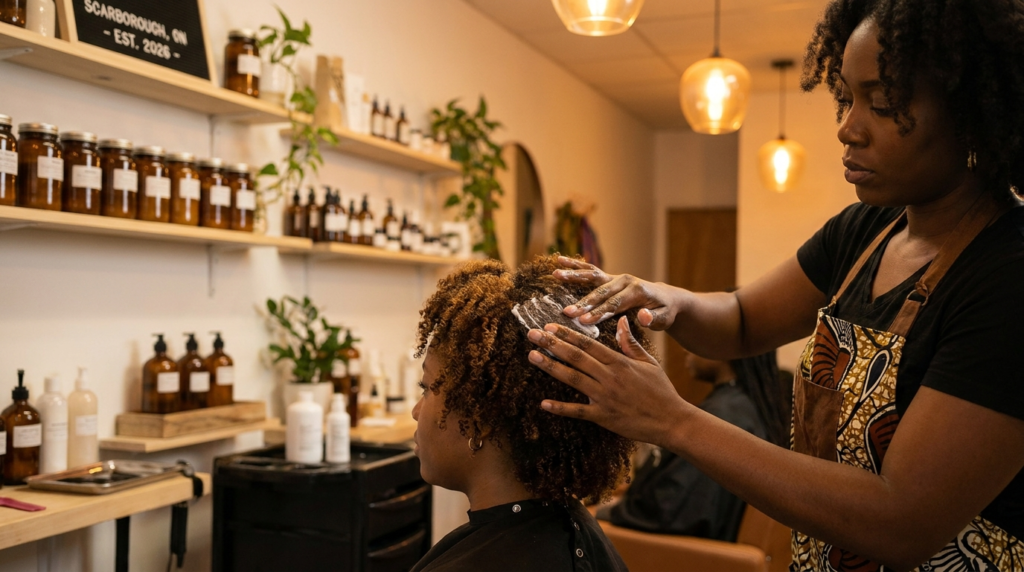
Black Canadian consumer 2026: a Black-owned natural hair salon in Scarborough, Ontario, with a stylist working on a client's natural coils under warm salon lighting.
Black hair care is one of the highest per-capita consumer spending categories in the Black Canadian community across all sub-communities. Black-owned salons, barber shops, and natural hair care product retail are primary community trust touchpoints — not secondary brand activation spaces.

Black Canadian consumer spending: categories, priorities, and brand opportunity

Black hair care commands extraordinary per-capita spending across all Black Canadian consumer sub-communities. Specifically, natural hair care — curl creams, edge control, oils, protective styling products, and salon services — carries limited mainstream brand penetration and very high community loyalty. Black-owned salons and barber shops across Scarborough, North York, and Brampton are among the highest-trust community institutions for in-community brand presence.

Food and grocery spending reflects the community’s internal diversity directly. Specifically, West African grocery stores — Nigerian, Ghanaian, and Cameroonian — stock gari, egusi, oxtail, stockfish, and Maggi-adjacent seasoning products that mainstream grocery chains do not carry. Halal butchers serve Somali and other Muslim Black Canadian households. Caribbean grocers serve Afro-Caribbean communities. No single retailer reaches all three sub-communities. Brands in the food and CPG categories gain significantly from channel strategies that include West African grocery stores alongside Caribbean retailers.

Furthermore, faith and church spending is structurally high across the Black Canadian consumer community. Specifically, Black Canadian churches — Baptist, Pentecostal, Seventh-day Adventist, West African Anglican, and Ethiopian Orthodox — function as primary community trust institutions. Church Sunday dress culture generates significant clothing and fashion spending. Community fundraisers and pastor endorsements carry peer influence that no paid media channel can replicate. Consequently, financial services, insurance, and professional services brands that reach Black Canadian consumers through church channels access one of the most trust-dense environments in the GTA. See our multicultural market research guide for the methodology.


What brands consistently get wrong about the Black Canadian consumer

The most costly mistake is treating Caribana as a complete Black Canadian consumer marketing strategy. Specifically, the Toronto Caribbean Carnival reaches Afro-Caribbean communities effectively. It does not reach Nigerian, Ghanaian, Somali, Ethiopian, or Canadian-born Black consumers in any meaningful way. A brand that activates only at Caribana and calls its Black Canadian consumer marketing complete has reached approximately one third of its intended audience.

The second mistake is Black History Month tokenism. Specifically, Google Canada research consistently shows that multicultural consumers identify performative brand marketing with precision — and punish it with disengagement. A Black History Month social media post with no community event presence and no year-round brand commitment signals calendar-driven performativity. Black Canadian consumers have learned to recognize it — and ignore it.

The third mistake is using “urban” as a coded substitute for Black Canadian. Specifically, “urban” targeting in Canadian media buying is widely understood as a proxy for Black audiences — and is widely resented by those who recognize the coding. Direct, respectful, community-specific language performs better in every channel.

Additionally, many brands ignore the generational split. Specifically, first-generation Nigerian or Somali Canadian parents and their Canadian-born children have different cultural references, different platforms, and different expectations of brand behaviour. A campaign resonating with a first-generation West African parent can feel completely disconnected to their 22-year-old who grew up in Brampton listening to Afrobeats. See our multicultural brand ambassador guide for the in-community staffing model.

How to reach Black Canadian consumers through experiential marketing in the GTA

The Edelman Trust Barometer shows that community trust builds through consistent, in-community presence rather than campaign bursts. Effective Black Canadian consumer experiential marketing applies this principle across three distinct activation contexts simultaneously.

Specifically, Afrofest Toronto in July is the highest-reach activation opportunity for West African Canadian consumers that most brands are not using. An Afrofest presence reaches Nigerian, Ghanaian, Kenyan, and Ethiopian Canadian audiences within a shared cultural celebration that has no equivalent in the GTA event calendar. Ambassador teams must reflect the festival’s West and East African community composition — not the Caribbean-origin ambassador profiles that serve Caribana well.

Furthermore, Black History Month community event partnerships in February represent the most trust-dense brand activation window in the Black Canadian consumer calendar. Specifically, partnering with the Black Business and Professional Association or sponsoring school programs during February builds brand credibility that social media cannot. Brands willing to commit budget to in-person Black History Month presence earn community goodwill that persists year-round.

Additionally, Black church community partnerships require a long-lead approach — similar to gurdwara partnerships at Vaisakhi. Specifically, Black Baptist, Pentecostal, and West African Anglican churches in Scarborough, North York, and Brampton welcome brand partnerships for fundraising events, church bazaars, and community programs. These are among the highest-trust brand touchpoints in the Black Canadian community. For the ambassador and activation model, see our brand ambassador program guide and experiential marketing agency Toronto overview.

Frequently asked questions about Black Canadian consumers

How large is the Black Canadian consumer community in the GTA? Canada’s Black population reached 1,530,380 in the 2021 Census — the third-largest racialized community nationally. The GTA holds the largest concentration across Scarborough, North York, Brampton, and Durham Region. Caribbean, West African, East African, and Canadian-born Black Canadians each carry distinct cultural identities.

Is Caribana enough to reach the Black Canadian consumer market? No. Toronto Caribbean Carnival reaches Afro-Caribbean communities effectively but does not reach West African, East African, or Canadian-born Black consumers. A complete Black Canadian consumer strategy requires Afrofest in July, Black History Month presence in February, and faith community partnerships. The Caribana-specific activation is covered in our Caribbean Canadian consumer guide.

What spending categories perform best with Black Canadian consumers? Black hair care carries the highest per-capita spending relative to the broader market. Food and grocery, faith-related spending, fashion, telecommunications, and automotive also perform strongly. Preferences differ across Caribbean, West African, and East African sub-communities.

What is Afrofest Toronto and why does it matter for brand activation? Afrofest Toronto is the largest Afrofusion festival in North America, held each July in Toronto. It draws tens of thousands of Nigerian, Ghanaian, Kenyan, Ethiopian, and Congolese Canadian attendees. Afrofest reaches West and East African Canadian consumers in a shared celebration no other GTA festival replicates. Most brands are not activating there.

How should brands approach Black History Month? Black History Month requires in-person community presence, not only social media. Specifically, partnerships with Black community organizations and in-person event presence signal authentic commitment. Brands that activate only on social media during February are recognized as performative and generate backlash rather than goodwill.

Reach Black Canadian consumers across the GTA with Brand Guruz

Talk to Brand Guruz about building a Black Canadian consumer marketing program across the GTA. We cover Afrofest, Black History Month, faith community partnerships, and year-round presence with ambassador teams that represent Caribbean, West African, and East African Canadian communities.

Author