Navratri marketing in Canada is the starting gun of the South Asian festive season — not the prelude to Diwali. Specifically, Statistics Canada’s 2021 Census confirms that South Asian Canadians now represent one of the largest and fastest-growing multicultural communities in the GTA. Dussehra — the tenth day after Navratri begins — falls approximately 20 days before Diwali in 2026. Brands that activate only at Diwali have already missed the moment when South Asian Hindu consumers begin their festive season purchasing.
The commercial case for Navratri marketing in Canada rests on a simple mechanism. Specifically, Dussehra marks the traditional start of gold and electronics purchasing for the Diwali gifting season. Clothing purchases for Navratri Garba nights represent a separate and significant spending surge — often exceeding Diwali fashion spend in Gujarati Canadian households. The 20-day window from Dussehra to Diwali is the Hindu festive season equivalent of the pre-Christmas shopping period.
Most brand managers in Canada have a Diwali strategy. Almost none have a Navratri or Dussehra strategy. Consequently, brands that activate at Navratri marketing in Canada reach South Asian Hindu consumers first. They build brand association across the entire 20-day festive window before competitors arrive. For the Diwali-specific activation guide, see our Diwali marketing Canada brand guide. The full 2026 cultural occasions overview is in our Canadian multicultural events calendar.
Navratri runs nine nights, followed by Dussehra on the tenth day and Diwali 20 days after that
distinct Navratri celebrations in the GTA: Gujarati Garba (Brampton and Mississauga) and Bengali Durga Puja (Scarborough and North York) — each requiring a different brand activation approach
the window between Dussehra and Diwali, when gold, electronics, clothing, and home décor purchase intent peaks across South Asian Hindu communities
Most brand marketing calendars in Canada treat the South Asian festive season as a single Diwali event. Specifically, campaigns launch in late October, activate on Diwali day, and conclude before Dhanteras. This narrow window misses three weeks of rising purchase intent — the weeks when Navratri marketing in Canada would have built brand familiarity before competitors arrived.
The mechanism is straightforward. Specifically, Dussehra marks the moment when Hindu community members traditionally begin purchasing gold, electronics, and home décor for Diwali gifting. In India, Dussehra opens the festive sales season. Brands run Dussehra promotions precisely because consumers are in a gifting mindset from this point onward. This pattern carries over to Canadian South Asian Hindu households. South Asian Hindu households in the GTA begin Diwali-related purchases at Dussehra, not on Diwali day.
Moreover, Navratri itself generates distinct consumer spending that is separate from Diwali entirely. Specifically, Garba events across Brampton and Mississauga run every evening of Navratri — each night requiring traditional attire. New chaniya choli outfits, jewellery, and accessories are purchased specifically for Garba. This fashion spending is commercially significant and occurs weeks before any Diwali-specific purchasing begins. For the full South Asian consumer context, see our South Asian consumer Canada guide.
Additionally, Google Canada research confirms that multicultural consumers over-index on peer recommendations during cultural occasions. Navratri is a socially intense occasion — Garba events are community gatherings where brand experiences and product discoveries spread rapidly through community networks.
Two primary communities observe Navratri in Canada — each with a distinct cultural expression that shapes brand activation strategy. Specifically, Gujarati Canadians represent the largest Navratri-observing community in the GTA. Brampton and Mississauga hold the country’s largest Gujarati Canadian concentrations. The Garba events organized by community associations in these cities are among the largest Navratri celebrations outside India.
Bengali Canadians observe a different dimension of the same nine-night period. Specifically, the final four to five days of Navratri align with Durga Puja — the most significant occasion in the Bengali Hindu calendar. Bengali community associations in Scarborough, North York, and Mississauga erect pandals, host cultural programs, and serve bhog (consecrated community meals) throughout Durga Puja. This is a distinct cultural occasion from Gujarati Garba and requires a distinct brand activation approach.
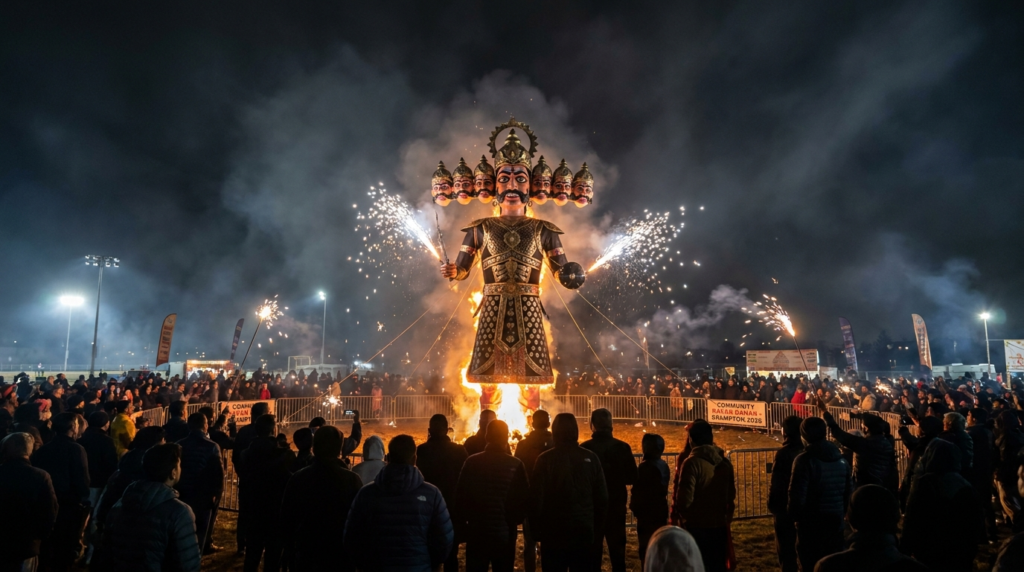
Additionally, North Indian Hindu communities observe Navratri through temple programs, fasting, and the Kanya puja ritual on Ashtami (the eighth night). These households are not typically attending Garba events but are active Navratri observers. Ravan Dahan — the burning of Ravana effigies on Dussehra — draws large North Indian and broader South Asian Hindu crowds in Brampton, Mississauga, and North York.
Furthermore, Punjabi Hindu families observe Navratri and Dussehra, though Punjabi Sikh households generally do not. Brands activating at Navratri marketing in Canada must note that the Punjabi corridor in Brampton contains both Hindu and Sikh households with different levels of Navratri engagement.
The Gujarati Garba event is among the highest-attendance cultural occasions in the GTA — drawing thousands of community members nightly across the nine evenings of Navratri. Specifically, large Garba events at convention venues in Brampton and Mississauga are organized by Gujarati community associations and sell tickets in advance. They require formal traditional attire — chaniya choli for women, kediyu or dhoti for men. The fashion spending associated with Garba is exceptional. New outfits are often purchased for Garba specifically, distinct from the new clothing purchased for Diwali.
Additionally, Garba events are fasting-occasion events. Specifically, many Gujarati Navratri observers fast during the nine days — avoiding onion, garlic, non-vegetarian food, and certain grains. Brand activations involving food sampling at Garba events must offer Navratri-fasting-compliant products. Food brands that understand these constraints and offer appropriate product lines earn strong community credibility.
Durga Puja pandals operate on a different model. Specifically, Bengali community associations host five-day celebrations at rented halls and community centers across Scarborough and North York. Pandals house elaborate clay Durga idols, cultural performances, and bhog distribution — free community meals served to all attendees. Brands that sponsor pandal events, bhog ingredients, or cultural program elements enter a deeply community-rooted activation context. The Edelman Trust Barometer consistently confirms that community-institution sponsorships build brand trust that advertising cannot replicate.
Furthermore, Ravan Dahan events on Dussehra attract large crowds across community lines — Gujarati, Bengali, North Indian, and broadly South Asian Hindu community members attend together. Dussehra Ravan Dahan events in Brampton and Mississauga are some of the most accessible single-day brand activation opportunities in the Navratri marketing Canada window.

Commercially, Dussehra is the starting point of the South Asian festive buying season. Specifically, gold jewellery purchases for Diwali and Dhanteras gifting traditionally begin at Dussehra. Electronics promotions launched at Dussehra reach South Asian consumers three weeks before Diwali-week campaigns. They arrive at a moment of genuine purchase intent rather than last-minute competition.
Brands in the clothing and fashion sector face a specific Navratri opportunity. Specifically, chaniya choli outfits and Navratri jewellery are purchased in September — weeks before Diwali salwar kameez and saris are purchased. A fashion brand that shows up at Navratri marketing in Canada captures a spending occasion entirely separate from its Diwali campaign. This is additive commercial reach, not a substitution for Diwali activation.
Home décor and gifting purchases also begin moving at Dussehra. Specifically, South Asian households in Brampton and Mississauga begin Diwali decoration shopping after Dussehra — a pattern consistent with the traditional Indian commercial calendar. Financial services brands that run Navratri and Dussehra messaging frame their products around prosperity and new beginnings. They do this before Diwali-week communications become saturated with competitor messaging.
Moreover, the 20-day window between Dussehra and Diwali is when brand preference is formed — not on Diwali day itself. A brand encountered at a Garba event in late September becomes a familiar name by the time Diwali purchasing peaks. Brands encountered for the first time during Diwali week compete against established associations. For the complete festive season activation framework, see our festival brand activation playbook and brand ambassador program guide.
Effective Navratri marketing in Canada requires presence in two distinct contexts: the Garba venue and the Durga Puja pandal. Ambassador teams and creative must be tailored to each separately. Specifically, Garba event activations require in-language Gujarati-speaking ambassadors who understand the occasion, the fasting context, and the social dynamics of the event. A generalist ambassador team at a Garba event signals inauthenticity within minutes.
Durga Puja pandal partnerships in Scarborough and North York require a Bengali-community-familiar approach. Specifically, sponsoring bhog preparation — providing quality ingredients or cooking equipment for the community meal — earns the highest goodwill available at Durga Puja. Cultural program sponsorships (musical performances, dance programs, traditional arts) are the second most trusted brand presence format at pandal events.
Additionally, Dussehra Ravan Dahan event sponsorships reach the broadest cross-section of the South Asian Hindu community in a single activation. Specifically, Ravan Dahan events in Brampton draw Gujarati, Bengali, North Indian, and Punjabi Hindu community members simultaneously. They are the most efficient single-day Navratri marketing in Canada opportunity for brands seeking broad South Asian Hindu reach.
For the ambassador model, see our multicultural brand ambassador guide and experiential marketing agency Toronto overview.
The most common mistake is treating Navratri as a preview event for Diwali creative. Specifically, brands that run early Diwali creative at Navratri events misread the occasion entirely. Navratri is not Diwali — it has its own iconography (Goddess Durga, Garba dance, dandiya sticks, navratri colours), its own fasting culture, and its own emotional register. Diwali creative at a Garba event signals cultural indifference.
The second mistake is failing to separate the Gujarati and Bengali expressions of Navratri. Specifically, Garba event creative featuring Durga iconography will confuse Gujarati attendees for whom Garba is about devotion to Goddess Amba, not Goddess Durga. Durga Puja pandal creative featuring Garba imagery will feel alien to Bengali community members. Specifically, each community’s Navratri has distinct imagery, deities, and cultural codes.
The third mistake is food sampling without fasting awareness. Specifically, onion, garlic, and non-vegetarian products are traditionally avoided by Navratri fasting observers. Any brand distributing such products at Garba events undermines trust with the portion of the audience actively observing the fast.
Finally, many brands miss the Dussehra gold and electronics trigger entirely. Specifically, gold dealers, electronics retailers, and financial services brands that start Diwali campaigns in Diwali week have ceded the Dussehra purchase-intent moment to competitors who understood the 20-day window.
When does Navratri happen in 2026 and how long does it run? Navratri 2026 begins in late September and runs for nine nights. Dussehra follows on the tenth day. Diwali falls 20 days after Dussehra — on October 20, 2026. The complete Navratri marketing window in Canada runs from the first Garba event through Diwali.
What is the difference between Gujarati Navratri and Bengali Durga Puja? Gujarati Navratri centres on Garba and Dandiya-Raas dance events — large, ticketed evenings with formal traditional attire. Bengali Durga Puja runs across the last four to five days of Navratri, centred on pandal worship, cultural programs, and bhog meals. Navratri marketing in Canada requires separate strategies for each.
Why is Dussehra commercially significant for brand marketing? Dussehra marks the traditional opening of the South Asian festive purchasing season. Gold jewellery purchases for Dhanteras begin at Dussehra. Electronics, clothing, and home décor purchase intent rises from this point. Brands that activate at Dussehra reach consumers three weeks before Diwali-week competition begins.
What brands perform best at Garba events? Fashion and clothing brands perform exceptionally well — chaniya choli and Navratri accessories are purchased specifically for Garba. Jewellery, beauty, and personal care brands also perform strongly. Food brands must offer Navratri-fasting-compliant products — specifically avoiding onion, garlic, and non-vegetarian ingredients. Financial services brands that frame Navratri around the themes of prosperity and new beginnings find strong community receptivity.
How should brands approach the Navratri fasting context? Many Gujarati Navratri observers fast for all nine days. Fasting restrictions eliminate onion, garlic, non-vegetarian food, and certain grains during this period. Food sampling at Garba events must comply. Brands distributing non-compliant products damage community trust and risk visible social media backlash.
Talk to Brand Guruz about activating the full 20-day Navratri and Dussehra marketing window in Canada. We cover Garba events, Durga Puja pandals, and Ravan Dahan activations across Brampton, Mississauga, Scarborough, and North York — with Gujarati and Bengali ambassador teams who know the occasion from the inside.