Ramadan marketing in Canada is one of the most commercially significant multicultural brand windows that most Canadian brands leave entirely unrealized. Specifically, Statistics Canada’s 2021 Census confirms approximately 1.8 million Muslims in Canada. The GTA hosts the largest single Muslim concentration in the country. Roughly 300,000 to 400,000 Muslim residents are concentrated across Scarborough and Mississauga. Ramadan — the 30-day period of fasting, reflection, and community gathering — runs from late February into late March in 2026. It falls within the same spring planning window as Holi.
The most consequential error in Ramadan marketing Canada planning is the conflation of Ramadan with Eid al-Fitr. Eid celebrates the end of Ramadan — it is a gifting, family gathering, and celebration occasion. Ramadan itself is a community, charity, and reflection period. These require different brand behaviour, different creative, different timing, and different community touchpoints. A brand that launches its campaign on the first day of Eid has missed 30 days of the Ramadan trust-building window.
This guide covers the Ramadan marketing Canada activation calendar, spending categories, iftar sponsorship, charitable activation, and the errors that create missed opportunities. For the Eid activation framework, see our Eid marketing Canada guide. The Arab Canadian community profile is covered in our Arab Canadian consumer guide.
the length of Ramadan; brands that show up for all 30 days earn community trust at a rate that Eid-only campaigns cannot replicate in a single occasion burst
Muslims in Canada nationally (Statistics Canada 2021), with the GTA holding the highest provincial concentration of Muslim Canadian consumers of any city in the country
the daily evening meal breaking the fast at sunset, which in late February and March falls between 6:00 and 7:30 PM in Toronto; this creates a daily high-community, high-consumption window that reshapes Muslim household shopping, restaurant, and media consumption patterns for the entire month
Ramadan restructures daily life for Muslim Canadian households in ways that create distinct brand marketing opportunities throughout the month. Notably, Muslim Canadians adjust their eating, sleeping, shopping, and media consumption patterns fundamentally during Ramadan. Grocery shopping shifts toward late afternoon and evening, peaking just before iftar. Restaurant dining shifts to after sunset. Social and community gatherings happen after iftar, often late into the evening. Media consumption peaks between iftar and midnight.
Google Canada research confirms that multicultural consumers respond significantly more to brands that demonstrate specific cultural knowledge rather than generic diversity signals. For Ramadan marketing in Canada, that cultural knowledge means understanding iftar timing, the role of charitable giving, and the mosque’s function. The Muslim Canadian market spans Arabic, Urdu, Bangla, Persian, Somali, and Turkish speaking communities — each with distinct media habits.
Indeed, Ramadan carries a distinct brand trust logic compared to most multicultural occasions. Specifically, brands that show up throughout Ramadan — at iftar events, through charitable partnerships, and in-language digital campaigns — earn different community trust. Brands that appear only for Eid do not. The Edelman Trust Barometer consistently shows that sustained community presence outperforms occasion-based advertising in tight-knit cultural communities. Ramadan is the highest-trust-building window in the Muslim Canadian brand calendar. It runs for 30 days of sustained community life, not a single celebration.

Practically, Ramadan marketing Canada planning should begin eight to ten weeks before the start of Ramadan. Specifically, mosque iftar sponsorship opportunities require partnership discussions with mosque administrators in December or January for a February or March occasion. Community iftar events run by Muslim community organizations in Scarborough, Mississauga, and Brampton similarly require advance booking for brand activation presence.
The Ramadan marketing Canada window has three distinct internal phases. First, the early Ramadan phase (days one through ten) is the highest-energy gathering period. Mosques fill for Tarawih prayers and charitable campaigns launch. Second, the middle Ramadan phase (days eleven through twenty) is when community engagement deepens and brand familiarity converts into purchasing behaviour. Third, the final ten days represent the most spiritually significant period. Brands should reduce promotional content and increase charitable and community support signals during this window.
Eid al-Fitr falls on the first day after Ramadan ends. For Ramadan marketing Canada programs, Eid is the conversion and gifting moment that the preceding 30 days of brand presence enables. Brands that invest in the Ramadan trust-building phase and transition into Eid gifting creative see the highest conversion rates. Their Muslim Canadian brand programs outperform single-occasion Eid campaigns. For the full multicultural events calendar and activation timing, see our multicultural events calendar 2026.
Food and grocery purchasing increases significantly during Ramadan — more than any other multicultural occasion in the Canadian brand calendar. Specifically, Muslim Canadian households prepare larger and more varied iftar meals than their regular daily cooking. Grocery spending on dates, specialty breads, halal meats, and Middle Eastern and South Asian grocery staples increases substantially before and throughout Ramadan. For food and beverage brands with halal-certified products, Ramadan marketing in Canada is the highest-volume brand trial window.
Restaurants and food service brands benefit from the late-night dining shift that Ramadan produces. Indeed, Muslim Canadian families dine out after iftar — after 6:30 or 7:00 PM during Ramadan — in concentrated community dining patterns. Restaurants in Scarborough, Mississauga, and Brampton that offer iftar-specific menus or Ramadan dining events see significant traffic increases from Muslim Canadian households. Brands that partner with these restaurants for iftar kit sampling or product placement reach Muslim Canadian consumers during the highest-engagement dining moment.
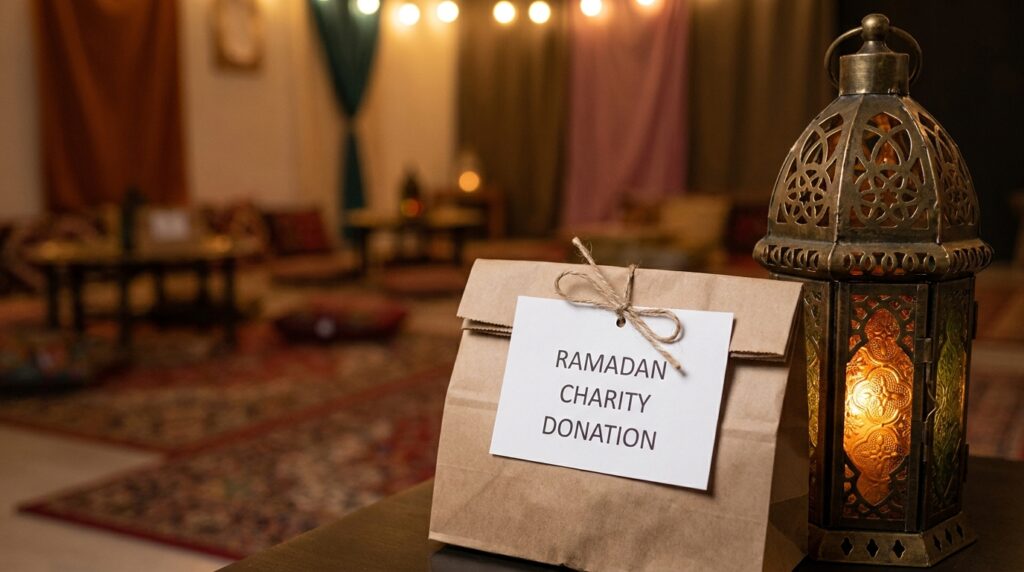
Charitable giving is the most distinctive spending category Ramadan marketing Canada programs can activate. Notably, Zakat (obligatory annual charity) and Sadaqah (voluntary charity giving) are both elevated significantly during Ramadan. Muslim Canadian households direct more charitable giving during Ramadan than any other month of the year. Brands that build credible donation mechanisms into their Ramadan marketing Canada programs earn community trust that product sampling and advertising alone cannot generate. For the broader experiential framework, see our festival brand activation playbook.
Iftar sponsorship at community mosques is the most credible and highest-impact Ramadan marketing Canada activation format available to brands. Specifically, many GTA mosques host nightly community iftar dinners during Ramadan — open to the community, often serving hundreds of attendees. A brand that sponsors dates, beverages, or food items for a mosque community iftar receives direct product exposure within the highest-trust institution.
Iftar sponsorship requires cultural sensitivity in execution. Brands should not place advertising materials within the prayer hall or mosque prayer spaces. Sponsorship presence belongs in the iftar dining area, not in spaces dedicated to religious observance. Additionally, sponsorship must be arranged with mosque administrators in advance. Unannounced brand activation at a mosque community iftar produces exactly the trust damage that Ramadan programs are designed to avoid.
Charitable brand activation is the second major format in Ramadan marketing Canada programs. Specifically, brands that partner with credible Muslim Canadian charitable organizations for donation-matched Ramadan campaigns earn community alignment that advertising alone cannot build. The charitable partnership must be announced in-language — Arabic, Urdu, or Bangla depending on the target community. It must include a credible verification mechanism: a percentage of purchase tracked and published, or a matching campaign with transparent totals. For the community trust framework, see our multicultural marketing guide.
The Muslim Canadian community’s media ecosystem is linguistically fragmented in ways that require community-specific channel planning. Specifically, the Arab Canadian community in the GTA consumes Arabic-language social media — Facebook and Instagram — as its primary channel. Pakistani and Bangladeshi Canadian communities consume Urdu and Bangla-language social media, YouTube diaspora creators, and WhatsApp community groups. Somali Canadian communities access Somali-language digital content through Facebook and YouTube. Importantly, no single in-language Ramadan marketing Canada media buy reaches all of these communities simultaneously.
Mosque communication channels are the most trusted and most underutilized Ramadan marketing Canada media format. Specifically, GTA mosques communicate with their congregations through weekly Jumu’ah announcements, mosque newsletters, WhatsApp community groups, and mosque event calendars. A brand that earns a mosque communication channel mention — through iftar sponsorship or charitable partnership — receives community endorsement that paid advertising cannot replicate.
Digital advertising in-language during Ramadan marketing Canada programs should run on Facebook and Instagram with Arabic, Urdu, and Bangla language targeting. Timing matters critically. Specifically, Ramadan social media engagement peaks after iftar — between 7:00 PM and midnight — not during daytime hours when Muslim consumers are fasting. Brands that run their Ramadan marketing Canada digital campaigns on standard daytime schedules miss the peak engagement window. For the complete in-language media channel strategy, see our in-language media strategy Canada guide.
The most common Ramadan marketing Canada mistake is treating Ramadan as an aesthetic backdrop rather than a community occasion. Specifically, brands that use Ramadan imagery without community investment — no iftar presence, no charitable activation — produce performative marketing. Muslim Canadian communities identify this pattern immediately. This approach reliably generates lower engagement from Muslim Canadian audiences than a brand’s regular content.
Ignoring the linguistic diversity of the Muslim Canadian market is the second major mistake. Specifically, an Arabic-language Ramadan campaign does not reach Urdu-speaking Pakistani Canadian consumers, Bangla-speaking Bangladeshi Canadian consumers, or Somali-speaking households. These are distinct communities with distinct languages and distinct media ecosystems. Consequently, Ramadan marketing Canada programs targeting multiple Muslim Canadian communities require multilingual creative — not a single Arabic campaign applied across the entire market.
Running Ramadan and Eid creative simultaneously is the third mistake. Specifically, Ramadan’s 30-day brand tone is one of restraint, community, and charity — not celebration and gifting. Brands that launch party-themed, bright-coloured gifting campaigns during Ramadan signal that they do not understand the occasion’s character. Eid creative belongs in the last 48 hours of Ramadan and the days immediately following. Ramadan creative belongs in the preceding 28 to 29 days. For the Eid activation framework that follows Ramadan, see our Eid marketing Canada guide and multicultural brand ambassador guide.
When does Ramadan fall in 2026 and how early do brands need to plan? In 2026, Ramadan is expected to begin approximately February 18 and end approximately March 19. The exact start date is confirmed by moon sighting. For Ramadan marketing Canada programs, brands need eight to ten weeks of planning lead time — meaning December or January for a February Ramadan. Specifically, mosque iftar sponsorship requires advance partnership discussions with mosque administrators. Community event activation space and charitable partnership agreements also require lead time that February planning windows cannot accommodate.
What is the difference between Ramadan marketing and Eid marketing in Canada? Ramadan marketing covers the 30-day fasting period — community, charity, iftar timing, and nighttime brand presence. Eid marketing covers the two to three days of celebration following Ramadan — gifting, family gathering, and celebratory brand tone. Specifically, these are distinct occasions requiring distinct creative, distinct channel timing, and distinct brand behaviour. Eid creative launched during Ramadan signals cultural unfamiliarity. Ramadan-tone creative continued through Eid misses the gifting conversion window. Effective Ramadan marketing Canada programs transition clearly between the two.
Which product categories perform best during Ramadan marketing Canada programs? Food and grocery, halal food products, restaurants with iftar menus, charitable-aligned brands, and personal care products perform best during Ramadan marketing. Specifically, food and beverage brands with halal certification have the clearest and highest-volume activation pathway. Charitable donation mechanisms perform exceptionally well across categories — even non-food brands see community trust increases from credible Ramadan charitable partnerships. Electronics and high-ticket gifting belong to the Eid window, not Ramadan.
How should brands handle the linguistic diversity of the Muslim Canadian market in Ramadan campaigns? Each major Muslim Canadian community requires its own language. Arabic serves Arab Canadian consumers, Urdu serves Pakistani Canadian consumers, and Bangla serves Bangladeshi Canadian consumers. Specifically, a single-language Ramadan marketing Canada campaign — even a well-executed Arabic one — reaches only a fraction of the Muslim Canadian market. Brands targeting multiple communities need multilingual creative sets, not a single pan-Muslim campaign. Mosque communication channels offer community-specific reach that paid media cannot replicate.
Talk to Brand Guruz about building a Ramadan marketing Canada program across the GTA’s Muslim communities. We plan and execute iftar sponsorships, charitable activation partnerships, multilingual campaigns, and brand ambassador programs. The result is lasting Muslim Canadian consumer relationships.