The Chinese Canadian Consumer: A 2026 Guide for Brand Marketers

The Chinese Canadian consumer is one of the most commercially significant audiences in the Canadian market — and one of the most consistently misunderstood. Specifically, Chinese Canadians numbered approximately 1.7 million in the 2021 Census, making the community the second-largest visible minority group in Canada. Moreover, the GTA holds the largest urban concentration of Chinese Canadians in the country. This community anchors in Markham, Richmond Hill, Scarborough, and North York. Consequently, any brand with serious ambitions in the GTA consumer market cannot afford to treat the Chinese Canadian consumer as an afterthought.

The deeper challenge, however, is that the Chinese Canadian consumer community is not one audience. It contains two distinct linguistic communities with different cultural references, media ecosystems, and spending patterns. Specifically, Cantonese-speaking Chinese Canadians — concentrated in Scarborough, North York, and downtown Chinatown — largely trace their roots to Hong Kong and Guangdong. Mandarin-speaking Chinese Canadians — concentrated in Markham and Richmond Hill — arrived predominantly since the early 2000s from Mainland China. Brands that activate in one dialect and ignore the other effectively exclude half the community.

This guide covers the community size, spending priorities, cultural occasions, and brand activation approach for this community in 2026. For the broader multicultural framework, see our multicultural market research guide. The Caribbean Canadian consumer guide and South Asian consumer Canada guide cover the other key community profiles in this cluster.

~1.7M

Chinese Canadians in 2021, the second-largest visible minority group in Canada (Statistics Canada)

~40%

approximate share of Markham’s population identifying as Chinese Canadian, the highest urban concentration in Canada

February 17

 Lunar New Year 2026 (Year of the Horse), the most commercially significant annual occasion in the Chinese Canadian consumer calendar

The Chinese Canadian consumer: community size, geography, and GTA concentration

Chinese Canadians cluster in the GTA to a degree that gives the region a distinct commercial character found nowhere else in Canada. Specifically, Markham holds the highest Chinese Canadian concentration of any Canadian city — approximately 40% of the city’s population identifies as Chinese Canadian. Richmond Hill and Scarborough follow closely. Additionally, North York and downtown Toronto carry significant Chinese Canadian populations across distinct Cantonese and Mandarin-speaking corridors.

Furthermore, these geographic clusters translate directly into commercial ecosystems. Specifically, Pacific Mall in Markham is one of the largest indoor Asian malls in North America. T&T Supermarket — Canada’s largest Asian grocery chain — anchors Chinese Canadian retail life across the GTA. Additionally, Mandarin-serving commercial strips in Richmond Hill and Cantonese-serving strips in Scarborough operate as near-separate retail economies. Both sit within the broader GTA market.

The community’s two dominant linguistic groups occupy different parts of this geography. Specifically, the older Cantonese-speaking community traces its roots to Hong Kong and Guangdong and concentrates in Scarborough and North York. The newer Mandarin-speaking community arrived predominantly from Mainland China and concentrates in Markham and Richmond Hill. Additionally, a Taiwanese Canadian community adds further linguistic and cultural nuance, primarily in Markham. Each sub-community maintains distinct cultural references, media habits, and brand relationships that reward marketers who demonstrate specific fluency.

Chinese Canadian consumer spending: priorities, occasions, and category behaviour

The Chinese Canadian consumer directs spending toward categories tied to family investment, cultural identity, and community standing. Specifically, education commands an outsized share of household budgets. Chinese Canadian families consistently over-index on tutoring services, enrichment programs, and post-secondary preparation compared to the broader Canadian average. Brands in the education and professional development space find strong, loyal audiences within the community.

Real estate ranks as the second dominant spending priority. Specifically, Chinese Canadian homeownership rates in Markham, Richmond Hill, and Scarborough rank among the highest in the GTA. Moreover, multigenerational household purchase patterns — families buying homes large enough to accommodate parents and grandparents — drive higher average transaction values. Financial services, mortgage, and insurance brands that understand this pattern capture significant community loyalty.

Additionally, health and wellness spending runs high within this community. Specifically, traditional Chinese medicine, herbal supplements, specialty health foods, and wellness products all see strong demand across both Cantonese and Mandarin-speaking households. Food and grocery spending centers on T&T Supermarket and independent Chinese grocers. Brands with shelf placement in these retailers gain direct access to the community’s weekly purchase cycle. Google Canada research confirms that multicultural consumers over-index on peer recommendations within community retail environments. In-store presence is a critical brand touchpoint for this reason.


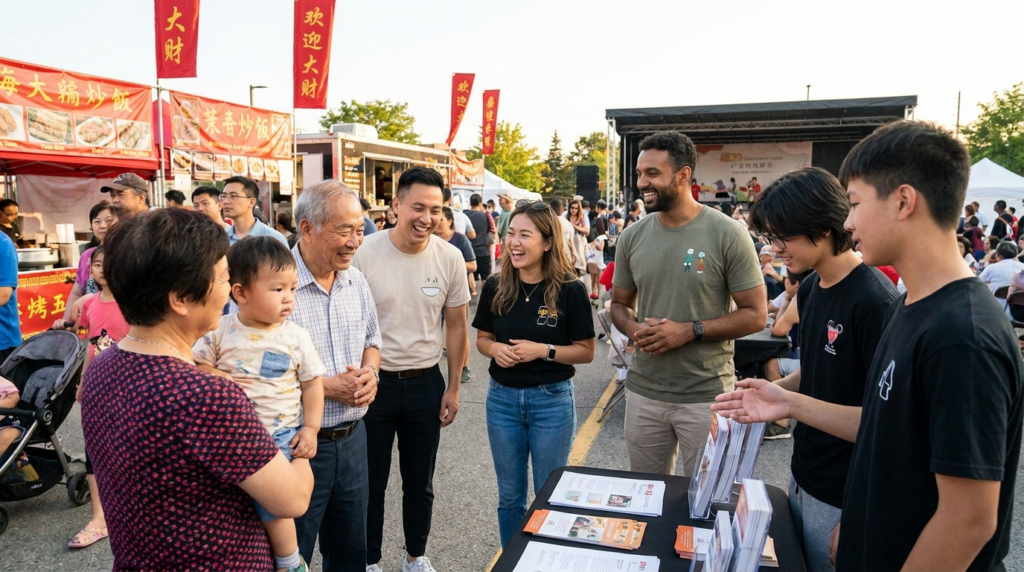
Chinese Canadian consumer 2026: brand ambassador team engaging with Chinese Canadian families at a community cultural event in Markham, Ontario.
Reaching the Chinese Canadian consumer requires presence in the community's commercial and cultural corridors — Markham, Richmond Hill, and Scarborough — not just Lunar New Year brand campaigns.

The cultural occasions that shape Chinese Canadian consumer decisions

Lunar New Year anchors the Chinese Canadian consumer cultural calendar and commands more brand attention than any other occasion in the community. Specifically, the 2026 Lunar New Year falls on February 17 — the Year of the Horse. In Markham, Richmond Hill, and Scarborough, Lunar New Year celebrations run for two weeks. They include community parades, temple visits, family banquets, and significant gift-giving activity. Brands that invest in authentic Lunar New Year activations — not just red-envelope graphics — earn strong Chinese Canadian consumer trust.

Additionally, the Dragon Boat Festival in June generates significant outdoor community event activity. The Mid-Autumn Festival — also called the Moon Festival — falls in September. It marks one of the most commercially significant secondary occasions in the Chinese Canadian consumer calendar. Specifically, mooncake gifting runs extremely high in September, and food and grocery brands see strong sales lifts in the weeks surrounding the festival.

Furthermore, Qingming Festival in April carries cultural weight within Chinese Canadian households, particularly among older Cantonese-speaking community members. The Winter Solstice Festival in December holds similar significance. Generally, brands that acknowledge the breadth of the Chinese Canadian consumer cultural calendar — not just Lunar New Year — signal genuine community fluency. For a full overview of 2026 cultural occasions, see our Canadian multicultural events calendar.

What brands get wrong about Chinese Canadian consumer marketing

The most common error brands make is running a single Lunar New Year campaign and calling it a Chinese Canadian consumer marketing strategy. Specifically, Lunar New Year is the most commercially significant occasion — but it occupies roughly two weeks of a 52-week consumer relationship. Brands that disappear after February miss the remaining 50 weeks of Chinese Canadian consumer spending.

The second error is ignoring the Cantonese-Mandarin divide. Specifically, Cantonese and Mandarin are mutually unintelligible spoken languages. A brand ambassador team that speaks only Mandarin cannot effectively serve Cantonese-speaking Chinese Canadian consumers in Scarborough — and vice versa in Markham. Additionally, the cultural references that resonate with Hong Kong-origin Cantonese speakers differ significantly from those that resonate with Mainland Chinese Mandarin speakers.

The third error involves media strategy. Specifically, WeChat dominates communication among Mandarin-speaking Chinese Canadian consumers far more than any mainstream social media platform. Brands without a WeChat presence miss the primary information-sharing and peer-recommendation network within the Mandarin-speaking Chinese Canadian consumer community. The Edelman Trust Barometer consistently shows that peer trust networks outperform broadcast advertising for community-oriented audiences. WeChat dominates the peer network. See our multicultural brand ambassador guide for the in-language activation model.

How to reach Chinese Canadian consumers through experiential marketing

The Chinese Canadian consumer responds most strongly to in-community presence within established commercial and cultural corridors. Specifically, activations at Pacific Mall and T&T Supermarket locations reach Chinese Canadian consumers where they already spend. Community events in Markham and Richmond Hill extend that reach.

The brand ambassador team for a Chinese Canadian consumer activation must include both Cantonese and Mandarin speakers to reach the community effectively. Additionally, cultural fluency matters beyond language. Brand ambassadors who understand gift-giving customs, lucky numbers, and family hierarchy deliver stronger results than generalist teams with in-language scripts.

Moreover, community partnership matters enormously for the Chinese Canadian consumer. Specifically, working with Chinese Canadian cultural organizations, Lunar New Year parade committees, and Dragon Boat Festival organizers gives brands a community endorsement signal. No amount of paid media replicates that. For the festival activation framework, see our festival brand activation playbook and our brand ambassador program guide. Additionally, for the broader GTA experiential model, see our experiential marketing agency Toronto guide.

Frequently asked questions about the Chinese Canadian consumer

What is the most important brand activation occasion for the Chinese Canadian consumer? Lunar New Year — falling on February 17, 2026 — drives the highest single-occasion concentration of Chinese Canadian consumer spending and social activity. Specifically, Markham and Richmond Hill host the GTA’s largest Lunar New Year celebrations. Gift-giving, family banquets, and community events run two full weeks. The Mid-Autumn Festival in September ranks as the top secondary occasion for food and grocery brands.

What is the difference between Cantonese and Mandarin-speaking Chinese Canadian consumers? Cantonese-speaking Chinese Canadians trace their roots to Hong Kong and Guangdong Province and concentrate in Scarborough and North York. Mandarin-speaking Chinese Canadians arrived predominantly from Mainland China and concentrate in Markham and Richmond Hill. Both groups speak different languages, consume different media, and hold distinct cultural references.

Which GTA neighbourhoods hold the highest Chinese Canadian consumer concentration? Markham holds the highest Chinese Canadian share of any Canadian city at approximately 40% of its total population. Richmond Hill, Scarborough, and North York also carry very high Chinese Canadian consumer concentrations.

What role does WeChat play in Chinese Canadian marketing? WeChat functions as the primary social communication and peer-recommendation platform for Mandarin-speaking Chinese Canadian consumers. Specifically, community group chats, peer reviews, and promotional content spread through WeChat at a speed mainstream social media cannot match within this community.

What spending categories perform best with the Chinese Canadian consumer? Education, real estate, health and wellness, food and grocery, and financial services all perform strongly. Specifically, Chinese Canadian consumers over-index significantly on education spending relative to the broader Canadian average. Traditional Chinese medicine, herbal supplements, and specialty health foods see consistent purchasing year-round.

Reach Chinese Canadian consumers across the GTA with Brand Guruz

Talk to Brand Guruz about building a Chinese Canadian consumer activation program across the GTA. We cover Lunar New Year, Dragon Boat, Mid-Autumn Festival, and year-round community presence. In-language Cantonese and Mandarin ambassador teams operate across Markham, Richmond Hill, and Scarborough.

Author